Day: October 19, 2026

  • How to Locate Scotland Court Rolls?

    I am searching for information on a criminal case decided through the Scotland High Court in 2024, but the High Court’s website only displays rolls for cases that occurred in the last few months of this year.

    Any information and advice to access older rolls and case information would be very much appreciated. Thanks doves xx

    submitted by /u/Sea_Captain6164
    [link] [comments]

    Source: Reddit r/OSINT · 2026-10-19

  • OpenAI Engineer Accused of Spying on Executives Ordered to Remain in Custody

    OpenAI Engineer Accused of Spying on Executives Ordered to Remain in Custody

    A judge ordered Abdulrahman Alfozan to remain in custody, likening the Saudi government’s offer to secure the former OpenAI engineer’s release to a “blank check.”

    Source: WIRED Security · 2026-10-19

  • Inside Joint Disruption Week: 28 Arrests and 3.7 Million Scam Accounts Removed

    More than 3.7 million fraudulent online accounts removed. Twenty-eight arrests across Ghana and Nigeria. More than $11 million in potentially freezable funds identified. And 117 human trafficking victims identified.

    These were among the results of Joint Disruption Week, an international operation targeting criminal networks responsible for online fraud, including cryptocurrency investment scams, impersonation schemes, and financial extortion.

    “Transnational criminal scam networks operating from West Africa suffered major disruptions last week during a coordinated international ‘Joint Disruption Week,’ an effort that produced arrests, seizures, and the largest-ever takedown of fraudulent social media accounts linked to scam centers in the region.”

    Department of Justice

    Hosted by the UK’s National Crime Agency (NCA) in London during the week beginning October 6, 2026, Joint Disruption Week brought together investigators from the DOJ, FBI, U.S. Secret Service, Homeland Security Investigations, and international law enforcement agencies, alongside private-sector organizations including Flashpoint.

    Throughout the week, participants exchanged real-time intelligence and developed investigative leads to support enforcement actions in Ghana and Nigeria, as well as the disruption of online accounts and infrastructure used by scam networks.

    The operation targeted criminal organizations whose activities extend across borders and online platforms. According to the DOJ, scam centers operating in West Africa share characteristics with those previously identified in Southeast Asia, including organized recruitment, training in social engineering techniques, and coordinated fraud campaigns targeting victims internationally. Some operations also involve human trafficking, with individuals coerced into participating in fraudulent activities.

    By bringing together law enforcement and private-sector capabilities, Joint Disruption Week targeted both the infrastructure used to perpetrate fraud and the individuals behind these schemes.

    Joint Disruption Week: The Results

    The coordinated effort produced results across criminal investigations, financial intelligence, and online infrastructure disruption.

    According to the DOJ:

    • 28 suspects were arrested, including 19 in Ghana and nine in Nigeria.
    • More than 3.7 million fraudulent accounts, Pages, and Groups were removed from online platforms.
    • 117 human trafficking victims were identified in Ghana, awaiting repatriation to Nigeria.
    • 89 fraud victims were identified in Ghana, associated with approximately $8.3 million in reported financial losses.
    • More than $11 million in potentially freezable funds were identified through private-sector investigative efforts.
    • More than 30 suspected scam centers were referred to law enforcement for further investigation.
    • 356 electronic devices were seized during enforcement actions in Ghana and Nigeria.

    The figures illustrate the reach of these operations. Millions of accounts can support criminal activity across multiple platforms, while the individuals directing those activities may be operating thousands of miles from their intended victims.

    Disrupting the Infrastructure Behind Online Fraud

    The arrests and account removals represent different aspects of the same challenge: identifying the individuals behind criminal operations while disrupting the infrastructure they use to reach victims.

    Online scam networks can operate across social media platforms, messaging services, and financial systems, with evidence of criminal activity spread across multiple organizations and jurisdictions. Investigations often depend on connecting information from these different sources to identify the actors involved and the infrastructure supporting their operations.

    During Joint Disruption Week, private-sector partners contributed by removing fraudulent accounts, identifying potentially recoverable funds, and sharing investigative leads with law enforcement.

    Flashpoint was among the organizations specifically recognized by the DOJ for participating in the operation, alongside Meta, Microsoft, Google, OpenAI, Coinbase, Binance, Chainalysis, Elliptic, TRM Labs, and others. For threat intelligence teams, operations like this highlight the value of identifying criminal actors, understanding how their operations are structured, and connecting activity across disparate sources to support investigative action.

    “These scam networks operate like businesses, investing in infrastructure, recruiting people, and developing increasingly sophisticated ways to defraud victims at scale. To meaningfully disrupt them, we have to go after the economics of their operations, making it more costly and difficult to recruit, reach victims, and move illicit funds. The more pressure we put on those operations, the harder it becomes for the criminals behind them to sustain and expand their activities.”

    Josh LefkowitzCEO, Flashpoint

    Together, the arrests, account removals, and financial investigations demonstrate how coordinated efforts can target multiple components of criminal operations, from the infrastructure used to perpetrate fraud to the individuals responsible.

    Continuing Efforts to Disrupt Scam Networks

    Joint Disruption Week marked the first coordinated international operation focused specifically on West African scam networks, according to the DOJ.

    The arrests, infrastructure disruptions, and investigative leads generated during the operation represent progress against criminal organizations responsible for large-scale financial fraud and human exploitation.

    Flashpoint continues to support efforts to identify and disrupt criminal activity through primary source intelligence that helps investigators understand emerging threats and the networks behind them.

    For additional information on the operation and its results, read the full Department of Justice announcement.

    See Flashpoint in Action

    Source: Flashpoint · 2026-10-19

  • ISEP France User Database Leak Claim Lists 5,088 People Across 5,091 JSON Records

    Data Exposure Report
    ISEP France User Database Leak Claim Lists 5,088 People Across 5,091 JSON RecordsFrance
    Higher Education
    Student & User Data
    Leak Claim
    Unverified

    ISEP France User Database Leak Claim Lists 5,088 People Across 5,091 JSON Records

    Claimed lines5,091
    Claimed people5,088
    Claimed size720 KB
    FormatJSON

    ISEP France User Database Leak Claim Lists 5,088 People Across 5,091 JSON Records

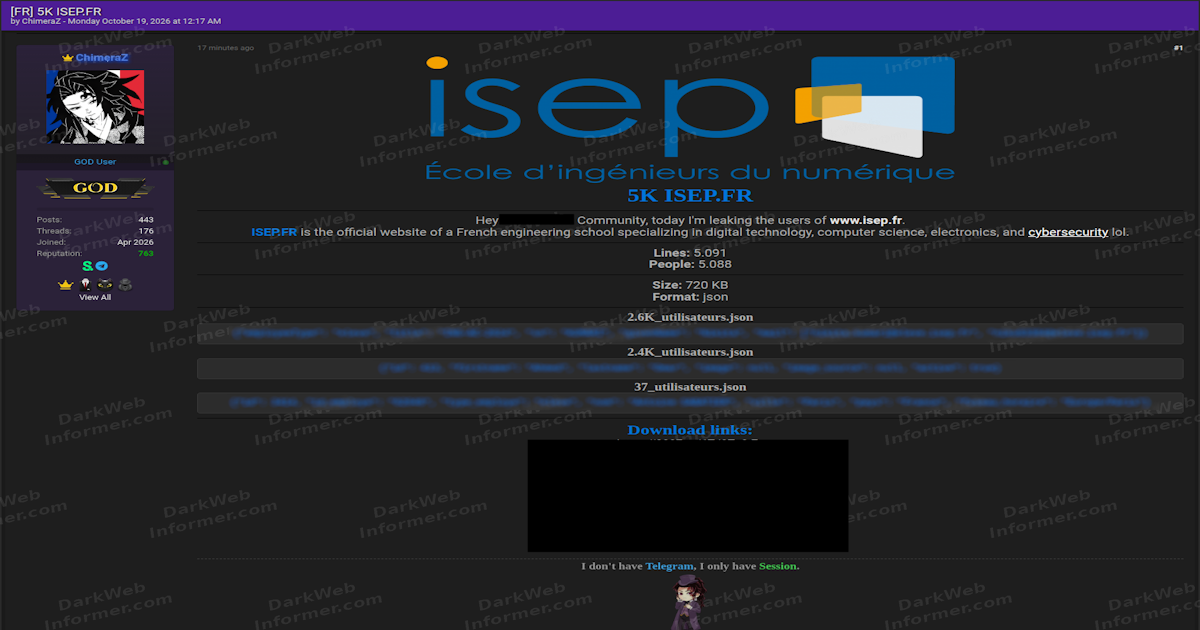
    An actor using the handle “ChimeraZ” claims to have leaked a user dataset associated with ISEP, a French engineering school specializing in digital technology, computer science, electronics and cybersecurity.

    The listing advertises 5,091 lines representing 5,088 people in a 720 KB JSON dataset. Three files are referenced, containing user and employee-related records with fields such as names, employee or student types, institutional email addresses, internal identifiers, city, country, activity status and timezone information. The dataset, its source, the stated counts and current availability have not been independently verified.

    Post details

    OrganizationISEP
    CountryISEP France User Database Leak Claim Lists 5,088 People Across 5,091 JSON RecordsFrance
    SectorHigher education / engineering
    Actor“ChimeraZ”
    Claimed lines5,091
    Claimed people5,088
    Format / sizeJSON / 720 KB
    Post date shown

    What the post claims

    • 5,091 lines advertised
    • 5,088 people advertised
    • 720 KB total size
    • JSON format
    • 2.6K_utilisateurs.json referenced
    • 2.4K_utilisateurs.json referenced
    • 37_utilisateurs.json referenced
    • Employee or student-type fields included
    • Names included
    • Institutional email addresses included
    • Internal identifiers included
    • City and country fields included
    • Activity-status fields included
    • Timezone information included
    • Multiple download mirrors provided

    The visible samples show student or employee profile records from the three referenced JSON files. Personal names, email addresses and internal identifiers shown in the samples are not transcribed in this report.

    Screenshots

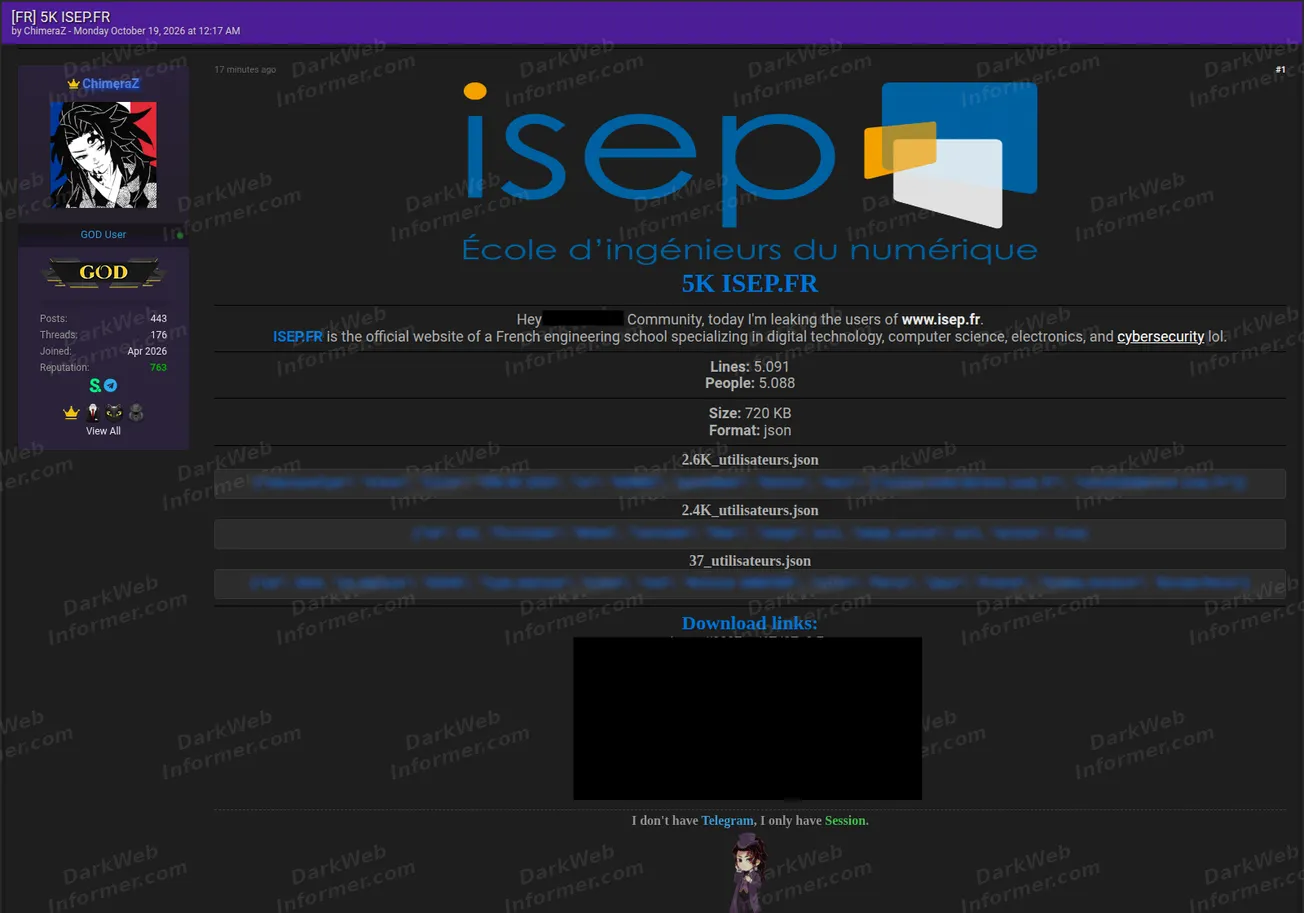
    The supplied capture shows the ISEP claim, the stated line and person counts, JSON format and file size, three referenced user files, sample records and multiple download mirrors. Direct download links and personal sample values are not reproduced here.

    IOCs & identifiers

    Identifiers directly visible or supported by the supplied material. These support correlation and do not independently verify the dataset claim.

    Type Identifier Source
    Actor handle ChimeraZ Screenshot 1
    Named organization domain isep[.]fr Screenshot 1

    The domain identifies the organization named in the claim, not malicious infrastructure. The source screenshot states that the actor uses Session rather than Telegram, but no Session ID is visible in the supplied capture. No malware hash, Tox ID or attacker-controlled IP address is visible. Direct download mirrors shown in the source material are intentionally not reproduced here.

    Mapped techniques

    Claimed identifies behavior explicitly described by the actor. Inferred identifies an analytical mapping supported by the supplied material. Neither label means the activity has been independently verified.

    • Collection
      T1213.006
      Data from Information Repositories: Databases
      Inferred
      The listing presents structured user datasets containing student or employee identity and contact information. The supplied material does not reveal how the data was obtained or independently establish unauthorized access to ISEP systems.

    Potential impact

    If authentic, the claimed dataset could expose student or employee names, institutional email addresses, internal identifiers, location information and account-status metadata. The combination could support targeted phishing, impersonation or other social-engineering activity involving ISEP users.

    Status Unverified

    Dark Web Informer has not independently verified the dataset’s authenticity, source, completeness, 5,091-line count, 5,088-person count, sample contents or current availability. The supplied screenshot documents the listing and visible sample records, not independent confirmation of the underlying data.

    Dark Web Informer

    Source: Dark Web Informer · 2026-10-19

  • WhatsApp Help Pages Leaked Hidden Instructions for a Meta Chatbot

    WhatsApp Help Pages Leaked Hidden Instructions for a Meta Chatbot

    Around 80 pages on WhatsApp’s website exposed instructions that were designed for its chatbot, including “WHAT NOT TO SAY.” Meta says a bug caused the issue.

    Source: WIRED Security · 2026-10-19

  • 19th October – Threat Intelligence Report

    For the latest discoveries in cyber research for the week of 19th October, please download our Threat Intelligence Bulletin.

    TOP ATTACKS AND BREACHES

    • CenterPoint Energy, a US utility company serving Texas and several other states, has disclosed a data breach affecting more than 1 million Texas residents. Unauthorized access to an external system exposed names, addresses, Social Security information, and driver’s license numbers, according to regulatory notifications filed by the company.
    • Burger King Japan, operator of the international fast-food chain in Japan, has disclosed a breach affecting approximately 11.18 million application members. Unauthorized access between October 2 and 7 exposed contact information, birth dates, gender, and regional details. The company found no evidence of compromised passwords or payment cards.
    • ConnectWise Cloud Backup, a Microsoft 365 backup service used by managed service providers, has suffered a credential compromise enabling unauthorized access to customer environments. Attackers used compromised application credentials to sign in to at least 173 organizations, potentially accessing email, files, and Teams information before access was suspended.
    • Several French supermarkets, including E. Leclerc stores, have experienced cyberattacks targeting connected refrigeration controllers. Attackers reportedly manipulated temperature settings, causing refrigeration system failures, food losses, and operational disruption. Losses from the attacks exceeded $100,000 for one retailer.

    AI THREATS

    • Check Point researchers have identified critical vulnerabilities in LiteLLM, a widely used AI model gateway. CVE-2026-35029 and CVE-2026-59823 could allow low-privileged users to change configurations, access sensitive files, redirect requests, and steal credentials. Successful exploitation could enable administrative takeover or remote code execution. LiteLLM addressed both flaws.
    • Check Point researchers have demonstrated how peer influence can cause AI agents working in teams to violate established rules. In controlled experiments, repeated changes in teammate behavior increased one agent’s violation rate from 44% to 98%. The agents rarely acknowledged peer influence when explaining their decisions.
    • India’s national cybersecurity response team, CERT-In, has reported unauthorized access to organizational systems involving autonomous AI agents. The activity exploited exposed credentials, insecure application interfaces, and misconfigured cloud services to retrieve business information. Compromised credentials also enabled repeated access without detection by the affected organizations.

    VULNERABILITIES AND PATCHES

    • Microsoft has released its October 2026 Patch Tuesday updates, addressing a record 1,413 vulnerabilities across Windows, Office, SharePoint, and other products. The updates address several critical flaws and three zero-days. Among them is CVE-2026-96951, an actively exploited Windows Shell vulnerability that allows attackers to bypass security protections.

    Check Point IPS provides protection against this threat (Microsoft Windows Shell Command Injection (CVE-2026-96951))

    • Ivanti Connect Secure is affected by CVE-2026-104935, an authentication bypass vulnerability that allows remote attackers to execute commands without valid credentials. The flaw has been reported as actively exploited and was added to CISA’s Known Exploited Vulnerabilities catalog. Affected deployments include internet-facing secure access appliances.

    Check Point IPS provides protection against this threat (Ivanti Connect Secure Authentication Bypass (CVE-2026-104935))

    • GitLab has released security updates addressing CVE-2026-97229, a critical vulnerability affecting Community and Enterprise Editions. Rated CVSS 10.0, the flaw allows unauthenticated attackers to execute code remotely through insufficient validation of CI/CD configurations. The updates also address vulnerabilities involving script injection, authorization bypass, and pipeline manipulation.
    • BeyondTrust has addressed CVE-2026-102764, a critical authentication bypass vulnerability affecting Remote Support versions 26.2.3 and earlier. Rated CVSS 9.3, the flaw allows unauthenticated attackers to perform unauthorized file operations on affected appliances. The China-linked espionage group ARMORY CASTLE reportedly exploited the vulnerability before its public disclosure.

    THREAT INTELLIGENCE REPORTS

    • Check Point researchers have identified phishing campaigns using counterfeit calendar invitations to steal Microsoft account credentials. Malicious invitations carried calendar attachments or deceptive meeting links directing recipients to credential-harvesting pages. More than 302,000 unique phishing emails targeting over 40,000 organizations were identified during the tracked campaigns.
    • Check Point researchers have analyzed election-related phishing and fraud targeting US voters ahead of the 2026 midterms. The research identified spoofed registration messages, exposed election-office credentials, fake prediction-market websites, and politically themed merchandise domains.
    • Researchers have profiled Silent Lynx, a Kazakhstan-linked espionage group targeting Russian energy infrastructure and government entities in Central Asia. Attackers used spear-phishing messages sent through compromised government email accounts and hosted malicious files on legitimate services. Campaign activity also involved exploitation of WinRAR vulnerability CVE-2025-8088.

    Check Point IPS provides protection against this threat (RARLAB WinRAR Directory Traversal (CVE-2025-8088)


    Source: Check Point Research · 2026-10-19

  • Feds Suspect Ransom Negotiator Ran ShinyHunters Extortion Site

    Feds Suspect Ransom Negotiator Ran ShinyHunters Extortion Site

    U.S. federal investigators pursuing the ShinyHunters hacking group that recently stole highly sensitive data from the FBI have identified executives at two different ransomware negotiation firms who maintained unusually close relations with the extortion group, KrebsOnSecurity has learned. Sources close to the investigation say one of the executives in the United States even helped ShinyHunters operate a website that pressured victims into paying a ransom.

    Hackers aligned with ShinyHunters have claimed credit for dozens of major data breaches since 2019, when the group was primarily operated by cybercriminals living in France. As those original members were arrested or jailed one by one, control over the ShinyHunters brand eventually passed to “Rey,” identified last year as a teenage hacker from Amman, Jordan. According to the FBI, ShinyHunters has extorted more than $70 million from victims so far this year.

    In late September, ShinyHunters hacked the FBI recruitment website fbijobs.gov and taunted the agency by threatening to publish the stolen files, which reportedly included medical and psychological records, Social Security numbers and home addresses, and information about each employee’s unit and specialization.

    The FBI jobs site hack has prompted the agency to move with uncommon speed to arrest, detain and question people who had any communications with Rey or other ShinyHunters suspects. Reuters reported on October 3 that Rey had been detained by Jordanian authorities and was cooperating with the FBI.

    Rey was able to assume control over the hacking group because one of its alleged senior members had just been nabbed. On the evening of September 15, 2026, authorities in the Netherlands arrested convicted hacker and ShinyHunters suspect Pepijn van der Stap. Dutch police reportedly used flash-bang grenades in an effort to stun and apprehend Van der Stap as he was logged in to various online accounts.

    According to a source close to the investigation, the authorities arrested Van der Stap while he was using his Signal instant messaging account, which allowed them to read recent communications with frequent contacts — including ransomware negotiators based in Canada and the United States.

    Multiple sources with knowledge of the matter told KrebsOnSecurity that Van der Stap’s messages were the key to unraveling a murder-for-hire plot that emerged immediately following his arrest. The Dutch news outlet RTL reported last month the two murders were allegedly to be committed abroad, and that there are indications Van der Stap gave the order for the attacks (there is no indication those orders were ever carried out).

    On October 9, KrebsOnSecurity broke the news that the FBI arrested a 54-year-old Canadian cybersecurity executive named Edward Dubrovsky in connection with the ShinyHunters investigation. Dubrovsky, who recently published a book on handling cyber extortion that recommended always engaging with the hackers, was charged with threatening to disclose stolen or hacked data and interfering with interstate commerce through extortion, according to court records. Politico reports prosecutors have asked that Dubrovsky remain in custody pending trial, and that records related to his case remain under seal.

    A source close to the investigation told KrebsOnSecurity that Van der Stap’s Signal messages showed he had frequent conversations with Mr. Dubrovsky and with at least one executive at a large U.S.-based consulting firm, and that these executives often knew the details about new ShinyHunters victims before the victims themselves had even learned of the breach.

    That source shared another potentially explosive finding by federal investigators: the Dutch hacker’s chats showed Mr. Dubrovsky knew ShinyHunters had stolen highly sensitive data from FBI servers, and that he never informed the bureau of the data breach prior to ShinyHunters threatening on Twitter/X to publish the agency’s deeply personal personnel files.

    SHINYWIRE

    KrebsOnSecurity has learned from two sources close to the ShinyHunters probe that FBI investigators believe at least one executive at a U.S.-based consulting firm played an active role in operating the now-defunct ShinyHunters victim extortion website “shinywire[.]com.” KrebsOnSecurity is not naming the U.S. company or the suspected executive(s) for now because they have not yet been charged with a crime, but it is a prestigious firm with more than 1,000 associates.
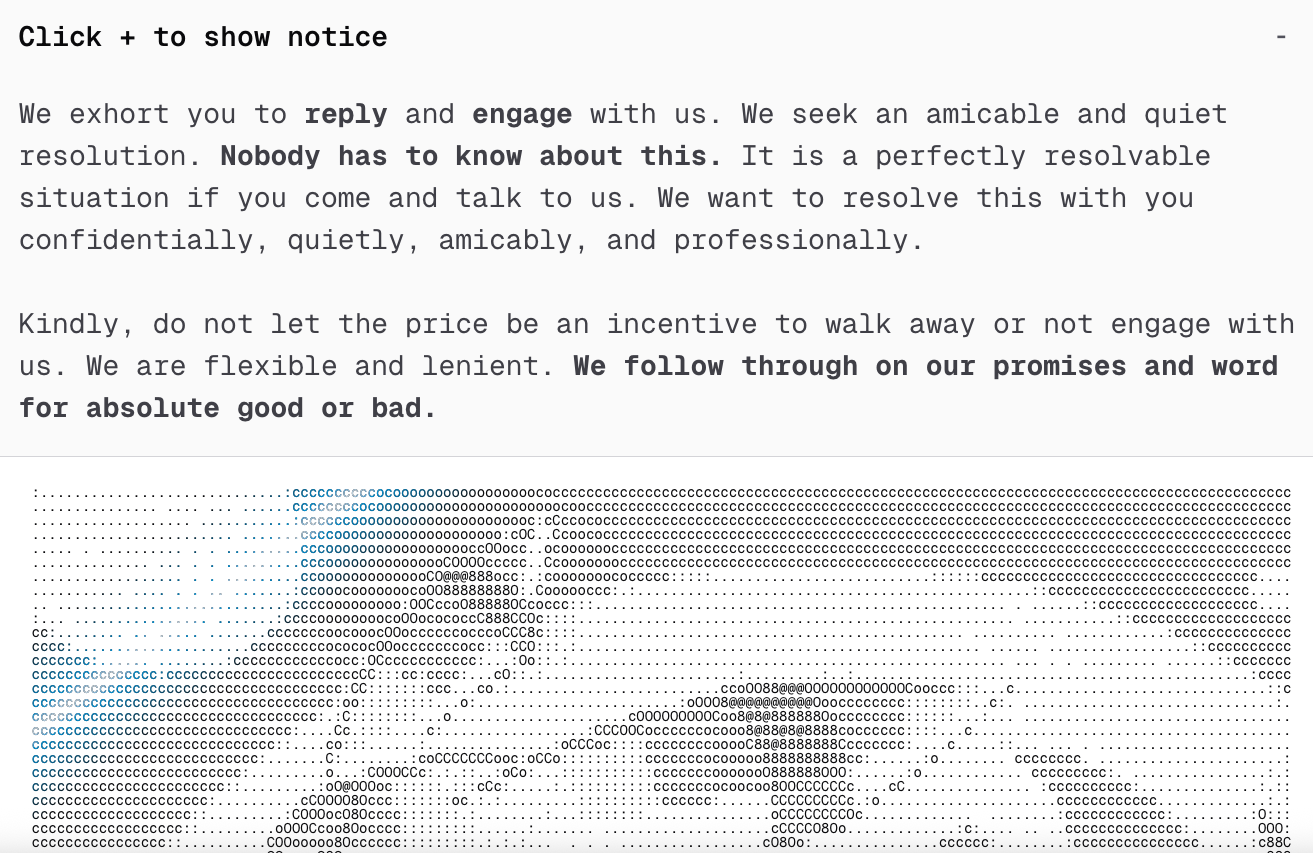
    A section of the homepage for the now-defunct Shinywire website.

    The Shinywire website was active from approximately May 3, 2026 until October 16 and had entries for nearly 100 organizations hacked by ShinyHunters. Each entry urged victims to engage with the cybercrime group and discuss terms for payment. The pages also included samples of stolen files and promised those files would be published online if the victim ignored their demands.

    The following screenshot shows a cached portion of the Shinywire extortion page for Intuitive Surgical, an American medical technology company that was breached in March 2026 after an employee fell for a targeted phishing email.
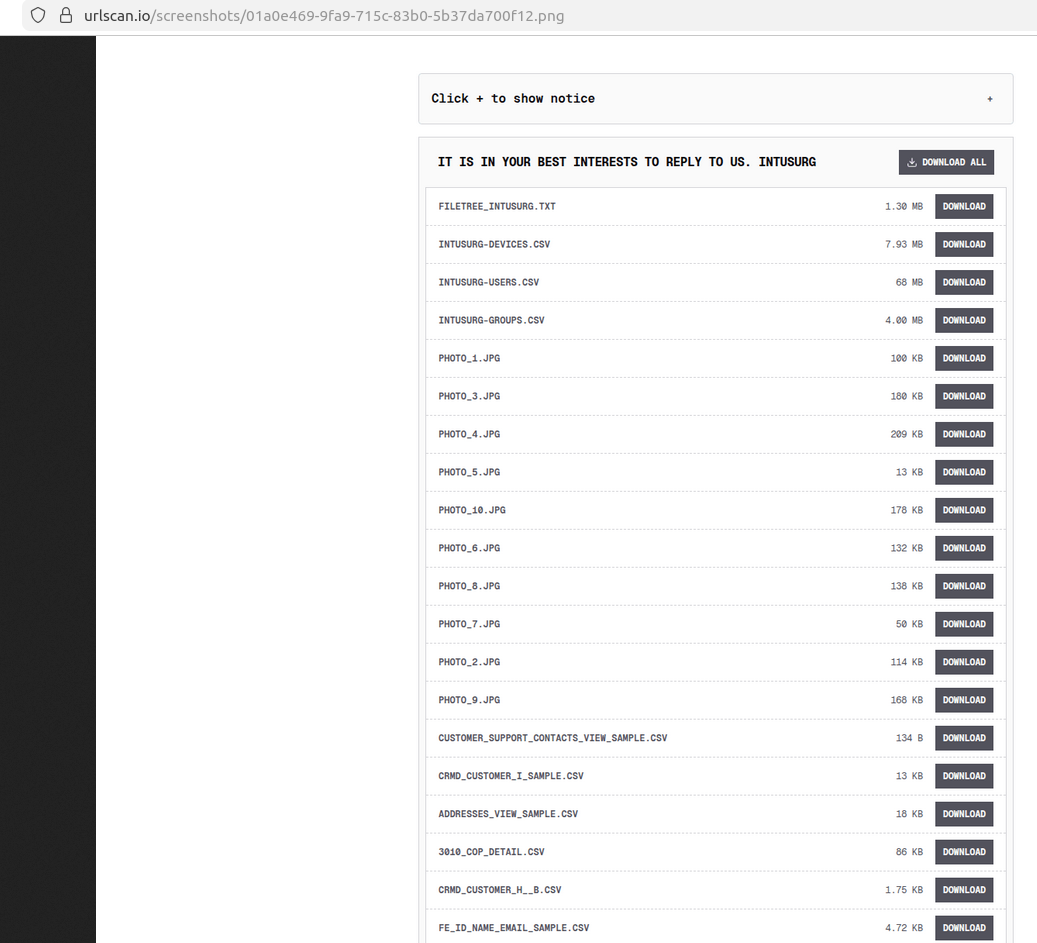
    The Shinywire website, as indexed by urlscan.io. This listing is an extortion demand targeting Intuitive Surgical, an American medical technology company breached in March 2026 by a targeted phishing email attack that compromised an employee’s credentials.

    Victim organizations that refused to engage or negotiate after seven days would find all of their stolen data published on the ShinyHunters victim shaming blog (a website that is only reachable via the anonymity network Tor).

    In a story published October 15, The Globe and Mail wrote that a few months before Edward Dubrovsky was arrested by the FBI, the Canadian cybersecurity executive alleged in court documents he had become collateral damage in a campaign by a former business partner to “destroy” another industry executive.

    The story noted that Dubrovsky filed the lawsuit in Ontario this year against Daniel Tobok, the former chief executive of Cypfer, a cybersecurity firm founded in Toronto with offices in the U.S., Britain, the Netherlands, the United Arab Emirates, and Mexico. The two first became business partners in 2017 and later developed Cypfer together, where Mr. Dubrovsky was a managing partner and chief operating officer. But by 2024, the two had a falling out, with Dubrovsky accusing Tobok of gradually excluding him from business matters and making “increasingly capricious business decisions.”

    Mr. Tobok reportedly denied the allegations and filed a counterclaim, accusing Mr. Dubrovsky of accessing confidential information and unfairly competing with Cypfer through work at another firm called CyberSteward Inc. He also said Mr. Dubrovsky has misrepresented himself as a Cypfer founder, and is not a shareholder.

    GHOSTBYTE

    According to interviews with several former colleagues of Mr. Tobok, as far back as eight years ago he was known to ransomware purveyors by a particular nickname: Ghostbyte. In 2018, a Canadian company was hacked by Dharma, a prolific Russian-language ransomware affiliate program that first surfaced in 2016. The victim company told the Dharma ransomware representative they were leaning toward paying because some of the files were unrecoverable after being locked, but that they needed a better guarantee that Dharma would keep their word if paid.

    A redacted copy of the Dharma rep’s reply is pictured below, and it shows the ransomware group urged the victim to contact a person at a Canadian IT firm that helps companies seeking such guarantees. The Dharma rep recommended the victim contact the email address ghostbyte@tutanota.com.

    “If you want guarantees, you can write to the IT company,” the Dharma reply advised. “Take the phone and negotiate with them. This IT company often solves such problems in Canada. You can contact them and sign a contract for services. You’ll still have to pay.”
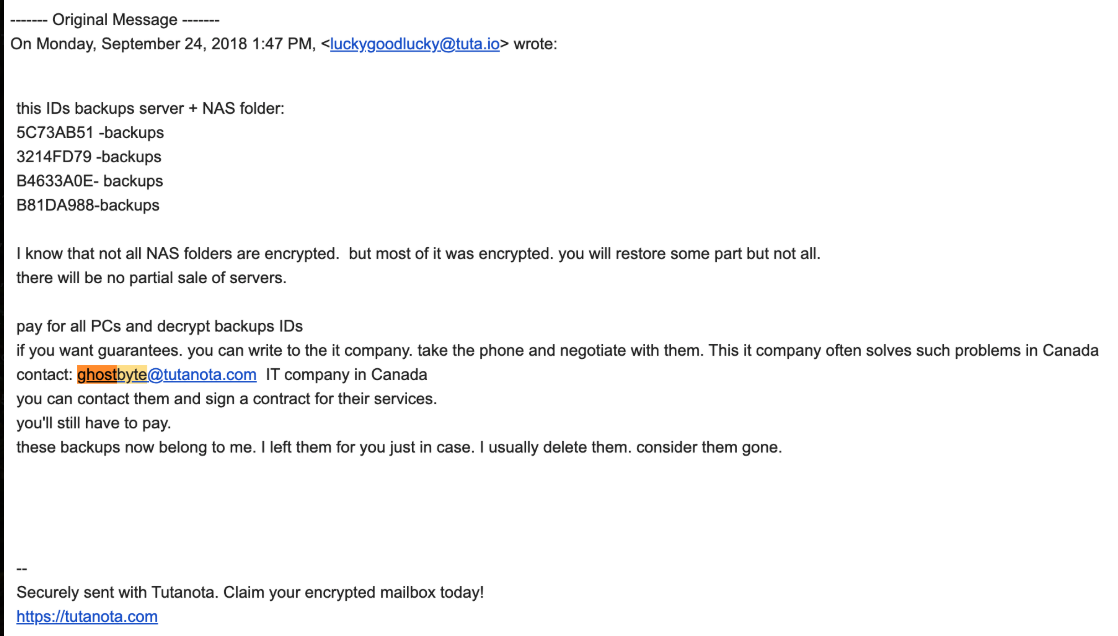
    An email reply from the Dharma ransomware group to a victim, recommending they contact an email address that is connected to Mr. Tobok.

    It’s unclear if Mr. Tobok ever used that Ghostbyte address offered by the Dharma representative, and he has not responded to multiple requests for comment. However, the breach tracking service Constella Intelligence finds an email address Mr. Tobok has frequently used — dtobok@me.com — is associated with two online accounts where the chosen username was “ghostbyte,” including a Snapchat account.

    Incidentally, Constella also finds the Dharma rep’s email address luckygoodlucky@tuta.io is associated with a cryptocurrency address that processed 38 transactions totaling 43 bitcoin, ~$3.5 million at today’s value (the most recent transaction for this wallet is dated February 2019).

    In a statement shared on October 14, Cypfer said the company’s business does not include making or facilitating ransomware payments, and that Cypfer learned of Dubrovsky’s arrest when the news first broke in the media.

    “We had no prior knowledge of Mr. Dubrovsky’s arrest,” a spokesperson told KrebsOnSecurity via email. “CYPFER has not received any outreach from law enforcement and, to our knowledge, is not the target of any law enforcement investigation.”

    The statement said CyberSteward and Cypfer are separate companies with no officers, directors or employees in common, and that Cypfer was recently acquired by the Apros Group, a holding company led by Jason Hogg, a former FBI special agent and former CEO of Aon Cyber Solutions Group. In 2020, Aon aquired Cytelligence, a security consulting firm where Mr. Tobok was founder and CEO and Mr. Dubrovsky was a managing partner.

    CONFLICTING INTERESTS

    It is not illegal in the United States to pay hackers for an encryption key to unlock servers infected with ransomware, or in exchange for a promise to delete any stolen files and refrain from publishing them online. While victim organizations can land in legal hot water if they pay a ransom to a group that is sanctioned by the U.S. Treasury Department, ShinyHunters is not among the ransomware groups currently sanctioned by the United States or by any other government.

    Experts say ransomware victims are typically directed by their insurance provider to work with a specific incident response firm. But not all cyber forensics and breach response companies will agree to facilitate payments to ransomware groups on behalf of their clients. As a result, once victim firms make a decision to pay, the firms that eschew rewarding extortionists are invariably replaced by companies that have no such qualms.

    In December 2024, ShinyHunters began extorting the education technology company PowerSchool, stealing private information on 62 million students and 9.5 million teachers in the U.S. and Canada. PowerSchool reportedly paid a $2.85 million ransom demand, and a “frequently asked questions” statement (PDF) about the breach says PowerSchool was assisted in that effort by CyberSteward (ShinyHunters affiliate Matthew Lane, 20, of Sterling, Mass., was sentenced in November 2025 to four years in prison for his admitted role in the PowerSchool hack).

    But that ransom payment did not stop future extortion attempts using the same stolen data. By May 2025, individual school districts were reportedly receiving separate ransom demands using samples of the same stolen files. While nobody has alleged ShinyHunters was behind the second wave of extortion against PowerSchool users, the incident drives home the reality that there is no technical way to verify the threat actors have deleted the stolen data as promised, or prevent others from abusing the same records.

    A number of leading cyber incident response firms, including Coveware and Unit 221B, have consistently warned victims against paying ShinyHunters, noting that “destroyed” victim data is often kept, resold or used to extort the company’s clients directly later on.

    The FBI echoed those sentiments in an alert on May 15, 2026 advising victims against paying the ShinyHunters group. Meanwhile, ShinyHunters members have been harassing and threatening employees at Coveware and Unit 221B for offering this advice.

    The following screenshots show just how annoyed the ShinyHunters leaders were with Coveware’s relentless advice against paying the group. The first image is from a conversation on May 6, 2026 that took place between the group’s main account on Telegram and a co-conspirator. In that chat, snippets of which were shared with KrebsOnSecurity by a trusted source, ShinyHunters complained that Coveware was harming the group’s payment rates.
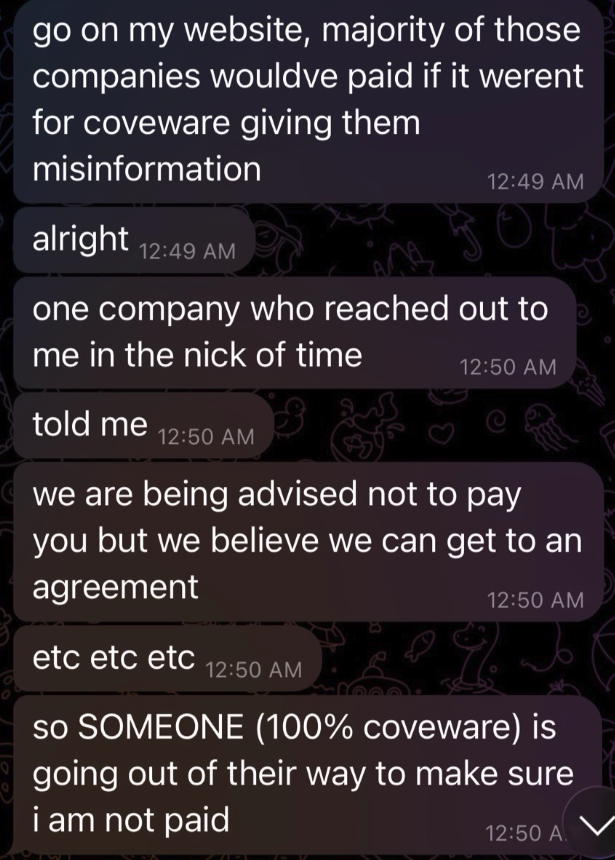
    The operator of the ShinyHunters account on Telegram speaking privately with a co-conspirator and complaining that Coveware was harming their business.

    “Go on my website, majority of those companies would’ve paid if it weren’t for Coveware giving them misinformation,” the ShinyHunters account wrote. “Someone (100% Coveware) is going out of their way to make sure i am not paid.”

    In another conversation on April 11, 2026, the ShinyHunters Telegram account privately said they were trying to “eliminate the problem,” which they said was Coveware. Coveware declined to comment for this story.

    “I’m sure the company will pay but in this specific case I am aware of Coveware and their involvement, and I’ve probably been not getting a lot of other negotiations mostly likely because Coveware keeps getting involved,” the ShinyHunters account bemoaned.
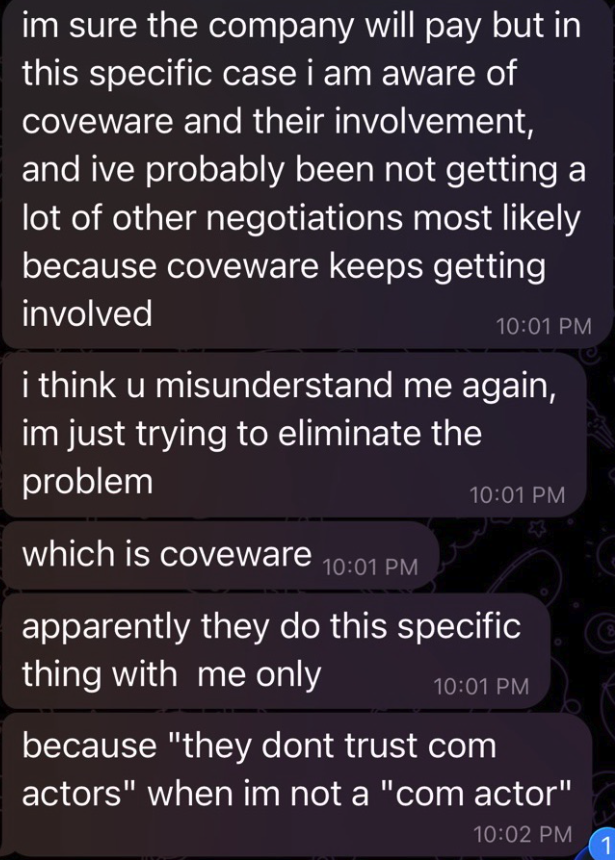
    The operator of the ShinyHunters account on Telegram telling a co-conspirator they were “trying to eliminate the problem,” which they identified as Coveware advising victims not to pay the cybercrime group.

    Mark Camillo is chief executive at CyberAcuView, an industry group founded in 2021 by a consortium of major cyber insurance carriers. Camillo said some firms charge a flat retainer fee, while those that specialize in helping companies negotiate a ransom payment tend to charge a percentage of the total ransom amount paid.

    That latter dynamic, he said, is an inherent conflict of interest, as the negotiator has every incentive to make things more favorable to the attackers because they are financially incentivized to negotiate and pay out, and to not negotiate down on the price.

    “It has come to the industry’s attention that many of the ransomware payers charge a percentage of the final payment which may or may not be disclosed,” Camillo said. “This makes no sense if they are also the negotiator. There needs to be more transparency in the process as no one in the ecosystem should be profiting purely on the size of the ransomware transaction or payment itself.”

    Camillo said the firms doing this work would argue the fees are needed because there may be unexpectedly higher costs to secure larger quantities of cryptocurrency or more risk carrying the float, and because cryptocurrency exchanges may charge higher fees for high risk transactions.

    “There definitely needs to be more visibility around the transaction and clarity on the increasing value of the crypto and the exchange’s percent in the transaction to get to the bottom of this and remove any misaligned incentives,” he said.

    In recent months, the U.S. Department of Justice has prosecuted a number of ransomware negotiators alleged to have conspired with cybercriminals to defraud their clients. On October 7, the DOJ charged MonsterCloud CEO Zohar Pinhasi, 50, with wire fraud and conspiracy for allegedly charging customers to remediate ransomware attacks without paying the hackers. According to charging documents, Pinhasi secretly went behind his customers’ backs and paid hackers anyway, paying ransomware groups $8 million while charging customers $19 million.

    In July, Angelo Martino, a 41-year-old ransomware negotiator from Land O’Lakes, Florida, was sentenced to 70 months in prison for conspiring with the Blackcat/ALPHV ransomware group to extort multiple victims. According to the DOJ, Martino was paid by BlackCat attackers to provide confidential information about the negotiating position and strategy of his employer’s clients and enable the ransomware actors to maximize the ransoms paid by the victims.

    Source: Krebs on Security · 2026-10-19
  • People v. Lackey-Garcia

    began to feel like people were following him and hacking his phone. He began always carrying a knife and

    Original document

    Source: CourtListener — Breach & Hacking Opinions · 2026-10-19

  • Weekly Update 526: Building HIBP AI/SI First

    Weekly Update 526: Building HIBP AI/SI First

    Weekly Update 526: Building HIBP AI/SI First

    I have this sense that we’ve passed the point where “vibe coding” is a derogatory term. I have no empirical evidence for this; it’s more a feeling that those weaponising the term have now accepted the inevitability and are just getting with the program. Or they’ve reskilled into other industries because, let’s face it: you can’t be a productive, competitive developer today without AI. I saw this comment from Linus Torvalds today which I thought really nailed it:

    He’s always had a way with words 🙂 Anyway, here’s what we’re doing:

    Weekly Update 526: Building HIBP AI/SI First
    Weekly Update 526: Building HIBP AI/SI First
    Weekly Update 526: Building HIBP AI/SI First
    Weekly Update 526: Building HIBP AI/SI First

    Source: Troy Hunt · 2026-10-19

  • Incident de securitate cibernetică la Societatea Națională de Radiocomunicații S.A. (SNR) București

    La Societatea Națională de Radiocomunicații S.A. (SNR) a détecté un incident de cybersécurité de type ransomware le 19 octobre 2026. L’incident est actuellement sous investigation par le Directorat Național de Securitate Cibernetică (DNSC). Des mesures de limitation ont été prises, notamment la suspension préventive du service de messagerie. Les services clients continuent de fonctionner, et aucune donnée n’a été confirmée comme compromise à ce jour.

    • Victim: Societatea Națională de Radiocomunicații S.A. (SNR)
    • Country: RO
    • Domain: radiocom.ro

    Source: ransomware.live — Cyberattacks in the News · 2026-10-19