Tag: Time to Patch

  • Microsoft Fixes Nearly 1,100 Security Vulnerabilities

    Microsoft Fixes Nearly 1,100 Security Vulnerabilities

    Microsoft did another four-digit patch drop today, releasing updates to fix almost 1,100 security vulnerabilities in its Windows operating systems and supported software. This month’s Patch Tuesday addresses 63 critical flaws — including a zero-day in Microsoft Outlook — and comes amid important security updates from other software makers, including Adobe, Apple, Google and Mozilla.

    Image: Shutterstock.com. Diorama by @zepp1969.

    November’s patch release from Redmond tackles 1,093 vulnerabilities, fixing 63 “critical” flaws that can be exploited to seize control over a Windows system with little or no help from users. Nearly half of those critical bugs are remote code execution vulnerabilities. Overall, 535 of the flaws addressed this month allow an attacker to elevate their privileges on a vulnerable device.

    This latest round of updates means Microsoft has shipped more than 5,100 security patches so far this year, a staggering number considering that a year ago Microsoft was averaging around 100 patches per month. Microsoft credits advances in artificial intelligence for helping to find (and fix) such a large volume of security bugs in recent months. Last month, Microsoft pushed more than 1,400 fixes.

    According to Redmond, just one of the flaws is already seeing active exploitation: CVE-2026-124194, a spoofing bug in Outlook. The advisory for CVE-2026-124194 says it affects Microsoft 365 Apps for Enterprise and editions of Microsoft Office.

    Several other major software makers pushed security updates this week to fix critical weaknesses in their products. Apple on Monday released out-of-cycle security updates to fix at least nine vulnerabilities in iOS/iPadOS, macOS, watchOS and visionOS. Among the weaknesses reportedly fixed in Apple’s release include an iMessage flaw that could let a remote attacker join a group chat and receive its messages; the updates also fix a separate iMessage flaw that could let someone added to a group access messages sent before they joined.

    Lee Neely, an instructor at the SANS Institute, noted that Apple backported the fix to iOS 18.

    “I take notice when Apple releases fixes to more than two versions,” Neely wrote in a SANS newsletter today. “You really need to get to version 27.2.1 of their OSes and push folks who are holding onto devices which cannot run the current version. The best plan often involves setting an upgrade date for old hardware. Run through all your Apple devices and make sure everything is up to date, don’t assume the fixes went out automatically.”

    Google this week released Chrome version 157.0.8103.50, which resolves nine security holes, including CVE-2026-125350, the sixth zero-day vulnerability this year for Chrome (this bug also being patched in Chromium-based browsers like Edge). The latest Chrome version follows its November 3 release, which fixed 213 vulnerabilities. A new version of Mozilla Firefox out today (Firefox 160) resolves almost 100 CVEs, about half of them high severity.

    Adobe today released patches for at least 110 vulnerabilities across a range of products, with nearly half of the flaws rated high severity. Adobe said there is no evidence any of the security holes it addressed this month are being actively exploited.

    Chris Goettl, vice president of product management at Ivanti, said it’s easy for security teams at large enterprises to feel overwhelmed by the volume and criticality of patches from Microsoft lately. But he notes that while some 95,000 vulnerabilities have been assigned CVEs this year across all vendors, only 217 have so far this year been added to the Known Exploited Vulnerabilities (KEV) list maintained by the U.S. Cybersecurity and Infrastructure Security Agency (CISA).

    “Roughly four in ten of this year’s exploited vulnerabilities sit in operating systems, endpoint software, browsers, and server platforms, which a continuous patch strategy can close quickly,” Goettl said.”The rest calls for exposure management alongside patching, especially the 44% that sit in edge devices and IT management or remote access tools, the internet-facing systems that hold privileged access. Teams that can quickly identify those assets, confirm exposure and act on confirmed exploitation can focus on the small slice of vulnerabilities attackers are actively using, while the rest stays on the normal patch cadence.”

    Please don’t neglect to back up any important data if you haven’t recently; generally speaking, this is a task best accomplished before applying operating system updates. As ever, if you experience any issues applying this month’s bundle of love from Microsoft, please drop a comment about it in the space below.

    Source: Krebs on Security · 2026-11-10

  • Widespread PHP Flaw May Cause Many Site Outages Today

    Widespread PHP Flaw May Cause Many Site Outages Today

    Expect to see quite a few websites serving error pages today: Nearly 70 percent of websites need to update their core software to fix a pair of vulnerabilities that allow an attacker to seize full control over affected servers. Experts say there are working exploits for the flaws, and that these critical bugs are already being exploited in the wild.

    Image: Shutterstock.com, Sashkin.

    The flaws at issue are present in PHP, the programming language that powers sites running on a large number of web publishing systems, including Drupal, Magento, Joomla and WordPress. Earlier today, PHP released an emergency security update to fix two critical bugs that can allow an attacker to execute code of their choosing on a vulnerable server.

    Reuters reports that government websites in Europe and elsewhere went offline today after the PHP vulnerabilities were disclosed. Cloudflare said it has already detected some exploitation of the flaw, and that at 3:02 am (UTC) it implemented web application firewall rules to protect websites from attack traffic seeking to exploit the bugs, which could cause a denial of service condition, remote code execution, and data exposure.

    OpenAI, which was involved in the vulnerability research and outreach, said “given the severity of these flaws and PHP’s widespread use, we consider this one of the most impactful security issues in recent memory.”

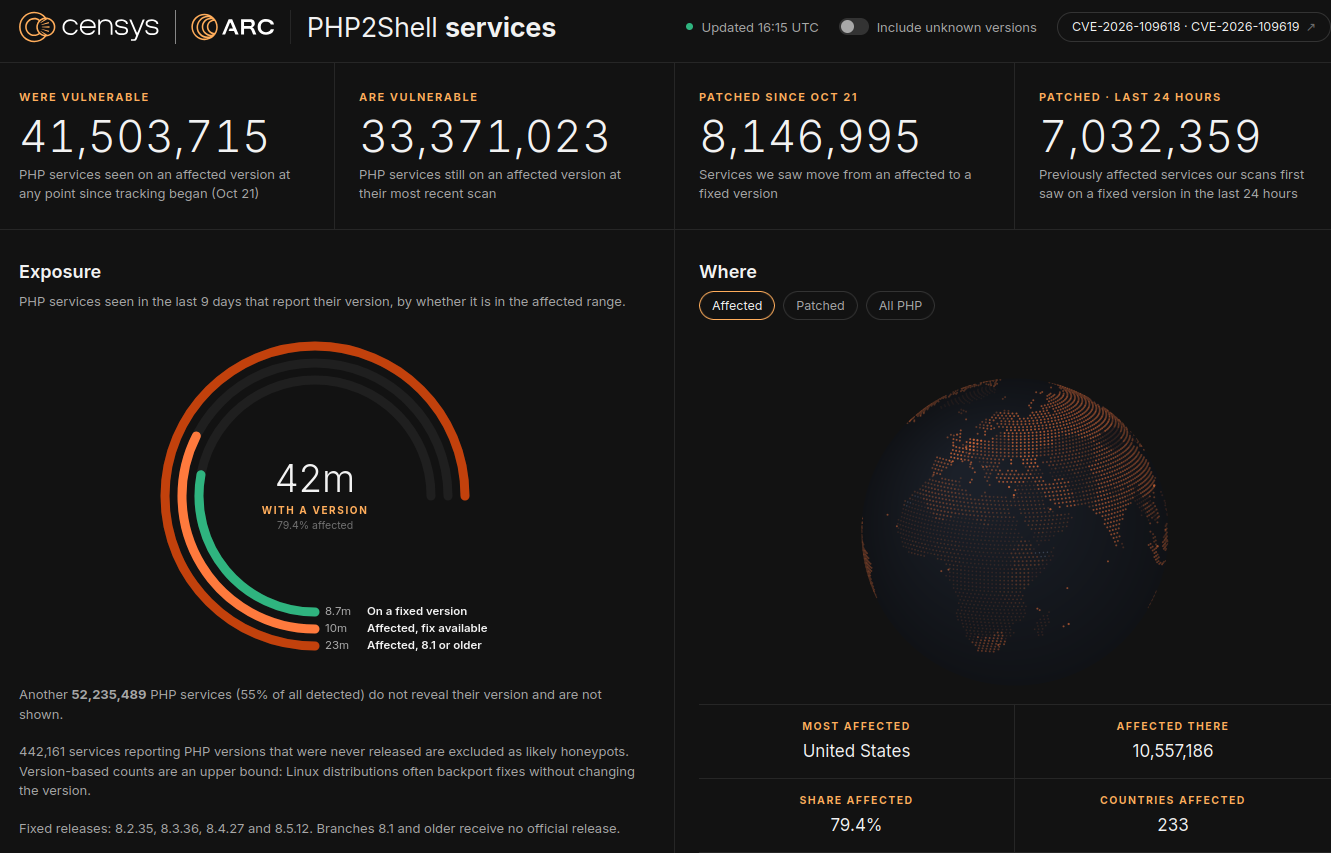
    Censys, a company that tracks the technology used by Internet hosts, said a recent scan identified approximately 2.58 million Internet facing hosts and 54.9 million web properties running PHP.

    Security experts at Wiz said every PHP version released in the last decade is affected by at least one of these vulnerabilities [full disclosure: Wiz is an advertiser on this blog].

    “These findings rank among the most severe vulnerabilities discovered in PHP, and arguably in software history,” reads a blog post published today by a team of researchers at Wiz, which was one of several organizations credited with discovering the vulnerabilities. “The underlying flaws had been present for decades, but demonstrating their exploitability required an exceptionally complex chain of steps, at the edge of what human researchers could practically achieve. Frontier AI models substantially reduced that barrier, turning a longstanding flaw into an exploit.”

    The Wiz researchers say it is likely the PHP vulnerabilities will be mass-exploited to install web-based backdoors or “web shells,” which give attackers a web-based panel that allows them to remotely control infected sites. Wiz said that prior to the PHP bugs being publicly disclosed, the company worked with the PHP team, Calif and OpenAI to measure the size of the problem and coordinate patch verification and disclosure.

    The PHP zero-day vulnerabilities are being tracked by their CVE numbers, CVE-2026-109618 and CVE-2026-109619, and they affect all web servers running PHP 5.4 or later. The bugs are fixed in PHP 8.5.12, 8.4.27, 8.3.36, and 8.2.35.

    According to Wiz, PHP is so deeply embedded in many web applications that we are likely to see organizations struggling to patch these vulnerabilities for some time to come, comparing this PHP vulnerability pair with the Log4Shell weakness that emerged in 2021 — a widespread, severe-as-it-gets security flaw in Log4j, a popular Java logging framework.

    “A vulnerability in core PHP reaches far beyond a single application,” the Wiz researchers wrote. “PHP runs across clouds, hosting providers, content-delivery networks and millions of independently managed servers. Reducing exposure before the technical details became public required coordinated work across that entire ecosystem.”

    The SANS Internet Storm Center is keeping an eye on major software platforms that are shipping updates to deal with these PHP flaws. For example, Ubuntu just released updated PHP packages. For a technical deep-dive on these vulnerabilities that tells the timeline of the discovery of these bugs in a comic book style, check out this post from Calif, another technology company credited with finding the PHP flaws.

    A snapshot of php2shell.censys.com, the website Censys set up to track the PHP vulnerabilities.

    This is a fast-moving story. Updates will be noted here with timestamps.

    Update, 2:30 pm ET: Add figures from Censys and a link to Calif’s writeup.

    Source: Krebs on Security · 2026-10-21

  • Microsoft Patches More Than 1,400 Security Flaws

    Microsoft Patches More Than 1,400 Security Flaws

    Microsoft today issued updates to fix more than 1,400 security vulnerabilities in its Windows operating systems and other software. Today’s epic patch batch dwarfs September’s record of nearly 1,000 fixes, which was already about ten times the normal monthly patch load from Redmond.

    Just one of the weaknesses patched this week is considered a “zero day,” or already exploited in the wild. CVE-2026-96951 is a security feature bypass in the Windows Shell that affects Windows 10 and 11 systems, as well as some Server versions.

    Windows 10 users might be wondering if they can still expect security updates after this month. Microsoft had been slated to stop shipping updates for Windows 10 systems in October 2025, but ended up adding another year of free updates after considerable pushback. A few months ago, Microsoft quietly extended that support for another year (until October 2027).

    At least 78 of the flaws fixed this month are rated “critical,” meaning they could be exploited with little or no action by the user, and most of those critical bugs allow an attacker to execute code of their choice on the vulnerable system.

    While Microsoft said there are no signs anyone is exploiting it yet, a security feature bypass in the .NET Framework (CVE-2026-108398) was publicly disclosed prior to today, potentially giving attackers advance time to work out how to exploit the bug.

    Satnam Narang at Tenable said the number of flaws fixed this month far surpasses the previous record-setting year 2020, when Microsoft patched 1,261 CVEs.

    “We’ve now crossed the 4,000 CVE mark with two months left to go,” he said.

    Microsoft credits large language models for the high volume of bug discovery, and presumably AI gets credit for many of the patches used to fix these flaw. Meanwhile, security experts have been warning that these unusually large patch volleys from Microsoft are placing extra strain on corporate security teams, which often have to test individual updates before deploying them across a network to ensure the fixes don’t cause problems for other software.

    Tyler Reguly, associate director of security research and development at Fortra, notes that just 26 Microsoft vulnerabilities appeared in the “Known Exploited Vulnerabilities” (KEV) catalog maintained by the U.S. Cybersecurity & Infrastructure Security Agency (CISA) so far this year, and security teams would do well to prioritize patching those 26 vulnerabilities first.

    “Security leaders should focus on exploitable risk, and ask whether their teams have the clarity, capacity and support to act,” Reguly said.

    Which vulnerabilities deserve the most scrutiny in your organization? The folks at Cisco Talos have a useful roundup of the more noteworthy flaws that Microsoft fixed today, and of course the SANS Internet Storm Center has a reliable roundup that indexes vulnerabilities by severity, CVE number and affected software.

    Source: Krebs on Security · 2026-10-13