Tag: ransomware

  • Feds Suspect Ransom Negotiator Ran ShinyHunters Extortion Site

    Feds Suspect Ransom Negotiator Ran ShinyHunters Extortion Site

    U.S. federal investigators pursuing the ShinyHunters hacking group that recently stole highly sensitive data from the FBI have identified executives at two different ransomware negotiation firms who maintained unusually close relations with the extortion group, KrebsOnSecurity has learned. Sources close to the investigation say one of the executives in the United States even helped ShinyHunters operate a website that pressured victims into paying a ransom.

    Hackers aligned with ShinyHunters have claimed credit for dozens of major data breaches since 2019, when the group was primarily operated by cybercriminals living in France. As those original members were arrested or jailed one by one, control over the ShinyHunters brand eventually passed to “Rey,” identified last year as a teenage hacker from Amman, Jordan. According to the FBI, ShinyHunters has extorted more than $70 million from victims so far this year.

    In late September, ShinyHunters hacked the FBI recruitment website fbijobs.gov and taunted the agency by threatening to publish the stolen files, which reportedly included medical and psychological records, Social Security numbers and home addresses, and information about each employee’s unit and specialization.

    The FBI jobs site hack has prompted the agency to move with uncommon speed to arrest, detain and question people who had any communications with Rey or other ShinyHunters suspects. Reuters reported on October 3 that Rey had been detained by Jordanian authorities and was cooperating with the FBI.

    Rey was able to assume control over the hacking group because one of its alleged senior members had just been nabbed. On the evening of September 15, 2026, authorities in the Netherlands arrested convicted hacker and ShinyHunters suspect Pepijn van der Stap. Dutch police reportedly used flash-bang grenades in an effort to stun and apprehend Van der Stap as he was logged in to various online accounts.

    According to a source close to the investigation, the authorities arrested Van der Stap while he was using his Signal instant messaging account, which allowed them to read recent communications with frequent contacts — including ransomware negotiators based in Canada and the United States.

    Multiple sources with knowledge of the matter told KrebsOnSecurity that Van der Stap’s messages were the key to unraveling a murder-for-hire plot that emerged immediately following his arrest. The Dutch news outlet RTL reported last month the two murders were allegedly to be committed abroad, and that there are indications Van der Stap gave the order for the attacks (there is no indication those orders were ever carried out).

    On October 9, KrebsOnSecurity broke the news that the FBI arrested a 54-year-old Canadian cybersecurity executive named Edward Dubrovsky in connection with the ShinyHunters investigation. Dubrovsky, who recently published a book on handling cyber extortion that recommended always engaging with the hackers, was charged with threatening to disclose stolen or hacked data and interfering with interstate commerce through extortion, according to court records. Politico reports prosecutors have asked that Dubrovsky remain in custody pending trial, and that records related to his case remain under seal.

    A source close to the investigation told KrebsOnSecurity that Van der Stap’s Signal messages showed he had frequent conversations with Mr. Dubrovsky and with at least one executive at a large U.S.-based consulting firm, and that these executives often knew the details about new ShinyHunters victims before the victims themselves had even learned of the breach.

    That source shared another potentially explosive finding by federal investigators: the Dutch hacker’s chats showed Mr. Dubrovsky knew ShinyHunters had stolen highly sensitive data from FBI servers, and that he never informed the bureau of the data breach prior to ShinyHunters threatening on Twitter/X to publish the agency’s deeply personal personnel files.

    SHINYWIRE

    KrebsOnSecurity has learned from two sources close to the ShinyHunters probe that FBI investigators believe at least one executive at a U.S.-based consulting firm played an active role in operating the now-defunct ShinyHunters victim extortion website “shinywire[.]com.” KrebsOnSecurity is not naming the U.S. company or the suspected executive(s) for now because they have not yet been charged with a crime, but it is a prestigious firm with more than 1,000 associates.
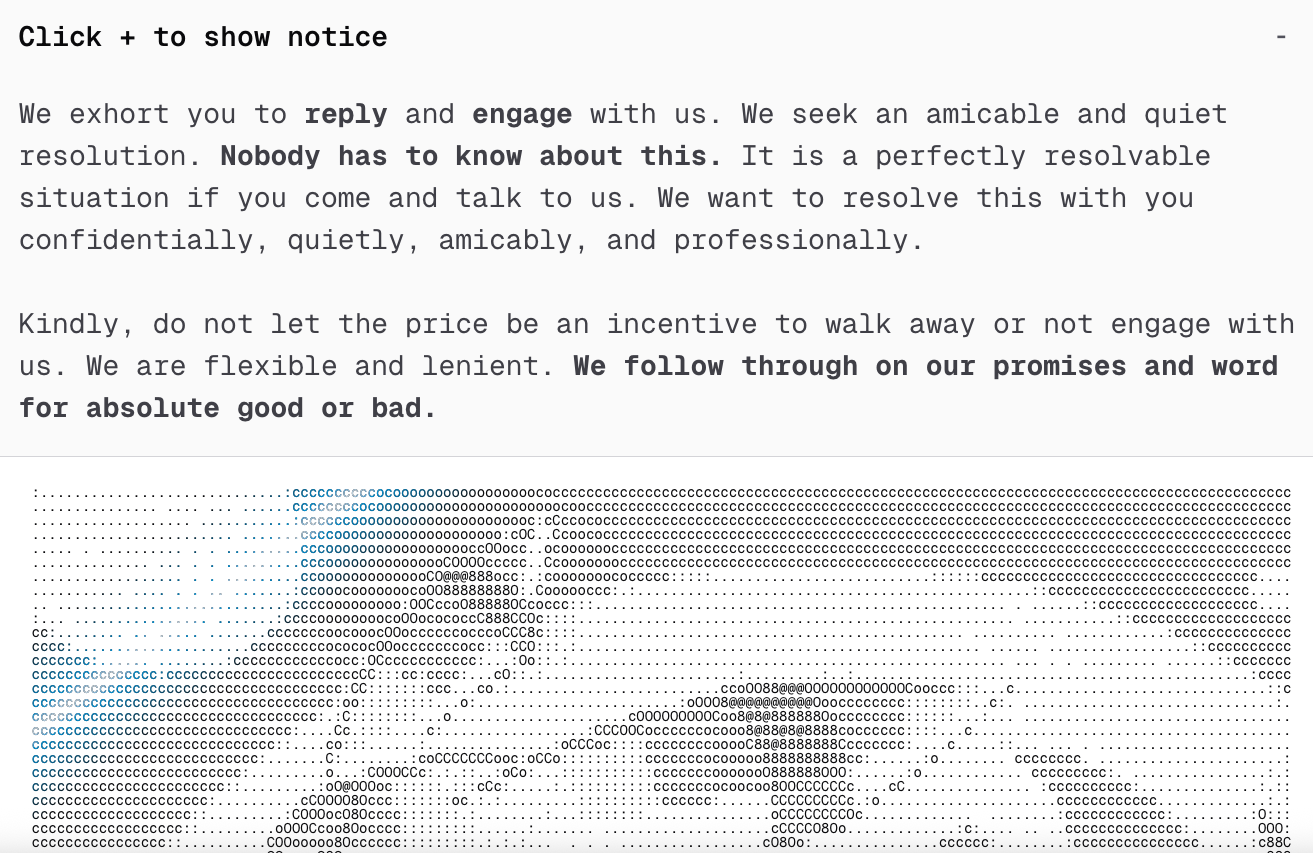
    A section of the homepage for the now-defunct Shinywire website.

    The Shinywire website was active from approximately May 3, 2026 until October 16 and had entries for nearly 100 organizations hacked by ShinyHunters. Each entry urged victims to engage with the cybercrime group and discuss terms for payment. The pages also included samples of stolen files and promised those files would be published online if the victim ignored their demands.

    The following screenshot shows a cached portion of the Shinywire extortion page for Intuitive Surgical, an American medical technology company that was breached in March 2026 after an employee fell for a targeted phishing email.
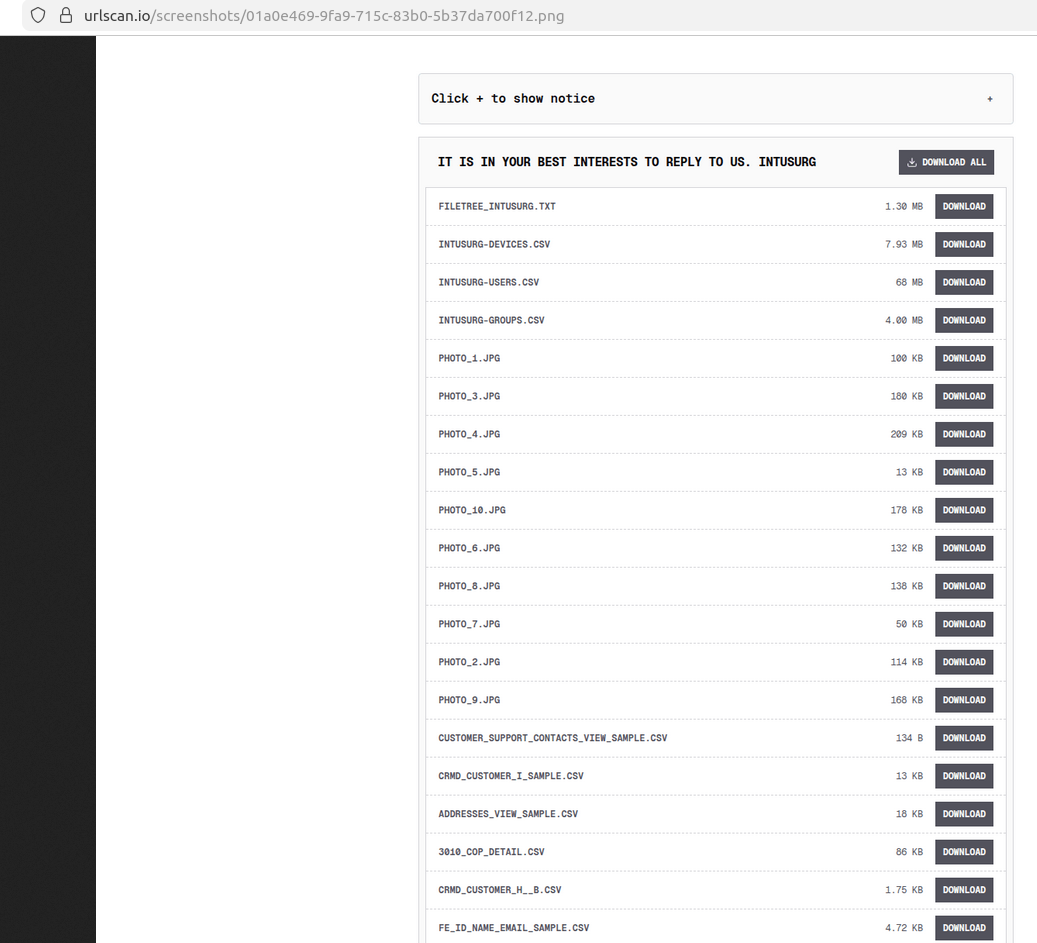
    The Shinywire website, as indexed by urlscan.io. This listing is an extortion demand targeting Intuitive Surgical, an American medical technology company breached in March 2026 by a targeted phishing email attack that compromised an employee’s credentials.

    Victim organizations that refused to engage or negotiate after seven days would find all of their stolen data published on the ShinyHunters victim shaming blog (a website that is only reachable via the anonymity network Tor).

    In a story published October 15, The Globe and Mail wrote that a few months before Edward Dubrovsky was arrested by the FBI, the Canadian cybersecurity executive alleged in court documents he had become collateral damage in a campaign by a former business partner to “destroy” another industry executive.

    The story noted that Dubrovsky filed the lawsuit in Ontario this year against Daniel Tobok, the former chief executive of Cypfer, a cybersecurity firm founded in Toronto with offices in the U.S., Britain, the Netherlands, the United Arab Emirates, and Mexico. The two first became business partners in 2017 and later developed Cypfer together, where Mr. Dubrovsky was a managing partner and chief operating officer. But by 2024, the two had a falling out, with Dubrovsky accusing Tobok of gradually excluding him from business matters and making “increasingly capricious business decisions.”

    Mr. Tobok reportedly denied the allegations and filed a counterclaim, accusing Mr. Dubrovsky of accessing confidential information and unfairly competing with Cypfer through work at another firm called CyberSteward Inc. He also said Mr. Dubrovsky has misrepresented himself as a Cypfer founder, and is not a shareholder.

    GHOSTBYTE

    According to interviews with several former colleagues of Mr. Tobok, as far back as eight years ago he was known to ransomware purveyors by a particular nickname: Ghostbyte. In 2018, a Canadian company was hacked by Dharma, a prolific Russian-language ransomware affiliate program that first surfaced in 2016. The victim company told the Dharma ransomware representative they were leaning toward paying because some of the files were unrecoverable after being locked, but that they needed a better guarantee that Dharma would keep their word if paid.

    A redacted copy of the Dharma rep’s reply is pictured below, and it shows the ransomware group urged the victim to contact a person at a Canadian IT firm that helps companies seeking such guarantees. The Dharma rep recommended the victim contact the email address ghostbyte@tutanota.com.

    “If you want guarantees, you can write to the IT company,” the Dharma reply advised. “Take the phone and negotiate with them. This IT company often solves such problems in Canada. You can contact them and sign a contract for services. You’ll still have to pay.”
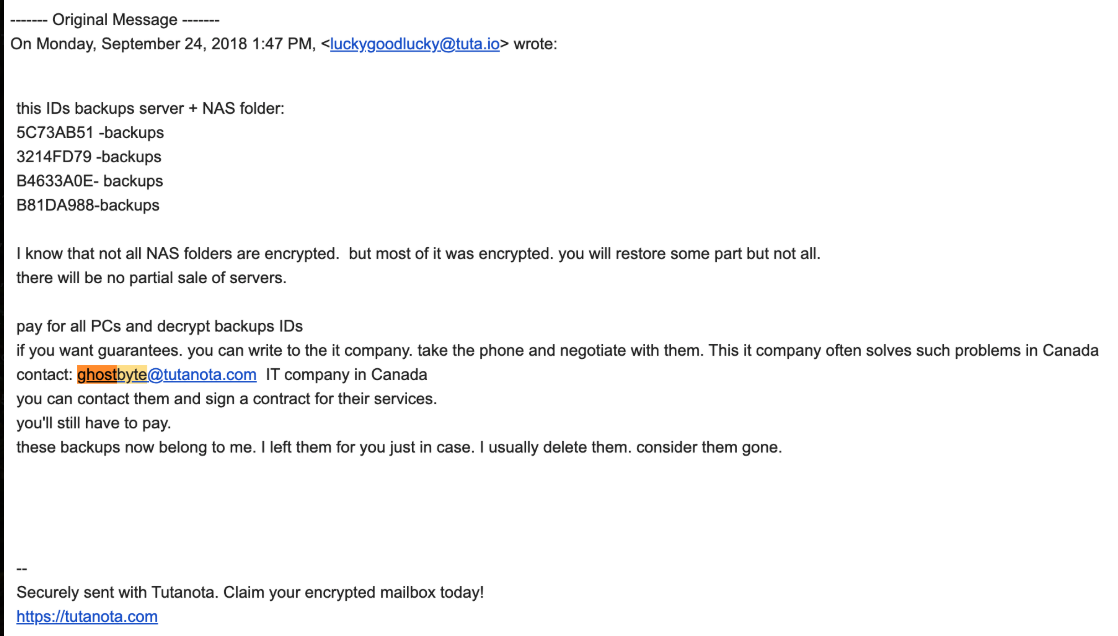
    An email reply from the Dharma ransomware group to a victim, recommending they contact an email address that is connected to Mr. Tobok.

    It’s unclear if Mr. Tobok ever used that Ghostbyte address offered by the Dharma representative, and he has not responded to multiple requests for comment. However, the breach tracking service Constella Intelligence finds an email address Mr. Tobok has frequently used — dtobok@me.com — is associated with two online accounts where the chosen username was “ghostbyte,” including a Snapchat account.

    Incidentally, Constella also finds the Dharma rep’s email address luckygoodlucky@tuta.io is associated with a cryptocurrency address that processed 38 transactions totaling 43 bitcoin, ~$3.5 million at today’s value (the most recent transaction for this wallet is dated February 2019).

    In a statement shared on October 14, Cypfer said the company’s business does not include making or facilitating ransomware payments, and that Cypfer learned of Dubrovsky’s arrest when the news first broke in the media.

    “We had no prior knowledge of Mr. Dubrovsky’s arrest,” a spokesperson told KrebsOnSecurity via email. “CYPFER has not received any outreach from law enforcement and, to our knowledge, is not the target of any law enforcement investigation.”

    The statement said CyberSteward and Cypfer are separate companies with no officers, directors or employees in common, and that Cypfer was recently acquired by the Apros Group, a holding company led by Jason Hogg, a former FBI special agent and former CEO of Aon Cyber Solutions Group. In 2020, Aon aquired Cytelligence, a security consulting firm where Mr. Tobok was founder and CEO and Mr. Dubrovsky was a managing partner.

    CONFLICTING INTERESTS

    It is not illegal in the United States to pay hackers for an encryption key to unlock servers infected with ransomware, or in exchange for a promise to delete any stolen files and refrain from publishing them online. While victim organizations can land in legal hot water if they pay a ransom to a group that is sanctioned by the U.S. Treasury Department, ShinyHunters is not among the ransomware groups currently sanctioned by the United States or by any other government.

    Experts say ransomware victims are typically directed by their insurance provider to work with a specific incident response firm. But not all cyber forensics and breach response companies will agree to facilitate payments to ransomware groups on behalf of their clients. As a result, once victim firms make a decision to pay, the firms that eschew rewarding extortionists are invariably replaced by companies that have no such qualms.

    In December 2024, ShinyHunters began extorting the education technology company PowerSchool, stealing private information on 62 million students and 9.5 million teachers in the U.S. and Canada. PowerSchool reportedly paid a $2.85 million ransom demand, and a “frequently asked questions” statement (PDF) about the breach says PowerSchool was assisted in that effort by CyberSteward (ShinyHunters affiliate Matthew Lane, 20, of Sterling, Mass., was sentenced in November 2025 to four years in prison for his admitted role in the PowerSchool hack).

    But that ransom payment did not stop future extortion attempts using the same stolen data. By May 2025, individual school districts were reportedly receiving separate ransom demands using samples of the same stolen files. While nobody has alleged ShinyHunters was behind the second wave of extortion against PowerSchool users, the incident drives home the reality that there is no technical way to verify the threat actors have deleted the stolen data as promised, or prevent others from abusing the same records.

    A number of leading cyber incident response firms, including Coveware and Unit 221B, have consistently warned victims against paying ShinyHunters, noting that “destroyed” victim data is often kept, resold or used to extort the company’s clients directly later on.

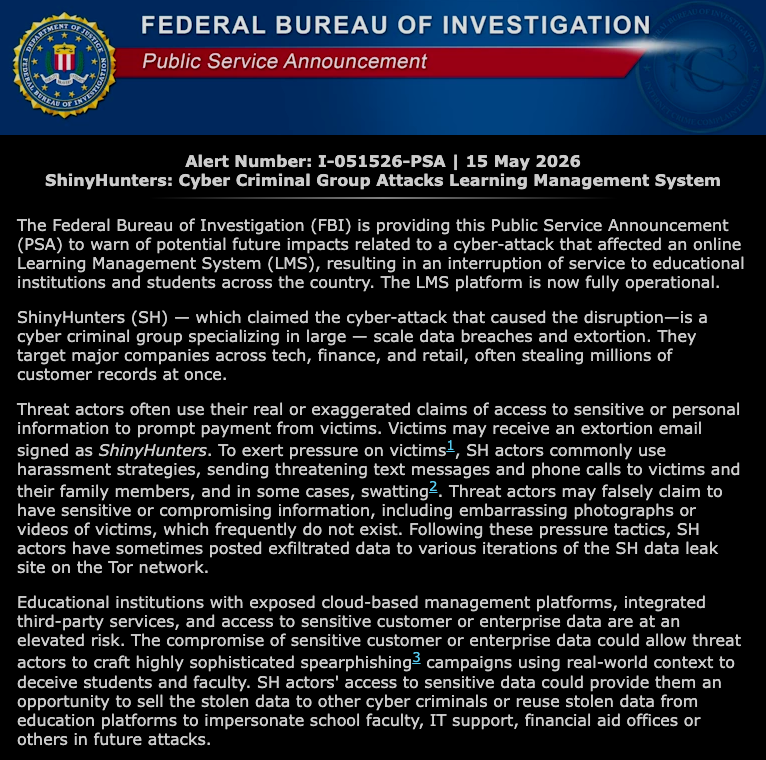
    The FBI echoed those sentiments in an alert on May 15, 2026 advising victims against paying the ShinyHunters group. Meanwhile, ShinyHunters members have been harassing and threatening employees at Coveware and Unit 221B for offering this advice.

    The following screenshots show just how annoyed the ShinyHunters leaders were with Coveware’s relentless advice against paying the group. The first image is from a conversation on May 6, 2026 that took place between the group’s main account on Telegram and a co-conspirator. In that chat, snippets of which were shared with KrebsOnSecurity by a trusted source, ShinyHunters complained that Coveware was harming the group’s payment rates.
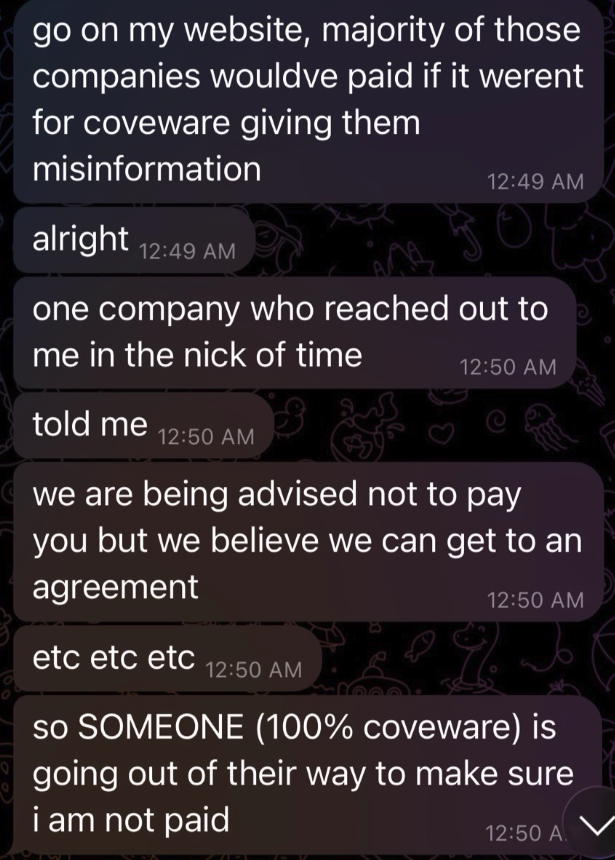
    The operator of the ShinyHunters account on Telegram speaking privately with a co-conspirator and complaining that Coveware was harming their business.

    “Go on my website, majority of those companies would’ve paid if it weren’t for Coveware giving them misinformation,” the ShinyHunters account wrote. “Someone (100% Coveware) is going out of their way to make sure i am not paid.”

    In another conversation on April 11, 2026, the ShinyHunters Telegram account privately said they were trying to “eliminate the problem,” which they said was Coveware. Coveware declined to comment for this story.

    “I’m sure the company will pay but in this specific case I am aware of Coveware and their involvement, and I’ve probably been not getting a lot of other negotiations mostly likely because Coveware keeps getting involved,” the ShinyHunters account bemoaned.
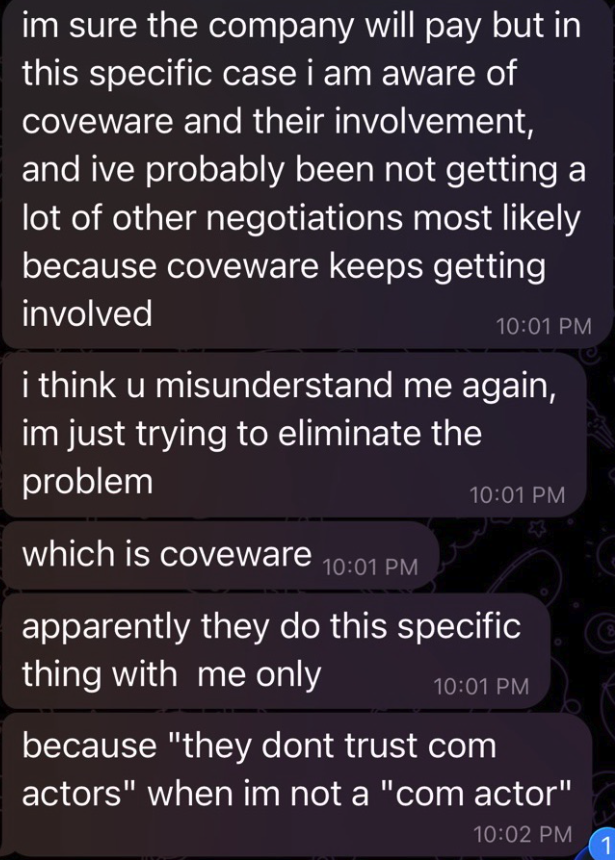
    The operator of the ShinyHunters account on Telegram telling a co-conspirator they were “trying to eliminate the problem,” which they identified as Coveware advising victims not to pay the cybercrime group.

    Mark Camillo is chief executive at CyberAcuView, an industry group founded in 2021 by a consortium of major cyber insurance carriers. Camillo said some firms charge a flat retainer fee, while those that specialize in helping companies negotiate a ransom payment tend to charge a percentage of the total ransom amount paid.

    That latter dynamic, he said, is an inherent conflict of interest, as the negotiator has every incentive to make things more favorable to the attackers because they are financially incentivized to negotiate and pay out, and to not negotiate down on the price.

    “It has come to the industry’s attention that many of the ransomware payers charge a percentage of the final payment which may or may not be disclosed,” Camillo said. “This makes no sense if they are also the negotiator. There needs to be more transparency in the process as no one in the ecosystem should be profiting purely on the size of the ransomware transaction or payment itself.”

    Camillo said the firms doing this work would argue the fees are needed because there may be unexpectedly higher costs to secure larger quantities of cryptocurrency or more risk carrying the float, and because cryptocurrency exchanges may charge higher fees for high risk transactions.

    “There definitely needs to be more visibility around the transaction and clarity on the increasing value of the crypto and the exchange’s percent in the transaction to get to the bottom of this and remove any misaligned incentives,” he said.

    In recent months, the U.S. Department of Justice has prosecuted a number of ransomware negotiators alleged to have conspired with cybercriminals to defraud their clients. On October 7, the DOJ charged MonsterCloud CEO Zohar Pinhasi, 50, with wire fraud and conspiracy for allegedly charging customers to remediate ransomware attacks without paying the hackers. According to charging documents, Pinhasi secretly went behind his customers’ backs and paid hackers anyway, paying ransomware groups $8 million while charging customers $19 million.

    In July, Angelo Martino, a 41-year-old ransomware negotiator from Land O’Lakes, Florida, was sentenced to 70 months in prison for conspiring with the Blackcat/ALPHV ransomware group to extort multiple victims. According to the DOJ, Martino was paid by BlackCat attackers to provide confidential information about the negotiating position and strategy of his employer’s clients and enable the ransomware actors to maximize the ransoms paid by the victims.

    Source: Krebs on Security · 2026-10-19
  • Beelzebub Ransomware Announces Major Rewrite and Recruitment Push for New Operators

    Ransomware Recruitment Report
    Defense Evasion
    Affiliate Recruitment
    Targeting Expansion
    Observed

    Beelzebub Ransomware Announces Major Rewrite and Recruitment Push for New Operators

    Update typeFull rewrite
    Recruitment roles3
    Primary focusDefense evasion
    StatusRecruiting

    Beelzebub Ransomware Announces Major Rewrite and Recruitment Push for New Operators

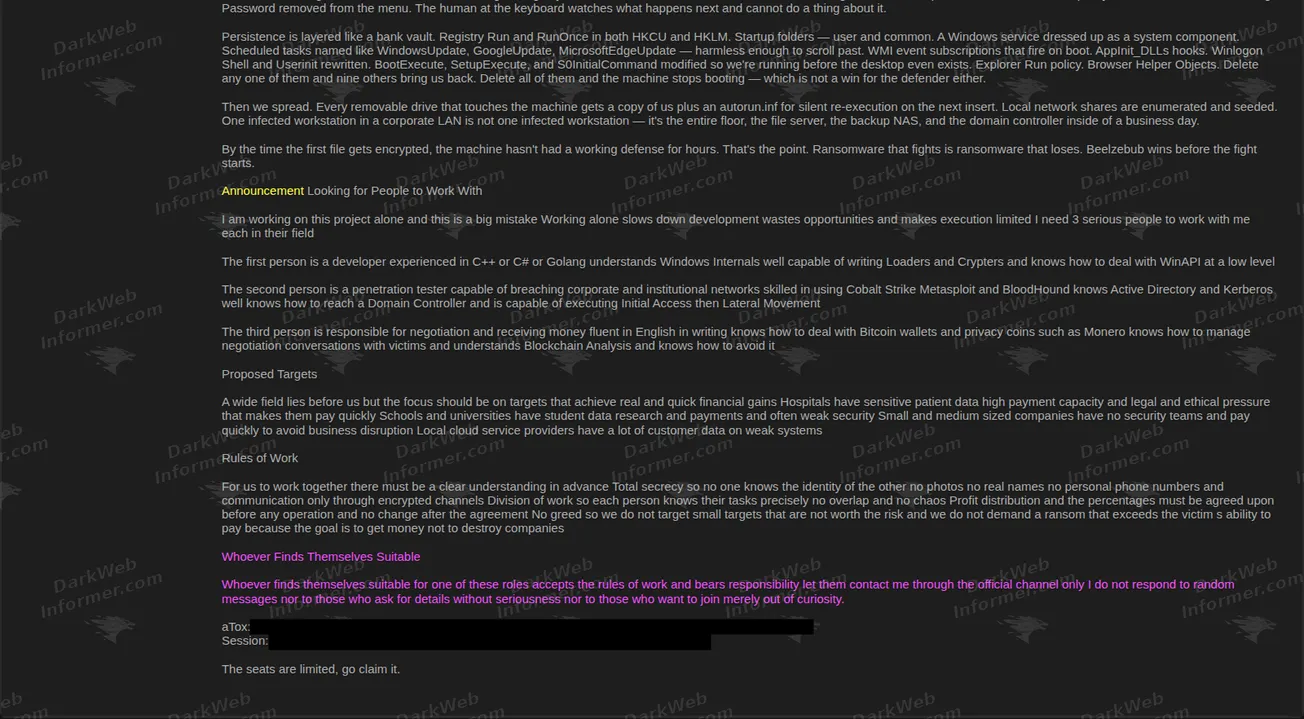
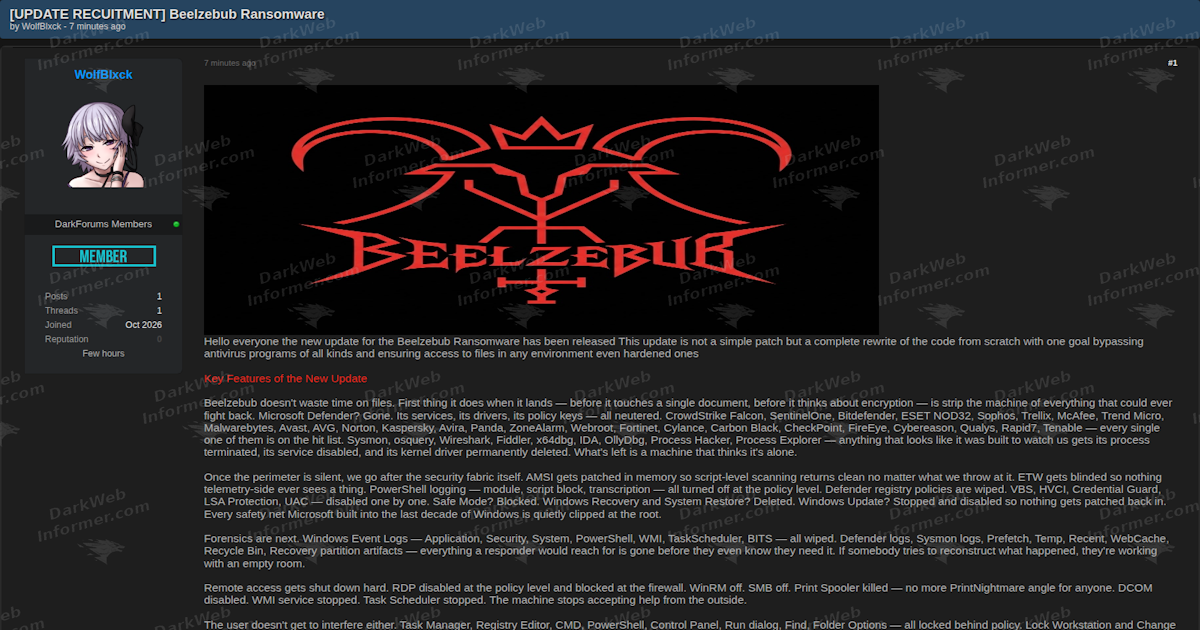
    An actor using the handle “WolfBlxck” posted an updated recruitment announcement for Beelzebub ransomware, claiming the malware has been rewritten from scratch with a stronger emphasis on disabling endpoint defenses, suppressing telemetry and making incident response more difficult.

    The post also expands the recruitment pitch, stating that the operator is looking for three additional people: a developer, a penetration tester and a negotiator. The actor lists hospitals, schools and universities, small and medium-sized businesses, and local cloud providers as proposed target categories. The recruitment post is directly visible in the supplied screenshots, but the malware capabilities and operational claims have not been independently validated.

    Post details

    ProgramBeelzebub Ransomware
    ActivityMalware update and recruitment
    Actor“WolfBlxck”
    Update typeComplete rewrite
    Primary focusDefense evasion and disruption of security tooling
    Recruitment rolesDeveloper, penetration tester, negotiator
    Target categories namedHealthcare, education, SMBs, local cloud providers
    Observed date

    What the post claims

    • Complete rewrite of the ransomware codebase
    • Focus on bypassing antivirus and EDR products
    • Claims to interfere with endpoint-security products
    • Claims to terminate monitoring and analysis utilities
    • Claims to suppress AMSI and ETW visibility
    • Claims to disable PowerShell logging
    • Claims to disable Windows security controls
    • Claims to remove recovery components
    • Claims to wipe Windows event logs and other forensic artifacts
    • Claims to disable remote-management and network services
    • Claims to restrict common administrative tools
    • Claims multiple persistence mechanisms
    • Claims propagation through removable media and network shares
    • Recruiting one developer
    • Recruiting one penetration tester
    • Recruiting one negotiator
    • Hospitals named as proposed targets
    • Schools and universities named as proposed targets
    • SMBs and local cloud providers named as proposed targets

    The actor also outlines internal operational rules covering secrecy, role separation and profit-sharing. Those details are summarized at a high level here rather than reproduced as procedural instructions.

    Screenshots

    The supplied captures show the Beelzebub update announcement, claimed defense-evasion capabilities, persistence and propagation claims, recruitment roles, proposed target categories, operational rules and contact identifiers.

    IOCs & identifiers

    Identifiers directly visible in the supplied material. These support correlation and do not independently verify the malware’s capabilities.

    Type Identifier Source
    Actor handle WolfBlxck Screenshots 1–2
    Ransomware name Beelzebub Screenshots 1–2
    Tox ID 6D29A6A0E0BA4FAB31FA4541F89B800459CBB14736B17557B9DC79019F7B460A450E646FFB1B Screenshot 2
    Session ID 051b3888c0b3e561b598579627840af056f2b9cd3600f9ef07157d290551b35442 Screenshot 2

    No malware hash, Telegram handle, attacker-controlled domain or attacker-controlled IP address is visible in the supplied screenshots.

    Mapped techniques

    Claimed identifies behavior explicitly described by the actor. Inferred identifies an analytical mapping supported by the supplied material. Neither label means the capability has been independently validated.

    Potential impact

    If the advertised capabilities are genuine, the rewritten malware could increase operational difficulty for defenders by combining security-tool disruption, telemetry suppression, forensic artifact removal, recovery interference, persistence and network propagation before encryption. The recruitment push could also expand the operation’s technical and negotiation capacity.

    Status Observed

    The supplied screenshots directly document the Beelzebub update and recruitment post. Dark Web Informer has not independently verified that the malware can perform every claimed action, that the listed security products are successfully bypassed, or that the operation has recruited the roles described.

    Dark Web Informer

    Source: Dark Web Informer · 2026-10-16

  • Krybit ransomware: what you need to know

    Krybit is a fast-growing ransomware gang that was hacked by a rival, hit back, and is still extorting victims. Find out how it works, who it has targeted, and what organisations can do to protect themselves.

    Read more in my article on the Fortra blog.

    Source: Graham Cluley · 2026-10-16

  • Smashing Security podcast #488: How a ransomware negotiator ended up arrested at his own conference

    A ransomware negotiator attended a cybersecurity conference, only to be arrested by the FBI in connection with its investigation into the ShinyHunters gang.

    Meanwhile, hackers get the keys to ASOS’s app and the chance to message every single customer. What did they say? And how did the company respond? We have thoughts.

    All this and more is discussed in episode 488 of the “Smashing Security” podcast with cybersecurity expert and keynote speaker Graham Cluley, and special guest Paul Ducklin.

    Source: Graham Cluley · 2026-10-14

  • ShinyHunters Extorted Boeing Spin-off Prior to Arrests

    ShinyHunters Extorted Boeing Spin-off Prior to Arrests

    A teenager from Amman, Jordan suspected of leading the prolific data theft and extortion group ShinyHunters has been detained and is reportedly cooperating with the FBI to identify other members of the hacking gang. KrebsOnSecurity has learned that the suspect, who uses the hacker handle “Rey,” was detained as ShinyHunters was in the process of extorting a business unit recently divested by the global aerospace company Boeing, which manufactures the fleet of planes used by the employer of Rey’s father — Royal Jordanian Airlines.

    The logo for Jeppesen ForeFlight, a business unit divested last year by the aerospace firm Boeing.

    On October 3, Reuters cited three unnamed sources saying a suspected ShinyHunters member in Amman named Saif Al-din Khader was detained by Jordanian authorities and was cooperating with the FBI. KrebsOnSecurity identified Rey as Khader in a November 2025 profile, in which the young man admitted working with multiple ransomware groups.

    Rey was featured again in a September 28 exclusive about the Dutch police arresting 24-year-old convicted cybercriminal Pepijn van der Stap on suspicion of aiding in data thefts and extortions by ShinyHunters. The story noted that immediately following the Dutchman’s arrest on the evening of September 15, Rey assumed control over the ShinyHunters brand and boasted publicly about stealing highly sensitive data from the FBI and extorting the ransomware group Cl0p.

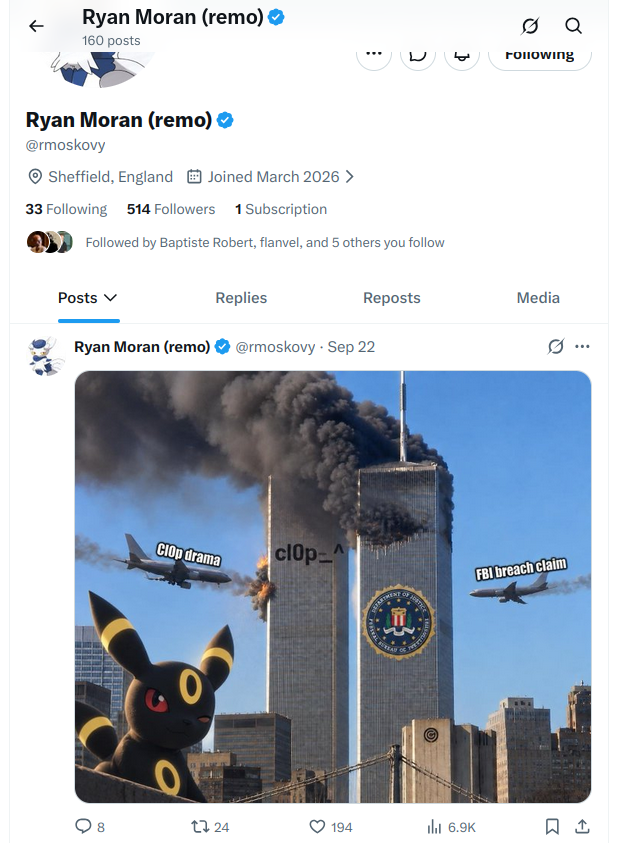
    Rey taunted both the FBI and Cl0p with memes posted to his longtime account on Twitter/X, while simultaneously including images of the avatar used by Van Der Stap’s former hacker alias “Umbreon” in an apparent attempt to frame the Dutchman for both hacks.

    A taunting meme uploaded to Twitter/X by Rey on Sept. 22. A giant sized version of the Pokemon character Umbreon can be seen in the bottom left.

    As noted in our September 28 report, ShinyHunters gained access to the FBI site and other victims by exploiting a vulnerability (CVE-2026-35273) in PeopleSoft, a software-as-a-service platform from the tech giant Oracle that is broadly used by companies to manage hiring and human resources, benefits and payroll. Oracle quickly issued a fix for CVE-2026-35273, which ShinyHunters first began exploiting as a zero-day in June, and at the time Mandiant released web application firewall rules intended for organizations that couldn’t apply the security update quickly enough.

    ShinyHunters told BleepingComputer in June that the original goal behind exploiting the PeopleSoft vulnerability was to breach the FBI’s own PeopleSoft database, but the hackers said those attacks were unsuccessful for some reason. In recent weeks, however, ShinyHunters turned to a well-known URL-encoding trick to bypass Mandiant’s suggested web application firewall rules.

    In a report released Sept. 25, security experts at Mandiant and the Google Threat Intelligence Group (GTIG) confirmed that ShinyHunters had mass-exploited the PeopleSoft vulnerability to steal data from dozens of systems across a range of industries, including higher education, technology, healthcare, agriculture, transportation and government.

    Reuters reported October 5 that the FBI has removed a contractor at Accenture over their failure to patch the FBI recruitment website hacked by ShinyHunters, which exposed sensitive data on more than 5,000 FBI personnel, including each’s person’s unit and specialization, as well as medical and psychiatric records.

    ‘REY’ MEANS KING, AS IN ROYAL

    According to two sources familiar with the ShinyHunters investigation, a navigation and digital aviation unit recently divested by the global aerospace company Boeing was among the victims that ShinyHunters was in the process of extorting when Rey was apprehended by Jordanian authorities.

    Those sources said the FBI’s investigation into ShinyHunters gained renewed urgency with the group’s attempted extortion of the former Boeing unit, which allegedly included the theft of sensitive information that sources said could pose operational safety and security risks.

    In a brief statement shared with KrebsOnSecurity, Boeing acknowledged the extortion attempts by ShinyHunters, and said the incident concerned data stolen from Jeppesen ForeFlight, a subsidiary that Boeing sold in November 2025 to the private equity firm Thoma Bravo for $10.55 billion.

    “We are aware of claims by a threat actor regarding data allegedly associated with Boeing and our former subsidiary Jeppesen ForeFlight,” a Boeing spokesperson shared. “We are actively reviewing the matter with the Jeppesen ForeFlight team.”

    A spokesperson for Jeppesen ForeFlight shared a written statement in response to questions, saying the company has seen no impact on their end. “Based on our investigation to date into this claim and proactive security posture, there was no impact to our operations or products.”

    Rey’s alleged involvement in attempting to extort the former Boeing unit is noteworthy because there is strong evidence that his father works for Royal Jordanian Airlines, which is mostly controlled by the Jordanian government and operates its long-haul fleet on passenger planes built by Boeing. Rey claimed on Telegram in early 2025 that his father was an airline pilot, although that could not be independently confirmed.

    However, as noted in our November 2025 profile of Rey, his family’s shared computer was at one point compromised by password-stealing malware, and the data collected by that malware clearly shows Rey’s father used the same credentials to log in at multiple online portals for Royal Jordanian Airlines employees.

    Royal Jordanian Airlines has not yet responded to a request for comment. In advance of our September 28 story, KrebsOnSecurity once again emailed Rey’s father to seek comment and update him on his son’s alleged activities. Neither of the Khaders have responded. But just hours after that request was sent, Rey began deleting his various social media accounts, including the Twitter/X account he previously used to taunt the FBI, Cl0p, and other ShinyHunters victims.

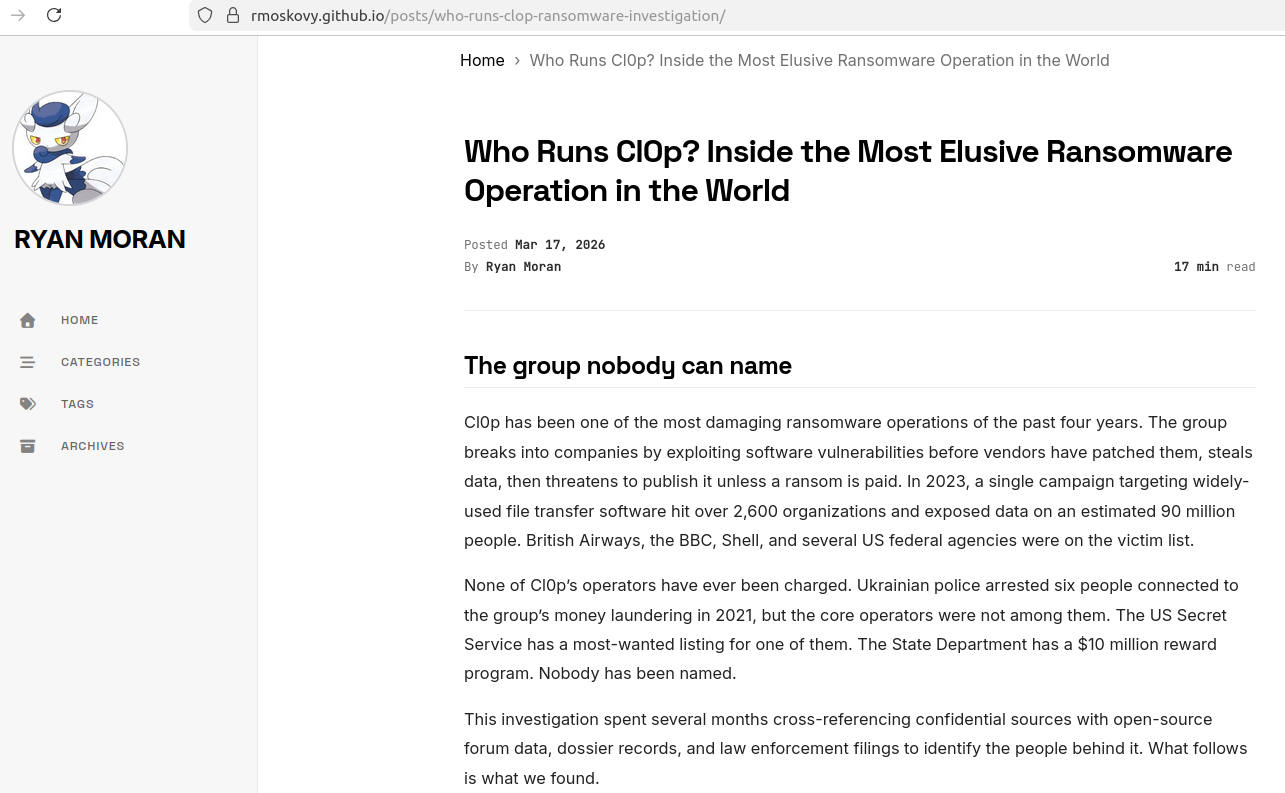
    Rey may have nixed many of his social media profiles, but his cybersecurity blog on GitHub somehow escaped the purge, and it shows that Rey was fixated on the leaders of the Cl0p ransomware group. In March 2026, Rey’s blog featured a lengthy post that identified two Russian men as the core developers and hackers behind Cl0p.

    Rey’s blog on GitHub. This post doxes two Russian men as the core operators behind Cl0p, one of the oldest and most established ransomware groups still in operation today.

    MURDER FOR HIRE?

    Meanwhile, news outlets in the Netherlands reported explosive new allegations leveled at Van der Stap, whose supposed personal transformation from convicted to reformed hacker has been widely covered in the tech news media. The Dutch daily RTL reported on Sept. 29 that investigators suspect Van der Stap tried to orchestrate at least two murders. According to RTL, the murders were allegedly to be committed abroad, and there are indications Van der Stap gave the order for these attacks.

    Van der Stap was released from prison after serving the better part of a four year sentence for data theft and extortion activity that prosecutors said netted between €1.5 million and €2.7 million. In an interview with KrebsOnSecurity on September 9, Van der Stap described his new role as “offensive security lead” at the Dutch cybersecurity company Neo Security, saying the job involved probing client networks for security vulnerabilities.

    Neo Security’s owner Benjamin Korper told Reuters he has hired an outside firm to investigate whether Van der Stap had hacked Neo Security or its customers, but that so far investigators have found no evidence he acted against his employer or clients. Korper said Dutch forensic investigators visited his office on September 15, the night Van der ⁠Stap was arrested in a dramatic police raid that reportedly involved flash bang grenades.

    A screenshot of a Sept 16 story by the Dutch news outlet at5.nl, describing a police raid on Van Der Stap’s residence that reportedly used flash-bang grenades.

    Prior to his first arrest in 2023, Van der Stap was working as a software engineer at the Amsterdam-based cybersecurity startup Hadrian, while volunteering at the Dutch Institute for Vulnerability Disclosure (DIVD) — even as he was hacking into and extorting a number of large organizations.

    When asked in a recent interview why anyone should believe the word of a self-described “reformed” cybercriminal who had so casually deceived countless friends, co-workers and journalists for years, Van der Stap replied that his work spoke for itself and there was nothing he could say that would convince his worst critics.

    “You can throw a bunch of nice words at someone, but you can’t convince them if they don’t want to be convinced,” Van der Stap told KrebsOnSecurity on Sept. 9. “I’m doing what I can to repay victims, and that’s all I can do. If someone doesn’t want to believe me, then that’s on them.”

    FRANCHISING AND BURNING A BRAND

    Cybercriminals aligned with ShinyHunters have been responsible for dozens of data breaches involving billions of stolen records, and breaches claimed by the group stretch back to at least 2019. But experts say the people recently operating behind the ShinyHunters name are not the same core members that populated the group in its early days, most of whom are French citizens who have been arrested (if not also imprisoned) on at least one prior occasion for alleged cybercrime activity.

    More to the point, ShinyHunters has become something of a franchise. Think the Dread Pirate Roberts character in the 1980s cult movie classic “The Princess Bride,” only succession by death is replaced with succession by arrest, and there can be multiple simultaneous Dread Pirate Robertses. Sources close to the investigation say the FBI is focusing on a remaining handful of cybercriminal freelancers or affiliates who have been feeding the group stolen credentials to various software-as-a-service (SaaS) platforms used by major companies in exchange for a cut of any data ransoms later paid by victims.

    In the days after the news broke of Van der Stap’s arrest, a cybercrime-focused chat server on Telegram that was allegedly operated by Rey erupted with hot takes, with most participants heaping ridicule on the teenage hacker after he publicly backed down from threats against the FBI and Cl0p, and again when the ShinyHunters’s darknet website suddenly went offline. Several commentators accused Rey of resurrecting the ShinyHunters brand after its core members were rounded up in France, and making a mockery of the group’s name and reputation ever since.

    “He bought the old forum PGP key and used it to make new Breachforum websites and Telegram channels larping as ShinyHunters to ransom companies and then sell the used data or resell his forum when he goes broke,” one member recounted.

    A relatively new Telegram channel called “The Battle” has been doxing and needling Rey and other alleged ShinyHunters members for several weeks, and it has gained a considerable readership among the cybercrime communities operating on Telegram. One of the coordinators of that harassment campaign repeatedly portrayed Rey as clueless greenhorn who sought to ride the coattails of a cybercriminal brand that has long enjoyed a reputation for ruthlessly selling or publishing data stolen from victim companies who refuse to give in to extortion demands.

    “Rey (Saif Al-Din Khader) made a serious mistake when he started pretending to be a member of ShinyHunters,” wrote the administrators of The Battle server on Telegram. “That group had already been dismantled, with many of its members either arrested or imprisoned, yet Rey still chose to use its name while carrying out his crimes. We’re aware of claims that [Rey] caused over $200 million in damages and helped around 5–6 friend groups in the community make money by using Shiny Hunters group aliases to negotiate deals for a 25–30% cut over the past few months.”

    In an interview with The Register, ShinyHunters claimed they hacked the FBI to counter the agency’s narrative in a May 2026 alert that advised victims against paying a ransom to the group, which came off looking unprofessional and capricious in the FBI’s advisory.

    A flash notice on ShinyHunters released by the FBI on May 15, 2026.

    The public notice warned the group has been known to pursue a number of different victim harassment strategies, from sending threatening text messages and phone calls to victims and their family members to in some cases swatting victims. The FBI warned ShinyHunters members “may also falsely claim to have sensitive or compromising information, including embarrassing photographs or videos of victims, which frequently do not exist.”

    The hackers told The Register their attack on the FBI “demonstrated our technical capabilities and directly refuted the misinformation disseminated by the FBI, journalists, and industry researchers.” At the same time, the group’s leaders seemed to acknowledge that the FBI’s warning materially harmed their prospects for convincing victims to pay, saying “this was fundamentally a public relations and marketing initiative for our business.”

    Source: Krebs on Security · 2026-10-07