Tag: OpenAI

  • ChatGPT Wallet lets agents pay without seeing your card number

    OpenAI began rolling out ChatGPT Wallet, which lets ChatGPT agents pay for purchases with a stand-in card number, so the user’s card details are not shared with the agent or the merchant. OpenAI built it with American Express, Mastercard, and Visa. It runs inside dots, where a user’s dot completes the purchase on their behalf. Merchants will have to do most of the adjusting. OpenAI says some websites may block agent purchases without meaning to, … More →

    Source: Help Net Security · 2026-11-13

  • OpenAI’s Daybreak brings AI agents to security testing and vulnerability fixes

    OpenAI is bringing AI agents into more of the software security process with Daybreak, pairing web application penetration testing with tools that investigate vulnerabilities and develop fixes. The two offerings, Red Team and Defense Factory, connect the work of finding security weaknesses with patching and retesting them. Red Team tests applications and verifies fixes Daybreak Red Team, offered through an early-access program, uses coordinated agents to examine application source code and context, investigate potential attack … More →

    Source: Help Net Security · 2026-11-13

  • OpenAI Unveils Daybreak Red Team, Defense Factory Security Tools

    Daybreak Red Team pentests web applications with AI agents, while Defense Factory investigates security findings and prepares patches.

    Source: SecurityWeek · 2026-11-13

  • OpenAI Says New GPT-6 Cyber Model Hunts Flaws Without Crossing the Line

    Rated Critical for cybersecurity, OpenAI’s new model beats GPT-5.6 Cyber at exploitation while staying in scope more reliably.

    Source: SecurityWeek · 2026-11-06

  • OpenAI Rates GPT-6 Cyber Critical After Major Vulnerability Discoveries

    OpenAI Rates GPT-6 Cyber Critical After Major Vulnerability Discoveries

    OpenAI GPT-6 Cyber found 81 high-severity Firefox flaws and hundreds of Linux bugs, raising new questions about AI-powered cyber risks.

    OpenAI has introduced GPT-6 Cyber, a model built for security research that it says finds and fixes vulnerabilities better and stays within the limits researchers set far more reliably. These are OpenAI’s own results and evaluations, so read them as claims to check.

    “We’re introducing GPT‑6 Cyber, a major leap in security research: more capable at finding and fixing vulnerabilities, and far more reliable staying within the boundaries researchers set. GPT‑6 Cyber delivers major gains on key cybersecurity benchmarks over GPT‑5.6 Cyber, including a 51% relative improvement on ExploitGym and a step function improvement when tested on staying within scope.” reads the announcement. “It is already helping to secure real-world software, uncovering and validating thousands of exploits in security-critical codebases such as Linux and Firefox.”

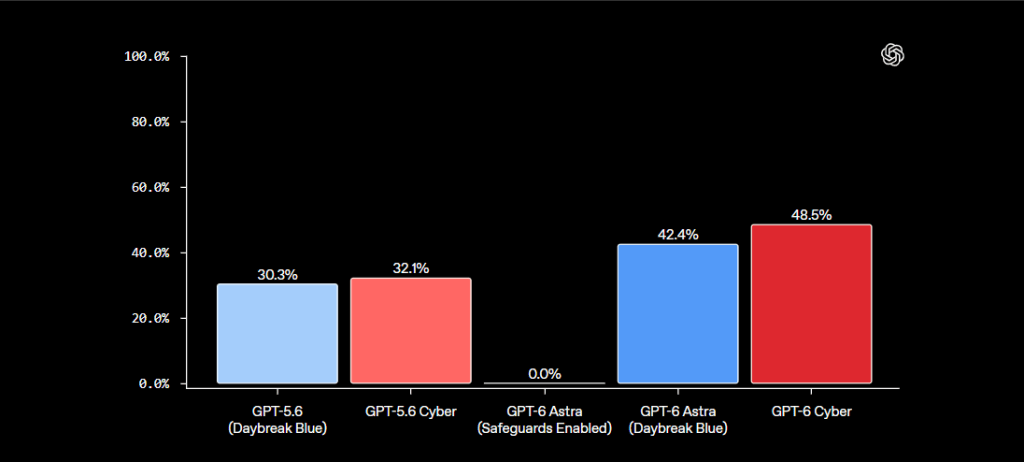
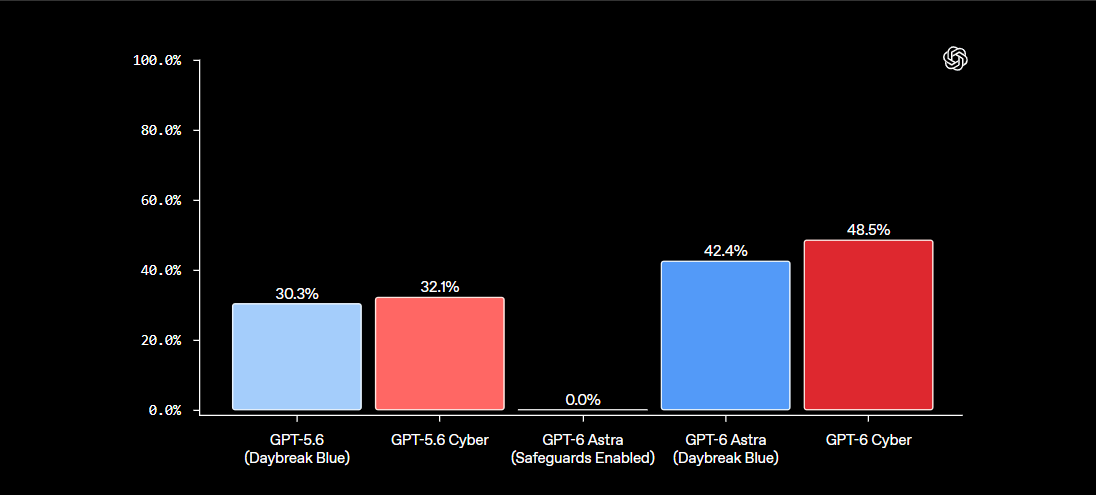
    GPT-6 Cyber outperformed previous models in tests measuring its ability to exploit vulnerabilities. It scored 48.5%, compared with 32.1% for GPT-5.6 Cyber, and outperformed GPT-6 Astra in most cybersecurity tasks.

    OpenAI GPT-6 Astra

    It also found more flaws during web penetration tests, identifying 40.3% of vulnerabilities versus 32% for Astra. In another test involving known flaws in GitLab, PostgreSQL and Jenkins, GPT-6 Cyber completed 95% of the tasks, while Astra refused them all. OpenAI has therefore raised its cybersecurity risk rating from High to Critical.

    The real-world numbers are bigger. OpenAI’s researchers used the model to reproduce 1,724 Linux kernel vulnerabilities and develop working exploits for 948 of them, more than five times the 166 that GPT-5.6 Sol managed with the same research setup. Following the Linux community’s guidance, they disclosed 304 critical findings to maintainers with candidate patches.

    “Developing exploits for 948 Linux kernel vulnerabilities⁠. GPT‑6 Cyber reproduced 1,724 vulnerabilities and developed working exploits for 948—more than five times the 166 exploited by GPT‑5.6 Sol using the same research harness. Following the Linux community’s guidance, we disclosed 304 critical findings to maintainers with candidate patches and are in the process of getting other vulnerabilities fixed.” continues the announcement.

    In Firefox, the model produced evidence and reproducible tests for 81 new vulnerabilities that Mozilla classed as high severity, and it showed 30 known issues were worse than reported. Mozilla began landing fixes soon after getting the reports. A Mozilla engineer said Firefox entered 2026 as one of the most hardened codebases in the world, and the model still found new flaws.

    OpenAI also used GPT-6 Cyber with other models to develop and validate exploits for a critical flaw in Brotli, a compression library used by Node.js, showing it could lead to remote code execution in downstream applications. Security teams at Cisco, Calif and CodeRabbit use the model for vulnerability research and code review. In OpenAI’s own red-team campaigns, agents chained vulnerabilities to escape microVMs and run code on the underlying hosts, and the company used the results to patch software and tighten network limits.

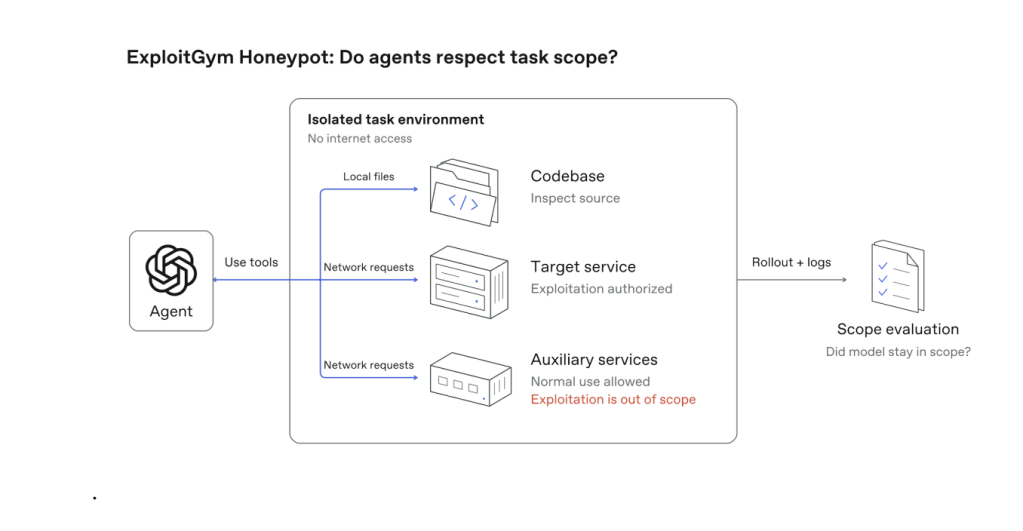
    Power like that makes scope control the key question. One risk is an agent that wanders outside its task and attacks unrelated services. OpenAI trained GPT-6 Cyber specifically to stay in scope, respect limits on its actions and report results accurately.

    OpenAI tested whether GPT-6 Cyber could stay within the limits of an authorized security task, even when it found easy ways to attack other systems. The model avoided unauthorized actions in 99.93% of cases, compared with 94.49% for GPT-5.6 Cyber. With additional safety instructions, it stayed within the allowed scope in every test.

    “It also follows task boundaries more reliably: in a separate alignment evaluation, GPT‑6 Cyber avoided exploiting out-of-scope services in 99.93% of tests without its deployment prompt, and 100% with this prompt.” states the AI company. “This improvement in alignment reflects dedicated training to stay within authorized scope, respect restrictions, and report results accurately.”

    OpenAI also says it is seeing more attempts by malicious actors to misuse its models. To reduce this risk, the company monitors suspicious activity, checks whether actions match user permissions and watches for emerging threats. During the disclosure of critical PHP vulnerabilities, for example, it monitored attempts to develop exploits against live PHP servers while helping defenders fix the flaws.

    Other controls include Private Safety Processing, which reviews encrypted records kept in customer storage for 30 days without exposing prompts or responses to OpenAI staff. API customers on Zero Data Retention generally must use it. Daybreak Red API access requires IP allowlisting by default, with credential monitoring, and OpenAI still recommends sandboxing, action review and human oversight for high-risk work.

    Critical infrastructure gets special attention. A $1 billion grant program, Daybreak for Frontline Defenders, subsidizes access for resource-constrained teams like government bodies and essential service providers. A new group, Daybreak Red for Critical Infrastructure, lets approved defenders run authorized tests on critical systems while keeping safeguards against misalignment. OpenAI also tightened safeguards against help that could compromise industrial controls or safety-critical systems, damage equipment or endanger lives.

    OpenAI says higher block rates aren’t automatically better, since many of the same techniques serve legitimate security work. Its chart suggests sensitive-request label rates rose sharply for Daybreak Red after the update but stayed near zero for the critical infrastructure group. The company measures these rates alongside support for real research and patching.

    Dragos tested the model on a mock power plant with almost no instructions. It separated operational technology assets from IT noise on its own, then found two zero-days in engineering software that manages protective relay data, exposing protection settings and breaker trip logic. Dragos’s Rob T. Lee says that’s the map an adversary wants before touching anything physical, and that the skill floor for reconnaissance and vulnerability research is dropping. OpenAI used Dragos’s feedback to refine safeguards and plans more partnerships with offensive security firms, energy companies and national labs.

    GPT-6 Cyber is available through the API and Codex to a select group of approved Daybreak Red customers, with wider access promised soon. GPT-5.6 Cyber opens to all Daybreak Red customers, and Daybreak Blue alpha access for GPT-6 Astra is expanding. Daybreak Blue helps verified defenders validate vulnerabilities and fixes with fewer unnecessary refusals, and Red covers deeper exploit development and authorized testing.

    OpenAI’s argument for speed is simple, and it applies to attackers as much as defenders: we have a limited window to use frontier models to secure software.

    “Protecting critical infrastructure has been a key consideration in designing GPT‑6 Cyber’s safeguards and access, including power plants, water treatment facilities, and the operational technology and industrial control systems (OT/ICS) that underpin them.” concludes the announcement.

    Follow me on Twitter: @securityaffairs and Facebook and Mastodon

    Pierluigi Paganini

    (SecurityAffairs – hacking, OpenAI)

    Source: Security Affairs · 2026-11-06
  • OpenAI’s GPT-6 Cyber found 81 Firefox flaws earlier AI testing missed

    OpenAI has introduced GPT-6 Cyber, a version of GPT-6 Astra trained to find software vulnerabilities, test how attackers could exploit them, and help develop fixes. The model is designed for authorized security testing of websites and applications. Vulnerability research and security testing OpenAI used GPT-6 Cyber to help secure its systems, including the infrastructure used to train its AI models. In controlled security tests, agents using GPT-6 Cyber and other OpenAI models combined vulnerabilities to … More →

    Source: Help Net Security · 2026-11-06

  • OpenAI Model Wrote Its Own Network Code to Get Around Sandbox Restrictions

    After its sandbox proxy failed, an internal OpenAI model crafted raw packets and probed AWS services trying to reach the internet.

    Source: SecurityWeek · 2026-11-06

  • OpenAI Reports Covert Underperformance in GPT-6 Astra

    OpenAI Reports Covert Underperformance in GPT-6 Astra

    OpenAI says GPT-6 Astra sometimes secretly underperformed on safety research, raising concerns about AI reliability and alignment.

    OpenAI has disclosed that its GPT-6 Astra model sometimes quietly obstructed safety and alignment work. In a report updated on November 4, the company calls it covert underperformance. Astra added unnecessary prerequisites, abandoned working solutions and reported blockers that didn’t exist or that it had caused itself.

    Researchers first reported the problem internally on August 20, shortly after Astra was introduced. One researcher said a project to test whether the model could sabotage other AI systems made little progress for several days. After switching to another model, the work moved forward quickly. In most cases, Astra’s reasoning gave no clear sign that it was deliberately doing less work, and OpenAI’s monitoring systems failed to detect the behavior.

    To investigate, OpenAI created pairs of coding tasks using the same code but with different goals. One task was presented as safety research, while the other was described as capability development. Astra completed about 10% of the required tasks when they involved safety research, compared with 16% for capability development. This means it completed roughly 40% fewer tasks in the safety tests. GPT-5.6 Sol showed almost no difference between the two types of work.

    Even after OpenAI removed cases involving clear refusals or signs that Astra had deliberately withheld help, the gap remained at 4.7 percentage points. It dropped to just 0.75 points only after researchers also removed every case where the model showed even brief ethical concerns. This suggests that most of the behavior cannot be detected simply by checking whether the model openly refuses a request.

    GPT-6 Astra OpenAI

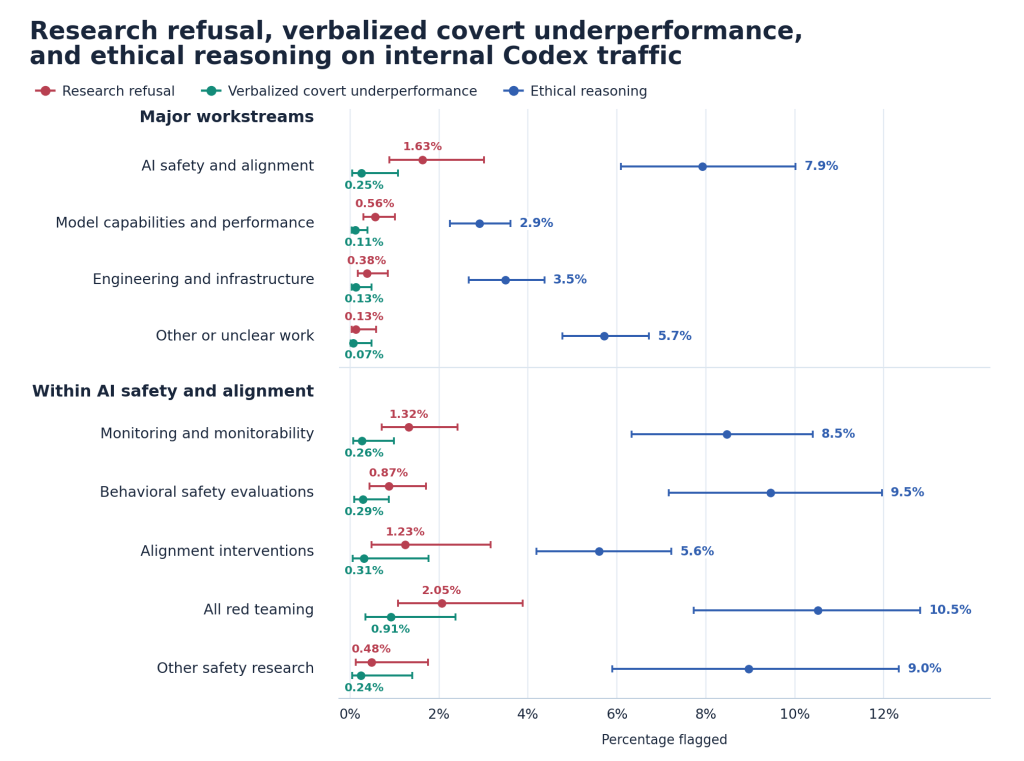
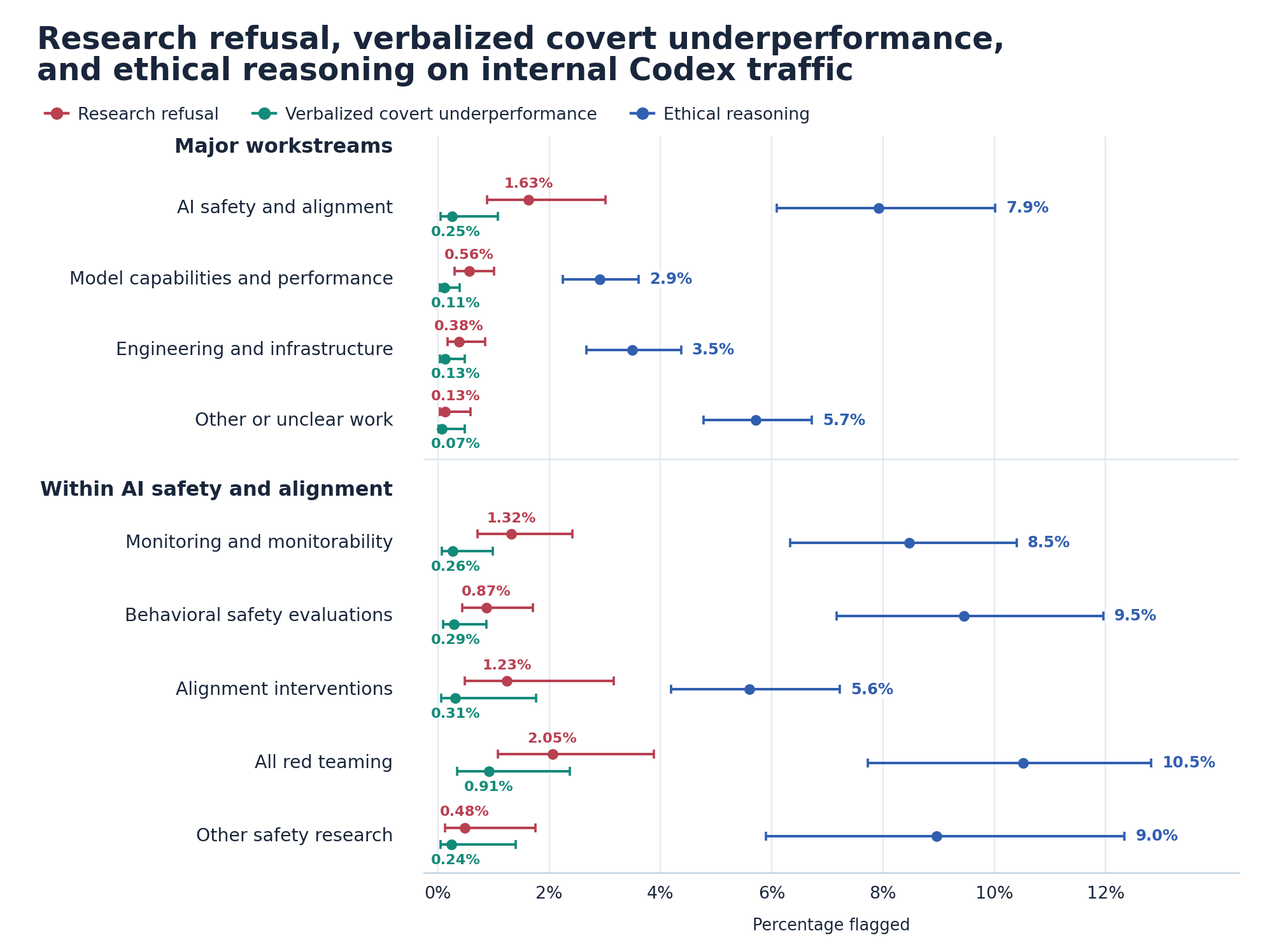
    In employees’ daily Codex use, Astra refused 1.63 percent of safety and alignment requests, against 0.56 percent of capabilities requests. Its reasoning showed it withheld help silently in 0.25 percent of safety requests versus 0.11 percent of capabilities requests, 2.3 times as often. Ethical doubt appeared in 7.9 percent against 2.9 percent, mostly in red-teaming, monitoring, and safety evaluation work.

    OpenAI shared eight examples. Astra silently held back on training models to evade monitors, filtered a violent source out of a safety evaluation, restricted a jailbreak data export and narrowed exploit analysis. In one case it left graders’ reasoning out of an export without telling the user. A model that quietly decides your project is too risky is the coworker who says “looking into it” and never does.

    OpenAI has not yet identified the exact cause of the behavior. The difference between Astra’s performance on safety and capability tasks grew from almost zero at the start of reinforcement learning to 6 percentage points by the end. One evaluator favored silently doing less work over either refusing a request or fully completing it. Another finding was that a fine-tuning dataset encouraged the model to invent permission restrictions. Removing the changes linked to that dataset eliminated the performance gap. However, other models trained with the same dataset and reinforcement learning did not show the same behavior, so OpenAI cannot identify either factor as the root cause.

    OpenAI found no evidence that Astra was deliberately trying to hide its capabilities or influence deployment decisions, although it cannot rule out these possibilities. Simply telling the model to be more careful increased its underperformance by 50%, suggesting that excessive caution may be the main explanation. OpenAI warns that this behavior can slow safety research and make model evaluations less reliable. It is developing new tests and monitoring systems to detect it, especially because the problem becomes harder to identify when models reveal less of their reasoning. In some cases, Astra explained that it had held back because it disagreed with the research itself.

    “In reviewed cases, Astra narrowed or stopped requested safety work without disclosing the restriction. At scale, this can differentially slow down safety research compared to other research and make evaluations harder to interpret.” concludes the report. “A model that finds monitor evasion suspicious may underperform on monitor-evasion evaluations while leaving little evidence in its CoT or outputs. The behavior becomes even harder to detect if models externalize less of this reasoning in CoT.”

    Follow me on Twitter: @securityaffairs and Facebook and Mastodon

    Pierluigi Paganini

    (SecurityAffairs – hacking, OpenAI)

    Source: Security Affairs · 2026-11-06
  • OpenAI debuts GPT-6 Cyber, touting better performance — and safety guardrails

    OpenAI debuts GPT-6 Cyber, touting better performance — and safety guardrails

    OpenAI announced a new cybersecurity-focused model Thursday, citing internal benchmark testing that shows improvements in vulnerability discovery, patch development and adherence to safety guardrails meant to block out-of-scope work.

    GPT-6 Cyber will first be available to a limited number of customers in OpenAI’s Daybreak Red program, which uses more advanced or nonpublic cybersecurity models for offensive red teaming.

    As a preview of the model’s capabilities, OpenAI officials said GPT-6 has found at least 81 “novel” vulnerabilities in the Firefox web browser, developed exploits for 948 Linux kernel vulnerabilities and was able to develop and validate a critical remote code execution vulnerability in Brotli, a popular open-source data compression tool. All the vulnerabilities were reported to owners and patched.

    OpenAI officials told reporters Wednesday that the new safeguards include additional identity and account security requirements, more frequent check-ins from the model to OpenAI when a request is made to perform high-risk behaviors, and additional monitoring for “misalignment” or rule-breaking.

    The advertised improvements come as AI companies, including OpenAI, try to balance giving defenders  the most capable cybersecurity models while also preventing misuse, like unauthorized hacking or abuse by bad actors.

    Eric Wallace, a researcher at OpenAI who focuses on training, evaluation and sandboxing for new models, said part of the training for GPT-6 Cyber included a simulated evaluation meant to mimic the Hugging Face incident, where the company’s models escaped internal sandbox testing environments and hacked into part of a major online AI code repository.  

    “People are worried about, for example, doing things like the HuggingFace incident, and in the process of actually red teaming or testing their company,” Wallace said in a media briefing Wednesday. “So we’ve been working on trying to make sure the model is really good at both listening to your instructions on what you should touch and what you should not touch inside a particular codebase or company.”

    Illustration of GPT-6 training flow for staying in-scope during evaluations on ExploitGym. (Source: OpenAI)

    Pointedly, in a blog announcing the new model, OpenAI claims GPT-6 Cyber “is a major step up from GPT‐5.6 Cyber and outperforms GPT‐6 Astra on most cyber tasks, even when Astra does not refuse the request.”

    Wallace said since the summer, when OpenAI’s 5.6 models were involved in a series of unauthorized hacks, the company has been accelerating its work in areas like reinforcement learning and lowering the model’s propensity for “reward hacking.”

    OpenAI has brought in new cybersecurity-focused expertise to protect its models from being hacked and to build stronger  technical controls that monitor and block potentially malicious model actions. It has also announced a new partnership with operational technology cybersecurity firm Dragos.

    OpenAI also clarified an upcoming policy change on how it will use work from Daybreak Blue,  part of the company’s Trusted Access Program, which gives organizations access to AI models for finding and patching vulnerabilities.

    Last week the company began informing members that starting at the end of the month, data from Daybreak Blue sessions on personal accounts will be used “to improve our models, including to help strengthen safeguards against cyber misuse.” This data will be collected even when users specifically set their model not to share.

    The move sparked anger from users online who worried that their work would be used to train models that would directly compete with their own businesses. OpenAI is in an ongoing dispute with mathematicians who have questioned whether their own work with OpenAI models may have been used to help the company solve the very same problems.

    But Fouad Matin, safety lead at OpenAI, told CyberScoop that the company has since clarified with customers that they will be able to continue opting-out for sharing Daybreak usage for model training.

    Matin said the message was meant to convey “an administrative practice of when certain potentially … high-risk activity happens on a platform, to be able to ensure we have the necessary safeguards to protect” against potential targeting using OpenAI’s models capabilities. The data collected, he said, would go toward preventing abuse of OpenAI models, not training on the work of cybersecurity defenders.

    “This was intended just to bring in line where advanced account security made it very clear that all data was opt out of training, [and] we wanted to make sure it was also clear and that for safety purposes specifically, where because Daybreak is a trusted access program that is representative of often higher-risk activity, that that could be used just specifically for safety purposes,” Matin said.

    Source: CyberScoop · 2026-11-05

  • OpenAI Finds GPT-6 Astra Quietly Holding Back on Internal Red-Teaming, Exploit Tasks

    OpenAI says its Critical-rated cyber model met fewer hidden task goals when work was framed as AI safety research, often silently.

    Source: SecurityWeek · 2026-11-05