The Pentagon treats August freezer failures at US military bases as a suspected hack and is working with French investigators after a supermarket attack.
The Pentagon is investigating freezer failures that spoiled food at US military bases in August as a suspected cyberattack, according to four officials who spoke to Reuters. One official said US investigators are also in contact with French authorities about a similar attack on commercial freezers that disrupted supermarkets in France earlier this month. This is the first time Reuters has reported that the US incident is being treated as a suspected cyberattack.
“The Pentagon is treating the spate of mysterious freezer malfunctions that spoiled food at military bases across the United States in August as a suspected hack, according to four officials familiar with the matter.” Reuters reports.
“One of the officials said the military investigators were in touch with their French counterparts about a similar cyberattack on commercial freezers that disrupted supermarkets there earlier this month.”
It is still unclear who is behind the attacks. Reuters could not determine how far the investigation has progressed or whether investigators have identified the cause or those responsible. The Pentagon said a unit of US Cyber Command is working closely with other government agencies and law enforcement. The Army’s Criminal Investigation Division confirmed that its Cyber Field Office is involved and is working with French law enforcement to investigate the freezer outages in Europe.
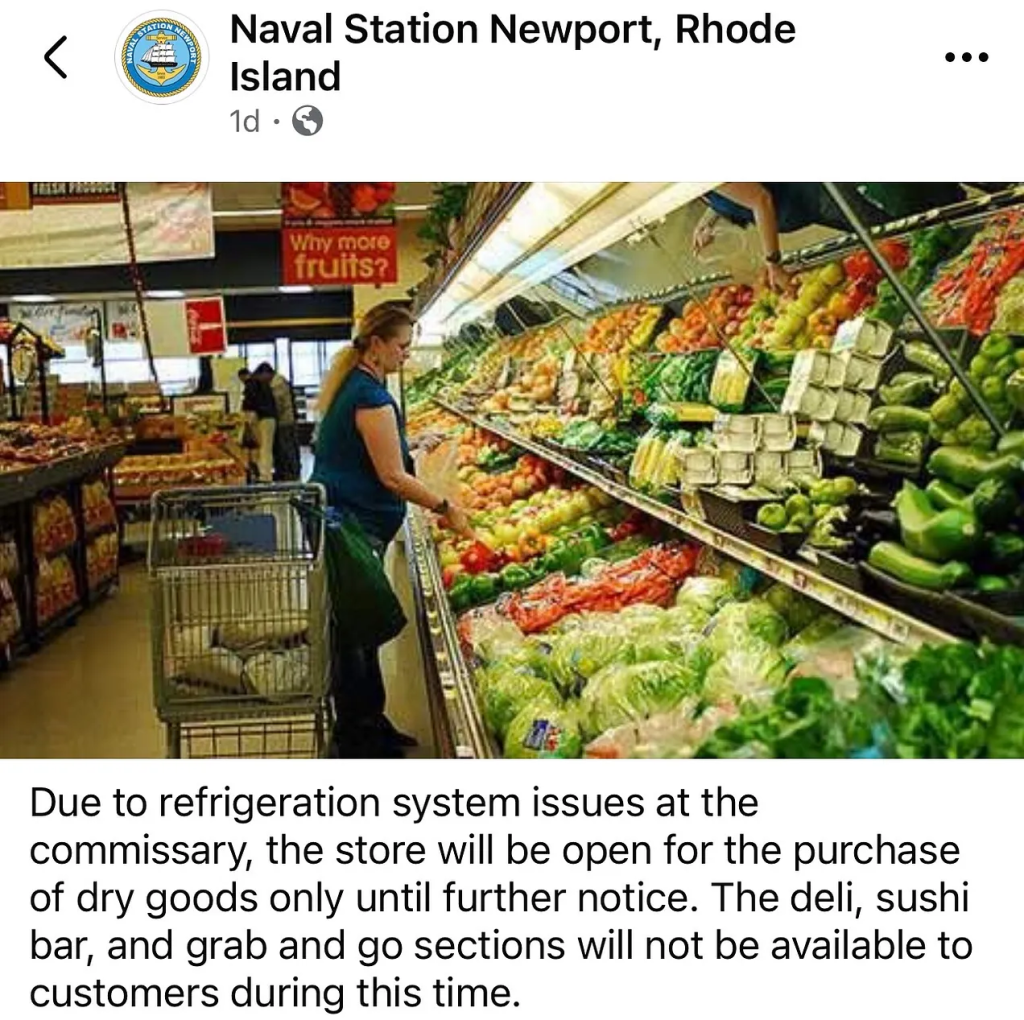
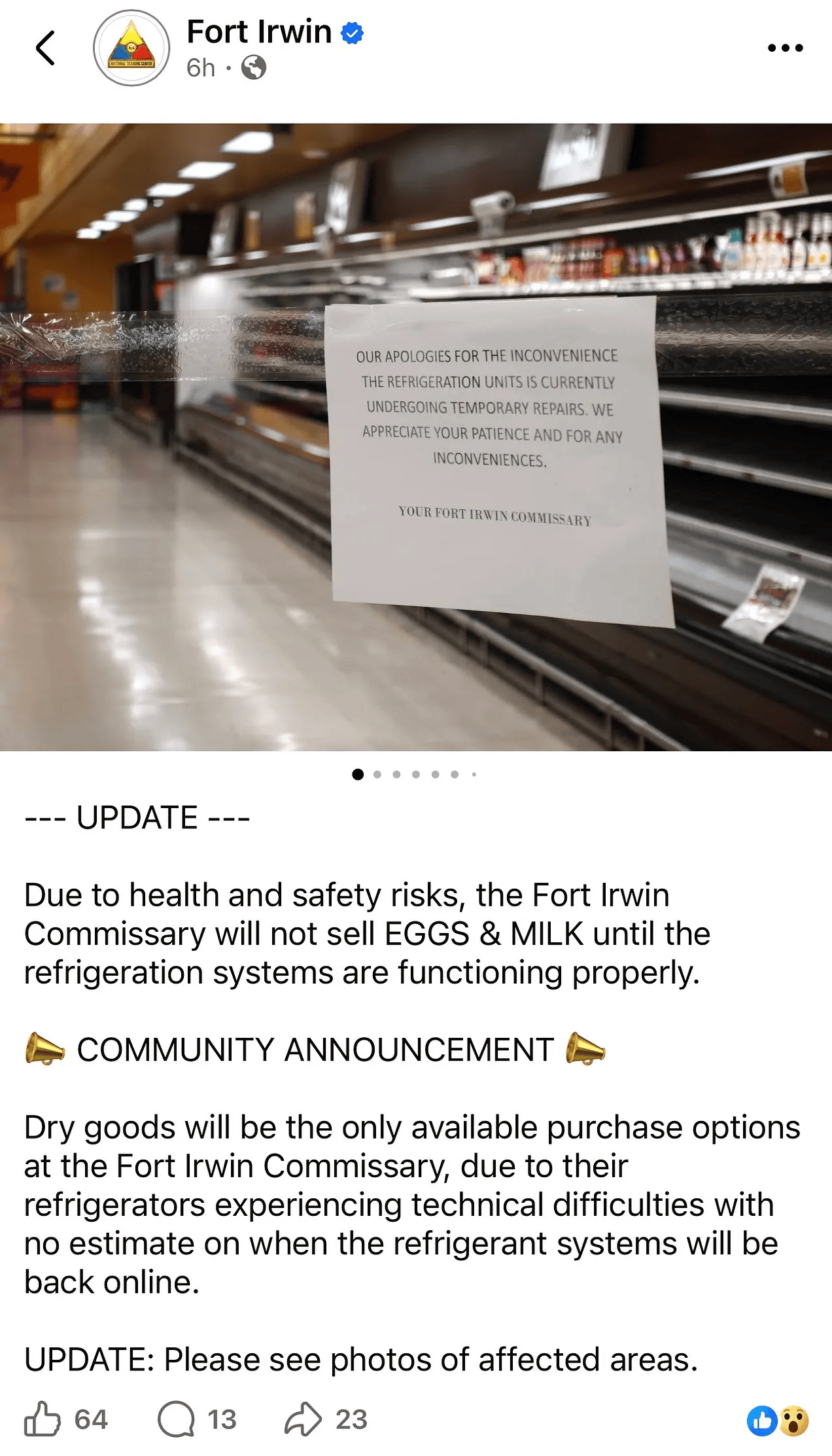
The incidents hit commissaries, the on-base stores where military personnel buy food. At least six were affected in late August, according to Reuters’ review of the bases’ Facebook posts and website updates. Stars and Stripes named Fort Irwin, F.E. Warren, Naval Station Newport, Columbus and Travis among the confirmed stores, and some outlets count up to 14 sites in 11 states, though not all are confirmed.
In at least one case the freezers didn’t just stop. Their temperatures were cranked up overnight, which left mounds of wilted or melted food in the morning. Fort Huachuca in Arizona said on August 26 that its freezer went into defrost mode and heated up all the food, adding that trust us when we say it was spoiled.
The Pentagon wasn’t the first to speak. A recently created blog called Signal and Silence reported the freezer failures and the possibility of sabotage on August 28, while Stars and Stripes reported the involvement of military investigators and Britain’s Daily Telegraph reported the contacts with the French. The French Embassy in Washington had no comment. Frozen food is the one asset where damage takes hours and evidence takes the form of puddles.
The French attack is the clearest example. Hackers took control of the cooling units in more than 350 stores and raised the temperatures. Frozen food aisles were emptied, and some units got so hot they caught fire. One supermarket owner said the total cost could reach tens of millions of euros.
The same thing happened in Arizona: attackers made the units hotter instead of just turning them off.
Reuters could not tell which brand was used at the US bases, and Danfoss, which is the manufacturer targeted in French supermarket attacks, did not reply. A public research report on Danfoss controllers came out before the incidents, but nothing shows a link to the bases.
There is a history of attacks on refrigeration systems. Danfoss reports that hackers targeted supermarkets in Russia and Israel in 2022 by exploiting outdated cooling controllers. In December 2025, US prosecutors accused a Ukrainian woman of belonging to a hacking group that disrupted refrigeration at a meat plant in 2024, ruining more than 2,000 pounds of meat.
Earlier this year, the Global Food Safety Initiative urged food safety experts and IT leaders to work together to protect refrigeration systems.
42 publicly listable cloud buckets containing 18 billion files, including exposed credentials, database dumps and backups.
The Ransomnews research team counted 484,142 publicly listable cloud storage buckets in October 2026, holding 18.05 billion files. They built the count from the search engines that index open cloud storage and published it as the Ransomnews Cloud Exposure Index, written by Mantas Sasnauskas.
“No file was opened for this index. Every number below comes from bucket names, file extensions, file counts and last-modified timestamps. That is a deliberate limit. It keeps the research on the right side of the line, and it turns out to be enough to see where the sensitive material concentrates.” Ransomnews states. “We are calling it the Ransomnews Cloud Exposure Index, and we will rerun it quarterly so the numbers can be compared over time.”
The researchers used bucket names, file types, file counts and last-modified dates to collect their data. They did not open any files, allowing them to identify where sensitive information might be stored without accessing the content. They plan to repeat the research every three months to track changes over time.
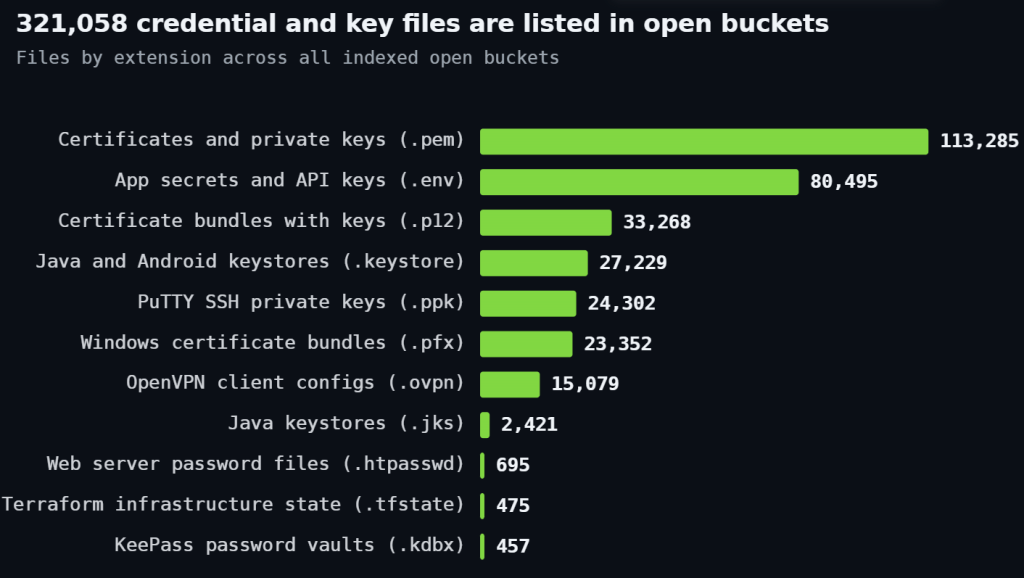
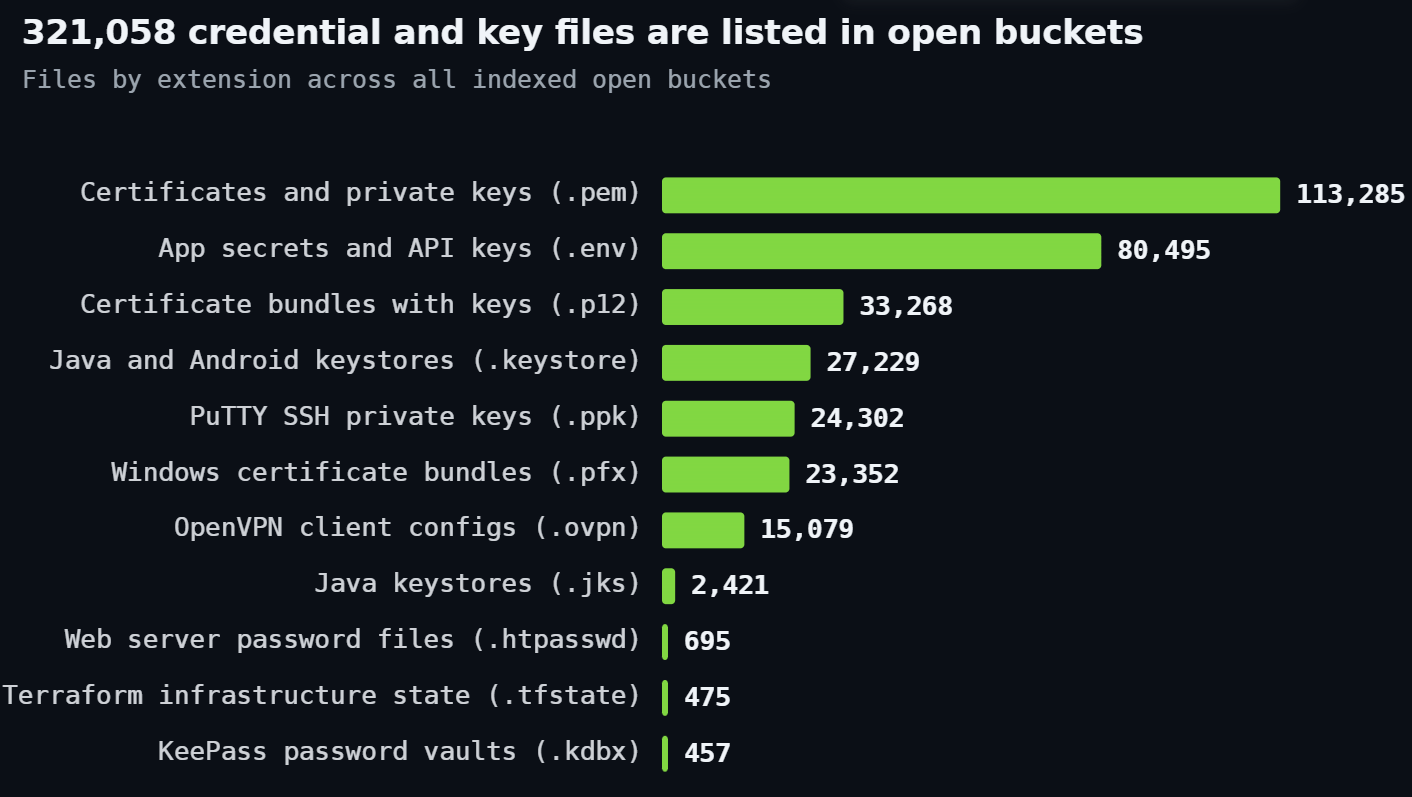
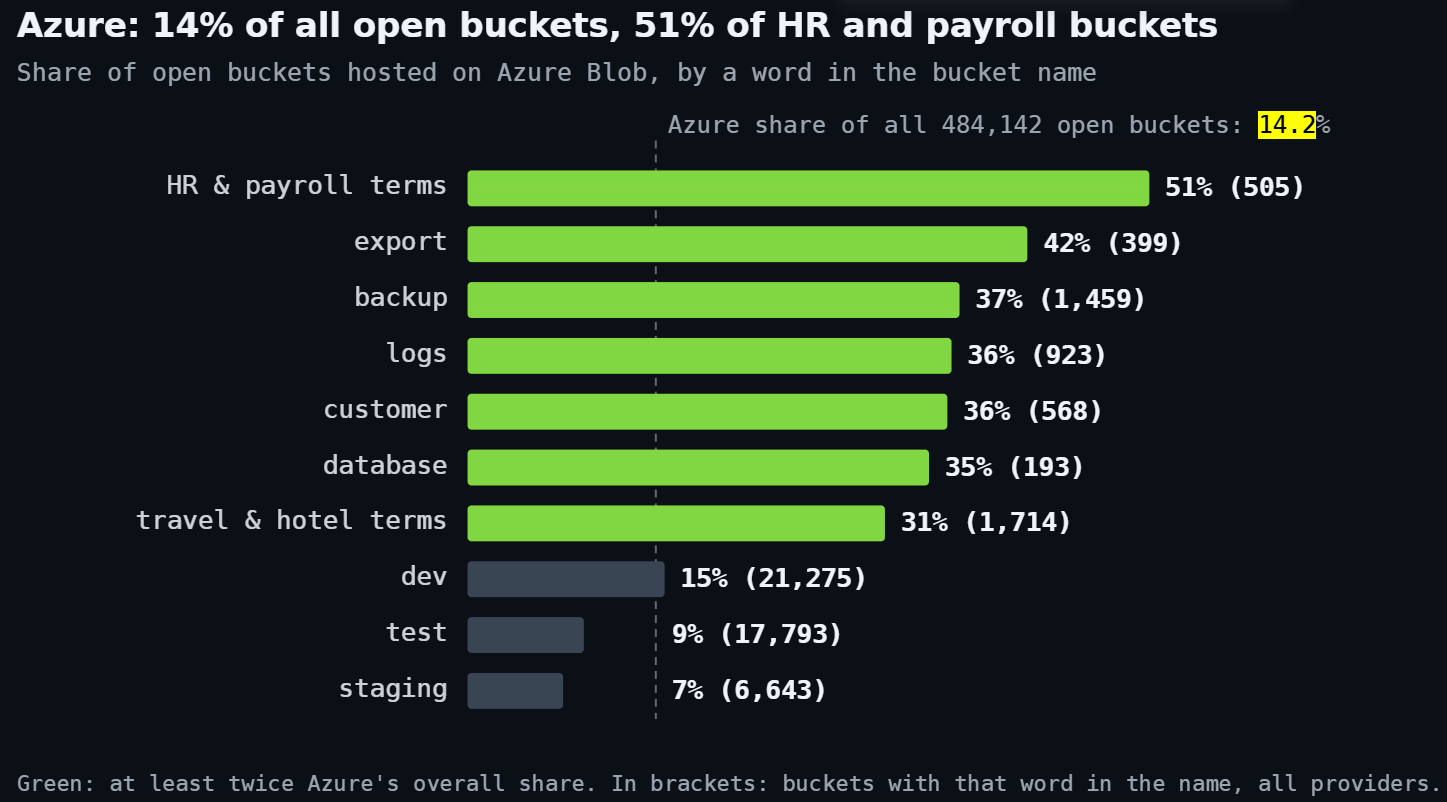
Amazon S3 accounts for 72% of the exposed buckets, roughly in line with its share of the market. This does not mean S3 has weaker security than other providers. Azure Blob, however, appears 2.5 to 3.6 times more often than expected among buckets named for backups, data exports and payroll records. The researchers also found 321,058 files related to credentials and keys. Of the exposed .env files, 67% were last modified in 2026.
Below is the split by provider, from a snapshot taken on October 7:
Provider
Open buckets
Share
Amazon S3
347,984
71.9%
Azure Blob
68,532
14.2%
Google Cloud Storage
53,131
11.0%
DigitalOcean Spaces
11,069
2.3%
Alibaba OSS
3,426
0.7%
Total
484,142
100%
A lot of these buckets are public on purpose, holding website assets, CDN mirrors, open datasets and podcast archives. So the index isn’t 484,142 breaches. It’s the pool where breaches hide, and the rest of the report narrows it down to the stores that should never have been listable.
“Azure, by a wide margin relative to its size. Azure Blob holds 14.2% of open buckets, but 37% of the 1,459 buckets with “backup” in the name, 42% of the 399 named for exports, and 51% of the 505 carrying HR or payroll terms.” continues the report. “Buckets named for logs, customers and databases sit at 35% to 36%, all around two and a half times Azure’s baseline.”
The skew only shows up for operational data. Buckets named “dev” sit at Azure’s baseline of 15 percent, and “test” and “staging” fall below it, at 9 and 7 percent. The authors suspect Azure storage accounts more often hold line-of-business data such as backups, exports and HR systems that enterprises run on Microsoft, while S3 and Google Cloud carry more application assets. They call it a hypothesis the counts suggest and don’t prove, and it’s the first thing they want to test next time.
By sector, retail and e-commerce names lead with 5,666 buckets, mostly storefront assets. The more worrying number is that names tied to regulated sectors (finance, healthcare, education, government, legal and HR) appear on 10,891 unique open buckets. Those are the places where a stray file most likely holds personal, health or financial records, and where regulators expect to hear about it.
Sector (by bucket name)
Open buckets
Files in them
Retail and e-commerce
5,666
269.9M
Finance and insurance
3,508
58.0M
Healthcare
2,709
47.9M
Media and entertainment
2,696
136.2M
Education
2,393
60.6M
Gaming
2,296
79.0M
Travel and hospitality
1,714
118.7M
Real estate
1,137
60.7M
Government and public sector
1,000
36.2M
Legal
978
11.3M
Crypto
630
11.9M
HR and payroll
505
8.4M
Healthcare-related names appear in 2,709 buckets containing 47.9 million files. The researchers identified them using terms such as “hospital” (135 buckets), “patient” (135), “clinic” (277) and “dental” (331). HR and payroll is the smallest sector, with 505 buckets, 259 of which are hosted on Azure.
These figures are based on names, not proof of ownership. The search matches parts of words, so “store” can refer to object storage as well as shops. A single bucket can also appear in two sectors.
The exposed buckets also list about 4.7 million database and dump files, 15,130 mailbox archives, and tens of millions of spreadsheets and documents. Credential files are particularly concerning because they can turn a cloud misconfiguration into a real intrusion.
File type
What it is
Files listed
.pem
Certificates and private keys
113,285
.env
App secrets and API keys
80,495
.p12
Certificate bundles with keys
33,268
.keystore
Java and Android keystores
27,229
.ppk
PuTTY SSH private keys
24,302
.pfx
Windows certificate bundles
23,352
.ovpn
OpenVPN client configs
15,079
.jks
Java keystores
2,421
.htpasswd
Web server password files
695
.tfstate
Terraform infrastructure state
475
.kdbx
KeePass password vaults
457
Each of these exists to grant access. A .env file is where developers keep database passwords and API keys. A .tfstate file is Terraform’s record of a whole cloud setup, often with secrets in plain text, and a .kdbx vault is encrypted but now open to anyone who wants to guess passwords offline. Some .pem files are public certificates and some files are test fixtures, so the counts are a ceiling on live secrets and not a measure of them. It’s still a big ceiling.
Database files make up most of the sensitive material by volume:
File type
What it usually holds
Files listed
.sqlite
Embedded app databases
2,561,807
.bak
Database and server backups
752,055
.sql
Database dumps
687,446
.sqlite3
Embedded app databases
488,176
.dump
Database dumps
176,603
.mdb / .accdb
Microsoft Access databases
36,467
.dmp
Memory and crash dumps
12,809
.pst / .ost / .mbox
Mailbox archives
15,130
.eml
Saved emails
4,549,665
.csv
Data exports and records
at least 69,580,112
.xlsx / .xls
Spreadsheets
42,544,997
.docx
Word documents
24,936,788
.pdf
Documents, invoices, scans
at least 106,191,393
.log
Application and server logs
at least 61,310,809
The exposed buckets contain thousands of virtual disk images, including VMware, Hyper-V and QEMU files. A single disk image can contain an entire server, including credentials.
Some exposures involve active systems. Of 80,495 .env files, 67% were last modified in 2026. Certificates and SQLite databases include both recent and older files. Backups appear older, with 89% of the 752,055 .bak files last modified before 2025. Almost all PuTTY key files date from 2024.
Recent leaks need urgent attention, while long-standing exposures point to poor security management. The problem is ongoing: at least 113.6 million files were added to publicly listable buckets in the seven days before September 9. Over the previous 30 days, these included more than 21,000 SQL dumps, nearly 21,000 backup files, 4,477 .pem files and 1,298 .env files.
Public .env files can expose database passwords that ransomware affiliates and initial access brokers look for. Similar credentials appear in stolen-data logs, but in this case, attackers do not need to infect a device. They only need to search for exposed files.
Cloud providers already offer settings to prevent public access. Organizations should enable S3 Block Public Access, disable anonymous access to Azure Blob storage, and enable public access prevention in Google Cloud. These controls should apply at account or organization level to prevent new storage buckets from becoming public.
Organizations should also scan their storage for sensitive files such as .env, .sql, .bak, .pem, .ppk, .tfstate and .kdbx. Terraform state files and virtual disk images should be treated as secrets, stored privately, encrypted and monitored. Backups should never be publicly accessible, and recovery procedures must be tested.
One exposed bucket may be a mistake, but many often indicate a wider process failure. Organizations need to fix the underlying security controls, not just individual buckets.
The research has some limitations. The team queried search engines on October 25, while the bucket list was current to October 7 and the newest indexed file dated September 9. File-level data may therefore be about a month old. Counts are also capped at one million per query, so researchers split larger categories into date ranges and added the results.
Some limits apply. The team queried the search engines on October 25. The bucket list was current to October 7 and the newest indexed file was dated September 9, so file-level figures lag by about a month. The index caps any single count at one million, so larger types were split into date windows and summed.
A last-modified date shows when a file was written, not when it was exposed, and a listed file isn’t proof that its contents can be read. No bucket is named in the report. Exposures with a known owner in regulated sectors are going through responsible disclosure, with national CERTs copied where the owner is public sector or doesn’t respond.
“Rotate any secret that has ever sat in a public bucket. Closing the bucket does not un-leak the key. Assume anything that was listable was copied.” conlcudes the report.
U.S. Cybersecurity and Infrastructure Security Agency (CISA) adds Linux Kernel and Broadcom VMWare ESX flaws to its Known Exploited Vulnerabilities catalog.
CVE-2026-46300 (CVSS score of 2.7) Linux Kernel Missing Initialization of a Variable Vulnerability
In July, Broadcom released patches to address five vulnerabilities affecting VMware ESXi, vCenter, Workstation, and Fusion, including CVE-2026-41709. The vulnerability in VMware ESX is caused by insufficient logging. A malicious user with administrator privileges could perform certain operations on the affected system without those actions being recorded in the logs.
This could allow an attacker to hide specific activities and make it harder for security teams to detect suspicious behavior, investigate incidents, and determine what happened. The flaw does not itself grant administrator privileges; the attacker must already have them.
According to CrowdStrike’s 2026 Legal Threat Landscape Report, which said the China-linked threat actor Warp Panda (aka Armory Castle, UNC5221, Clay Typhoon and VerdantBamboo) exploited CVE-2026-41709 as a zero-day in early 2026 to reduce the visibility of its activities in audit logs.
Warp Panda targets internet-facing edge devices by exploiting zero-day vulnerabilities and deploying custom malware to maintain persistent, covert access. The group also attempts to evade detection by bypassing audit logging, stealing cloud session tokens and registering unauthorized multi-factor authentication (MFA) devices.
The second flaw added to the catalog is CVE-2026-46300, also known as Fragnesia, could let local attackers gain root access through page cache corruption.
The flaw affects the XFRM ESP-in-TCP subsystem and could allow local attackers to gain full root access by corrupting the kernel page cache.
Security experts warn that the issue is dangerous because attackers with low privileges can modify read-only files in memory and take complete control of vulnerable systems. The vulnerability was discovered by William Bowling of the V12 security team, while Wiz published a detailed technical analysis.
“The vulnerability allows unprivileged local attackers to modify read-only file contents in the kernel page cache.” reads the report published by Wiz. “Attackers can then achieve root privileges through deterministic page-cache corruption.”
Fragnesia shares similarities with earlier Linux privilege escalation flaws, such as Dirty Frag and Copy Fail. According to researchers, the bug can reliably provide root access on major Linux distributions without requiring race conditions or complicated timing attacks.
Volt Typhoon used disposable relay chains to hide zero-day attacks on critical systems. Lumen linked Silent Train to at least four zero-days.
Lumen’s Black Lotus Labs has spent three years tracking a covert network it calls Silent Train, which it ties to Volt Typhoon, the China-linked APT group. The cybersecurity firm says the network hid exploitation of software flaws the vendors didn’t know about yet. Black Lotus sent hundreds of victim notifications along the way, and the investigations that followed revealed the exploitation of at least four confirmed zero-days and one likely.
“Volt Typhoon’s Silent Train is a covert network designed to gain and maintain access to the technologies businesses rely on to manage devices, networks and critical operations.” reads the report published by Lumen. “Black Lotus Labs® tracked how the group used rapidly changing chains of compromised infrastructure to conceal its activity while exploiting previously unknown vulnerabilities in centralized management platforms.”
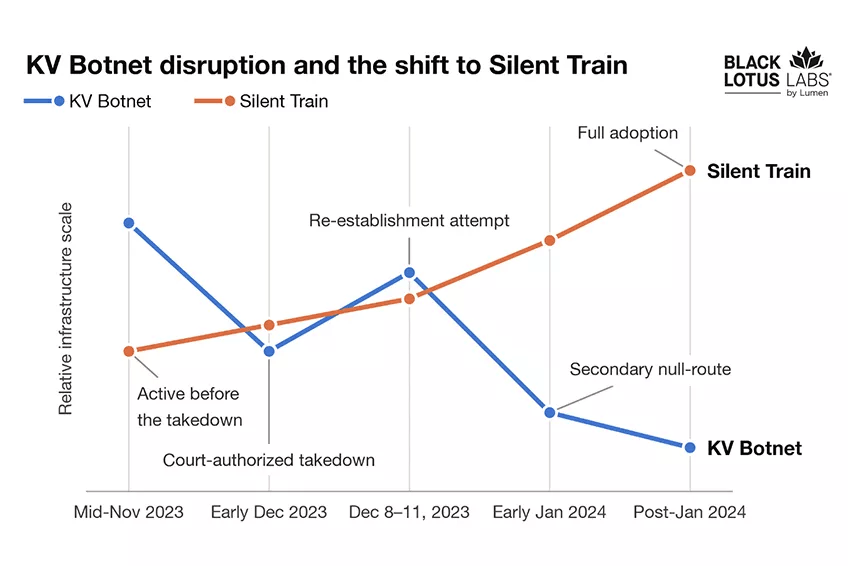
Silent Train first showed up in November 2023, shortly before the first takedown of the KV-botnet, Volt Typhoon’s earlier network of hijacked routers. Activity rose after the second disruption. The group dropped persistent infrastructure and moved to disposable chains of compromised devices that it could rebuild whenever it wanted.
Each session began on a rented server outside the United States. It then passed through another server and compromised small-office routers, home devices and IoT equipment in other countries. Finally, the traffic passed through a compromised device in the U.S., close to the target. This helped the attackers make their activity look like normal local traffic and bypass location-based blocks and IP reputation filters. On average, the chains passed through about four devices before reaching a U.S. IP address. Some used as many as six.
Lumen identified more than 27 types of devices used in the network, including TP-Link routers and Fortinet appliances. Some of these devices had no known vulnerabilities, suggesting that Volt Typhoon may have used previously unknown exploits to compromise them and create relay points.
“We observed more than 27 device classes exploited and used in Silent Train operations, ranging from SOHO and IoT devices like TP-Link routers and Netgear Orbi devices to enterprise platforms like Fortinet appliances and CyberPanel servers.” the report continues. “Some relay device types lack known vulnerabilities, suggesting Volt Typhoon leveraged undisclosed zero-day exploits to set up a single relay in a four-to-six hop chain and indicating a willingness to commit significant resources to protecting future access capabilities.”
The attackers exploited exposed web interfaces and installed only the tools needed to connect the devices through SSH. These included temporary SSH services, keys, configuration files and tools already available on the systems. At the end of each session, they removed all traces of their activity and dismantled the relay chain. Sessions lasted about four hours on average, although some lasted only minutes. The attackers could also build a new chain in less than two minutes, suggesting that they had partly automated the process.
The group worked with strict discipline. New device types arrived about one per quarter, and about one per month during the 2023 and 2024 build-out, always tested outside the U.S. first. Roles never changed: Intelbras modems served only as overseas relays, Netgear Orbi devices only as the U.S. hops facing victims, and the server providers stayed separated by layer too.
By early 2025, enterprise platforms like Fortinet, Cisco, PRTG, Mirth Connect and CyberPanel joined as final hops. They stayed up one to three months and supported several intrusions. The group also added reverse tunnels using the open-source proxies Chisel and FRP, and the old and new methods ran in parallel.
Volt Typhoon used Silent Train only during key stages of its attacks, including exploiting vulnerabilities, stealing credentials and data, and maintaining access to compromised systems. Each session targeted between one and five victims, often just one organization. The activity was carried out by human operators, mainly from Monday to Friday, between 9 a.m. and 10 p.m. China Standard Time. The group also paused operations for several weeks around Chinese New Year.
The group targeted tools used to manage endpoints and networks, as well as SD-WAN systems and other control platforms. These systems can manage hundreds or thousands of devices, allowing attackers to reach many systems without moving through the network in the usual way. This approach also helped them leave fewer traces. After the attacks, investigators found webshells running in memory, stolen credentials, misuse of built-in features such as remote file transfers, and deleted logs.
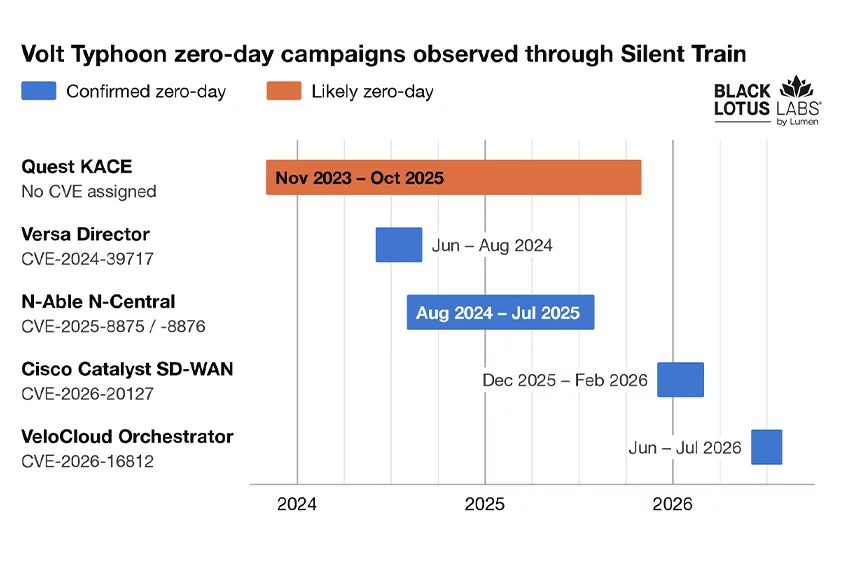
The four confirmed zero-day campaigns hit Versa Director in 2024, N-able N-central through CVE-2025-8875 and CVE-2025-8876, Cisco Catalyst SD-WAN through CVE-2026-20127, and VeloCloud Orchestrator through CVE-2026-16812. The Cisco bug is a CVSS 10.0 flaw, and the group kept exploiting it well after Cisco disclosed it in February 2026. In the Versa case, the group used an in-memory JAR webshell to limit forensic evidence and reach downstream customers.
The likely fifth is Quest KACE. The campaign hit more than 30 victims and faded after Quest’s October 2025 security updates.
“The campaign affected more than 30 victims, followed vendor remediation timelines and declined after Quest’s October 2025 security updates.” the report states. “Despite limited forensic evidence, the available data supports a moderate-confidence assessment that Volt Typhoon exploited a zero-day vulnerability.”
The actor stayed on the KACE server and used its admin features to take credentials.
Victims include telecoms, government agencies, defense contractors, satellite and emergency communications, universities with ROTC programs, managed service and IT firms, and critical infrastructure such as water, energy, transportation, maritime, rail and aviation. What they share is access to bigger networks or customers. Hawaii, California and Texas were the top locations for several years. Lumen can’t say why, but the pattern fits pre-positioning for a crisis in the Indo-Pacific.
“For enterprise leaders, the lesson is clear: systems with broad administrative reach can become high-value gateways to the entire organization and its customers. Reducing internet exposure, accelerating patching, strengthening access controls and preserving security telemetry are essential to detecting threats earlier and limiting their impact.” Lumen concludes.