The attackers used offensive agentic techniques to access the company’s systems and internal tools.
Source: SecurityWeek · 2026-11-02
The attackers used offensive agentic techniques to access the company’s systems and internal tools.
Source: SecurityWeek · 2026-11-02
North Korea was behind the theft of more than $6 billion in cryptocurrency from Binance, the FBI has confirmed. “The Federal Bureau of Investigation (FBI) is releasing information advising the Democratic People’s Republic of Korea (North Korea) was responsible for the theft of more than $6 billion USD in virtual assets from cryptocurrency exchange Binance, on or about October 29, 2026,” the bureau said in an alert published on October 31. The FBI tied the … More
Source: Help Net Security · 2026-11-02
Blockchain analytics firm Chainalysis says it was the target of a cybersecurity incident. A threat actor accessed its systems and internal tools and stole some non-sensitive customer data.
“This month, Chainalysis detected an external actor using offensive agentic techniques to gain unauthorized access to Chainalysis systems and internal tools.” reads the statement published by the company, which also includes the full email sent to affected customers.
Chainalysis says it discovered the attacker this month and described the methods used as offensive techniques involving AI agents. However, it did not explain how the attack was carried out. The company also warned that AI-powered attacks are becoming more common across the industry and said it is taking a company-wide approach to dealing with this growing threat.
The data the attacker reached matters most. According to Chainalysis, attackers gained access to user IDs, full names, email addresses and organization role labels for users on the platform. The company is still working out which records belong to which customer and promises a detailed breakdown when it finishes.
What the attacker didn’t reach is just as important. So far, Chainalysis has found no sign of access to investigation content such as graphs, notes or cases, or to transaction and query results. It also found no clear-text passwords, MFA secrets or user session tokens in the attacker’s hands.
“Based on the evidence available to date, we have found no indication that these incidents resulted in the unauthorized access of investigation content (such as graphs, notes, or cases), transaction or query results, passwords in clear text, MFA secrets, or user session tokens.” continues the press release.
Some non-sensitive customer data, such as user IDs, full names, email addresses, and organization role labels for users provisioned on our platform were accessed, including such information relating to your organization and users. We are in the process of determining the records for your organization that were accessed and will provide a detailed breakdown as soon as that analysis is complete.“
The company says it’s patching vulnerabilities and hardening its systems around the clock. It has hired outside cybersecurity experts and is using large language models to support a wider review that goes beyond the flaws the attacker used. It has already told all its customers and will keep them updated.
Chainalysis advises customers to watch out for unexpected password reset requests or login approval prompts. The company also strongly recommends enabling two-factor authentication (2FA) for all organizations that have not already done so. Since the exposed data includes names and email addresses, attackers could use it to launch phishing campaigns.
The company also clarified that the security incident has nothing to do with the recent theft of more than $6 billion from Binance.
Follow me on Twitter: @securityaffairs and Facebook and Mastodon
(SecurityAffairs – hacking, Chainalysis)
Source: Security Affairs · 2026-11-02
About $6.3 billion in cryptocurrency was stolen from Binance in what might be the biggest crypto hack in history. “Binance’s initial investigation suggests that the security incident may involve a compromised DevOps engineer’s laptop, which allowed an attacker to gain access to a service container and submit unauthorized withdrawal transactions,” the exchange said in a security update published early on October 30. The company found no evidence of a wallet private key leak and plans … More
Source: Help Net Security · 2026-10-30
The United Kingdom has issued economic sanctions against Cryptomus, a chameleonic cryptocurrency platform that experts say serves as a major conduit for payments related to ransomware, narcotics, darknet markets, fraud and cybercrime services that are helping Russia circumvent existing financial restrictions.
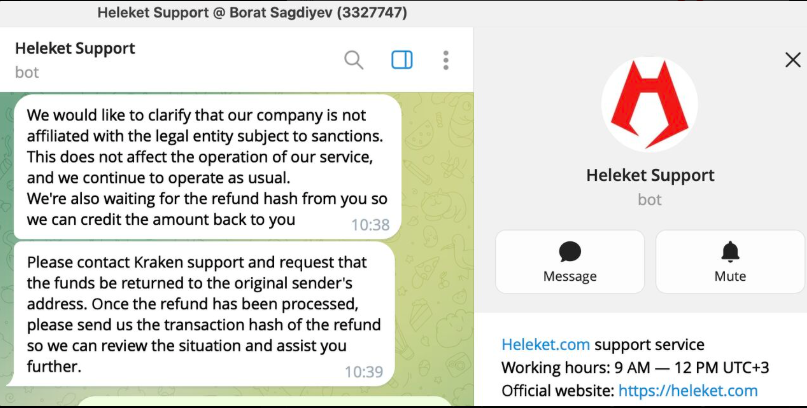
Heleket’s support agent on Telegram claims, despite all evidence to the contrary, that it is not affiliated with Cryptomus. Image: Richard Sanders.
On October 8, the U.K. issued sanctions (PDF) against Cryptomus — previously known as Certa Payments and Xeltox Enterprises — for processing payments that benefit the Russian government and its financial institutions. The sanctions freeze any Cryptomus assets at U.K. banks, and bar British companies from offering it any business, virtual or otherwise. Also targeted in these sanctions were the virtual payment platforms VexPay, TokenSpot, and the Tsunami Payments service.
As explained in our December 2024 investigation, “How Cryptocurrency Turns to Cash in Russian Banks,” Cryptomus has been a key payment processor for dozens of Russian cryptocurrency exchanges and websites hawking cybercrime services. The company has changed its name several times since emerging in 2022, most recently to “Heleket” last year after Canada levied a record CAD $176 million fine against the platform for anti-money laundering violations.
The blockchain data-crunching firm Chainalysis said the U.K. sanctions target the broader infrastructure supporting Russia’s wartime economy.
“Cryptomus and Heleket have emerged as major payment hubs for illicit activity,” Chainalysis wrote in an October 8 blog post. “Together, these services received more illicit funds across tracked categories than the mixers in our dataset and the number of illicit counterparties surged to more than 900 in a single month in late 2025.”

The Cryptomus support bot on Telegram, responding on Oct. 8 to an inquiry by saying the platform was suddenly unable to process transactions.
In April 2026, the blockchain analysis firm TRM Labs found Cryptomus had processed more than $7 billion in transactions since its inception in 2022, including transactions associated with child sexual abuse material vendors, terrorist financing networks, and human trafficking operations.
TRM noted that Cryptomus’s transaction volume cratered after the platform instituted new “know your customer” or KYC rules, and that the cryptocurrency platform responded to the Canadian fines by launching Heleket as a parallel service that continued to offer no-KYC payment processing.
Richard Sanders is a blockchain analyst and investigator who spent months mapping out Cryptomus’s payment infrastructure and transacting with its customers. Sanders said the U.K. sanctions on Cryptomus are important because Canada’s fine against the platform was ultimately unenforceable and uncollectible.
“A fine doesn’t stop a cryptocurrency payment processor from processing payments,” Sanders wrote on LinkedIn. “Sanctions kill the operation. The distinction matters.”
As our 2024 investigation noted, Cryptomus shared a Vancouver address with dozens of other foreign currency dealers and money transfer businesses — none of which appeared to be physically located there. Following the CAD $176 million fine for alleged money laundering violations, Cryptomus appealed the penalty, launched Heleket as a parallel service, and kept on processing large volumes of sketchy transactions, Sanders said.
Sanders said the sanctions also are notable because they are the first known instance of a “Five Eyes” country (referring to the Australia, Canada, New Zealand, the U.K. and the U.S.) sanctioning a cryptocurrency operation incorporated in another Five Eyes jurisdiction.
Where do entities like Cryptomus and Heleket derive their authority to offer international financial services? The answer appears to involve fake financial institutions overseen by a phony regulatory body positioned in a country that is not widely recognized as a sovereign nation.
Our 2024 investigation found the sole shareholder of Cryptomus’s parent company Certa Payments was a 25-year-old Ukrainian woman who also headed several other firms, including the WS Management and Advisory Corporation, which bills itself as the regulatory body that exclusively oversees licenses for cryptocurrency, foreign exchange and online gaming businesses incorporated in the disputed region in northwest Africa known as the Western Sahara.
That entity’s website — crasadr.com — says it assists applicants with bank setup and formation, online gaming licenses, and the creation and licensing of foreign exchange brokers. One of Certa Payments’ former sites — certa[.]website — also shared a server with 12 other domains, including rasd-state[.]ws, a website for the Central Reserve Authority of the Western Sahara.
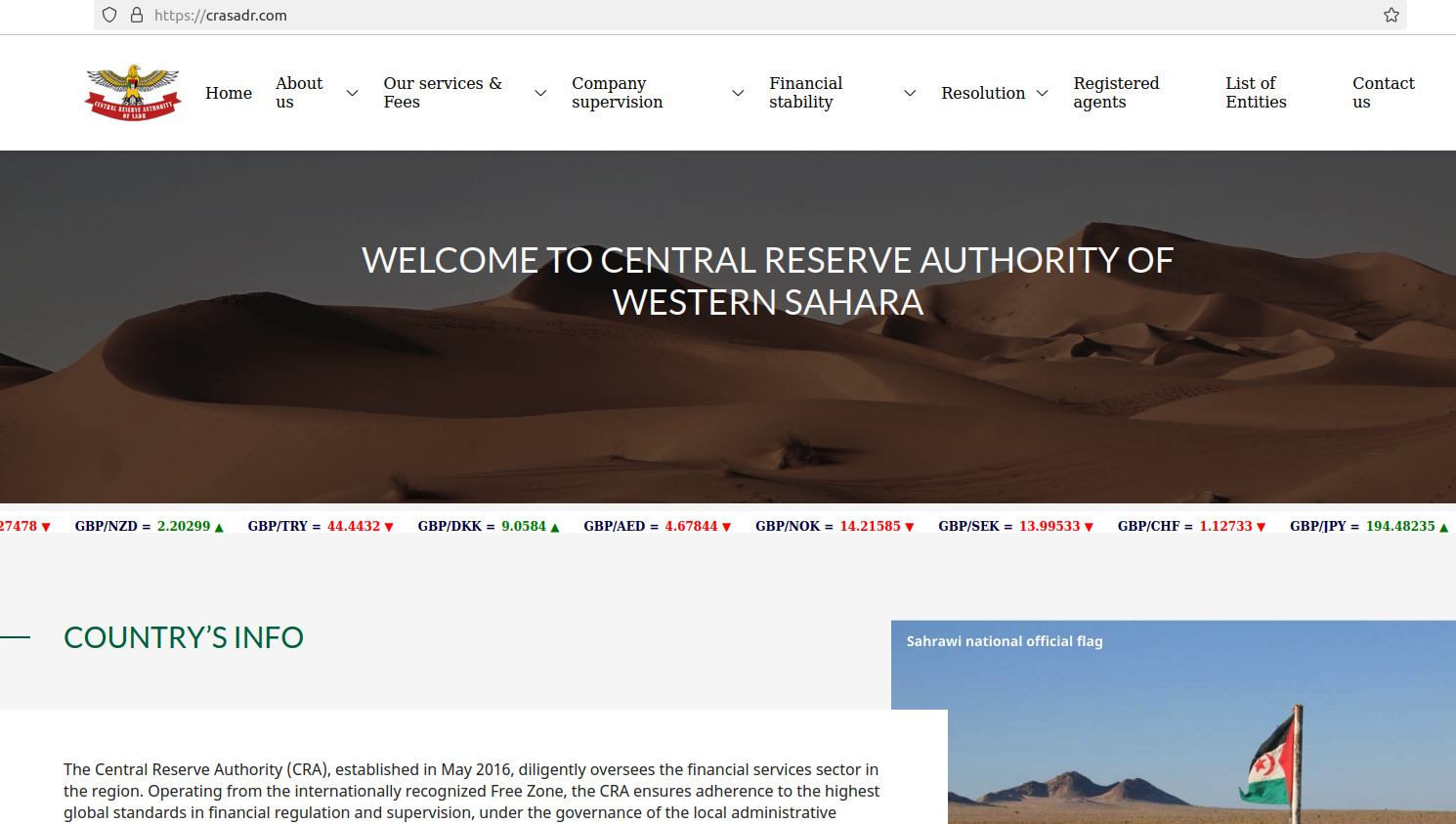
The website crasadr dot com, the official website of the Central Reserve Authority of Western Sahara, which lists the entities awarded licenses for cryptocurrencies, gaming and foreign exchange services.
Source: Krebs on Security · 2026-10-14