Tag: Breaking News

  • U.S. CISA adds Linux Kernel and Broadcom VMWare ESX  flaws to its Known Exploited Vulnerabilities catalog

    U.S. Cybersecurity and Infrastructure Security Agency (CISA) adds Linux Kernel and Broadcom VMWare ESX flaws to its Known Exploited Vulnerabilities catalog.

    The U.S. Cybersecurity and Infrastructure Security Agency (CISA) added Linux Kernel and Broadcom VMWare ESX vulnerabilities to its Known Exploited Vulnerabilities (KEV) catalog:

    Below are the flaws added to the catalog:

    • CVE-2026-41709 (CVSS score of 7.6) Broadcom VMWare ESX Insufficient Logging Vulnerability
    • CVE-2026-46300 (CVSS score of 2.7) Linux Kernel Missing Initialization of a Variable Vulnerability

    In July, Broadcom released patches to address five vulnerabilities affecting VMware ESXi, vCenter, Workstation, and Fusion, including CVE-2026-41709. The vulnerability in VMware ESX is caused by insufficient logging. A malicious user with administrator privileges could perform certain operations on the affected system without those actions being recorded in the logs.

    This could allow an attacker to hide specific activities and make it harder for security teams to detect suspicious behavior, investigate incidents, and determine what happened. The flaw does not itself grant administrator privileges; the attacker must already have them.

    According to CrowdStrike’s 2026 Legal Threat Landscape Report, which said the China-linked threat actor Warp Panda (aka Armory Castle, UNC5221, Clay Typhoon and VerdantBamboo) exploited CVE-2026-41709 as a zero-day in early 2026 to reduce the visibility of its activities in audit logs.

    Warp Panda targets internet-facing edge devices by exploiting zero-day vulnerabilities and deploying custom malware to maintain persistent, covert access. The group also attempts to evade detection by bypassing audit logging, stealing cloud session tokens and registering unauthorized multi-factor authentication (MFA) devices.

    The second flaw added to the catalog is CVE-2026-46300, also known as Fragnesia, could let local attackers gain root access through page cache corruption.

    The flaw affects the XFRM ESP-in-TCP subsystem and could allow local attackers to gain full root access by corrupting the kernel page cache.

    Security experts warn that the issue is dangerous because attackers with low privileges can modify read-only files in memory and take complete control of vulnerable systems. The vulnerability was discovered by William Bowling of the V12 security team, while Wiz published a detailed technical analysis.

    “The vulnerability allows unprivileged local attackers to modify read-only file contents in the kernel page cache.” reads the report published by Wiz. “Attackers can then achieve root privileges through deterministic page-cache corruption.”

    Fragnesia shares similarities with earlier Linux privilege escalation flaws, such as Dirty Frag and Copy Fail. According to researchers, the bug can reliably provide root access on major Linux distributions without requiring race conditions or complicated timing attacks.

    According to Binding Operational Directive (BOD) 22-01: Reducing the Significant Risk of Known Exploited Vulnerabilities, FCEB agencies have to address the identified vulnerabilities by the due date to protect their networks against attacks exploiting the flaws in the catalog.

    Experts also recommend that private organizations review the Catalog and address the vulnerabilities in their infrastructure.

    CISA orders federal agencies to fix CVE-2026-41709 by November 11, 2026, while CVE-2026-46300, must be fixed by October 31, 2026.

    Follow me on Twitter: @securityaffairs and Facebook and Mastodon

    Pierluigi Paganini

    (SecurityAffairs – hacking, CISA)

    CVE-2026-41709

    Source: Security Affairs · 2026-10-29
  • Volt Typhoon Used Silent Train to Hide Zero-Day Attacks

    Volt Typhoon Used Silent Train to Hide Zero-Day Attacks

    Volt Typhoon used disposable relay chains to hide zero-day attacks on critical systems. Lumen linked Silent Train to at least four zero-days.

    Lumen’s Black Lotus Labs has spent three years tracking a covert network it calls Silent Train, which it ties to Volt Typhoon, the China-linked APT group. The cybersecurity firm says the network hid exploitation of software flaws the vendors didn’t know about yet. Black Lotus sent hundreds of victim notifications along the way, and the investigations that followed revealed the exploitation of at least four confirmed zero-days and one likely.

    “Volt Typhoon’s Silent Train is a covert network designed to gain and maintain access to the technologies businesses rely on to manage devices, networks and critical operations.” reads the report published by Lumen. “Black Lotus Labs® tracked how the group used rapidly changing chains of compromised infrastructure to conceal its activity while exploiting previously unknown vulnerabilities in centralized management platforms.”

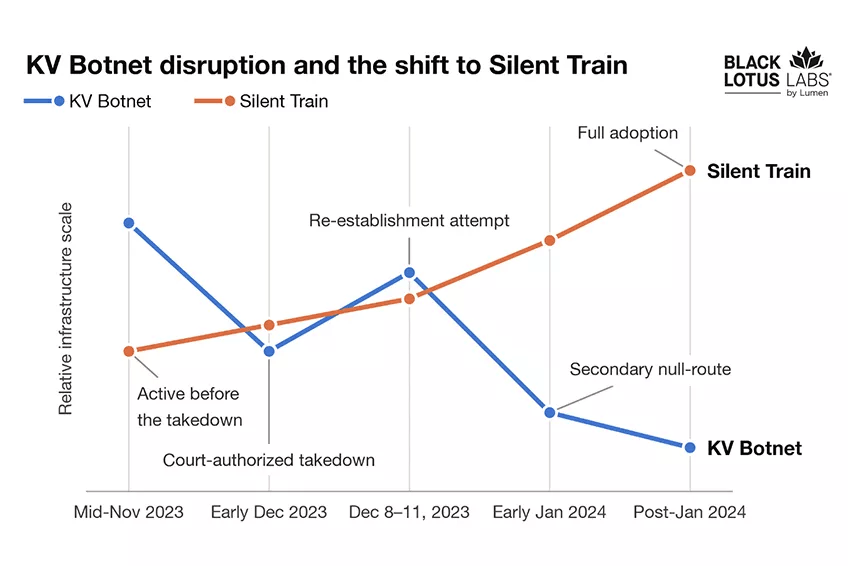
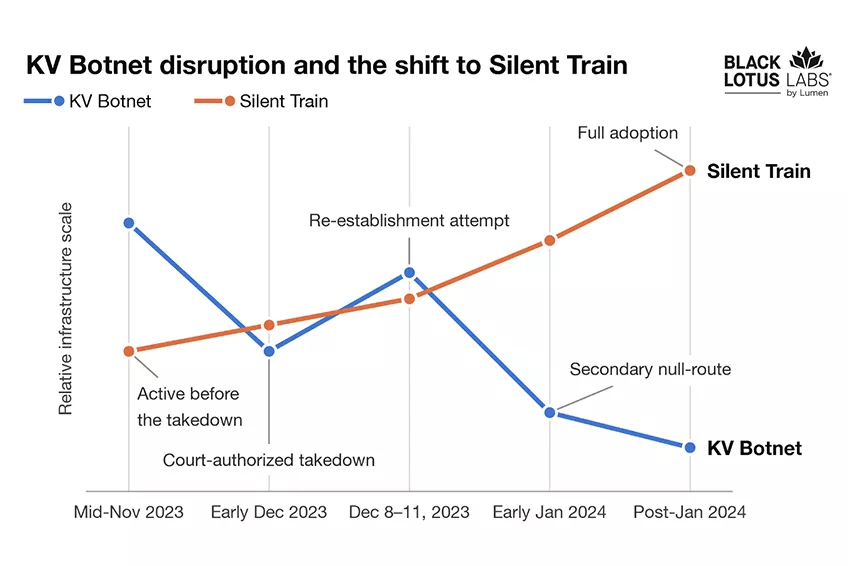
    Silent Train first showed up in November 2023, shortly before the first takedown of the KV-botnet, Volt Typhoon’s earlier network of hijacked routers. Activity rose after the second disruption. The group dropped persistent infrastructure and moved to disposable chains of compromised devices that it could rebuild whenever it wanted.

    Each session began on a rented server outside the United States. It then passed through another server and compromised small-office routers, home devices and IoT equipment in other countries. Finally, the traffic passed through a compromised device in the U.S., close to the target. This helped the attackers make their activity look like normal local traffic and bypass location-based blocks and IP reputation filters. On average, the chains passed through about four devices before reaching a U.S. IP address. Some used as many as six.

    Lumen identified more than 27 types of devices used in the network, including TP-Link routers and Fortinet appliances. Some of these devices had no known vulnerabilities, suggesting that Volt Typhoon may have used previously unknown exploits to compromise them and create relay points.

    “We observed more than 27 device classes exploited and used in Silent Train operations, ranging from SOHO and IoT devices like TP-Link routers and Netgear Orbi devices to enterprise platforms like Fortinet appliances and CyberPanel servers.” the report continues. “Some relay device types lack known vulnerabilities, suggesting Volt Typhoon leveraged undisclosed zero-day exploits to set up a single relay in a four-to-six hop chain and indicating a willingness to commit significant resources to protecting future access capabilities.”

    The attackers exploited exposed web interfaces and installed only the tools needed to connect the devices through SSH. These included temporary SSH services, keys, configuration files and tools already available on the systems. At the end of each session, they removed all traces of their activity and dismantled the relay chain. Sessions lasted about four hours on average, although some lasted only minutes. The attackers could also build a new chain in less than two minutes, suggesting that they had partly automated the process.

    The group worked with strict discipline. New device types arrived about one per quarter, and about one per month during the 2023 and 2024 build-out, always tested outside the U.S. first. Roles never changed: Intelbras modems served only as overseas relays, Netgear Orbi devices only as the U.S. hops facing victims, and the server providers stayed separated by layer too.

    By early 2025, enterprise platforms like Fortinet, Cisco, PRTG, Mirth Connect and CyberPanel joined as final hops. They stayed up one to three months and supported several intrusions. The group also added reverse tunnels using the open-source proxies Chisel and FRP, and the old and new methods ran in parallel.

    Volt Typhoon used Silent Train only during key stages of its attacks, including exploiting vulnerabilities, stealing credentials and data, and maintaining access to compromised systems. Each session targeted between one and five victims, often just one organization. The activity was carried out by human operators, mainly from Monday to Friday, between 9 a.m. and 10 p.m. China Standard Time. The group also paused operations for several weeks around Chinese New Year.

    The group targeted tools used to manage endpoints and networks, as well as SD-WAN systems and other control platforms. These systems can manage hundreds or thousands of devices, allowing attackers to reach many systems without moving through the network in the usual way. This approach also helped them leave fewer traces. After the attacks, investigators found webshells running in memory, stolen credentials, misuse of built-in features such as remote file transfers, and deleted logs.

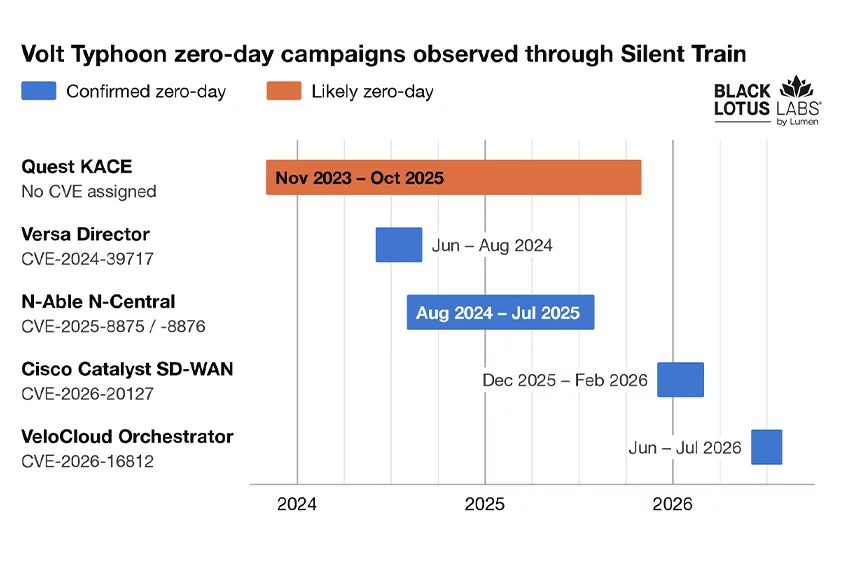
    The four confirmed zero-day campaigns hit Versa Director in 2024, N-able N-central through CVE-2025-8875 and CVE-2025-8876, Cisco Catalyst SD-WAN through CVE-2026-20127, and VeloCloud Orchestrator through CVE-2026-16812. The Cisco bug is a CVSS 10.0 flaw, and the group kept exploiting it well after Cisco disclosed it in February 2026. In the Versa case, the group used an in-memory JAR webshell to limit forensic evidence and reach downstream customers.

    The likely fifth is Quest KACE. The campaign hit more than 30 victims and faded after Quest’s October 2025 security updates.

    “The campaign affected more than 30 victims, followed vendor remediation timelines and declined after Quest’s October 2025 security updates.” the report states. “Despite limited forensic evidence, the available data supports a moderate-confidence assessment that Volt Typhoon exploited a zero-day vulnerability.”

    The actor stayed on the KACE server and used its admin features to take credentials.

    Victims include telecoms, government agencies, defense contractors, satellite and emergency communications, universities with ROTC programs, managed service and IT firms, and critical infrastructure such as water, energy, transportation, maritime, rail and aviation. What they share is access to bigger networks or customers. Hawaii, California and Texas were the top locations for several years. Lumen can’t say why, but the pattern fits pre-positioning for a crisis in the Indo-Pacific.

    “For enterprise leaders, the lesson is clear: systems with broad administrative reach can become high-value gateways to the entire organization and its customers. Reducing internet exposure, accelerating patching, strengthening access controls and preserving security telemetry are essential to detecting threats earlier and limiting their impact.” Lumen concludes.

    Follow me on Twitter: @securityaffairs and Facebook and Mastodon

    Pierluigi Paganini

    (SecurityAffairs – hacking, China)

    Source: Security Affairs · 2026-10-29