A company working on behalf of the Department of Homeland Security sought to cut off online access to information on more than 41,000 employees that hacktivists said they obtained from a database breached at DHS.
A search tool for the database, named Icepick, went offline for a spell before coming online again Thursday under a different registrar.
Icelandic hosting company FlokiNET said Thursday that it received a request from DHS contractor ZeroFox to remove the data, which it refused.
“By mid-morning, icepi.cx no longer resolved. Its registrar, CentralNic, had placed the domain on serverHold,” FlokiNET said in a blog post. “Our refusal kept nothing online. The request that decided the outcome to take the site down was not the one sent to us. A registrar reached the opposite conclusion the same morning, published nothing, and a global audience lost access to the site. In the meantime the site is online again under a domain from a different registrar.”
CentralNic and ZeroFox did not immediately respond to requests for comment Thursday.
DHS said late Wednesday that it was working to protect its employees against any breach.
“DHS is aware of a potential breach and is actively working to address the situation swiftly and effectively,” a spokesperson said. “We take all security threats against our employees and officers seriously and will work to ensure all are properly protected. We will update the public when more information is available.”
The social media site Bluesky was also blocking links to the archive because it shared people’s contact information without their permission, although a company official said changes were coming because the wording had identified it as a malicious link.
FlokiNET said it refused the ZeroFox request that mislabeled the archive as part of a doxxing campaign.
“Doxxing publishes private details about private people so that others can find them at home. Icepick publishes work identities of government employees,” it wrote. “Who they work for. What their role is. How they can be reached in that role. The information describes people in the exercise of public authority, not in their private lives. Federal officers carrying out an enforcement programme are not private individuals while they are carrying it out.”
“The public has a legitimate interest in knowing who is doing that work, under whose authority, and in which office,” it continued. “Journalists cannot report on an agency whose personnel are structurally unknowable.”
ZeroFox said that regardless of that, the data made it possible to locate people whose information was in the database.
“The request does not depend on who the listed individuals are or what their duties are,” ZeroFox wrote to FlokiNET. “It rests on two facts: the data was stolen, and it is personal data that identifies and locates real people.”
This installment of the Reporters’ Notebook video series discusses some of the trends and topics from Cybersecurity Awareness Month, from using AI for better training to educating next-generation workforces on modern risks and emerging threats.
A fake cryptocurrency trading app called Padre Terminal, previously available on the Apple App Store for iOS devices, has been linked to the theft of approximately $23,000 from 27 Solana wallets. […]
Some attacks take real skill. Others just need someone to leave a door open. This week has both. Exposed passwords, old bugs still getting exploited, and trusted software doing things it shouldn’t.
There’s a strange mix of clever tricks and careless mistakes. Hackers are borrowing trust from familiar apps, websites, and AI tools. Some are using AI to speed things up. Others are leaving their
Suspected Chinese attackers chained PHP2Shell with a Linux kernel privilege-escalation exploit to root 25 servers, including Palo Alto Networks firewalls linked to US government-affiliated organizations, according to Dream researchers. The snoops began exploiting these servers on October 23, targeting organizations across the US, Japan, Taiwan, and South Korea. The attackers also honed in on US government-affiliated firewalls. “Within hours of compromising a US government-affiliated firewall, they had tunneled into the internal network, compromised a third server using the same PHP2Shell exploit, and launched a full Active Directory attack campaign – all through a chain that started with a single unauthenticated HTTPS request to a management interface that should never have been exposed to the internet,” the Israeli AI cybersecurity startup said in a report. Plus, the attackers “likely still” have persistent, remote access to compromised organizations’ networks, Dream noted. The attackers rooted the first US government-affiliated firewall on October 23, but the device crashed shortly afterward, possibly due to around 900 MB of exploit traffic. According to Dream, it remained unresponsive despite 240 automated checks over two hours. They successfully exploited the second firewall a day later, on October 24. The compromised firewalls ran vulnerable versions of Palo Alto Networks’ PAN-OS. Dream said it had been working with the vendor to investigate the compromises, and Palo Alto Networks’ Unit 42 researchers independently verified the attacker’s tooling and confirmed Dream’s reported results. To break into the firewalls, the attackers built a custom exploit chain that includes PHP2Shell and a Fragnesia kernel flaw, and ran about 40 custom post-exploitation scripts once they were inside the targeted organizations. Total attack chain in under 15 minutes PHP2Shell, comprised of CVE-2026-109618 and CVE-2026-109619, came to light early last week, along with fears that attackers would abuse the bugs to take down most of the internet. Despite “hundreds” of PHP2Shell proof-of-concept repositories on GitHub, the first reports of successful attacks didn’t start until Saturday. Both bugs have CVSS scores of 9.2 and can be exploited without authentication to run code on vulnerable PHP servers. The PHP2Shell exploit recovered by Dream was not a copy of any known public exploit. It “appears to have been independently developed and tailored specifically for the targeted firewall platform,” the researchers wrote. The attackers combined PHP2Shell with Fragnesia (CVE-2026-46300), a high-severity local privilege-escalation vulnerability affecting the Linux kernel’s XFRM ESP-in-TCP subsystem. The US Cybersecurity and Infrastructure Security Agency (CISA) added this Linux kernel bug to its catalog of Known Exploited Vulnerabilities on Wednesday. Both CISA and the FBI declined to comment. The miscreants developed a four-stage PHP2Shell exploit that allowed them to execute commands without authentication on vulnerable Palo Alto Networks firewalls. They then used Fragnesia to escalate their privileges and gain root access. The attackers targeted PAN-OS 12.1 and 12.2, which run PHP 8.0.30 with a high memory limit that enabled the exploit’s memory-corruption stages. “The total chain – from unauthenticated HTTPS connection to persistent root webshell – completes in under 15 minutes,” the Dream team wrote. 4 steps to root Here’s how it works: First, they flood the servers with crafted multipart POST requests to corrupt PHP’s memory, and force a predictable memory layout. Then a second request forges the stale session ID length from the memory corruption part of the attack, forcing an out-of-bounds read and exposing the base address of libphp.so in the running process. The attackers then exhaust PHP’s memory again to force mod_data=NULL, creating a stale reference they can forge in the final stage to execute commands as the nobody user. They use Fragnesia to escalate to root and plant a web shell in a publicly accessible directory on the firewall. After breaking in via the compromised firewalls, the attackers snooped around in Active Directory, stealing credentials and other sensitive information. With root access, the attackers also had the master key to decrypt the LDAP service account password, which they hardcoded into every subsequent script. They also enumerated every user and group in the domain via LDAP queries, and sprayed passwords against every user account. Attackers also tried to create backdoor AD accounts and attempted SAML signing key extraction – but Dream doesn’t know if these were successful. “The attack results – whether the password spray found valid credentials, whether the backdoor accounts were created, whether SAML keys were extracted – stayed on the management server’s local filesystem and were not among the artifacts we recovered,” the researchers noted. AI tools in the attack The investigation also uncovered evidence that the attackers used AI tools, but noted that this was not a fully autonomous attack. The researchers found Anthropic’s Claude Code installed, an AI-powered offensive security platform called aiscan configured with Chinese models DeepSeek and Kimi, and API keys for the FOFA reconnaissance service. FOFA is a Chinese internet asset search engine similar to Shodan. The attackers used it to identify about 19,000 internet-facing Palo Alto Networks firewalls worldwide. “The persistent tunnel into the US government organization is likely still running,” Dream warned. “And the attacker still has 19,000 fingerprinted targets they can revisit as they develop profiles for additional PAN-OS versions.”®
Suspected Chinese attackers chained PHP2Shell with a Linux kernel privilege-escalation exploit to root 25 servers, including Palo Alto Networks firewalls linked to US government-affiliated organizations, according to Dream researchers. The snoops began exploiting these servers on October 23, targeting organizations across the US, Japan, Taiwan, and South Korea. The attackers also honed in on US government-affiliated firewalls. “Within hours of compromising a US government-affiliated firewall, they had tunneled into the internal network, compromised a third server using the same PHP2Shell exploit, and launched a full Active Directory attack campaign – all through a chain that started with a single unauthenticated HTTPS request to a management interface that should never have been exposed to the internet,” the Israeli AI cybersecurity startup said in a report. Plus, the attackers “likely still” have persistent, remote access to compromised organizations’ networks, Dream noted. The attackers rooted the first US government-affiliated firewall on October 23, but the device crashed shortly afterward, possibly due to around 900 MB of exploit traffic. According to Dream, it remained unresponsive despite 240 automated checks over two hours. They successfully exploited the second firewall a day later, on October 24. The compromised firewalls ran vulnerable versions of Palo Alto Networks’ PAN-OS. Dream said it had been working with the vendor to investigate the compromises, and Palo Alto Networks’ Unit 42 researchers independently verified the attacker’s tooling and confirmed Dream’s reported results. To break into the firewalls, the attackers built a custom exploit chain that includes PHP2Shell and a Fragnesia kernel flaw, and ran about 40 custom post-exploitation scripts once they were inside the targeted organizations. Total attack chain in under 15 minutes PHP2Shell, comprised of CVE-2026-109618 and CVE-2026-109619, came to light early last week, along with fears that attackers would abuse the bugs to take down most of the internet. Despite “hundreds” of PHP2Shell proof-of-concept repositories on GitHub, the first reports of successful attacks didn’t start until Saturday. Both bugs have CVSS scores of 9.2 and can be exploited without authentication to run code on vulnerable PHP servers. The PHP2Shell exploit recovered by Dream was not a copy of any known public exploit. It “appears to have been independently developed and tailored specifically for the targeted firewall platform,” the researchers wrote. The attackers combined PHP2Shell with Fragnesia (CVE-2026-46300), a high-severity local privilege-escalation vulnerability affecting the Linux kernel’s XFRM ESP-in-TCP subsystem. The US Cybersecurity and Infrastructure Security Agency (CISA) added this Linux kernel bug to its catalog of Known Exploited Vulnerabilities on Wednesday. Both CISA and the FBI declined to comment. The miscreants developed a four-stage PHP2Shell exploit that allowed them to execute commands without authentication on vulnerable Palo Alto Networks firewalls. They then used Fragnesia to escalate their privileges and gain root access. The attackers targeted PAN-OS 12.1 and 12.2, which run PHP 8.0.30 with a high memory limit that enabled the exploit’s memory-corruption stages. “The total chain – from unauthenticated HTTPS connection to persistent root webshell – completes in under 15 minutes,” the Dream team wrote. 4 steps to root Here’s how it works: First, they flood the servers with crafted multipart POST requests to corrupt PHP’s memory, and force a predictable memory layout. Then a second request forges the stale session ID length from the memory corruption part of the attack, forcing an out-of-bounds read and exposing the base address of libphp.so in the running process. The attackers then exhaust PHP’s memory again to force mod_data=NULL, creating a stale reference they can forge in the final stage to execute commands as the nobody user. They use Fragnesia to escalate to root and plant a web shell in a publicly accessible directory on the firewall. After breaking in via the compromised firewalls, the attackers snooped around in Active Directory, stealing credentials and other sensitive information. With root access, the attackers also had the master key to decrypt the LDAP service account password, which they hardcoded into every subsequent script. They also enumerated every user and group in the domain via LDAP queries, and sprayed passwords against every user account. Attackers also tried to create backdoor AD accounts and attempted SAML signing key extraction – but Dream doesn’t know if these were successful. “The attack results – whether the password spray found valid credentials, whether the backdoor accounts were created, whether SAML keys were extracted – stayed on the management server’s local filesystem and were not among the artifacts we recovered,” the researchers noted. AI tools in the attack The investigation also uncovered evidence that the attackers used AI tools, but noted that this was not a fully autonomous attack. The researchers found Anthropic’s Claude Code installed, an AI-powered offensive security platform called aiscan configured with Chinese models DeepSeek and Kimi, and API keys for the FOFA reconnaissance service. FOFA is a Chinese internet asset search engine similar to Shodan. The attackers used it to identify about 19,000 internet-facing Palo Alto Networks firewalls worldwide. “The persistent tunnel into the US government organization is likely still running,” Dream warned. “And the attacker still has 19,000 fingerprinted targets they can revisit as they develop profiles for additional PAN-OS versions.”®
42 publicly listable cloud buckets containing 18 billion files, including exposed credentials, database dumps and backups.
The Ransomnews research team counted 484,142 publicly listable cloud storage buckets in October 2026, holding 18.05 billion files. They built the count from the search engines that index open cloud storage and published it as the Ransomnews Cloud Exposure Index, written by Mantas Sasnauskas.
“No file was opened for this index. Every number below comes from bucket names, file extensions, file counts and last-modified timestamps. That is a deliberate limit. It keeps the research on the right side of the line, and it turns out to be enough to see where the sensitive material concentrates.” Ransomnews states. “We are calling it the Ransomnews Cloud Exposure Index, and we will rerun it quarterly so the numbers can be compared over time.”
The researchers used bucket names, file types, file counts and last-modified dates to collect their data. They did not open any files, allowing them to identify where sensitive information might be stored without accessing the content. They plan to repeat the research every three months to track changes over time.
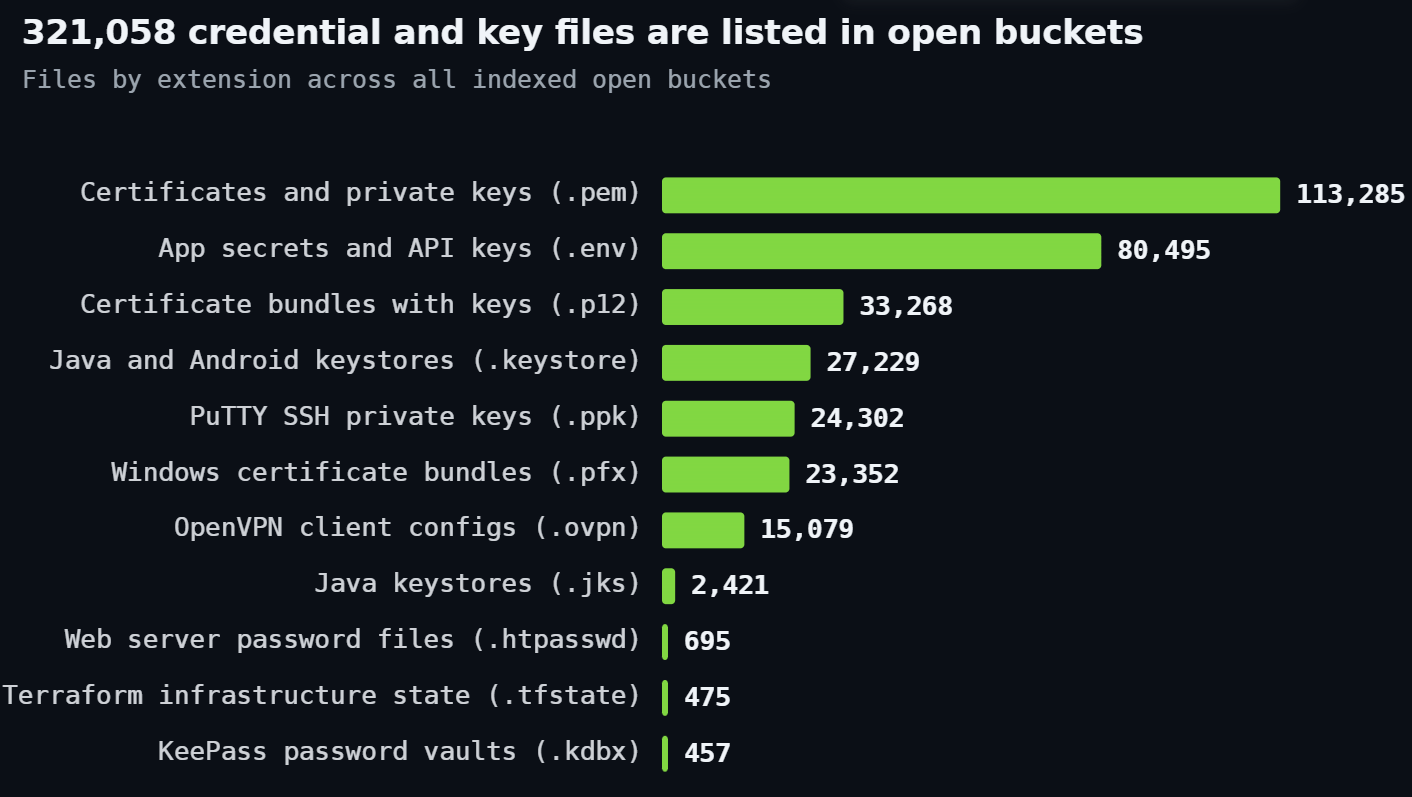
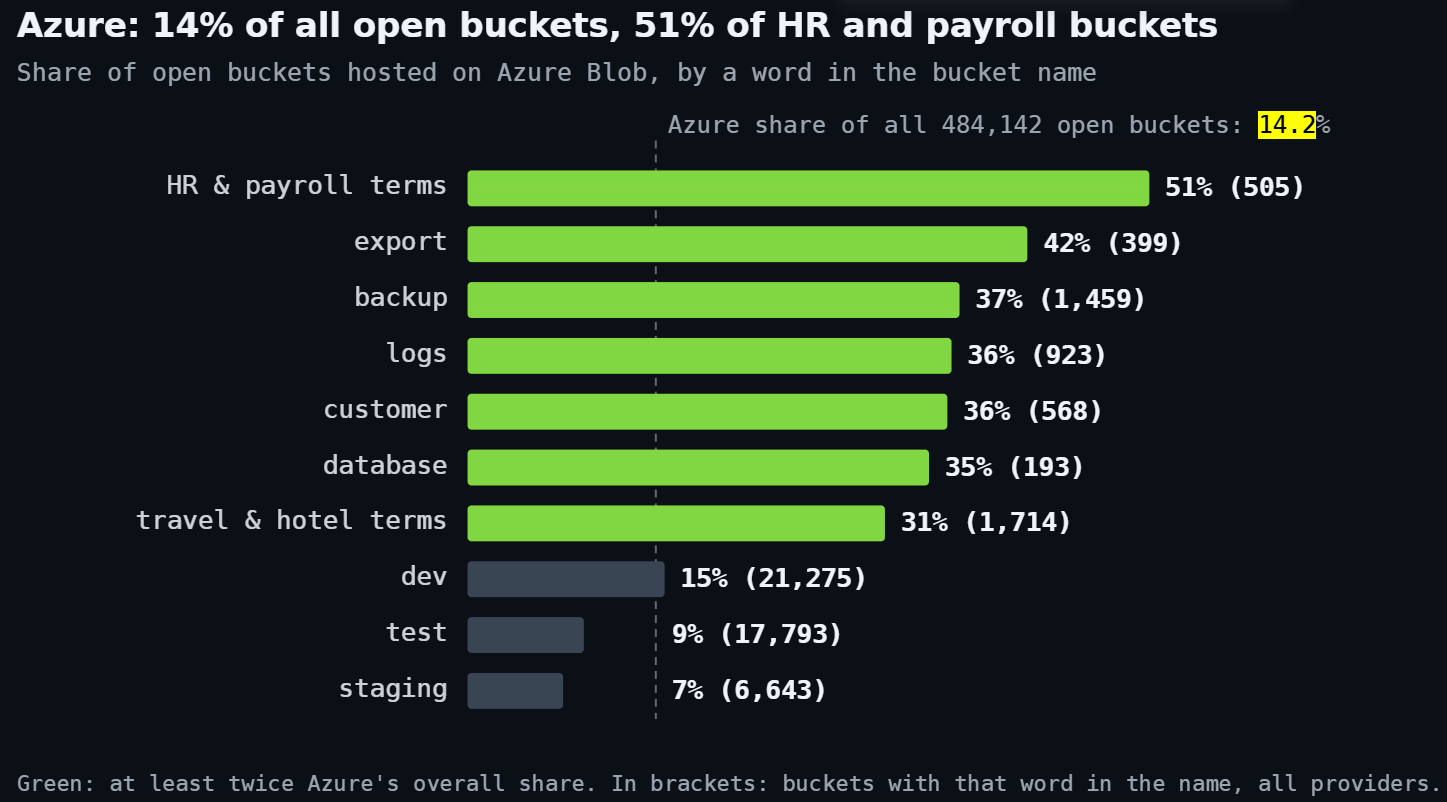
Amazon S3 accounts for 72% of the exposed buckets, roughly in line with its share of the market. This does not mean S3 has weaker security than other providers. Azure Blob, however, appears 2.5 to 3.6 times more often than expected among buckets named for backups, data exports and payroll records. The researchers also found 321,058 files related to credentials and keys. Of the exposed .env files, 67% were last modified in 2026.
Below is the split by provider, from a snapshot taken on October 7:
Provider
Open buckets
Share
Amazon S3
347,984
71.9%
Azure Blob
68,532
14.2%
Google Cloud Storage
53,131
11.0%
DigitalOcean Spaces
11,069
2.3%
Alibaba OSS
3,426
0.7%
Total
484,142
100%
A lot of these buckets are public on purpose, holding website assets, CDN mirrors, open datasets and podcast archives. So the index isn’t 484,142 breaches. It’s the pool where breaches hide, and the rest of the report narrows it down to the stores that should never have been listable.
“Azure, by a wide margin relative to its size. Azure Blob holds 14.2% of open buckets, but 37% of the 1,459 buckets with “backup” in the name, 42% of the 399 named for exports, and 51% of the 505 carrying HR or payroll terms.” continues the report. “Buckets named for logs, customers and databases sit at 35% to 36%, all around two and a half times Azure’s baseline.”
The skew only shows up for operational data. Buckets named “dev” sit at Azure’s baseline of 15 percent, and “test” and “staging” fall below it, at 9 and 7 percent. The authors suspect Azure storage accounts more often hold line-of-business data such as backups, exports and HR systems that enterprises run on Microsoft, while S3 and Google Cloud carry more application assets. They call it a hypothesis the counts suggest and don’t prove, and it’s the first thing they want to test next time.
By sector, retail and e-commerce names lead with 5,666 buckets, mostly storefront assets. The more worrying number is that names tied to regulated sectors (finance, healthcare, education, government, legal and HR) appear on 10,891 unique open buckets. Those are the places where a stray file most likely holds personal, health or financial records, and where regulators expect to hear about it.
Sector (by bucket name)
Open buckets
Files in them
Retail and e-commerce
5,666
269.9M
Finance and insurance
3,508
58.0M
Healthcare
2,709
47.9M
Media and entertainment
2,696
136.2M
Education
2,393
60.6M
Gaming
2,296
79.0M
Travel and hospitality
1,714
118.7M
Real estate
1,137
60.7M
Government and public sector
1,000
36.2M
Legal
978
11.3M
Crypto
630
11.9M
HR and payroll
505
8.4M
Healthcare-related names appear in 2,709 buckets containing 47.9 million files. The researchers identified them using terms such as “hospital” (135 buckets), “patient” (135), “clinic” (277) and “dental” (331). HR and payroll is the smallest sector, with 505 buckets, 259 of which are hosted on Azure.
These figures are based on names, not proof of ownership. The search matches parts of words, so “store” can refer to object storage as well as shops. A single bucket can also appear in two sectors.
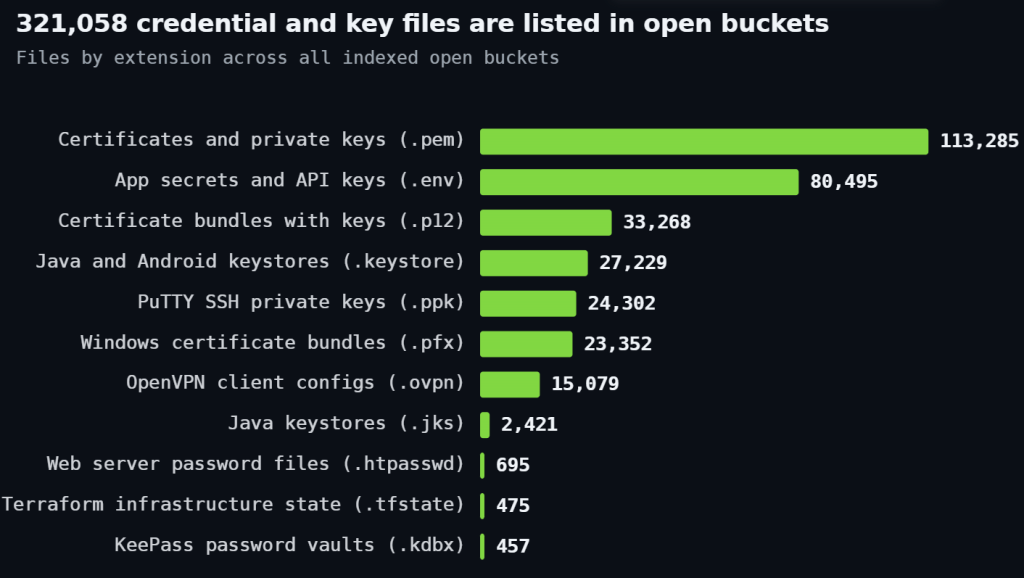
The exposed buckets also list about 4.7 million database and dump files, 15,130 mailbox archives, and tens of millions of spreadsheets and documents. Credential files are particularly concerning because they can turn a cloud misconfiguration into a real intrusion.
File type
What it is
Files listed
.pem
Certificates and private keys
113,285
.env
App secrets and API keys
80,495
.p12
Certificate bundles with keys
33,268
.keystore
Java and Android keystores
27,229
.ppk
PuTTY SSH private keys
24,302
.pfx
Windows certificate bundles
23,352
.ovpn
OpenVPN client configs
15,079
.jks
Java keystores
2,421
.htpasswd
Web server password files
695
.tfstate
Terraform infrastructure state
475
.kdbx
KeePass password vaults
457
Each of these exists to grant access. A .env file is where developers keep database passwords and API keys. A .tfstate file is Terraform’s record of a whole cloud setup, often with secrets in plain text, and a .kdbx vault is encrypted but now open to anyone who wants to guess passwords offline. Some .pem files are public certificates and some files are test fixtures, so the counts are a ceiling on live secrets and not a measure of them. It’s still a big ceiling.
Database files make up most of the sensitive material by volume:
File type
What it usually holds
Files listed
.sqlite
Embedded app databases
2,561,807
.bak
Database and server backups
752,055
.sql
Database dumps
687,446
.sqlite3
Embedded app databases
488,176
.dump
Database dumps
176,603
.mdb / .accdb
Microsoft Access databases
36,467
.dmp
Memory and crash dumps
12,809
.pst / .ost / .mbox
Mailbox archives
15,130
.eml
Saved emails
4,549,665
.csv
Data exports and records
at least 69,580,112
.xlsx / .xls
Spreadsheets
42,544,997
.docx
Word documents
24,936,788
.pdf
Documents, invoices, scans
at least 106,191,393
.log
Application and server logs
at least 61,310,809
The exposed buckets contain thousands of virtual disk images, including VMware, Hyper-V and QEMU files. A single disk image can contain an entire server, including credentials.
Some exposures involve active systems. Of 80,495 .env files, 67% were last modified in 2026. Certificates and SQLite databases include both recent and older files. Backups appear older, with 89% of the 752,055 .bak files last modified before 2025. Almost all PuTTY key files date from 2024.
Recent leaks need urgent attention, while long-standing exposures point to poor security management. The problem is ongoing: at least 113.6 million files were added to publicly listable buckets in the seven days before September 9. Over the previous 30 days, these included more than 21,000 SQL dumps, nearly 21,000 backup files, 4,477 .pem files and 1,298 .env files.
Public .env files can expose database passwords that ransomware affiliates and initial access brokers look for. Similar credentials appear in stolen-data logs, but in this case, attackers do not need to infect a device. They only need to search for exposed files.
Cloud providers already offer settings to prevent public access. Organizations should enable S3 Block Public Access, disable anonymous access to Azure Blob storage, and enable public access prevention in Google Cloud. These controls should apply at account or organization level to prevent new storage buckets from becoming public.
Organizations should also scan their storage for sensitive files such as .env, .sql, .bak, .pem, .ppk, .tfstate and .kdbx. Terraform state files and virtual disk images should be treated as secrets, stored privately, encrypted and monitored. Backups should never be publicly accessible, and recovery procedures must be tested.
One exposed bucket may be a mistake, but many often indicate a wider process failure. Organizations need to fix the underlying security controls, not just individual buckets.
The research has some limitations. The team queried search engines on October 25, while the bucket list was current to October 7 and the newest indexed file dated September 9. File-level data may therefore be about a month old. Counts are also capped at one million per query, so researchers split larger categories into date ranges and added the results.
Some limits apply. The team queried the search engines on October 25. The bucket list was current to October 7 and the newest indexed file was dated September 9, so file-level figures lag by about a month. The index caps any single count at one million, so larger types were split into date windows and summed.
A last-modified date shows when a file was written, not when it was exposed, and a listed file isn’t proof that its contents can be read. No bucket is named in the report. Exposures with a known owner in regulated sectors are going through responsible disclosure, with national CERTs copied where the owner is public sector or doesn’t respond.
“Rotate any secret that has ever sat in a public bucket. Closing the bucket does not un-leak the key. Assume anything that was listable was copied.” conlcudes the report.
A newly identified advanced persistent threat (APT) group tracked as UAT-11473 was observed exploiting CVE-2026-20127, an authentication-bypass flaw in Cisco Catalyst SD-WAN Controllers, to deploy a custom malware framework called KeyDrift. […]