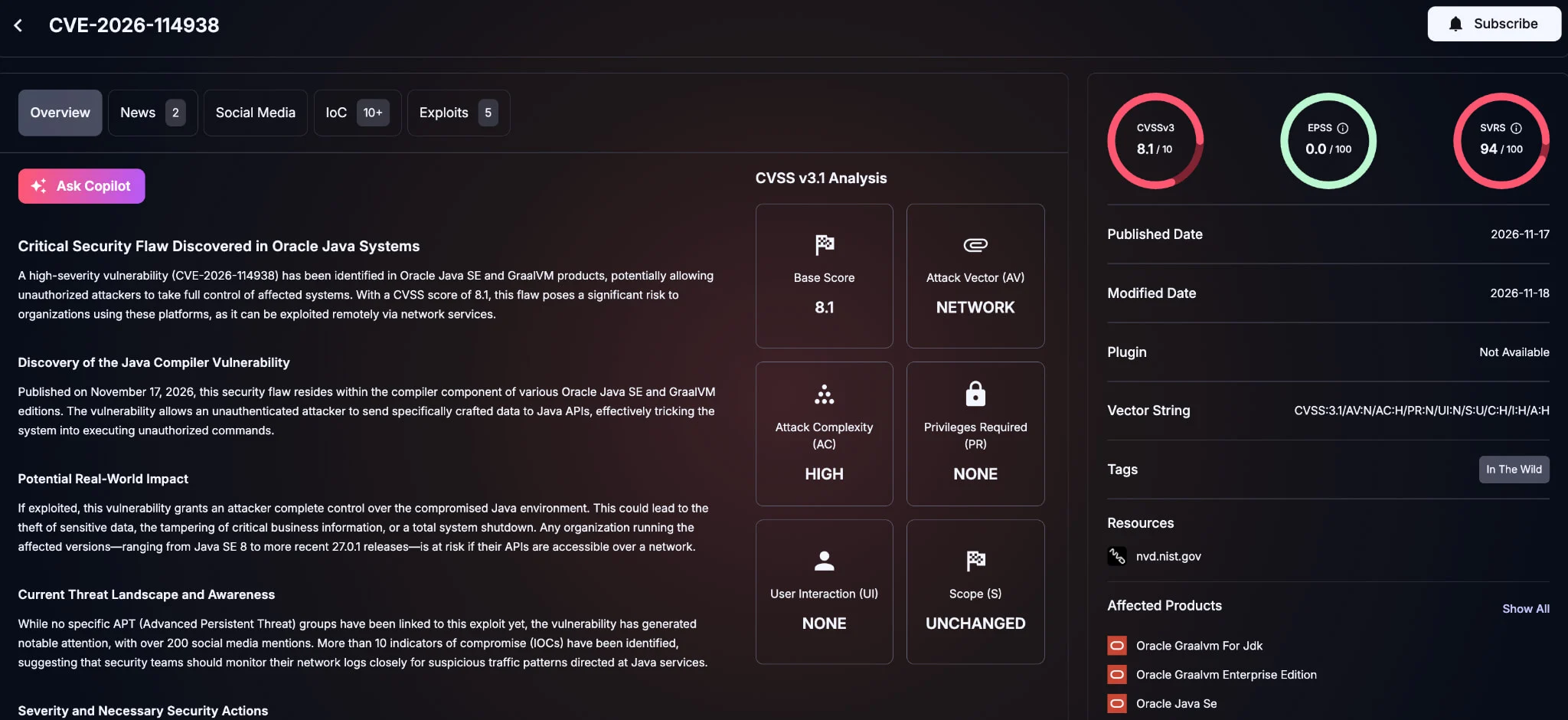
Java4Shell (CVE-2026-114938) is a memory corruption vulnerability in OpenJDK that lets malformed Base64 input write past the end of a heap array on servers with AVX-512 VBMI processors. Calif published its write-up on November 17, 2026, the same day Oracle and the OpenJDK project released fixes, and reported pre-authentication Remote Code Execution (RCE) against default installs of Jira, Confluence, Jenkins, Keycloak, JFrog Artifactory, and PingFederate.
Because the bug sits in the Java runtime, any Java service that Base64-decodes attacker-supplied data on affected hardware can be exposed, although each application needs its own exploit chain. This FAQ covers affected versions and processors, severity, exploitation status, fixes, and interim mitigations.
Key Takeaways
- What it is: A heap out-of-bounds write in OpenJDK’s hardware-accelerated Base64 decoder, which researchers chained into heap memory leaks and RCE
- Who is affected: Unpatched Java 17.0.6 and later, the Java 21, 25, and 27 lines, and Oracle Java SE 8u511b33-perf, on x86-64 processors with AVX-512 VBMI (Vector Byte Manipulation Instructions); ARM64 hosts and standard Java 8 and 11 are not affected
- Severity: 8.1 (High) under CVSS v3.1 from Oracle and the OpenJDK Vulnerability Group; Calif rates it 9.2 (Critical) under CVSS v4.0
- Status: As of November 18, 2026, no in-the-wild exploitation is confirmed and the flaw is not in CISA’s Known Exploited Vulnerabilities catalog, although CISA urged immediate patching in a November 17 alert
- Action: Install your vendor’s November 2026 Java update, or restart affected Java Virtual Machines (JVMs) with -XX:-UseBASE64Intrinsics until a fixed build is in place
Java4Shell at a Glance
| Attribute | Details |
|---|---|
| CVE ID | CVE-2026-114938 |
| CVSS | 8.1 CVSS v3.1 (Oracle and OpenJDK), vector CVSS:3.1/AV:N/AC:H/PR:N/UI:N/S:U/C:H/I:H/A:H; 9.2 CVSS v4.0 (Calif, vector not published) |
| Affected Products | OpenJDK HotSpot JVM (hotspot/compiler) and distributions built from it, including Oracle Java SE, Oracle GraalVM, Amazon Corretto, Eclipse Temurin, Microsoft Build of OpenJDK, Azul Zulu, BellSoft Liberica, SAP SapMachine, and Red Hat build of OpenJDK |
| Affected Versions | Java 17.0.6 through 17.0.21.0.3; Java 21.0.13.0.3, 25.0.5.0.3, and 27.0.1.0.3 and earlier; Oracle Java SE 8u511b33-perf; Oracle GraalVM for JDK 17.0.21.0.3 and 21.0.13.0.3; Oracle GraalVM Enterprise Edition 21.3.20.0.3; only on x86-64 processors with AVX-512 VBMI |
| Fixed In | Oracle Java SE 17.0.21.1, 21.0.13.1, 25.0.5.1, 27.0.1.1, and 8u513-perf; Oracle GraalVM for JDK 17.0.21.1 and 21.0.13.1 and Enterprise Edition 21.3.20.1; other distributions on their own release schedules |
| Exploitation Status | No confirmed in-the-wild exploitation and not in CISA KEV, as of November 18, 2026; CISA urged immediate patching on November 17, 2026 |
| Patch Available | Yes, from Oracle and OpenJDK since November 17, 2026; downstream vendor builds are rolling out |
| Discovered By | Quang Luong of Calif; Oracle’s advisory also credits Albert Yang |
What Is Java4Shell (CVE-2026-114938)?
Java4Shell is the name given to CVE-2026-114938, a heap out-of-bounds write in the x86-64 Base64 decoding routine that OpenJDK’s HotSpot JVM uses on processors with AVX-512 VBMI. A malformed Base64 string can overwrite memory next to the output array, and the researchers turned that overwrite into heap memory disclosure and remote code execution in widely used Java applications.
Oracle tracks the issue under the Compiler component of Java SE and GraalVM, and the OpenJDK advisory files it under hotspot/compiler. Because the flaw sits in the shared Java runtime, the fix is a patched Java Development Kit (JDK), with a JVM startup flag as a temporary workaround.
How Does the Java4Shell Vulnerability Work?
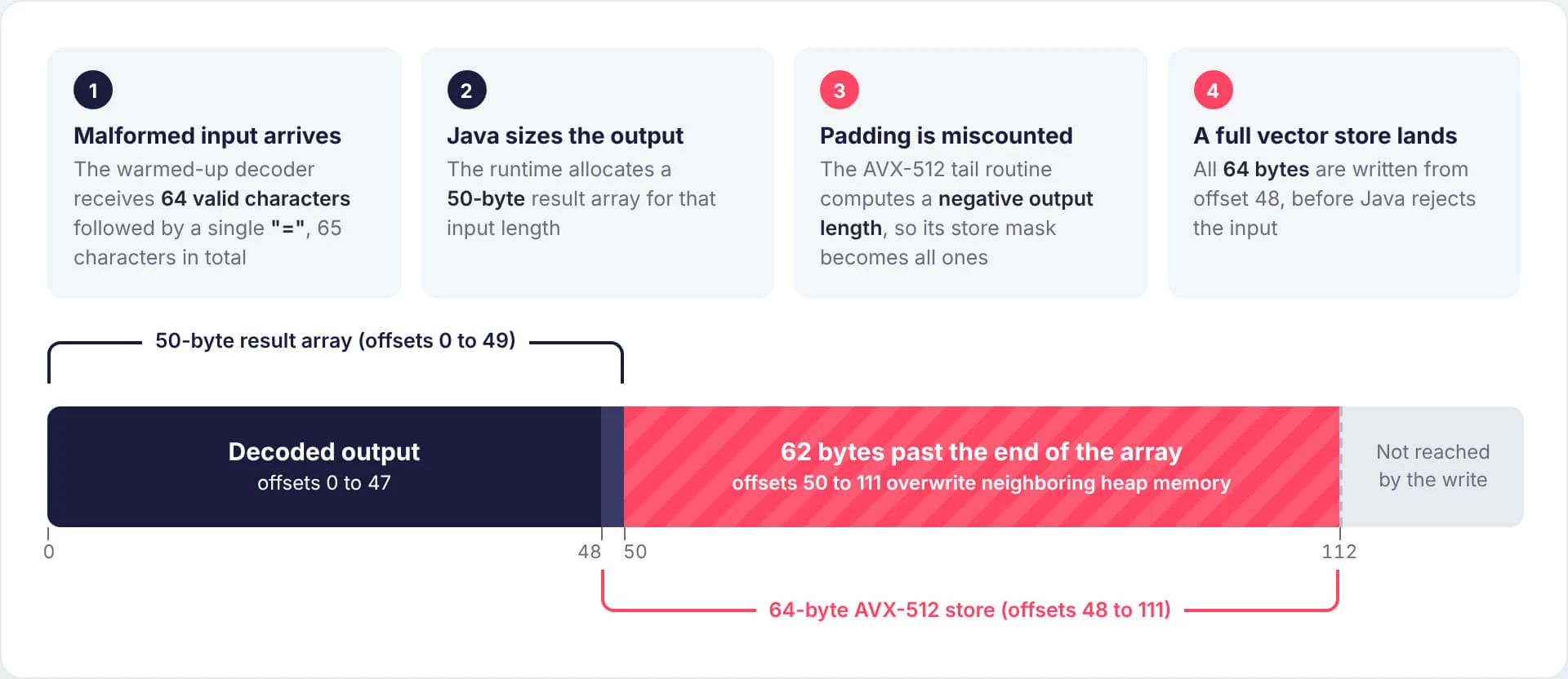
Java4Shell stems from a padding-handling error in OpenJDK’s AVX-512 Base64 intrinsic, a hand-written machine-code routine that speeds up decoding. When the last block of input carries a stray “=” padding character, the routine computes a negative output length, its store mask becomes all ones, and a full 64-byte vector write spills past the end of the destination array.
The faulty routine runs only after HotSpot’s C2 just-in-time (JIT) compiler optimizes the decoder, which happens once the method has been called many times. In the published example, a 65-character input gets a 50-byte result array, and the stray write reaches 62 bytes past it. Java then rejects the input, but the neighboring memory is already overwritten.
The out-of-bounds bytes are not attacker-chosen. Heap grooming can place the overflow over the length field of an adjacent array, which turns the fixed write into a bounded write of chosen values and a heap read primitive, and from there into code execution.
Is Java4Shell Related to Log4Shell?
Java4Shell and Log4Shell are separate vulnerabilities with similar names. Log4Shell (CVE-2021-44228) was a lookup-injection flaw in the Apache Log4j logging library, while Java4Shell is a memory corruption bug in the JVM’s own Base64 decoder. Updating Log4j has no effect on Java4Shell, which needs a fixed Java runtime, with a JVM flag as a stopgap.
Exploitation also differs. Java4Shell has no universal payload, since each target needs its own decoder route, heap layout, and feedback channel, while a single injected string could trigger Log4Shell across many applications.
Who Discovered Java4Shell, and How Was AI Involved?
Quang Luong of security research firm Calif discovered Java4Shell, and Oracle’s November 2026 advisory credits him and Albert Yang. Luong pointed an AI coding agent at HotSpot’s JIT compiler, intrinsics, widely used APIs, and cryptography, found the bug in about an hour, and had a first working exploit two hours later, for under $200 in tokens.
The write-up credits Jenish Rakholiya with exploit improvements and notes that researcher samczsun shared a client-side exploit, in which a Java program is compromised after opening a TLS connection to a malicious server. After building pipelines and strategies up front, the team had AI agents produce most later exploit chains almost autonomously.
Which Java Versions Are Affected by Java4Shell?
Java4Shell affects OpenJDK-based runtimes from Java 17.0.6 onward, including the Java 21, 25, and 27 release lines, up to the November 17, 2026 fixes. The OpenJDK advisory lists 17.0.21.0.3, 21.0.13.0.3, 25.0.5.0.3, and 27.0.1.0.3 and earlier as affected, and the original write-up lists the major OpenJDK distributions as vulnerable too.
| Product or Release Line | Affected Builds | Notes |
|---|---|---|
| Java 17 (OpenJDK-based) | 17.0.6 through 17.0.21.0.3 | Calif places the start of the affected range at 17.0.6 |
| Java 21 (OpenJDK-based) | 21.0.13.0.3 and earlier | Listed by OpenJDK and Oracle |
| Java 25 (OpenJDK-based) | 25.0.5.0.3 and earlier | Listed by OpenJDK and Oracle |
| Java 27 (OpenJDK-based) | 27.0.1.0.3 and earlier | Listed by OpenJDK and Oracle |
| Oracle Java SE 8 Enterprise Performance Pack | 8u511b33-perf | Standard Java 8 is not affected |
| Oracle GraalVM for JDK | 17.0.21.0.3, 21.0.13.0.3 | Listed by Oracle |
| Oracle GraalVM Enterprise Edition | 21.3.20.0.3 | Listed by Oracle |
Every affected build is vulnerable only on x86-64 processors with AVX-512 VBMI. Older OpenJDK 17 builds need a longer malformed input to reach the vulnerable code path, but the result is the same out-of-bounds write.
Are Java 8 and Java 11 Affected by CVE-2026-114938?
Standard Java 8 and Java 11 are not affected by CVE-2026-114938: the OpenJDK advisory marks neither release line, and the original write-up starts the affected range at Java 17.0.6. The one exception is Oracle Java SE 8 Enterprise Performance Pack build 8u511b33-perf, which Oracle lists as affected and fixes in 8u513-perf.
Java 8 and 11 installations still need attention: Oracle’s November 2026 Critical Security Patch Update fixes other Java SE vulnerabilities in those lines, so skipping it leaves those flaws open.
Which Processors Are Vulnerable to Java4Shell?
Java4Shell triggers only on x86-64 processors that support AVX-512 VBMI, because the faulty code is the AVX-512 version of the Base64 decoder. Affected families include Intel Xeon Ice Lake, Sapphire Rapids, Emerald Rapids, and Granite Rapids, plus AMD EPYC and Ryzen processors from Zen 4 onward. ARM64 systems are not affected.
AVX-512 support alone is not enough, since some older Xeon generations offer AVX-512 without the VBMI extension. On Linux, the command below prints the relevant CPU flags:
grep -m1 ‘^flags’ /proc/cpuinfo | tr ‘ ‘ ‘\n’ | grep -E ‘^(avx512f|avx512bw|avx512vbmi|bmi2)$’
A host meets the hardware condition only when all four flags appear: avx512f, avx512bw, avx512vbmi, and bmi2.
Which Applications Are Exposed to Java4Shell?
The researchers demonstrated pre-authentication RCE against default installs of Keycloak, Atlassian Jira, Atlassian Confluence, JFrog Artifactory, Jenkins, and PingFederate, and post-authentication code execution in Apache Kafka Broker, Apache Solr, Elasticsearch, Gerrit, and Spinnaker. Both lists are incomplete, since routine features such as login handling and file uploads can pass attacker input to the decoder.
They also achieved code execution in sample applications built on Apache Struts and Spring Boot. The client-side scenario widens the scope further: a Java program that connects to a malicious TLS server can be compromised even when it exposes no network service of its own.
Are Cloud and Container Workloads Affected by Java4Shell?
Cloud and container workloads are vulnerable when the host processor exposes AVX-512 VBMI to the guest and the image ships a vulnerable Java build. Many current x86-64 cloud instance types run on Ice Lake or newer Xeon or Zen 4 or newer EPYC processors, and patching the host operating system does not update a JDK bundled inside an image.
Run the CPU flag check inside the virtual machine or container, since hypervisors can hide processor features from guests. Then check the Java runtime each service actually uses, because vendor products and images often ship their own JDK. Updated images must be rebuilt and redeployed before the fix takes effect.
How Severe Is CVE-2026-114938?
CVE-2026-114938 carries an 8.1 (High) score under CVSS v3.1 from Oracle and the OpenJDK Vulnerability Group, with the vector CVSS:3.1/AV:N/AC:H/PR:N/UI:N/S:U/C:H/I:H/A:H. Calif rates the flaw 9.2 (Critical) under CVSS v4.0 but has not published its vector. The v3.1 vector reflects network access, high attack complexity, no privileges or user interaction, and high impact on confidentiality, integrity, and availability.
Exploitation takes work: each target needs its own heap layout and request timing, and a misplaced write can crash the JVM instead of handing over control. Still, Oracle’s CVE record states that successful attacks can result in takeover of Java SE. Downstream ratings differ: Amazon scores the flaw 8.8 and describes code execution as requiring a low-privileged authenticated user in certain environments, a narrower view than the researchers’ pre-authentication results, while Red Hat rates it Critical.
Is Java4Shell Being Exploited in the Wild?
As of November 18, 2026, no confirmed in-the-wild exploitation of Java4Shell has been reported. Still, CISA issued an alert on November 17, 2026, with input from Canada’s Cyber Centre, urging organizations to patch immediately. Product-specific exploit chains are being withheld until organizations have had time to upgrade.
Technical details are now public, and most later exploit chains were built almost autonomously with AI, so the current quiet should not set patching priorities. Server-side attacks would map to Exploit Public-Facing Application (T1190), and the client-side TLS scenario to Exploitation for Client Execution (T1203).
Is There a Public Proof of Concept for Java4Shell?
Calif has published a safe proof of concept (PoC) that confirms whether a given Java runtime and processor combination reproduces the bug, without attempting code execution. The program warms up the decoder, feeds it a malformed string, and checks a larger test array for bytes overwritten past the decoded output. The team’s weaponized exploits for specific products remain private.
A positive result shows the runtime and CPU are vulnerable, but it does not prove that a particular application passes attacker input to the decoder. Separately, one researcher reported building a working exploit that must be adapted per application, and other teams reproduced crashes and memory leaks without demonstrating code execution. Trigger-only code from third parties also circulated publicly on November 17, 2026.
Did Java4Shell Leak Before the Patch?
Details of Java4Shell surfaced publicly before the coordinated November 17, 2026 release, and Calif said on X that the flaw had leaked ahead of a fix. Separately, a related malformed input was posted in a public OpenJDK pull request on September 9, 2026; no source has tied that pull request to the leak they described.
A pre-patch leak means others may have studied the bug before fixes existed. Together with the public write-up, that possibility is another reason to patch quickly, even without confirmed attacks.
Which Java Versions Fix Java4Shell?
Oracle’s November 17, 2026 Critical Security Patch Update fixes Java4Shell in Java SE 17.0.21.1, 21.0.13.1, 25.0.5.1, and 27.0.1.1, and in Java SE 8 Enterprise Performance Pack build 8u513-perf. Other OpenJDK distributions ship fixes on their own schedules, so confirm the fixed build in your vendor’s advisory.
| Distribution | Fixed Builds | Status as of November 18, 2026 |
|---|---|---|
| Oracle Java SE | 17.0.21.1, 21.0.13.1, 25.0.5.1, 27.0.1.1, 8u513-perf | Released November 17, 2026 |
| Oracle GraalVM | GraalVM for JDK 17.0.21.1 and 21.0.13.1; Enterprise Edition 21.3.20.1 | Released with the November 2026 update |
| Amazon Corretto | 17.0.21.1.2, 21.0.13.1.2, 25.0.5.1.2, 27.0.1.1.4 | Downloads released; Amazon Linux packages still marked Pending Fix |
| Azul Zulu | 17.70.201, 21.54.201, 25.38.201, 27.30.201 (Patch Set Update builds); 17.69.204, 21.53.202, 25.37.202 (Critical Patch Update builds) | Released; no Critical Patch Update build listed for Zulu 27 |
| Red Hat build of OpenJDK and RHEL packages | None listed | Fix pending; Red Hat is still investigating affected builds |
| Eclipse Temurin | None listed | No fixed release announced |
| Microsoft Build of OpenJDK | None listed | No fixed release announced |
| SAP SapMachine, BellSoft Liberica | Not confirmed by the vendor | Check the vendor’s release notes |
Restart every Java process after updating, since a running JVM keeps the old code in memory until it stops.
How Can I Check If My Systems Are Vulnerable to Java4Shell?
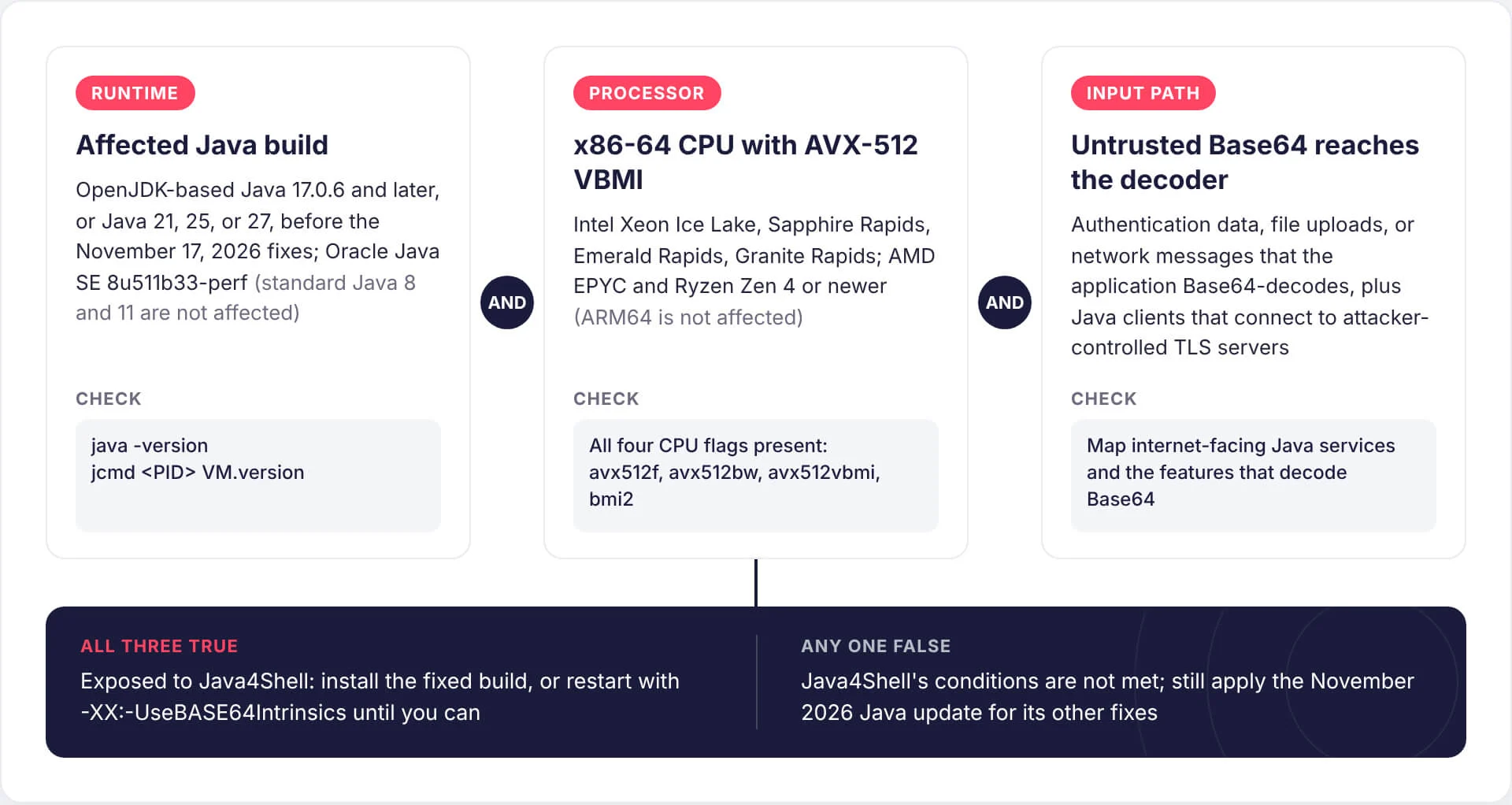
A system is exposed to Java4Shell only when three conditions hold together: an affected Java build, an x86-64 processor that reports AVX-512 VBMI, and attacker-reachable input that the application Base64-decodes. Check the version of every running JVM, confirm the CPU flags on each host or guest, and start with internet-facing identity providers, build pipelines, and collaboration tools.
- Runtime version: Run java -version with the same binary the service uses, or query the live process with jcmd <PID> VM.version
- Processor flags: Confirm that avx512f, avx512bw, avx512vbmi, and bmi2 all appear in the CPU flags
- Bundled runtimes: Inspect the JDK inside vendor products, appliances, and container images, since operating system updates skip them and software inventories often miss them
- Workaround status: Run jcmd <PID> VM.flags -all and check the UseBASE64Intrinsics and UseAVX values on hosts that rely on a JVM flag
- Safe reproduction: Run the published trigger program on a non-production host with the same runtime and CPU to confirm the combination
How Can I Mitigate Java4Shell If I Cannot Patch Yet?
Until a fixed build is installed, restart affected JVMs with -XX:-UseBASE64Intrinsics, the researchers’ interim mitigation, which disables hardware-accelerated Base64 encoding and decoding. The alternative, -XX:UseAVX=2, turns off AVX-512 entirely and works only on x86-64 hosts, because Java on ARM fails to start with it.
Neither Oracle’s nor OpenJDK’s advisory mentions these flags, so treat them as temporary measures. -XX:-UseBASE64Intrinsics is the narrower option, while -XX:UseAVX=2 gives up a wider set of processor optimizations. Test the performance impact on Base64-heavy services, apply the flag in each service’s startup configuration, restart, and verify it on the live process.
Where a flag or restart is not yet possible, CISA’s alert recommends temporary compensating controls: restrict and validate Base64 input at the application boundary, enforce input-size limits, and limit unauthenticated access.
Does a Reverse Proxy or WAF Protect Against Java4Shell?
A reverse proxy or web application firewall (WAF) offers only partial protection against Java4Shell. Some published heap-grooming profiles depend on delivering request bodies in pieces, which nginx’s default request buffering prevents. The Elasticsearch chain, however, needs just one complete request, and traffic inside an upgraded WebSocket tunnel bypasses body buffering.
WAF rules that flag Base64 with misplaced padding may catch crude attempts, but Base64 travels inside authentication headers, tokens, and file uploads, so full coverage is hard to prove. The current chains are also sensitive to network latency and jitter, which an attacker can reduce by renting infrastructure in the target’s cloud region. Patching remains the only complete fix.
Mitigation and Recommendations for Java4Shell
Patching the Java runtime is the only complete fix for CVE-2026-114938. These steps take a team from inventory to verified remediation.
- Inventory every JVM: List the Java runtimes on servers, virtual machines, containers, and vendor appliances, including bundled JDKs, and record the vendor, build, and host processor for each
- Rank by exposure: Patch internet-facing identity providers (Keycloak, PingFederate), build and artifact systems (Jenkins, JFrog Artifactory), and collaboration tools (Jira, Confluence) first
- Install fixed builds: Move to Oracle Java SE 17.0.21.1, 21.0.13.1, 25.0.5.1, 27.0.1.1, or 8u513-perf, or to your distribution’s equivalent build, then restart every Java process
- Rebuild container images: Update base images, rebuild, and redeploy, since a patched host leaves the JDK inside an image unchanged
- Apply the JVM flag where patching waits: Add -XX:-UseBASE64Intrinsics to the service’s startup options, restart, and confirm it with jcmd <PID> VM.flags -all; use -XX:UseAVX=2 only on x86-64 hosts
- Limit reachability in the meantime: Restrict administrative and login endpoints of affected Java services to VPN or trusted networks, and validate and size-limit Base64 input at the application boundary
- Update ARM64 and older Java lines too: Those hosts fall outside Java4Shell’s scope, but Oracle’s November 2026 update also fixes other Java SE vulnerabilities
- Watch for warning signs: Alert on unexpected JVM crashes and new hs_err_pid crash logs, spikes in Base64-related IllegalArgumentException errors, unknown Java runtimes, and suspicious child processes spawned by Java services
- Track status changes: Recheck vendor advisories and the CISA Known Exploited Vulnerabilities catalog, since exploitation status and downstream fix availability are still moving
How SOCRadar Can Help
SOCRadar helps teams track Java4Shell and act on their own exposure:
- Vulnerability Intelligence: Follows CVE-2026-114938 as exploitation reports, PoC releases, and vendor fixes emerge, as part of the Cyber Threat Intelligence module
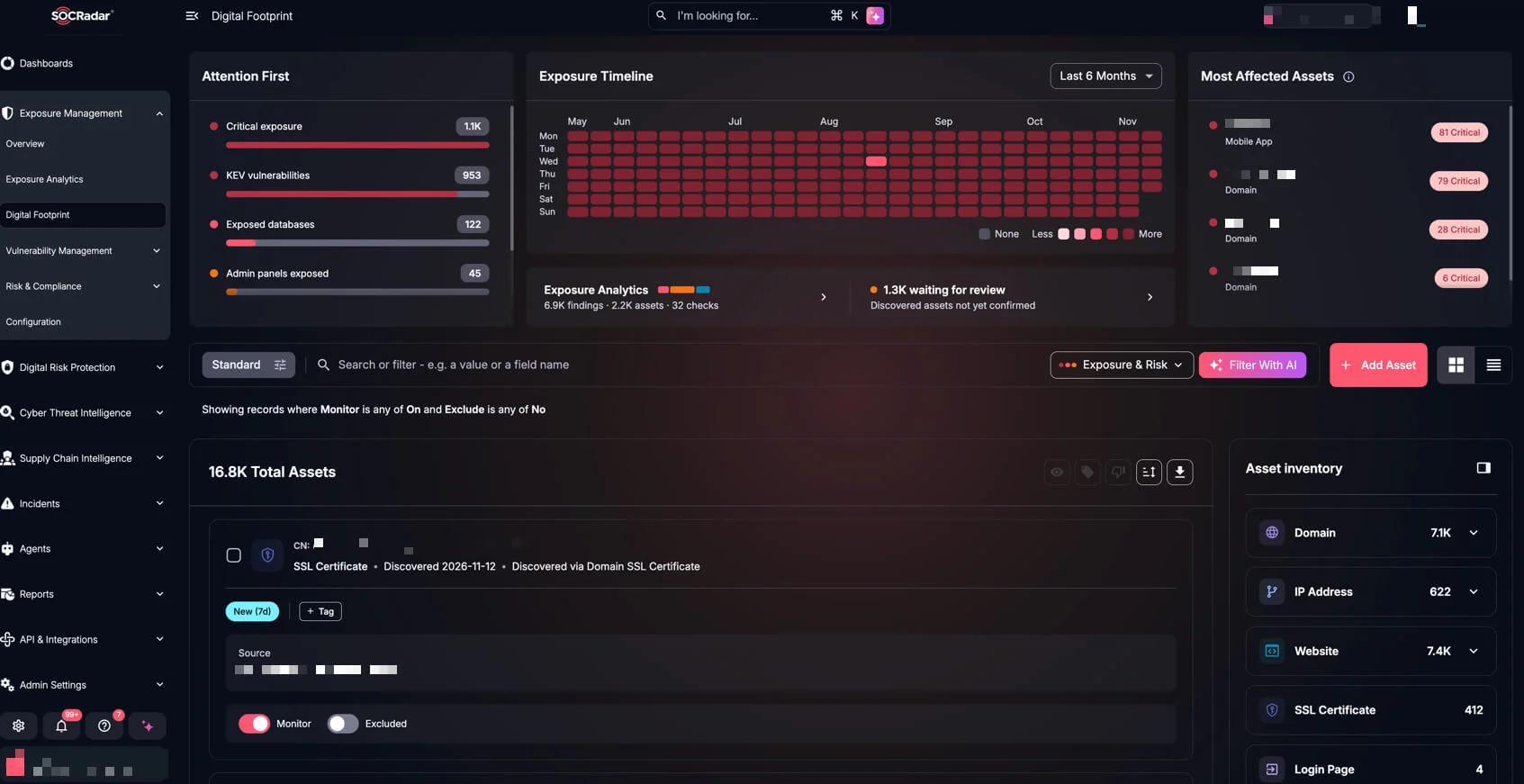
- Autonomous Exposure Management: Finds internet-facing assets running Java-based services such as Jira, Confluence, Jenkins, and Keycloak, so teams know which to patch or restrict first
- Advanced Dark Web Monitoring: Surfaces attacker chatter about Java4Shell exploits across criminal forums, marketplaces, and encrypted chat channels
- Supply Chain Intelligence: Extends vulnerability monitoring to third-party vendors, helping teams spot suppliers whose exposed services may be affected
As exploitation reports and vendor fixes for Java4Shell keep changing, SOCRadar keeps that picture current, so teams can act as soon as the risk shifts.

Source: SOCRadar · 2026-11-18