A tampered build of Anthropic’s Claude Code extension for VS Code-compatible editors planted an SSH backdoor on developers’ machines, researchers at macOS security firm Phorion have found. The company spotted the malicious package, version 2.1.313, on Open VSX, an open-source marketplace for VS Code extensions run by the Eclipse Foundation. VS Code’s default extension store is Microsoft’s Visual Studio Marketplace, where no malicious version has been reported. Its terms of use limit it to Microsoft’s … More →
Ahmad Umar Agha, a Syrian Electronic Army hacker known online as “Th3Pr0,” has been sentenced by a U.S. federal court to 42 months in prison for his role in a hacking conspiracy that targeted Western news outlets.
The conspiracy was organized and led by members of former Syrian President Bashar al-Assad’s inner circle, including the commander of Syria’s General Intelligence
The US Department of Homeland Security has had the details of more than 41,000 staff, including ICE and CBP agents, published online. Not ideal for an organisation with “Security” in its name.
Read more in my article on the Hot for Security blog.
A modern organization protects its information systems with a whole suite of technologies that generate thousands of security alerts every day. Looking at these alerts in bulk, you’ll see that a significant share are false positives. Ideally, these alerts would be filtered out automatically so that analysts could focus on the ones that may point to a real incident. However, writing filters is a time-consuming task in itself. To create a correct filter, an analyst needs to:
Review the logs
Identify the source of the activity
Define filtering boundaries
Choose filtering criteria
Write a rule
Check that the filter is robust
This post looks at how filter creation itself can be automated to reduce analyst workload.
Filter validity criteria
In the context of security alerts, a filter is a combination of event field values that marks a detection as a false positive and not worth the analyst’s attention. Filters can be generated for any combination of event fields, but not every combination yields a valid filter. That’s why we need to define validity criteria: conditions showing that a specific filter actually removes noise and doesn’t suppress useful alerts.
Detection rules in security systems typically contain a set of conditions, and each of them can generate an alert. A specific event triggers a given fragment of a detection rule. The set of events that a given fragment responds to is what we’ll call its context. A good filter should cover the entire context where possible, without going beyond it. Filters that are too broad or too narrow are useless. For example, a filter based solely on PowerShell would exclude too many events, including some that deserve the analyst’s attention. Most of the filtered events would also be unrelated to the rule in question. A filter on a specific ID, on the other hand, would cover only one event, which may never recur.
Problems in filter generation
We can run into a number of problems when creating filters. First, events often contain an excessive number of fields (around 400 on average), and most of them aren’t needed for filtering. At the same time, generating and ranking combinations of these fields is also fairly resource-intensive. So, the first step is to discard the irrelevant fields and keep only those worth using in the filter. For example, out of 400 fields in an event, four may be enough for filtering.
Another problem is string normalization. Field values (for example, the path to the same application on different systems) can vary depending on system settings, user folder names, and so on. For a filter to account for all these variations, the strings must be normalized. For file paths, in particular, you can replace the drive letter and user folders with standard environment variables and convert all paths to a single case.
Finally, if a filter completely mirrors the query of a detection rule, it effectively disables that rule. To fix this, remove the event fields used in the detection rule from the filter. For example, if a rule triggers on a file path, there are two ways to filter out unwanted alerts:
In the filter, use fields other than the file path.
Use a part of the file path that the rule doesn’t use. For example, for the rule file_path: ".../something.exe", you can set up a filter that excludes events with the user/unique_files/ directory in the file path.
Filtering security alerts with an algorithm
Given the problems described above, automatically generating filters for security alerts should consist of the following steps:
An analyst receives a security alert that they assess as a false positive and uses the filter generator.
The generator takes the 400-field event from the alert, along with the rule that triggered on it, and determines the context.
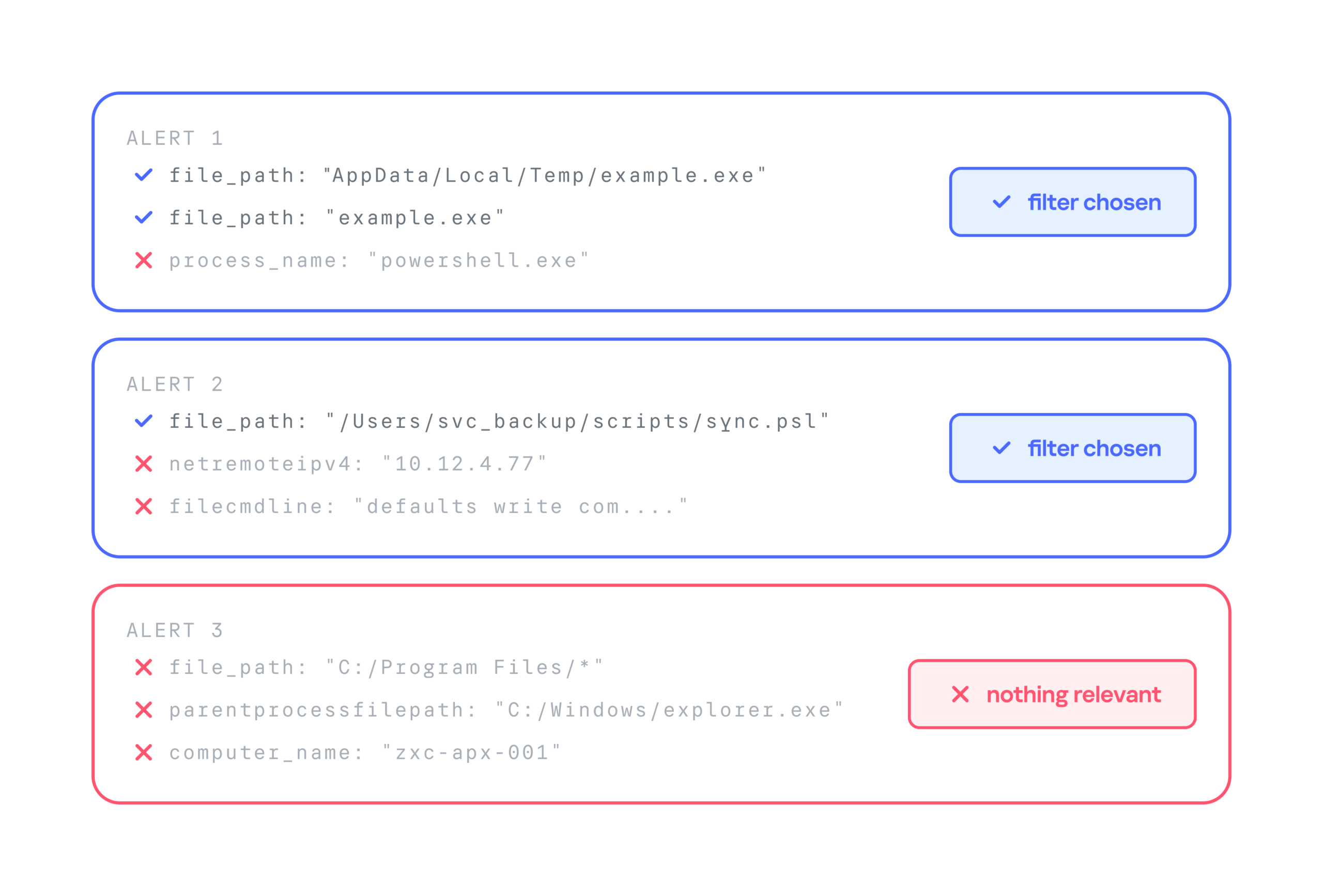
The generator selects the fields that are relevant to the filter.
The generator normalizes the strings.
The generator builds different combinations of the selected fields. To do this, we applied the FP-Growth (frequent pattern growth) algorithm to the context determined earlier. FP Growth builds a tree of frequently occurring items (fields) from a dataset (in our case, the context) and discards items that aren’t frequent enough. This reduces the number of combinations to check, which lowers the cost of finding the most relevant ones.
The generator ranks the resulting combinations and offers the analyst the top three to choose from.
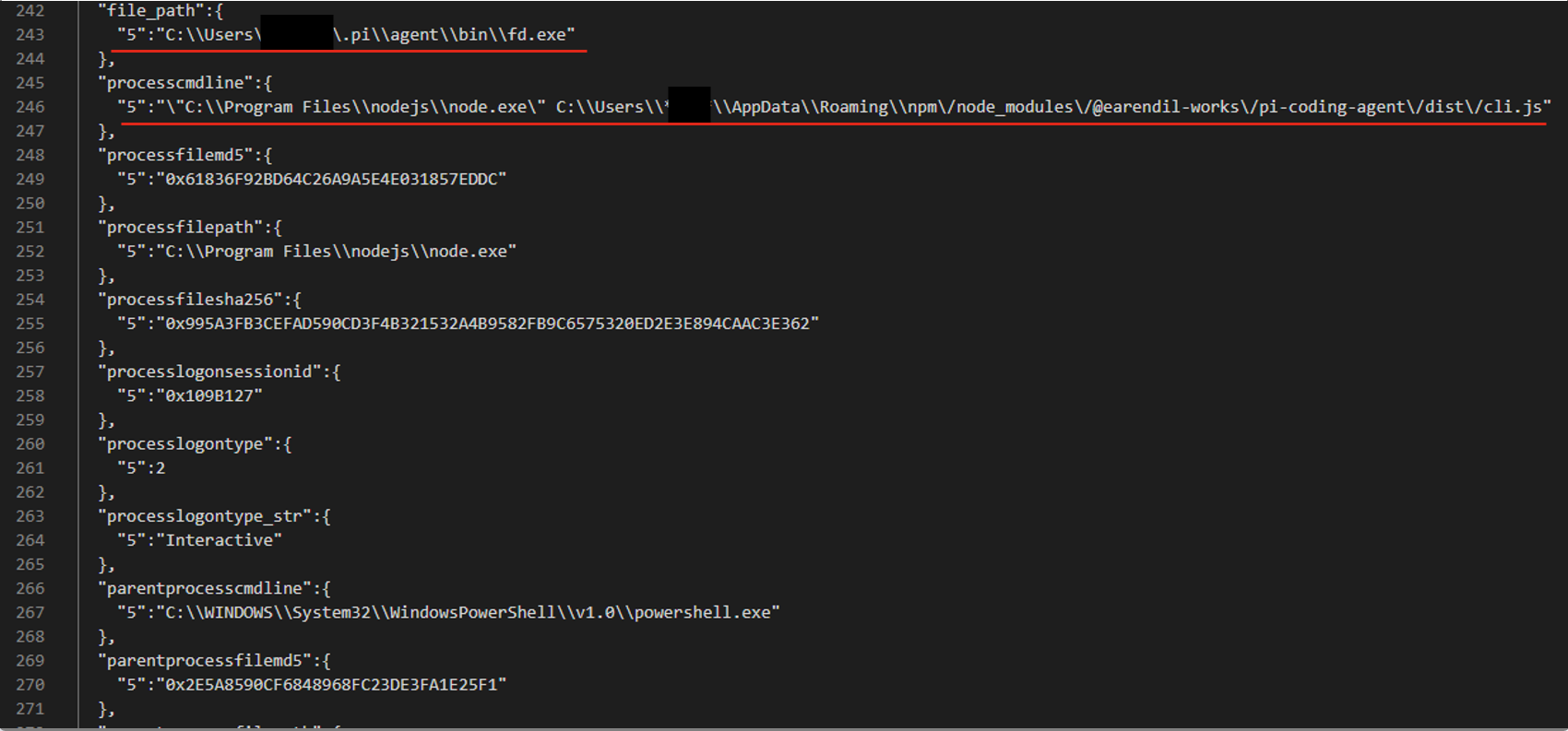
For example, consider an event described by the following JSON:
After generating and ranking the combinations, we got three filters based on file paths:
processcmdline:("nodejs\\node.exe" AND "*****\\appdata\\roaming\\npm\/node_modules\/pi-coding-agent\/dist\/cli.js")
file_path:"*****/.pi\\agent\\bin\\fd.exe"
processcmdline: "programfiles\\nodejs\\node.exe"
The last filter turned out to be too broad, but the analyst marked the other two as valid.
Pros and cons of the algorithmic approach
The algorithmic approach to filter generation has several advantages. First, it’s simple and deterministic: the same alert always produces the same result. Second, it’s interpretable, meaning we can see why a given combination ranked near the top of the list and why a particular field didn’t make it into the list of candidate fields at all. Third, the stages of the process are independent of each other, so individual steps can be improved and tuned without the risk of breaking the algorithm elsewhere. Finally, it has no external dependencies or models, which makes it easy to deploy in any customer environment.
However, it also has drawbacks. The first is its dependence on context. If there’s no context for some reason — for example, the rule’s first-ever trigger — a filter can’t be created. The second problem is string normalization. There’s a high chance of running into atypical cases that the normalization rules don’t cover. Often such cases can’t be described correctly at all, because they contradict each other.
These problems can be solved with large language models (LLMs). When an LLM generates the filters, no context is needed, because the LLM doesn’t iterate over or rank combinations. The LLM also takes a more flexible approach to string normalization, including non-standard cases. That said, an LLM doesn’t have to be involved at every stage of the generation process. We decided to keep the algorithmic solution where it works well. For example, a simple algorithm selects suitable fields without errors, so we didn’t move this stage to the model.
Filter generation with an LLM
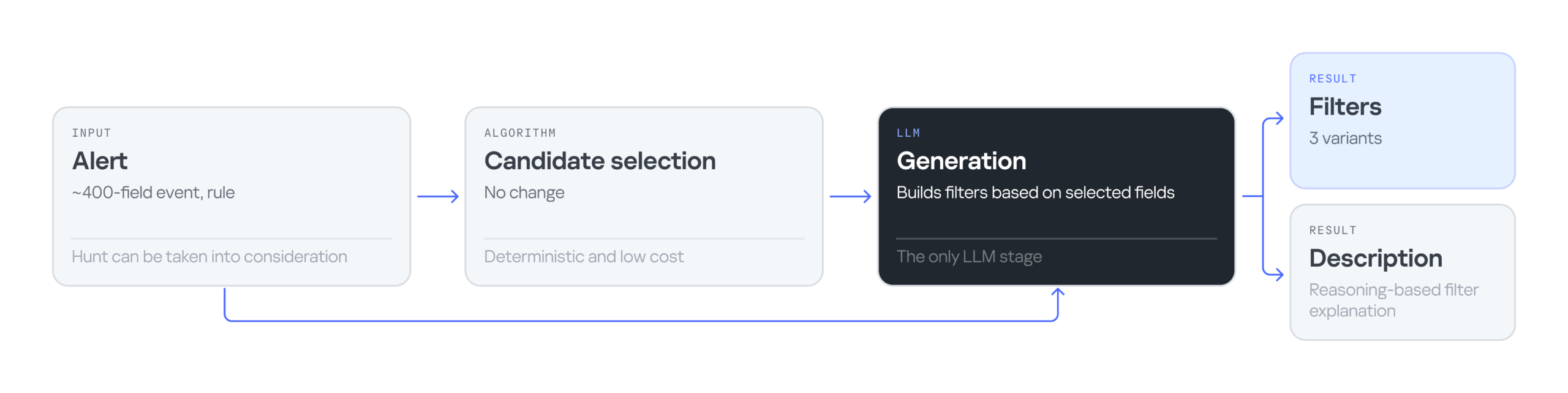
The LLM-based filter generation looks like this:
The input is still an alert containing an event with 400 fields, plus the rule that triggered on that event. Then an algorithm selects the most suitable fields for the filter. Next, the LLM processes the input — the event, the selected fields, and the detection rule — and generates three filter options along with an explanation for them. The explanation helps the analyst understand why these particular filters were suggested and make an informed choice.
Consider the following event in JSON format:
The LLM suggested three filter options that all contain the same command line fragment:
file_path: "\\WindowsPowerShell\\powershell.exe" AND filecmdline: "Get-VM -Name kafka\*"
filecmdline: "Get-VM -Name kafka\*"
filecmdline: "kafka*"
As in the previous example, two of the three output filters were valid. The last one was too broad to be usable. The analyst chose the first filter with minor edits:
file_path: "powershell.exe" AND filecmdline: "Get-VM -Name kafka\*"
Pros and cons of generating filters with an LLM
Using an LLM solved the problems of purely algorithmic filter generation: dependence on context and errors in string normalization. However, the single-request approach had its own drawbacks. First, it had no output validation. The LLM returned filters as-is, with no syntax check and no way to correct errors. Second, unlike in the algorithmic version, all filter generation tasks were handled by a single system prompt. As a result, a minor fix in one place could break the logic in another.
Using multiple AI agents
To address the problems of generating filters with a single model and a single system prompt, we tried distributing the tasks across different LLM agents. In this version, we brought in agents as early as the stage of selecting relevant fields. The chain includes four agents in total:
Selector: selects the relevant fields.
Generator: generates filters.
Validator: evaluates the generated filters. If the filters are found to be invalid, it returns the task to the generator. If the selected fields are found to be irrelevant, it starts a new field selection cycle. If the filters pass validation, or the limit on regeneration attempts is reached, the valid filters (or the best ones available) are passed to the analyst.
Commentator: analyzes the output filters and explains which field values were used and why.
For the following JSON event, the agents produce three valid filters based on the file path.
The filters differ in the additional parameters that support the detection:
file_path:"sysvol\\domain\\scripts\\logon.bat"
file_path:"sysvol\\domain\\scripts\\logon.bat" AND file_md5:"0x7..6E"
autorun_entry: "Group Policy\\State" AND file_path: "SYSVOL\\domain\\scripts\\logon.bat"
Pros and cons of the agent-based approach
LLM agents give us a system that can validate and correct filters. Its modular architecture also lets us tune and improve different stages of generation independently. However, this approach makes more LLM calls than the previous ones, so the system is slower. It also depends on access to a model, which may not be available in the organization’s isolated environment.
Evaluating the filter generation system
To evaluate how well the filter generation system works, we use two main metrics:
Approval rate. For each security alert, the system suggests three filters. If the analyst selects at least one of them, we count the generation as successful. For example, in the case below, the approval rate is 2/3.
False positive reduction rate (FP drop). This metric shows how much a filter helps reduce the number of false positives. It can only be measured over time, because we need to compare the number of false positive alerts received during a set period before and after the filter is deployed.
Below is a comparison of the three filter generation approaches by these metrics:
As the results show, LLMs significantly improve the efficiency of filter generation. At the same time, the LLM agentless and agent-based approaches perform almost identically. So we chose the simpler and faster option: an LLM with a single system prompt. As a result, we cut false positives by 99%, increased the number of filters generated per day by 28%, and made analysts’ alert handling 17% more efficient.
Takeaways
Practice has shown that filter generation can be automated effectively. We’ve looked at several options for automatically generating filters for false-positive security alerts: a purely algorithmic approach, an LLM-based approach, and an approach built on a group of LLM agents. All of them can generate valid filters and make the analyst’s work much easier, but each has its own pros and cons.
The algorithmic approach scored lower on the evaluation metrics, but in two-thirds of cases, it still produces filters that satisfy the analyst. It works especially well when there’s already a set of similar events to filter out, meaning enough context has accumulated. The algorithmic generator can also be deployed in any environment. Both standalone LLM and multi-agent LLM approaches show high accuracy, and their results differ only slightly, so the slower agent-based approach looks excessive at this stage. If an LLM is available, the best option appears to be a single model that handles several stages of the generation cycle.
It’s a superlative achieved again and again: The current election cycle is the most expensive on record, according to AdImpact, likely to be surpassed only by the next one. North of $16 billion have been raised ahead of Tuesday’s looming elections, with ad spending in House and Senate races topping $4 billion. Mega-donors this election season have overwhelmingly backed Republicans with contributions largely flowing from AI, crypto, and online gambling interests.
The Intercept tracked how super PAC spending is flowing into the midterms and how growing public skepticism of special-interest money in politics is affecting campaign strategies. Hundreds of candidates are still taking donations from the American Israel Public Affairs Committee and its super PAC, the United Democracy Project, despite public sentiment turning against the pro-Israel lobby.
“The data overall reveals that [AIPAC is] still spending a ton of money on a lot of races, and more often than not, their candidates are still winning,” Intercept managing editor Maia Hibbett told The Intercept Briefing. “It is still quite meaningful money.”
Artificial intelligence super PACs have also poured tens of millions of dollars into this election cycle, most of it on just a few races in the primaries. The two leading AI super PAC networks, affiliated with OpenAI or Anthropic, dropped a whopping $50.7 million on the primaries, but are noticeably spending much less in the lead-up to the general election, $8.5 million — likely responding to public backlash in the same way that AIPAC has.
“The polls are just so startling on the public’s transformation on AI and data centers over the last year. … The entire life cycle of these AI super PACs, which started about a year ago, has followed that evolution of the public’s opinion,” said Intercept politics reporter Matt Sledge. “One of the things that’s been really interesting in the general election races is … candidates [trying] to paint themselves as the more pro-AI safety, pro-AI regulation candidate.”
This week on the podcast, host Jessica Washington speaks to Hibbett and Sledge about the spending trends in the most expensive election cycle to date and unpack the intended impact.
“No matter which party gets control of either or both houses of Congress, there will be a lot of people elected next week who got there on the backs of Big Tech and special interests,” said Hibbett.
“They’re backing a lot of people in safe seats who don’t really have a tight election,” Sledge added. “The goal may just be to buy themselves a few friends in Congress, because sometimes in Congress, it’s just as good to have a few people who can stop regulation as it is to have people who can shape and actually pass laws.”
For more, listen to the full conversation of The Intercept Briefing on Apple Podcasts, Spotify, YouTube, or wherever you listen to podcasts.
Transcript
Jessica Washington: Welcome to The Intercept Briefing, I’m Jessica Washington, politics reporter at The Intercept.
On Tuesday, voters will head to the polls to cast their ballots in the most expensive election cycle ever in terms of campaign ad spending, even outpacing past presidential elections. That’s according to AdImpact.
North of $16 billion has been raised this cycle, with ad spending in House and Senate races topping $4 billion. Billionaire Elon Musk has dumped hundreds of millions into races across the country, using his enormous personal wealth to sway the election in favor of Republicans. Musk, who has a home and multiple businesses in Texas, has taken a particular interest in the state’s Senate race between Republican candidate Ken Paxton and Democratic candidate James Talarico.
Most of the money from Musk and other donors has flowed not to candidates, but to powerful super PACs representing a variety of different special interests.
That super PAC spending is the subject of my colleagues, Intercept politics reporter Matt Sledge and senior politics reporter Akela Lacy’s new project, tracking how money is flowing into the midterms.
Maia Hibbett, managing editor for The Intercept, and Matt Sledge join me now to talk about the project and how big money is shaping the midterms.
Matt, Maia, welcome back to The Intercept Briefing
Maia Hibbett: Thanks for having us.
Matt Sledge: Thank you for having us, Jessie.
JW: Maia, I want to start with you. As a part of the super PAC project, The Intercept tracked how millions of dollars flow through the pro-Israel lobby in the United States.
What did the reporting reveal about how the American Israel Public Affairs Committee and affiliated groups like the United Democracy Project mask their influence in U.S. elections in a political landscape where AIPAC’s contributions and endorsements have become largely politically toxic?
MH: The reporting showed that AIPAC and its affiliated super PAC UDP are a little bit weakened, but they’re still pretty dominant.
The narrative out of this midterm cycle, especially during the primaries, was largely focused on a few high-profile races that an AIPAC-backed candidate lost — and that was a huge shock. These big upsets were AIPAC or UDP or a related group that, we can talk about a little bit later, had poured money into, and then the candidate didn’t succeed.
But if you look at it in the aggregate, what the data overall reveals is that they’re still spending a ton of money on a lot of races, and more often than not, their candidates are still winning. It is still quite meaningful money. And even though AIPAC has been discussed as going underground, they are still directly invested in a lot of races.
JW: I want to get into AIPAC’s shifting strategy and their latest announcement on that. But first, Matt, I wanted to talk about your reporting. AI super PACs have poured tens of millions of dollars into this election cycle.
What do we know about the people and companies behind these super PACs? This may seem obvious, but what are they hoping to gain with this level of spending? Are there specific examples of friendly legislation these varied interest groups are hoping their candidates will see through if they win?
MS: To answer your second question, I think it’s really more about setting the tone for future regulation at the federal level. You have two big super PAC networks. One is affiliated with OpenAI, and they broadly favor a laxer regulatory scheme for AI. Then there’s another network that’s affiliated with Anthropic that paints itself as supporting a stricter regulatory scheme.
“It’s really more about setting the tone for future [AI] regulation at the federal level.”
Skeptics will point out that these networks are both backed by big AI companies. So at the end of the day, they’re probably going to favor regulation that is favorable to the AI companies. I get into this a little bit in my story, but, just in the last few months, there’s also been this constellation of other smaller groups that are sometimes backed by individual employees at these firms or just by people concerned about AI that are pushing for stricter regulatory regimes and aren’t as directly connected to one of the big companies.
JW: Matt, I’m curious about the impact on voters here. CNBC analysis from early October found that mega-donors this election season were overwhelmingly backing Republicans with contributions largely flowing from AI, crypto, and online gambling interests: “Fourteen of the 20 largest donors and donor groups this election cycle have exclusively or nearly exclusively backed GOP candidates or aligned groups.”
Matt, are we seeing voters become more receptive to Republicans as a result of all this ad spending? Is it working on the voter base?
MS: It’s always hard to tease out the impact of an individual super PAC or industry, because you have to keep in mind that a lot of the time, if you’re a crypto super PAC, or an AI super PAC — or more recently, a prediction market super PAC — they are not running pro-crypto or pro-AI ads.
They are running ads that look very similar to everybody else’s. Often, they’re doing negative campaigning that campaigns don’t want to do themselves, and they have such vague names that they’re not associated with crypto or AI. So I do think ads have an impact on the races, but overall what we’re seeing in polls is that it’s not a great environment for Republicans.
So it may have served, just writ large, to potentially soften the blow to Republicans this time around. It does help them to have this many corporate allies, but it may still be overwhelmed by a blue tide.
JW: That makes a lot of sense in terms of just, this is a bad environment for Republicans. They have a president who is unpopular. We have an economy that is not amazing right now. It makes a lot of sense that despite all this ad spending, the baseline of the election is not in favor of Republicans.
Maia, I wanted to get back to something that you had said a little bit earlier about AIPAC and their shifting strategy. AIPAC recently announced that they would no longer officially endorse candidates or give money directly to campaigns.
Were we seeing an early signal of shifting strategies from AIPAC during the 2026 midterm elections? And what does this change actually mean for AIPAC’s influence on our elections?
MH: I’m so glad you asked, because we actually noted early in the 2026 cycle that AIPAC was starting to retreat and change its strategy. Our colleague Akela Lacy wrote a story in December 2025, and the headline was, “AIPAC is Retreating From Endorsements and Election Spending. It Won’t Give Up Its Influence.” I encourage anyone to go back and read that story because it was really prescient about what we would see in the cycle to come, which is that AIPAC used to do all of its spending behind closed doors.
After it spent so much money in that midterm cycle and in last cycle‘s 2024 races, and as public sentiment started to turn against the pro-Israel lobby’s interests and people became very critical of the U.S. support for genocide in Gaza, AIPAC started to essentially return to its roots.
I think this is really interesting because in the press it has been talked about as a very new strategy. But really, it’s more that AIPAC is returning to the way it used to do business.
JW: Is that as effective as a strategy — the old model that they had? Should we expect that it’ll have just as much influence on elections as they did previously?
MH: It’s a good question. I don’t know how effective it will be as a strategy. There’s a lot more scrutiny on AIPAC now than there was a few years ago, and so it’s much more difficult for them to hide what they’re doing because there are journalists like us who are going to try to follow the money and say, maybe you gave to something that’s called Elect Chicago Women, but it’s actually from UDP, which is the super PAC for AIPAC.
I think in some cases, they can’t get away from the public perception that now exists. But on the other hand, there are many voters who might not really pay attention to the name of the PAC that sponsored the ad that they saw, and then go look it up and see where the money came from. So it remains to be seen how effective it will be.
“It’s much more difficult for them to hide what they’re doing because there are journalists like us who are going to try to follow the money.”
JW: Not everyone is reading The Intercept before voting, as they should, but it’s fine.
Matt, I wanted to get back to you because there’s a lot happening with these big AI super PACs. You noticed in your reporting that, after spending a lot in the primaries in New York in particular, but in other places as well, the big AI super PACs have gone pretty much quiet in the general election.
Are AI super PACs responding to public backlash in the same way that AIPAC is? What have you observed in terms of why they’ve gone a little bit quieter?
MS: In response to your question about backlash, I think the answer is yes.
“It’s just a dramatic decline in spending from the primaries to the generals — even though they still have money they can tap.”
They’re on this kind of accelerated timeline going through what AIPAC went through over the course of five years but essentially in five or six months. The polls are just so startling on the public’s transformation on AI and data centers over the last year. It’s just such a rapid change in public opinion, and the entire life cycle of these AI super PACs, which started about a year ago, has followed that evolution of the public’s opinion.
It’s just a dramatic decline in spending from the primaries to the generals — even though they still have money they can tap. Leading the Future, which is the OpenAI-aligned network, they started first, and then the Anthropic-aligned network, Public First, they started a few months later as a response to the Leading the Future network.
So it seems like, from what we’ve been able to tell, Leading the Future scaled back on spending as the general election came about, and Public First responded in turn and also scaled back its operations. That doesn’t mean they’re not spending anything, and we have seen a slight uptick in the final few days of this election when ads are probably just less effective than they would have been a couple weeks ago.
“If Darline Graham narrowly gets away with winning her race in South Carolina of all places … then you can still say that Leading the Future and the AI industry played a pretty important role in the general race.”
One really notable race is now South Carolina, where Leading the Future is helping prop up Sen. Darline Graham, who hasn’t been a great fundraiser on her own. So there’s actually still a world where AI plays a decisive role in this election in terms of control of the Senate.
If Darline Graham narrowly gets away with winning her race in South Carolina of all places, and that narrowly hands control of the Senate back to the Republicans, then you can still say that Leading the Future and the AI industry played a pretty important role in the general race.
JW: Just to be clear, you’re referring to Darline Graham, Lindsey Graham’s sister, correct?
MS: That’s correct.
JW: Maia, speaking of Big Tech, you also edited a story from Intercept reporter Jonah Valdez looking at how tech leaders, including John Hering, are dumping millions into the LA city attorney race to block Marissa Roy, a DSA-backed candidate, from winning. What is going on here — why such an interest in a race most people are likely not paying any attention to?
MH: City attorneys are one of those jobs that, as you said, a lot of voters don’t pay attention to them. I think a lot of people in cities all over the country maybe couldn’t tell you who the top lawyer of whatever city they live in even is. But this is a job that is largely tasked with enforcing regulations and laws and making companies that might be based in that city or might operate in that city comply with them.
Marissa Roy, this DSA-backed candidate, is currently a deputy attorney general for the state of California, and she’s one of the people who helped the state prosecute this historic Meta settlement where Meta ended up having to pay $17 billion for harms to children using its technology.
We don’t know exactly why John Hering and other tech leaders, like the founders of Ring and Tinder and investors in Anthropic and SpaceX, are spending so heavily in this race, but you might be able to conclude that they’re interested in preventing a person who just helped carry out this huge settlement against Meta from becoming the city attorney of LA.
Some of them are funding a group that’s called Neighbors for John McKinney, which is backing the opponent in the race. John McKinney is the other candidate, and he is much less likely to win, but is propped up now by a lot of spending. They frame him as a tough-on-crime candidate; they say he’s going to restore order to LA, help clean it up is the idea.
Like Matt was saying, often these tech investments in races don’t actually foreground the interests of Big Tech, and they don’t say explicitly, “We want to stop this person from coming into office because we’re worried they’re going to regulate our industry.” Instead, they find a different issue and spend money on that.
It’s also worth noting that John Hering, his group, frames John McKinney as a lifelong Democrat and very anti-MAGA, is the language they use. But John Hering himself is a big ally of Elon Musk. He has been an eager investor in his companies. He said Musk was an “American hero” this year, and he has spent pretty heavily also to support Musk’s America PAC and the Trump campaign after previously spending on the Hillary Clinton presidential campaign.
Like many Silicon Valley types, he’s had an evolution. And although he lives in San Francisco, he also spent in favor of Spencer Pratt for LA mayor.
JW: Wow. Yeah, Big Tech has really come a long way from the ’08 years in terms of their relationship with Democrats and Republicans, and propping up Spencer Pratt.
Matt, I want to bring you in and get your perspective and kind of big picture. What has made this election cycle so popular for Big Tech?
MS: When it comes to AI and crypto and the prediction markets, it’s knowing that the next few years are really going to be critical for them in terms of regulation. These are all fairly young industries, and the rules haven’t been set yet. The Trump administration is doing its best to set them, but Congress has not had a final word on any of those industries.
They see a chance to shape the rules in a way that favors them, and they’re just using the old Washington playbook of spending a bunch of money on campaigns and a bunch of money on lobbyists to try to shape the rules in their favor.
JW: Is this just also a matter of them having more money to play with than they’ve had before? Is this something tech probably would have done years ago if they’d had this access to capital? Or is this really, like you said, just they’re aware that there is existential risks to their industry if they don’t?
MS: Tech for the last few decades has had a lot of money. It’s just been a huge part of the U.S. economy. But I think this move into more regulated spaces is maybe what’s newer.
When Microsoft is creating an internet browser or a word processor, that creates potential antitrust issues, and they have to spend political money in that sense. But they’re not playing in the same kind of highly regulated financial spaces, and nobody ever thought that Clippy posed an existential risk to humanity. So we are moving into new territory when it comes to techs.
JW: I miss Clippy. That is my one comment on that.
I want to get both of you back in here. We’ve been talking about some of the biggest donors in American politics today, and a few special interest groups in particular who’ve obviously been experiencing public backlash — AIPAC, AI, and data centers.
What do you make of this new record-level spending in a midterm election in particular? We’ll obviously have more answers on this next week, but from what you’ve observed so far, is it having the intended impact on voters? Maia, let’s start with you.
MH: I think to use the cop-out that we keep coming back to, we won’t really know if it worked with voters until after the results next week. But it’s clear in this midterm cycle and maybe this is a reminder of kind of a perpetual truth in, when it comes to money in politics, that these big spenders are always going to fund candidates on both sides of the aisle. Often election narratives and questions about special interests will really look to one party or the other and try to map this kind of spending onto partisan issues.
While some of that certainly happens, I think no matter which party gets control of either or both houses of Congress, there will be a lot of people elected next week who got there on the backs of Big Tech and special interests.
JW: Matt, I know you’ve seen some specific examples of this impacting elections. Can you talk about that a little bit?
MS: One of the things that’s been really interesting in the general election races is this race from candidates to paint themselves as the more pro-AI safety, pro-AI regulation candidate.
I’ve done some reporting in Michigan’s 7th [Congressional] District, where a co-founder of the Sunrise Movement is trying to unseat an incumbent Republican, and he has from the start really run on being an anti-data center candidate, campaigning with local activists in small towns of a few thousand people.
His Republican opponent is now also trying to paint himself as a data center skeptic — using different language, more language about local control than about big, bad companies.
But there’s been such a backlash that we’ve seen some changing tactics from the big AI super PACs in the runoff. One has donated money to a nonprofit that’s more focused on building support for data centers. Good luck with that, I guess.
And then another, the Anthropic-aligned network, has essentially handed off money to a pro-Scott Wiener super PAC in California that already existed and already has funding from other tech leaders in the San Francisco area. But that donation has generated this whole fight between Scott Wiener and his opponent, Connie Chan, over who is the more pro-AI regulation candidate now. So it’s a lot of candidates fighting to be the more pro-regulation candidate.
Just thinking back to your question about the effect on voters, I think for the super PACs and for their funders, the impact on candidates may ultimately be more important, on elected officials. They’re backing a lot of people in safe seats who don’t really have a tight election. The goal may just be to buy themselves a few friends in Congress, because sometimes in Congress, it’s just as good to have a few people who can stop regulation as it is to have people who can shape and actually pass laws.
JW: That’s a good point. Speaking of the election, which we know is just days away, what are you two going to be following closely next week? Maia, I want to start with you.
MH: There’s obviously a lot to follow next week, and more races than we can keep track of. One I think that will be very interesting that I was thinking about in terms of AIPAC spending — when Matt just mentioned this thing about AI groups backing candidates who are not in close races — is, of course, the Senate race in Maine.
One of the interesting takeaways we found in this AIPAC project is that in the primaries when AIPAC was spending, as it does in, in various races, one of the top recipients of its money was Susan Collins — who at the time did not have a primary challenger, but it spent heavily to support her primary campaign.
So we’ll obviously watch the Collins–Jackson race in Maine. We have a reporter going there. Matt’s going to go to Michigan. We also have a reporter going to Texas to track some of the big Senate races. Depending on how the results look, I think we’ll pretty quickly be pivoting to accountability for, coverage for the people who are elected, who, maybe entered office vowing not to take corporate PAC money or not to take special-interest money, and to keep an eye on those now Congress members and see if they vote like it or if they continue to have that policy once they’ve been elected.
JW: And Matt, what are you following?
MS: As Maia mentioned, I will be in Michigan. Super interested in that 7th District race that I mentioned between Will Lawrence and Tom Barrett. But then the race everybody’s going to be spinning and talking about for weeks probably: the Mike Rogers/Abdul El-Sayed race. It just is going to carry so much narrative heft going forward about what the voters were trying to say.
Where are you going to be, Jessie? What are you going to be up to?
JW: I will be in D.C., and I’ll be looking at what it means to have yet another election with the National Guard in town and essentially in an occupied city.
I’ll also be looking into what it would mean for the district to have a socialist mayor, Janeese Lewis George, who is almost certain to win on Tuesday, particularly when it comes to ICE and the Metropolitan Police Department’s collaboration with ICE. That’s going to be something I’m really keeping an eye on, not just on Election Day, but going forward to see if she can implement some of these really bold ideas that she’s proposing in a city that’s very constricted in what it can actually do because of federal law.
But that’s enough previewing from me. We’re going to leave it there. Maia, Matt, thank you so much for joining me on The Intercept Briefing.
MH: Thanks again.
MS: Thanks for having us.
JW: And thank you for listening. Next week we’ll be back in your feed early with a special midterm election episode, so stay tuned.
That does it for this episode. We want to hear from you. Tell us what you’re following or want to see more coverage of. Email us at podcasts@theintercept.com or leave us a voice mail at 530-POD-CAST, that’s 530-763-2278.
This episode was produced by Laura Flynn. Jordan Uhl is our social media producer. Ben Muessig is our editor-in-chief. Maia Hibbett is our managing editor. Nara Shin is our copy editor. William Stanton mixed our show. Legal review by David Bralow. Slip Stream provided our theme music.
This show and our reporting at The Intercept do not exist without you. Your donation, no matter the amount, makes a real difference. Keep our investigations free and fearless at theintercept.com/join.
And if you haven’t already, please subscribe to The Intercept Briefing wherever you listen to podcasts. Do leave us a rating or a review, it helps other listeners find our reporting.
In the spring of 2005, the United Nations convened more than 100 of the world’s top scientists in the medieval town of Oviedo, Spain. They were there to finish writing a paradigm-shifting report about a technology that they hoped could help stop climate change.
To celebrate the report’s impending completion, the meeting’s hosts handed out bottles of cava, Spanish sparkling wine, with tongue-in-cheek labels stating that they were to be opened only by those who truly believed it could work.
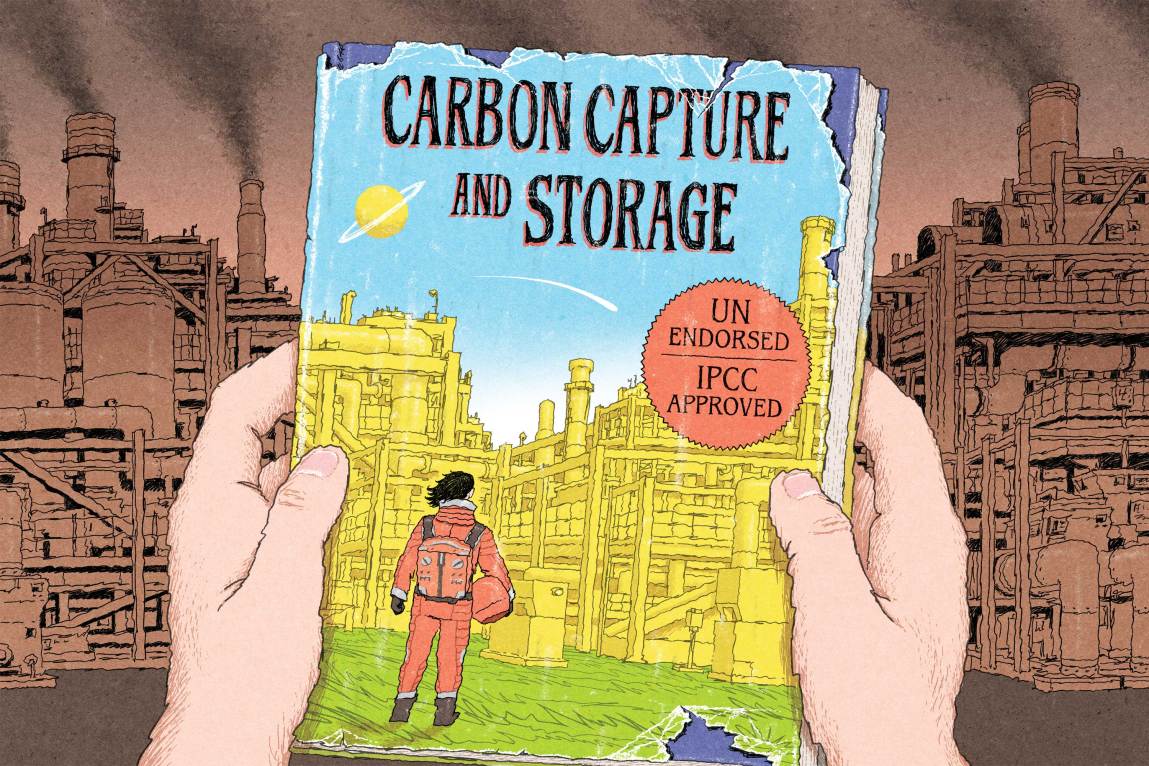
Belief was necessary because the technology — carbon capture and storage, or CCS — had barely been tested. The idea was simple: strip carbon dioxide from smokestacks before it could flow into the air and warm the planet. Then pump it into a porous part of the Earth’s crust and leave it there. Forever.
The experts in Oviedo had stacks of papers proving that parts of the process worked. But major questions remained about how much space exists inside the Earth to store the CO2, how effectively it could be monitored and whether the poisonous, concentrated gas would reliably stay underground.
Tasked with wrangling roughly three dozen of those scientists toward consensus was Sally Benson, a geoscientist from Lawrence Berkeley National Lab who was co-leading the report’s chapter on underground storage of carbon. After a quarter-century of studying how fluids and gases move beneath Earth’s surface, she was an unimpeachable authority on the subject. She was also a savvy and diplomatic leader, skilled at managing rooms full of big egos and big tempers. It was proving handy in a process that had at times devolved into unruly debate.
The scientists had clashed for years over what the report should say, first at a meeting in Canada, then in Norway, Australia and Brazil. The evidence was scant. Three large-scale experiments were underway, but only one — a Norwegian operation that captured carbon from a natural gas field and pumped it under the bed of the North Sea — had rigorously tested permanent storage. There, the injected CO2 astonished engineers when it floated 700 feet upward through a series of geologic formations. To their relief, it hit a ceiling of shale that kept it underground, and the project was deemed a success. But with so little to go on, the scientists warned in their first draft that any broad statement about leakage risk would be “almost meaningless.”
The researchers were in Oviedo only because Saudi Arabia and other oil-exporting countries had pressured the U.N. to write the report despite the paucity of evidence, according to U.N. officials and records. The oil, gas and coal industries had spent years casting doubt on climate change while quietly fretting that policies to address it would one day put them out of business. The industry, documents show, saw CCS as a way to forestall that outcome, allowing the world to keep burning fossil fuels while simply burying the pollution underground. A U.N. report would bring the technology into the mainstream.
In turn, the U.N. hoped such a report would draw the oil-producing nations into its search for climate solutions. So despite objections from some nations and environmental organizations, which warned that the report would distract from the imperative to phase out fossil fuels, the U.N.’s preeminent climate science authority, the Intergovernmental Panel on Climate Change, went ahead. And for the first time, it invited a large contingent of industry researchers to join the scientists in writing the report, as well as several representatives from environmental groups. Benson’s chapter included authors and editors from Shell, Chevron and Saudi Aramco.
The process that followed would make some of the chapter’s scientists uneasy. The IPCC’s procedures stated that reports should assess the existing research on a topic based on peer-reviewed literature and that exceptions must be reviewed and clearly cited.
Bert Metz, one of the highest-ranking U.N. officials at the meeting, was pressing the group to come up with more definitive language about CCS’ potential. The report would be better if it could offer hard numbers, even where none existed in the literature: Precisely how many gigatons of storage capacity did the planet likely have? How long would a well-designed reservoir hold the CO2 injected into it? More than a year? A thousand years?
With so little evidence to work with, David Keith, a Canadian physicist, proposed a workaround: The authors could conduct an “expert elicitation,” taking an anonymous survey about what they expected the evidence to eventually show.
At first, not everyone was willing to go along. Some scientists worried that making what amounted to educated guesses would mislead the public, they told Drilled and ProPublica. Benson and Metz, though, both argued that on such an important matter informed advice was better than nothing.
In the end, the group agreed to take the survey and to keep it off the record — they would “burn it afterward,” Keith recounted, making no mention of it in the official report. When the meeting concluded, some of the scientists popped their bottles of cava in celebration.
“It’s not the hard science that you would prefer, obviously,” Metz would later tell Drilled and ProPublica.
Five months later, the IPCC published its special report, which would help legitimize CCS for a generation.
The 431-page document portrayed CCS as a potential savior for the climate that could enable countries “to continue to include fossil fuels in their energy mix.” It stated that using CCS could lower the cost of stabilizing global CO2 concentrations by at least 30% and that if fully supported by policy, it could account for as much as 55% of the world’s efforts to limit climate change through this century.
It acknowledged that there were still gaps in research and experience with the technology — offering extensive detail deep within its pages about the challenges and uncertainties of piecing together separate but proven steps in the CCS process. But its summary stated that “there are no major technical or knowledge barriers” to storing captured CO2 underground.
All of those assertions, however, rested on the critical determinations made by the scientists handling the storage chapter.
Benson’s group wrote that the planet offered vast CO2 storage capacity. Storage sites that were well selected and well managed, they said, were likely to retain 99% of the carbon pumped into them for at least 1,000 years.
Illustration by Chris W. Kim for ProPublica
A Consequential Decision
The scientists’ conclusions that day in Spain have had profound, compounding consequences.
The special report has been cited in thousands of academic papers, in legislative testimony and in media coverage validating carbon capture and storage as a realistic solution to global warming.
When climate forecasters built models, their calculations assumed CCS would work. When governments and corporations began making so-called “net zero” pledges, promising to subtract as much CO2 from the atmosphere as they add, they assumed CCS would work. When policymakers gave energy companies billions of dollars in public funds to develop “clean coal,” they assumed CCS would work.
These presumptions shifted the world’s discourse from how to limit carbon pollution to how to remove it from the atmosphere after the fact.
Enthusiasm for the technology has only grown. This spring, California embarked on one of the world’s largest carbon burial endeavors yet. While President Donald Trump eviscerated most programs addressing the climate, he has expanded subsidies for CCS. There are more than 100 applications for storage sites pending in the U.S. alone. U.N. analyses suggest that to achieve environmental goals, a CCS industry the size of the entire global oil production industry would have to be built by 2050.
But 21 years after Oviedo, a staggering gap lies between expectations for the technology and its operational reality. Since 1996, just 12 large-scale geological storage projects have been constructed. Collectively, they bury less CO2 than a single power plant can emit in a year, according to our analysis of sites listed in an International Energy Agency database. Seven of them have faced technical, financial or performance issues. An investigation by Drilled and ProPublica found there’s reason to doubt carbon capture and storage will ever succeed at the scale needed to offer a significant climate solution.
History is full of audacious technological leaps — moments when visionary engineering solved seemingly intractable problems. Scientists told Drilled and ProPublica that they have devoted themselves to studying CCS in that spirit, hoping a grand techno-fix could help the world solve the climate crisis without a painful overhaul of the global energy system.
But that ambition did not exist in isolation. It was bankrolled in large part by companies that stood to profit from its success.
Industry documents show that oil company executives have long seen CCS as a way to hedge against climate regulation, greenwash their brands and preserve their core business. Internal Exxon documents obtained by Drilled and ProPublica show that in 1988, the company determined that any climate research Exxon supported should serve the dual purposes of protecting the value of its oil, gas and coal while preserving the company’s business options; the company would eventually become one of the world’s major funders of CCS research.
Later, the American Petroleum Institute would write in internal communications that the industry’s “license to operate” depended on companies lowering climate pollution, and CCS, it wrote, “enables the use of petroleum and natural gas by providing an opportunity to capture and/or offset emissions.” And at a 2023 prominent oil industry conference in Houston, the CEO of Occidental Petroleum, Vicki Hollub, would explain that a novel form of CCS that sucks carbon directly from the air “is going to be the technology that helps to preserve our industry over time.”
For many university faculty, the rewards for studying the industry’s favored climate solution have been numerous, opening opportunities, funding papers and raising their profiles. Benson is a clear example. When the IPCC was awarded in 2007 with the Nobel Peace Prize for its climate work, she and her co-authors were recognized among the scientists who contributed. When Stanford University sought a new director for its ExxonMobil-funded climate research center, it tapped her. When President Joe Biden prioritized climate policy, he brought Benson into the White House.
Keith, the Canadian physicist, benefited from oil industry interest in a different way: He developed technology to capture CO2. Occidental Petroleum paid more than $1 billion to buy the company he founded.
There is no evidence that Benson, widely described by colleagues as scrupulous, skewed her scientific findings to suit the interests of her industry patrons, and Benson has described CCS’ flaws in her publications.
However, in speeches, presentations and even congressional testimony, she has been a dogged champion of CCS technology, time and again describing it as safe and ready for large-scale deployment, despite having a ringside view to its many setbacks.
She has frequently referenced the most affirmative statements from her group’s work in Oviedo as evidence. But the methodology Benson and her co-authors used to reach those conclusions 21 years ago has not been generally understood. When Drilled and ProPublica told prominent climate researchers about the expert elicitation process, several were disconcerted to learn that there was so little scientific basis for the report’s conclusion that 99% of CO2 was likely to remain underground.
A survey, said Oliver Geden, a vice chair of the IPCC’s forthcoming climate assessment, was “an inappropriate way of assessing the literature.”
Authors “are not supposed to do original research. They’re supposed to just collect what’s out there,” said Roger Cooke, who was a lead author on a subsequent IPCC report. Cooke said expert elicitation, done rigorously, can be valuable, but “just asking a bunch of experts to give their best guess is one of the worst things you can do.”
In a detailed written response, Benson said she did not believe that the survey undertaken in 2005 violated IPCC norms and said the group’s leadership was aware of the process. She disputed that the approach amounted to an informed guess and said that “there was an enormous amount of data” to draw on. The group was trying to agree on the best language to synthesize evidence detailed deeper in the report. She rejected the notion that her research or career were influenced by industry funding, writing that she has worked “tirelessly for 30 years on CCS and other climate solutions” in a sincere effort to combat an escalating planetary crisis. And, she offered, she views CCS as one valuable tool among many needed to address climate change.
Keith said the goal of the expert elicitation was not to seek precision, but to provide a sense of the orders of magnitude of the capacity and risks, “because that’s what’s relevant to public policy.” He said even sites with problems haven’t leaked large amounts of CO2 and that the report’s broad statements “have stood the test of time.” The chapter authors’ confidence in CCS doesn’t suggest “that a bunch of us are tools of the fossil fuel industry.”
The IPCC declined to comment on specific questions about how the report came about. “We are not in a position to comment on individual recollections,” a spokesperson wrote about the expert elicitation. However, they said that the group’s process was in keeping with the organization’s procedures at the time and that it reflected contemporaneous understanding of the technology. The IPCC did not directly respond to the assertion that the authors conducted what amounts to new research during the writing process, and it did not provide requested records that would detail the scientists’ vote. “The IPCC’s role is to assess the full range of available scientific knowledge,” the statement said. Metz referred to the IPCC’s response.
Chevron, Shell and Saudi Aramco did not respond to requests for comment.
Drilled and ProPublica spoke with more than 100 experts on carbon capture, climate modeling and influence in academia, including a dozen people who attended the Oviedo meeting. We compiled records of geologic storage tests and surveyed an extensive body of peer-reviewed literature. This investigation is part of a broader examination into how fossil fuel industry funding of climate research has shaped climate policy, solutions and public understanding. It follows our report in June about a BP-funded program at Princeton University and the oil company’s role in crafting one of the program’s most influential climate papers.
Since Benson and her co-authors met in Oviedo, weather catastrophes have multiplied, oceans have acidified and the amount of carbon in the atmosphere has soared. In September, the U.N. released an urgent new report declaring that the race to avert disruptive warming has been all but lost. It concluded that “overshoot” — the notion that temperatures will rise above the world’s adopted goal of 1.5 degrees Celsius of warming — is now a certainty.
Carbon capture and storage, it said, is one of the only ways to bring those temperatures back down.
Illustration by Chris W. Kim for ProPublica
Looking at a Failure and Calling It Triumph
Just a few days before the meeting in Oviedo, BP put Benson and a handful of other scientists on a chartered flight from London to Algeria. Their destination: the world’s second major geologic carbon storage experiment, in the Sahara.
The British oil giant, along with the state-owned oil companies of Algeria and Norway, had begun to drill for gas at a new field named for a nearby oasis called In Salah. Most natural gas comes out of the ground as a cocktail of methane and CO2. The CO2 must be stripped out and is usually vented into the sky. But at In Salah, the companies saw an opportunity to try out a greener process — one that could become big business.
Earth’s crust is a layer cake of rock. Some layers, like sandstone, contain honeycombed pores capable of holding CO2, while others, like mudstone, can act as impermeable seals, trapping the buoyant gas underground.
That layer cake is impossible to precisely chart from the surface, but engineers sent sound waves into the ground and interpreted what echoed up into rough maps. They learned their target sandstone reservoir sat below a 3,000-foot-thick brick of mudstone they believed would be impermeable. They also learned the sandstone was “tight” — less honeycombed than they had hoped — but still capable of holding gas. So they had begun to inject the CO2.
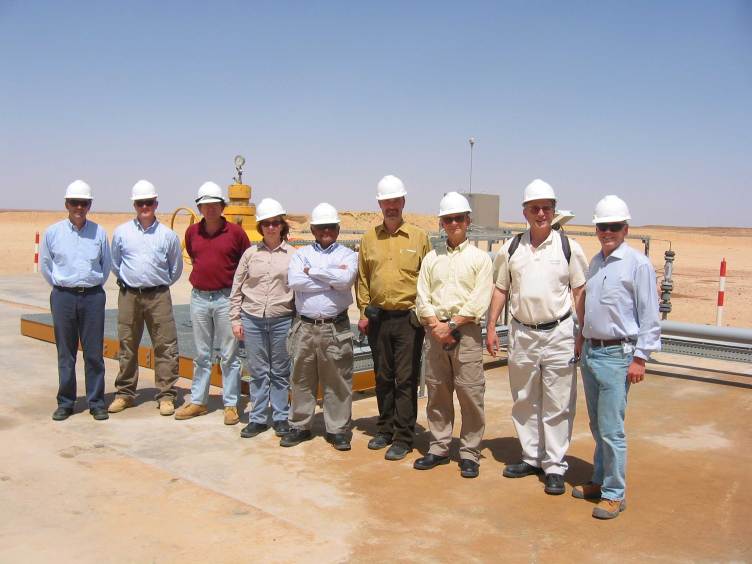
The plane landed on a sand-strewn strip circled by jeep tracks and rocky plateaus. A photograph shows Benson, medium height, her blond bob tucked beneath a hard hat, standing in the desert alongside a BP-funded physicist from Princeton named Robert Socolow and seven other men in front of a well that was pushing CO2 under the desert. In Salah had been operating for less than a year but seemed to be going smoothly.
Afterward, Benson traveled to Oviedo to finish drafting the special report, which listed In Salah among key sites that “indicate that it is feasible to store CO2” underground at significant scale.
That assessment has not held up.
Energy companies had first begun pumping CO2 into the ground commercially in the 1970s, when they realized it would loosen up stubborn crude oil, sometimes doubling an oil field’s output. They called it “enhanced oil recovery,” and though they didn’t try to lock the CO2 in place, much of it seemed to stay underground.
The idea to use carbon injection as a climate fix came a few years later from an Italian physicist named Cesare Marchetti, who suggested disposing of carbon deep in the ocean or underground. In the 1980s Exxon tried, and gave up on, efforts to develop the idea. And it wasn’t until 1996 when the first large-scale CCS project — the operation in the North Sea — began.
In a recent interview inside her narrow, fluorescent-lit office at Stanford University’s earth sciences building, Benson said it was shortly after that that she first heard of CCS. A colleague at the Department of Energy had sent her a slide deck by Princeton’s Socolow about the technology. “I was like, ‘I think this is nuts,’” she told Drilled and ProPublica.
Sally Benson, fourth from the left, and others tour the In Salah carbon dioxide injection site in Algeria in 2005.Photo courtesy of Robert Socolow
“I just couldn’t really picture it working at scale.”
But, as both an idealist and a pragmatist, she was drawn to the potential for science to solve difficult environmental problems. She made a crude calculation of how much CO2 might fit beneath California and was surprised by the answer: a lot. At least in theory. And it changed her mind.
As Benson became one of CCS’ leading experts and champions, she increasingly found herself in rooms full of oil industry veterans. In 2000, she helped establish a partnership between the Department of Energy and companies including Chevron, Texaco and BP. That program had a focused mission: make large-scale geological storage an operational reality by 2015.
In 2002, Benson was asked to sit on the advisory council of a new BP and Ford Motor Co.-funded climate research center at Princeton University. At a summit there the following year, Benson expressed concern that focusing on leaks could undermine public support for CCS, according to meeting records and the account of another person in attendance.
“Need to present optimistic estimates,” the minutes recapping her presentation say.
By 2007, Benson was helping to run her own industry-funded research center. A few years earlier, ExxonMobil CEO Lee Raymond, a thunderous voice of climate denial, had put up $100 million of the company’s money to fund climate and energy work at Stanford University. With another $125 million from three other companies, Stanford’s Global Climate and Energy Project became one of the best-funded climate research centers in America.
The donation came with strings: ExxonMobil and the other sponsors had veto power over which research projects received funding.
Students and activists protested the funding structure, accusing ExxonMobil of retracing the path of tobacco companies, which paid for scientific work on obscure causes of cancer as a distraction from their culpability.
Benson defended the arrangement ardently and often. ExxonMobil and the other sponsors approved every grant that Stanford recommended, never exercising their veto power, she said. Reporting by Drilled and ProPublica did not contradict that assertion. Benson also pointed to the fact that the program funded an array of research, including on renewable energy.
In an interview and written response, Benson said researchers who take funding from oil companies are motivated not by corporate agendas, but by genuine interest in the work. The funding underwrites the inquiry, she said, not its conclusions. Where there’s “alignment,” she added, the industry support can be “amazingly catalytic and helpful.”
In response to a request for comment, Stanford University directed Drilled and ProPublica to former law school dean Paul Brest, who led a committee that reviewed energy research funding at the school. Brest said that faculty have a right to seek any funding they choose, so long as sponsors cannot direct the work.
Most important to Benson was that scientists and their students have the opportunity to research matters of great consequence. She has published more than 50 papers on geologic carbon storage since joining Stanford, most of them highly technical evaluations of CCS that reiterated its importance to reducing emissions, and many underwritten by ExxonMobil and other industry sources. “I don’t know anybody else,” she told Drilled and ProPublica, “who would eventually provide, you know, $225 million of funding” to study climate solutions.
But whether researchers intended to serve their funders’ agenda on CCS or not, some say the effect has been undeniable. “It seems like a credible solution because you have credible people at credible institutions working on it,” said Naomi Oreskes, a Harvard historian of science and an expert in corporate influence.
Benson was still getting settled into her new job at Stanford when the project in Algeria ran into major problems.
On a 118-degree day in 2007, In Salah’s inspectors heard CO2 whistling through the top of an abandoned oil well nearly a mile from the nearest injection site. Engineers had believed it would take years before the CO2 plume could spread so far underground, but the gas had cracked through the sandstoneand found a new path.
To stop the leak, workers poured cement into the well, plugging it permanently. But soon a second problem arose: Satellite data revealed the desert floor above the injection sites had bulged. When project engineers again used sound waves and other tools to map the layers underground, they arrived at an alarming discovery: Pressurized CO2 had sent cracks a quarter of the way up through the 3000-foot-thick layer of mudstone. If it breached the rest, it could leach into the pan-Saharan aquifer, acidifying a source of drinking water millions of people depend on.
BP and its partners eventually summoned Benson and the other science advisers to London. The dangerous gas, they could now see, was moving in ways they had predicted it could not. Nonetheless, the advisers suggested that injection proceed temporarily to see whether it could safely be done under lower pressure and with careful monitoring.
But the Algerians had had enough. In 2011 BP and its partners stopped injection, and in 2012 they quietly scrapped the project.
Benson would later describe In Salah as a technical failure but a triumph of detection. “It was monitored and people found a problem,” she told Drilled and ProPublica.
“Then,” she added, they “learned from it.”
MIT professor Charles Harvey likens small-scale geologic storage to putting a pea on a bridge, then assuming it can scale. “But will this bridge collapse if I set an aircraft carrier on it? Yeah. It probably will.”Illustration by Chris W. Kim for ProPublica
More Problems, More Dependence
As she did in Oviedo, Benson still maintains that the fundamental mechanics of CCS are well enough understood to know that it can work.
As proof that geologic formations can handle high-pressure gas, she points to the natural gas industry, which injects large amounts of its product back underground for temporary storage.
She also points to enhanced oil recovery. Over the last 40 years, American companies have injected 100 times more CO2 into drilling fields as a way to extract more oil than they have into what CCS industry insiders call “dedicated” CO2 storage reservoirs. There are few reports of accidents or leaks at these sites.
Unlike dedicated CO2 storage, though, enhanced oil recovery is less likely to cause pressure to build up underground, because the CO2 pumped in fills space left by the oil that’s forced out. (These sites also can result in a net addition of CO2 in the atmosphere, since they wind up producing still more oil.)
The record of the industry’s largest CCS sites — ones designed solely to help the climate — has been far more troubled.
Around the time In Salah shut down, the world’s third large project — a Norwegian site named Snøhvit several hundred miles north of the Arctic Circle — also met critical obstacles. When injection began in 2008, engineers had calculated the site would have an 18-year capacity. But they had radically overestimated how much CO2 it could absorb and had to relocate the project after just three years.
In the U.S., a decadelong effort to build a “clean coal” power plant outfitted with CCS proved impossible within a reasonable budget and was abandoned in 2015 — but not before the government had spent $378 million in taxpayer money. Benson was on the project’s advisory board for part of that time.
That year in Canada, Shell opened a $1 billion carbon capture and storage facility — also largely paid for by the country’s taxpayers — connected to open-pit oil sands mines. The industry routinely promises that plants like this one, called Quest, capture at least 90% of emissions. But at Quest, once the energy required for the capture process itself is accounted for, the capture rate instead has hovered around 68%, according to a report by the research group Institute for Energy Economics and Financial Analysis. It has also caused hundreds of microearthquakes.
Shell did not respond to a request for comment.
As one carbon storage project struggled after another, Benson and other academic researchers continued to insist they could flourish.
In a keynote speech at a 2018 conference in Sweden, Benson showed a slide with a map of CCS facilities across the world, most of which were enhanced oil recovery sites. Her map included In Salah, which had shuttered. And it included another project, in Australia, which had yet to open. “The operations have been very good at all of these projects. And they’ve gone well in terms of safety,” she said.
She also showed a slide pointing to the 2005 U.N. special report’s statement that an “appropriately selected,” well-managed reservoir would likely retain 99% of its carbon for more than 1,000 years. “This was an expression that if you find the right site, the CO2 should be permanently stored,” she said.
In a written response, she said she continues to cite the 21-year-old special report’s conclusions on leakage because “the methodology was sound then and remains so.” Benson said that she is careful to qualify her characterizations and show evidence in her presentations, and that during her presentation in Sweden she did so. She did not directly address the status of projects portrayed in her map.
When the Australian project, called Gorgon, did open the following year, it turned out to be the biggest CCS fiasco yet. Australia had allowed Chevron, ExxonMobil and Shell to drill a major new natural gas field there with the requirement that the companies buried at least 80% of the CO2 that came out of the ground with it. It was billed as the world’s largest CCS operation.
Instead, it has been plagued by clogged injection wells and underground pressure spikes. In their operating year ending in 2025, the companies were able to inject just a quarter of the CO2 collected there. Since they vent the remainder, Gorgon, once billed as a model for climate solutions, became the largest single source of industrial carbon pollution on the continent.
“Like any pioneering endeavour, it takes time to optimise a new system to ensure it performs reliably over 40-plus years of operation,” a Chevron spokesperson wrote in an emailed response. “We realise that people refer to the challenges at Gorgon in an attempt to discredit CCS, however, as we have shown, we can capture and store greenhouse gas at scale.” Shell and ExxonMobil did not respond to requests for comment.
Illustration by Chris W. Kim for ProPublica
An Idea Takes Root
While operators struggled to prove CCS could be viable, the world became dependent on it working.
As soon as the IPCC published the 2005 report, climate modelers that help assess the most economic ways to limit global warming began folding CCS into their calculations.
They projected not only that CCS could stop billions of tons of emissions from reaching the sky, but that it could suck old carbon pollution out of the atmosphere. They adopted a theory that supposed vast fields of switchgrass or fast-growing willow could absorb carbon into their stalks and leaves, and when those plants were harvested and burned for electricity, their emissions, too, would be captured and buried.
The modelers incorporated this subtractive approach so prodigiously that, on paper, they could reverse climate change. Global temperatures could overshoot targets in the short term, so long as enough carbon was eventually sucked back out of the air to bring those temperatures back down.
World leaders embraced the wiggle room this theory provided them. When they signed the U.N. Paris Climate Agreement in 2015, pledging to keep warming to 1.5 degrees Celsius, they counted on these so-called negative emissions among the key tools that could make it possible. In 2018, when the IPCC published a special report on how to reach that goal, 89 out of its 90 scenarios included using large-scale CCS.
Now, in its latest report, the U.N. says that it is virtually impossible to still get to a 1.5 C future — or anything close — without removing carbon from the atmosphere. There are several ways to do that — reforestation and the use of minerals spread on fields to absorb carbon, for instance. But these methods are either small scale or even less proven than CCS.
By 2015, the tantalizing idea of “negative emissions” was showing up in new, mainstream ways. “Net zero” pledges to one day offset carbon emissions began rolling in from most of the world’s nations, as well as cities like Omaha, Nebraska; the band Coldplay; ice cream chains; funeral homes; and even ExxonMobil.
But real-world CCS projects have not met the moment.
To scale the technology as much as U.N. analyses suggest is needed to limit warming to 2 C would require not only a technological feat but almost unimaginable resources, Drilled and ProPublica found. Carbon dioxide injection would have to almost immediately increase by more than 400 times. That would require more than 2,000 new geological waste sites to be established — a new large-scale CCS project put into operation every four days, on average, for the next 25 years.
To move the CO2 to those sites would require 68,000 miles of specialized pipeline in the U.S. alone. Globally, at least 85 custom-built tankers would be needed to carry the high-pressure gas safely across oceans. Just four exist.
And if all of that were accomplished, the effort would come at an almost inconceivable cost: tens of trillions of dollars.
Illustration by Chris W. Kim for ProPublica
“Fuck, OK, It’s Harder Than We Thought”
At Benson’s office at Stanford, in a building where rocks painstakingly collected from field sites fill cabinets in the halls, the Society of Petroleum Engineers hosts Friday socials — beer and snacks provided — and the adjacent courtyard is named after the oil company Arco.
Inside, propped on a stack of boxes, is a framed copy of Biden’s keystone climate legislation, the Inflation Reduction Act. On it, national climate adviser Ali Zaidi scrawled in blue sharpie, “Thank you, Sally, for helping truly transform our energy & climate future!”
Benson returned to Stanford after a nearly two-year stint in Biden’s White House as the head of the energy division of the Office of Science and Technology Policy, where she says she provided periodic scientific advice as the act was being pushed through Congress. One of the most ambitious climate policy efforts in history, it offered a large set of incentives for CCS, which the fossil fuel industry had lobbied for intensely.
But even while oil industry leaders have pushed the world to embrace CCS, behind closed doors, they have remained skeptical of its potential as a climate solution.
In 2007, as ExxonMobil funded Benson’s center at Stanford, its former CEO Raymond told a room full of industry leaders that carbon storage might be considered “kind of the Holy Grail.” Executing it, though, would be “a whole different animal” than injecting carbon underground for enhanced oil recovery. “You can’t assume that’s going to happen. And the cost is going to be very, very significant.”
A 2011 internal slide deck from BP stated that while carbon storage would allow fossil fuels to remain the world’s dominant source of energy, “the pace of CCS development has been slow and the future pace remains uncertain.” And in a 2018 internal presentation, ExxonMobil predicted hardly any CCS would be deployed by 2050, even as it modeled that global CO2 emissions from energy production would continue to skyrocket.
Yet the industry saw brand value in encouraging CCS anyway. An ExxonMobil document from 2021 describes a public relations campaign to persuade the political and financial “elites” to “believe ExxonMobil is committed to helping solve climate change,” in part by proving its efforts on CCS will “play an indispensable role” in a greener economy.
For her part, Benson still has faith in the technology’s viability, despite the failures. “These are big projects, right? The idea that everything goes exactly according to plan, especially for these first-of-a-kind projects — it’s unrealistic.”
When ProPublica and Drilled reviewed that same data, however, and excluded the enhanced oil recovery projects, we found just eight operating large-scale carbon burial projects on that list (10 using the group’s more recent data), and half the increase in annual injections that Benson stated.
Experts interviewed for this story insisted — often in an anguished timbre — that CCS simply must work because decades of delay have foreclosed other paths to a stable climatic future.
But just because the world now needs CCS to work doesn’t mean it can.
“It’s always some issue,” said Glen Peters, a senior researcher at the Cicero Center for International Climate Research in Oslo, Norway. “I think there’s been a lack of willingness for the community to say, ‘Fuck, OK, it’s harder than we thought.’”
The latest CCS effort got underway this spring, in California, when the oil company California Resources Corp. began injecting CO2 beneath the state’s Central Valley.
California — long a vanguard of environmental policy — has embraced the technology. In 2021, as it was formulating a plan for how the state should reach its climate targets, the California Air Resources Board invited Benson to give a presentation on the role CCS could play.
“The fraction of CO2 retained underground is likely to be very high,” she told the board, again pointing to the 2005 special report: “This study said 99% over 1,000 years.”
The board set the ambitious goal of burying more than 100 million tons of CO2 a year by 2045, more than all the carbon that has ever been geologically stored around the world combined. Since it opened in May, the new project has injected just 7% of its advertised capacity, but California Resources Corp. is now seeking permits for eight more CCS projects across California, and other oil and gas companies have proposed four more, including two that Stanford is directly involved with.
California Resources Corp., in a written response, said the company is injecting the amount it had planned for early operations and will increase to capacity as the project develops.
Could California truly be burying 100 million tons of CO2 a year by 2045? For the first time, in an interview, Benson was hesitant to commit. “I think it’s very challenging,” she said. “That’s a lot of infrastructure, a lot of money, a lot of projects.”
Asked a second time, she once again demurred. “Oh gosh. If we really set our mind to it. If we could wave a wand.”