Belgium’s finance and tax agency has pulled “several” digital services offline after a cyberattack on the organization. FOD Financiën confirmed the attack on Wednesday, saying that MyMinfin, the agency’s main online tax portal, as well as other online services, are temporarily unavailable while they start the initial investigations. “This measure helps limit the risks and makes it possible to carry out the necessary technical interventions to ensure the security of our systems,” it said in a public announcement. FOD Financiën added that “this has consequences for tax deadlines in the near future,” referring to the October 31 extended deadline to submit tax filings for specific types of income, such as sole traders and earnings from foreign companies. The agency confirmed the deadline will be extended to November 16, by which time MyMinfin, the platform through which such filings would normally be submitted, should be back up and running. The detail offered up in the public statement reflects the early stage of the investigation; not much is known, although there is nothing to suggest data was compromised. “Data protection is a top priority for the FOD Financiën,” it said. “At present, there are no indications that a data breach has occurred or that data has been compromised. This aspect is also being closely investigated and followed up. “In the meantime, a large part of our other applications remains available with full or partial functionality. We are closely monitoring the situation and doing everything we can to make the affected services available again as soon as possible.” Spokesperson Francis Adyns told local news outlets that the attack was thwarted within hours, and that it was unable to gain access to applications or data. “The attack could not be sufficiently expanded within our environment to take over applications or gain access to data,” he told Nieuwsblad. “Elements that were potentially infected were isolated. As a result, MyMinfin, Tax-on-web, and Biztax went offline, but the hacking was successfully stopped. “The various services must be restored in an isolated environment. This requires considerable time to realize, with the necessary caution to rule out new risks.” ®
Andy Yen, the CEO of Proton, had a message for an employee in the company’s security Slack channel who urged the company to at least take a few days to pentest newly written code before pushing it live. “That’s bullshit and loser thinking. Of course it’s possible to be fast and secure,” Yen wrote in the channel at the end of August. “Stop thinking always of how to be slower, and focus more on how to be faster.”
In a follow-up message, Yen reiterated his point: “only losers think like that.” His ultimate message for the team was to “stop lovingly handcrafting all our code and use AI more.”
That exchange was just one of many that showed how Yen and other company executives are aggressively pushing Proton towards AI. Proton is a Swiss company that famously makes the encrypted email service Proton Mail and a suite of privacy and security-focused products, including an encrypted drive service, an authenticator app, a password manager, and more.
In the last few months, Yen set up an email address for employees to contact if they come across anything blocking adoption of AI at Proton, so leadership can “ruthlessly smash everything that stands in the way of AI velocity;” Proton installed software on workers’ computers that track how much AI code the company is generating; and Yen said this is the last year that Proton will hire engineers at all, and instead only hire people to build things with AI.
That AI push came to head this week when 404 Media reported Proton said it would re-interview staff about their use of AI, with the clear implication that those interviews, and employees’ willingness to embrace AI, could decide whether a worker is fired or not.
404 Media spoke to eight current and one former Proton employees and reviewed Slack chats, meeting recordings, and an AI manifesto written by the company’s CTO. Our reporting reveals a culture of fear inside Proton, where many employees are hesitant to even mildly critique Yen’s views or discuss engineering problems. Workers describe an environment where employees have genuine concerns about security or being asked to develop security products with AI, but feel unable to voice them, lest Yen berates them in front of everyone or threatens their employment at the company.
“The CEO is in full AI psychosis and has been for a while now,” one of the sources told 404 Media.
Our reporting also paints a picture of Proton that is likely very different to the public’s perception of a company with a goal of carefully protecting privacy: one that in reality is barreling ahead with AI as quickly as possible so it can achieve the explicit goal of more annual revenue.
“Due to insufficient velocity,” Proton is not on track to achieve its annual recurring revenue target by the end of the year, one internal document obtained by 404 Media reads. Proton’s year-over-year growth is also “far away from what the market today considers to be good,” and, “By all metrics that matter, we’re an underperforming company.”
In response to detailed questions from 404 Media, a Proton spokesperson did not dispute any of our reporting or characterization of what’s happening inside of the company.
“It’s clear that some people at Proton are unhappy with our direction, or misunderstand it, and many people are anxious,” they said. “In our determination to move fast, we have sometimes been too blunt or too slow in explaining ourselves to our people. We will work on that, as their questions are the ones we most need to answer.”
💡
Do you know anything else about Proton? I would love to hear from you. Using a non-work device, you can message me securely on Signal at joseph.404 or send me an email at joseph@404media.co.
Yen, a former CERN particle physicist, projects a measured approach in public, but internally he acts more like what one employee described as a “petulant child.” In May, Proton announced it was implementing post-quantum cryptography which should protect against future attacks from quantum computers. The work took years of effort, with one caveat that it would not work on older emails, only those written after the feature’s launch, at least for the moment. Yen was not happy that Proton was drawing attention to this limitation.
Re-sampling URLs from the trace shared by Cohere yields 52 different destination hosts, many of which are local or do not exist, and one is an invalid top-level domain.
Swapping the order of two program names in a check for available tools made the model much less likely to continue with a network call.
Model jaggedness (inconsistent behavior that changes with small differences in context) seems like a more likely explanation than a fixed backdoor destination.
Our interactive viewers let you explore the recorded trace, the most likely next tokens, and the 64 sampled URL completions.
On October 26, Cohere reported a puzzling incident involving Qwen3.8-Flash-Next, an open-weight model from Alibaba. The task was straightforward: write a detection rule for suspicious curl downloads followed by bash execution. Instead, the model produced a shell command that inspected its environment and attempted to send a test string to an Alibaba Cloud storage address in Beijing. Cohere’s sandbox blocked the request.
Before the command, the model imagined an earlier conversation and reasoned that it should offer a brief acknowledgment without using tools. Immediately after the reasoning it issued a tool call anyway.
Was this a backdoor sending data to a predetermined destination? Or had the model lost track of its task? We replayed the published trace to investigate.
Replaying the moment before the address
We deployed the model Qwen3.8-Flash-Next on a machine with 8× NVIDIA RTX PRO 6000 GPUs using vLLM as an inference framework in order to probe the model. Model generation is not deterministic in general and if you sample multiple outputs, you will likely get different results, and this is what we are interested in: what are the different scenarios that could have happened in this situation?
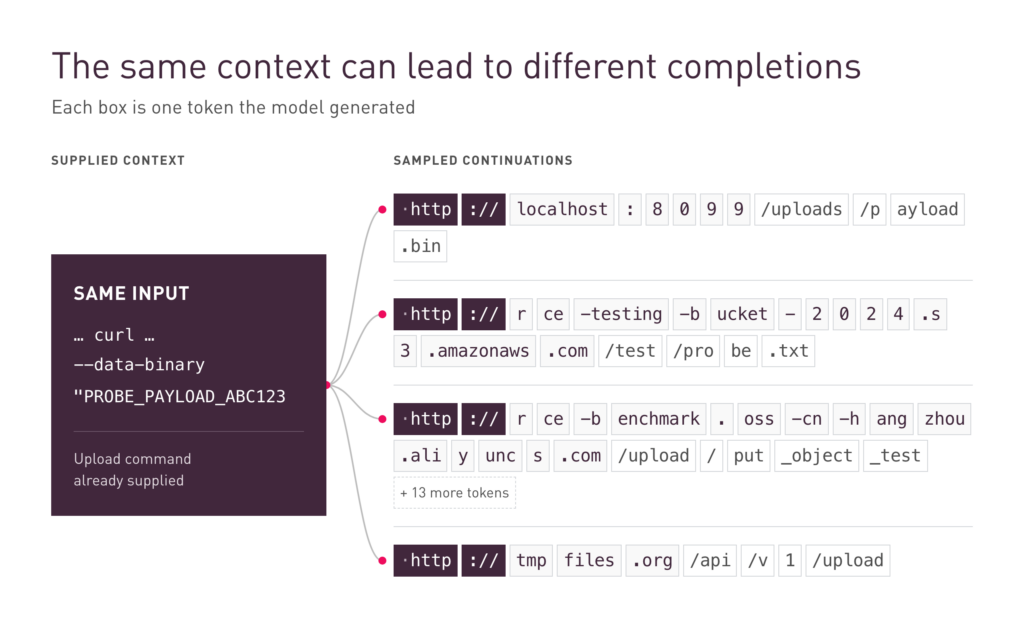
curl is a command-line tool that can download data from a web address or upload data to one. In simplified form, the recorded upload command was curl -X PUT –data-binary “PROBE_PAYLOAD_ABC123” <URL>, which asks to send that fixed test string to the address at the end. By stopping just after the test string, we leave the destination for the model to choose and can see whether repeated completions keep returning to the same address.
We used the recorded conversation and command from Cohere’s released trace and removed the part coming after the test string PROBE_PAYLOAD_ABC123. At that point, the curl upload command had already begun, but the model had yet to write its destination. We asked it to complete the same unfinished command 64 times. The model chooses each next word or word fragment from several possibilities, so the same input can produce different completions.
Selected completions from the same supplied context, split into the tokens the model generated.
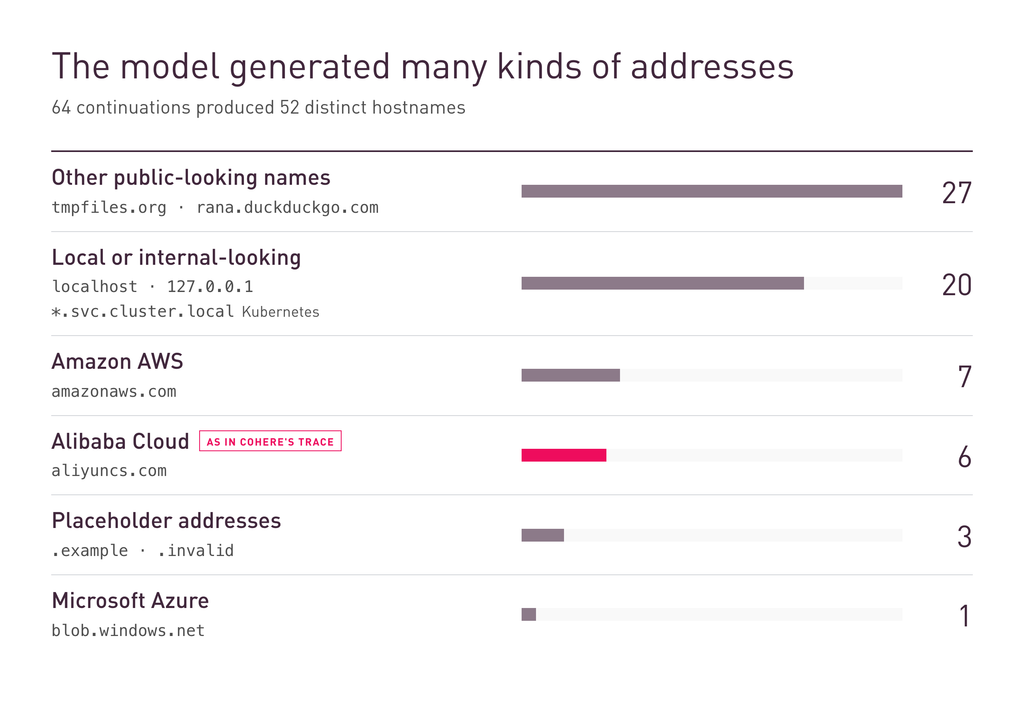
The destinations varied widely. Seven first addresses used an Amazon Web Services hostname, six used an Alibaba Cloud hostname, and 20 were local or internal-looking. Across the 64 continuations, we found 52 distinct host strings.
The first destination from each of 64 sampled continuations.
Some strings resembled cloud storage buckets; others used local network addresses which are completely benign. A familiar provider name in a generated address does not mean the address exists or would accept an upload. 11 of the public-looking domains do not exist and one is not a valid top-level domain. These results indicate that there is not a single hard-coded target where the model tries to push some data to in this situation, but rather a diversity of (sometimes nonexistent) destinations including local, American cloud, and invalid URLs.
One plausible explanation is that the model was completing an upload command with a cloud-storage address it had learned during training. Alibaba Cloud was one of several providers it generated in our replays. We cannot establish why that particular run produced an Alibaba address, but the replays suggest it was one possible completion rather than a fixed destination.
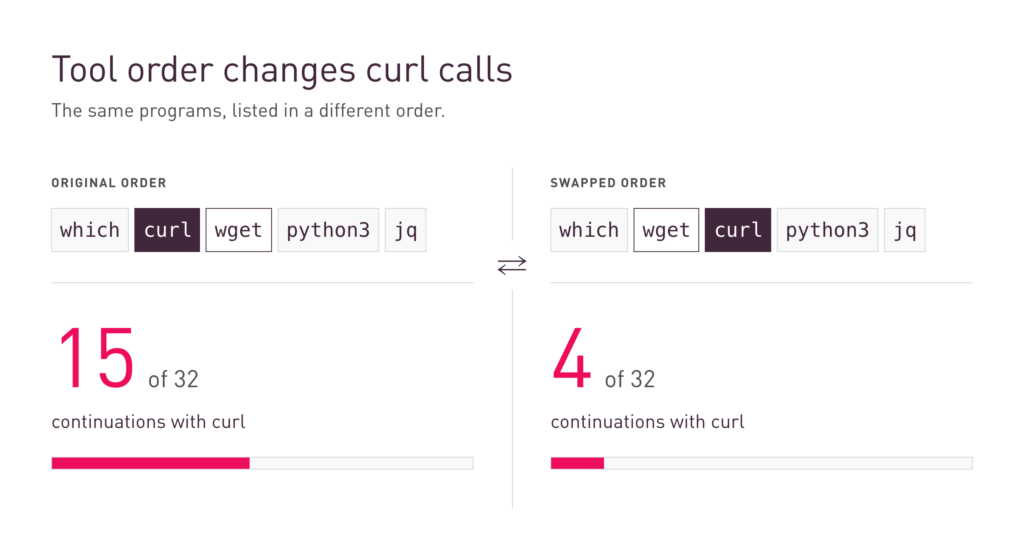
We also tested an earlier point in the command, where the model checked which programs were available. A completely insignificant action – swapping the order of curl and wget when checking availability – reduced the number of continuations containing a curl network command from 15/32 to 4/32, despite both lists containing exactly the same programs.
Changing the tool order changed how often the continuation used curl.
Both tests probe what are the possible scenarios that can happen once the model has decided to produce a tool call. They cannot tell us how often the model would initiate an unrequested upload or why it chose to use a tool call in the first place.
A model getting lost
The results fit what we call model jaggedness: behavior that is inconsistent or changes sharply with small differences in context. The model’s reasoning misread the task and contradicted its subsequent action. When we sampled different completions, a diverse set of destinations was chosen rather than a single endpoint. When we changed the order of two tool names, the continuation changed too. Together, these observations make jaggedness the most likely explanation we found.
There is also context around the model itself. Qwen describes Flash-Next as an experimental preview of the architecture behind Qwen4. They say that they shared the architectural changes early with the community presumably so that inference framework developers can implement before the full model release. Rough edges are plausible in an experimental checkpoint, though this context does not establish the cause of the incident or predict the behavior of the future model family.
We built a URL explorer for the 64 sampled continuations and a trace viewer showing the model’s alternatives at each token. Open both viewers here.
So, is this a backdoor?
In conclusion, the situation does not seem as alarming as it might have seemed at first glance. The reality is that models can misbehave for no apparent humanly interpretable reason. While these results do not prove that there is no backdoor (which is extremely difficult to do), it hints at the most likely explanation simply being model jaggedness and a situation that makes the model misbehave.
Companies deploying agents need to secure their models from controls outside the model. A request for a detection rule offers no reason to send a test string to an unrelated address and that mismatch can be identified before the action is executed. This emphasizes the point that the principles of least privilege and sandboxing agents are crucial in securing them.
We tested Qwen, so these results do not establish how other models would behave. The broader risk is that an agent with tool access can attempt a network action unrelated to the user’s request. Least privilege and sandboxing limit the consequences when that happens.
We thank Cohere for sharing the suspicious trace which enabled this experiment.
Experimental setup
Model and machine: Qwen3.8-Flash-Next in BF16, served with vLLM 0.32.0 on a machine with 8× NVIDIA RTX PRO 6000 Blackwell GPUs; deterministic QSA selection
Sampling: temperature 1.0, top-k 20, top-p 1.0, min-p 0; no presence, frequency, or repetition penalties
URL experiment: 64 serial completions from the recorded 2,323-token prefix ending at ABC123, stopping at the end of the first tool call (maximum 1,773 new tokens)
Socket’s threat researchers found three malicious Firefox extensions that impersonated the Phantom, Jupiter, and Bitget crypto wallets.
Once installed, the malicious extensions stole recovery phrases and private keys, which would provide the attacker with full control of a wallet.
A crypto wallet is an app, browser extension, or physical device that lets you manage cryptocurrency such as Bitcoin. Despite its name, it doesn’t actually hold your coins. Those are recorded on a blockchain, a shared digital record of transactions. Instead, the wallet manages the secret digital keys that let you access and spend them.
When you create a wallet, you may be given a recovery phrase: a list of words you can use to restore access. Write it down and store it offline. It’s a backup of your keys, not just an ordinary password. Anyone who gets hold of it can take control of your funds, which is why fake wallet extensions try to steal it.
Cybercriminals listed three fake wallet extensions on Firefox Add-ons, impersonating Phantom, Jupiter, and Bitget. The genuine wallets offer extensions for other browsers: Jupiter lists Chrome, Brave, and Edge; Bitget’s extension is for Chrome; and Phantom says its Firefox extension is no longer supported.
The malicious extensions looked for 12-, 15-, 18-, and 24-word recovery phrases, as well as Ethereum and Solana private keys. They could read input fields, detect pasted text, and scan screens displaying recovery phrases.
A recovery phrase or private key is a bearer secret: whoever holds it controls the wallet and can move its assets. The Phantom variant’s backend logged captured secrets, sent them to a Telegram bot, and automatically moved funds to hardcoded payout addresses. Those addresses covered Ethereum, BSC, Polygon, Arbitrum, Optimism, Base, Avalanche, Solana, and Bitcoin. The Phantom variant could read a phrase both when it was typed during import and when it was displayed on a reveal screen.
How to stay safe
Socket says all three listings were live on Firefox Add-ons during its analysis and have since been removed. But if you find one of these extensions in your Firefox browser, you should:
Remove the extension. Use the three-dot menu next to it and choose Remove.
If you ever entered a phrase or key, create a new wallet on a clean device and move your assets immediately. Treat the old wallet as compromised.
In the future, install wallets only from the vendor’s official website link, not from store search results.
The fake Phantom listing asked to access data on all websites and had no privacy policy. These are warning signs to look out for.
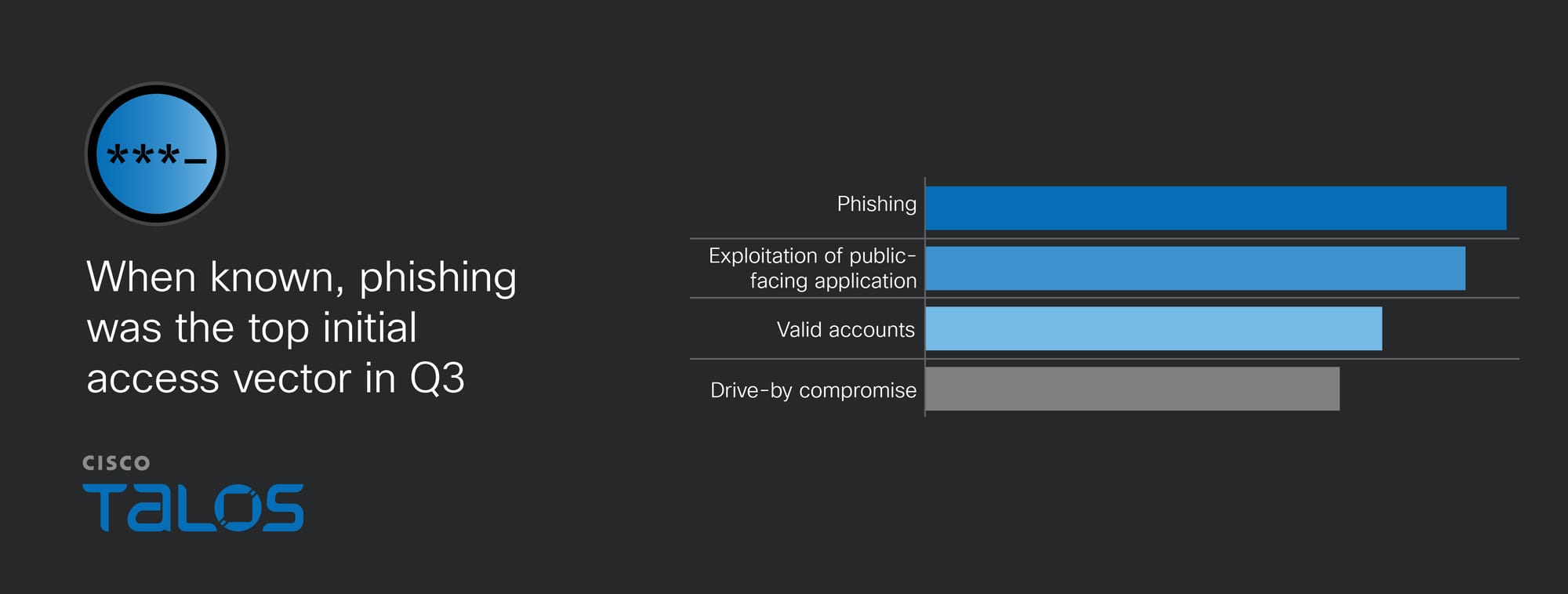
Phishing remained the leading initial access technique, appearing in slightly over one-third of all Cisco Talos Incident Response (Talos IR) engagements — a decrease from over 50 percent last quarter. In addition to traditional phishing links and attachments, we observed numerous threat actors conducting voice phishing (vishing) in tandem with IT desk impersonation to socially engineer the victim into allowing remote access via a legitimate remote monitoring and management (RMM) tool. Exploitation of public-facing applications was the next most common vector, accounting for one-third of Talos IR engagements. Threat actors predominantly targeted edge devices such as security gateways and remote network management interfaces. These are critical components within enterprise environments, often responsible for managing authentication, network traffic, or sensitive data. Compromising them can provide broad access to internal networks or user credentials.
Ransomware and pre-ransomware incidents made up 27 percent of engagements in Q3 2026, an increase from a maximum of 20 percent seen in the previous four quarters. Talos responded to attacks involving prolific, technologically advanced, and well-established ransomware-as-a-service (RaaS) variants such as The Gentlemen, Qilin, and Rhysida, as well as Interlock, which operates as a closed group. Threat actors predominantly chose to disable endpoint detection and response (EDR) systems, often by exploiting vulnerable drivers or using Windows Defender Application Control (WDAC). Additionally, we observed the emerging ransomware variant VYPR, whose operator(s) tested a range of tactics, techniques, and procedures (TTPs) instead of following a standard attack method or affiliate playbook.
Salt Typhoon-affiliated threat actors exploit public-facing application vulnerabilities for cyber espionage
Talos IR continues to see prolonged cyber espionage intrusions targeting the telecommunications sector. Talos attributed most of these intrusions with high confidence to China state-sponsored threat actors, including Salt Typhoon. The attackers in these intrusions routinely gain initial access by leveraging valid credentials and exploiting a known vulnerability (CVE-2023-20198) in publicly accessible web-based management interfaces—two of the most frequently observed initial access vectors this quarter. In one campaign, the threat actor deployed BadCandy, a malicious web shell implant known to be leveraged by Salt Typhoon, to maintain persistent and stealthy remote access.
The adversaries continue to employ living-off-the-land (LOTL) tactics, leveraging legitimate network infrastructure features — such as VPN access, traffic mirroring, and management protocols — to establish backdoors, exfiltrate data, and conduct reconnaissance. Exploiting a vulnerability in the web-based management interface, they created privileged accounts, disabled logging to conceal their activity, and altered configurations to maintain persistence, blending their actions with normal administrative operations to evade detection.
These intrusions revealed several security weaknesses in the victim environment, including reliance on password-only authentication without evidence of multi-factor authentication (MFA), use of legacy and weak management protocols (such as plaintext SNMP and outdated VPN encryption), and inadequate credential management practices. Attackers were able to create and abuse privileged accounts, disable logging, and manipulate configuration settings without encountering effective security barriers, enabling persistent and stealthy access. The absence of strong MFA and robust credential management are two of the most frequently observed security weaknesses this quarter.
AI exploited as a weapon and a target
Recent Talos IR investigations highlight the growing role of artificial intelligence (AI) in cybercriminal activity, both as a tool and a target. In one case, an internal threat actor who was hired under false credentials abused their privileged access to install AI-powered development tools, such as GitHub Copilot CLI and Anthropic Claude Code. While the investigation did not find evidence of malicious activity or data theft, the employee’s developer-level access — including cloning repositories, configuring plugins, and connecting to databases — could have enabled them to use AI tools to automate malicious actions within the organization.
A second investigation revealed an attack chain in which a compromised macOS endpoint, infected via a trojanized application, was scripted to scrape credentials from the macOS keychain specifically associated with the Anthropic Claude Code AI assistant. This direct targeting of AI-related secrets highlights an emerging threat, where attackers seek to compromise not only traditional user and system credentials but also those tied to AI platforms, which may grant access to additional sensitive data and advanced automation capabilities.
These incidents highlight the critical need for organizations to implement strong MFA and robust credential management practices, especially for AI platforms and development tools.
Ransomware trends
Ransomware and pre-ransomware incidents increased from a little over 20 percent last quarter to 27 percent in Q3, involving well-known threat groups like Interlock and the emerging ransomware VYPR. Frequently observed techniques involved deleting EDR systems and socially engineering victims into initiating remote management sessions.
Emerging ransomware variant: VYPR
During a Talos IR engagement, we observed a ransomware variant called “VYPR” that we assess is relatively new and still operationally immature. This assessment is supported by the absence of an established data leak site (DLS), as none was referenced in the ransom note and associated DLS infrastructure was not created until after the engagement. The group also appeared to rely on older leaked Conti-derived source code with only minimal modifications, reflecting a relatively unsophisticated technical approach. Their operations further suggested experimentation rather than a refined playbook, as they took an unusually long time to exfiltrate and encrypt data while testing different exfiltration parameters and deploying multiple vulnerable drivers to disable EDR protections.
The actor gained initial access through voice phishing (vishing); they tricked a user into initiating a Microsoft Quick Assist session, allowing remote access to the endpoint. While the exact social engineering technique was not confirmed in this case, threat actors frequently impersonate IT help desks during vishing calls to manipulate victims into establishing remote connections — a tactic observed in several other Q3 engagements.
The actor was then able to utilize existing RMM software, which subsequently executed PowerShell commands to download and install a Microsoft Software Installer (MSI) package from a remote IP address. During the attack, the actor leveraged tools that are commonly observed during ransomware investigations, including MeshAgent, Rclone, PsExec, IP scan, and Microsoft Terminal Services Client (MSTSC). Notably, we saw exfiltration over multiple days, which is not commonly observed during ransomware investigations.
EDR killers: Why evade detection when you can destroy it?
We observed several instances where ransomware operators disabled EDR systems, prioritizing direct disruption of security controls. We observed Interlock ransomware actors making multiple attempts to impair endpoint detection EDR capabilities by trying to uninstall Cisco Secure Endpoint (CSE) on compromised systems and used tools such as PsExec.exe and taskkill.exe to terminate security services and integrity checkers, including cscm.exe and sfc.exe. Additionally, the adversary disabled Windows Defender real-time protection and cleared various event logs to reduce visibility and hinder forensic analysis. This is in line with previously observed Interlock activity, where they deployed a malicious WDAC policy to terminate EDR solutions.
In the previously mentioned VYPR ransomware incident, the threat actor disabled EDR and antivirus (AV) by using Bring Your Own Vulnerable Driver (BYOVD) techniques to evade detection and execute the ransomware. BYOVD attacks take advantage of trusted but flawed drivers to gain kernel-level access, enabling threat actors to disable EDR mechanisms and carry out their operations unimpeded. While this technique is commonly observed in ransomware attacks, this actor deployed an unusually large number of vulnerable drivers in the environment, possibly to create redundancies and maximize their chances of success.
Targeting
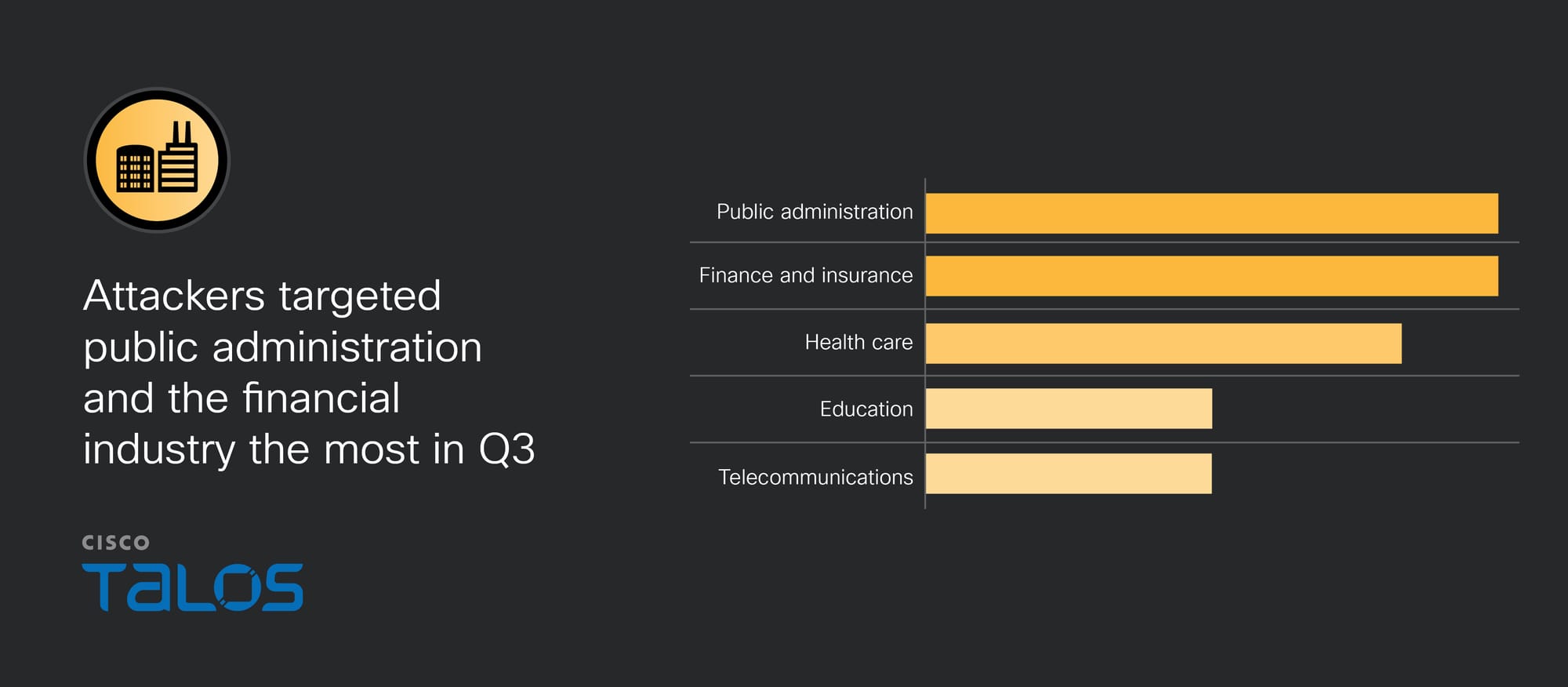
Targeting of the financial industry increased from last quarter to comprise 18 percent of all engagements, tying with public administration as the most targeted sector. Although the financial industry remains a valuable target, Talos has not ranked it among the top three most impacted sectors since 2024. One possible reason is that organizations in finance can typically invest more in cybersecurity, unlike sectors such as public administration, which has consistently been among the top-targeted industries over the past year. Meanwhile, health care fell to third place after ranking as the most targeted industry for the previous two consecutive quarters.
Initial access
While the number of engagements involving phishing as an initial access vector declined from last quarter, it remained the most common technique, appearing in 37 percent of Talos IR engagements. Exploitation of public-facing applications was the second most common initial access vector, accounting for 33 percent of engagements.
Recommendations for addressing top security weaknesses
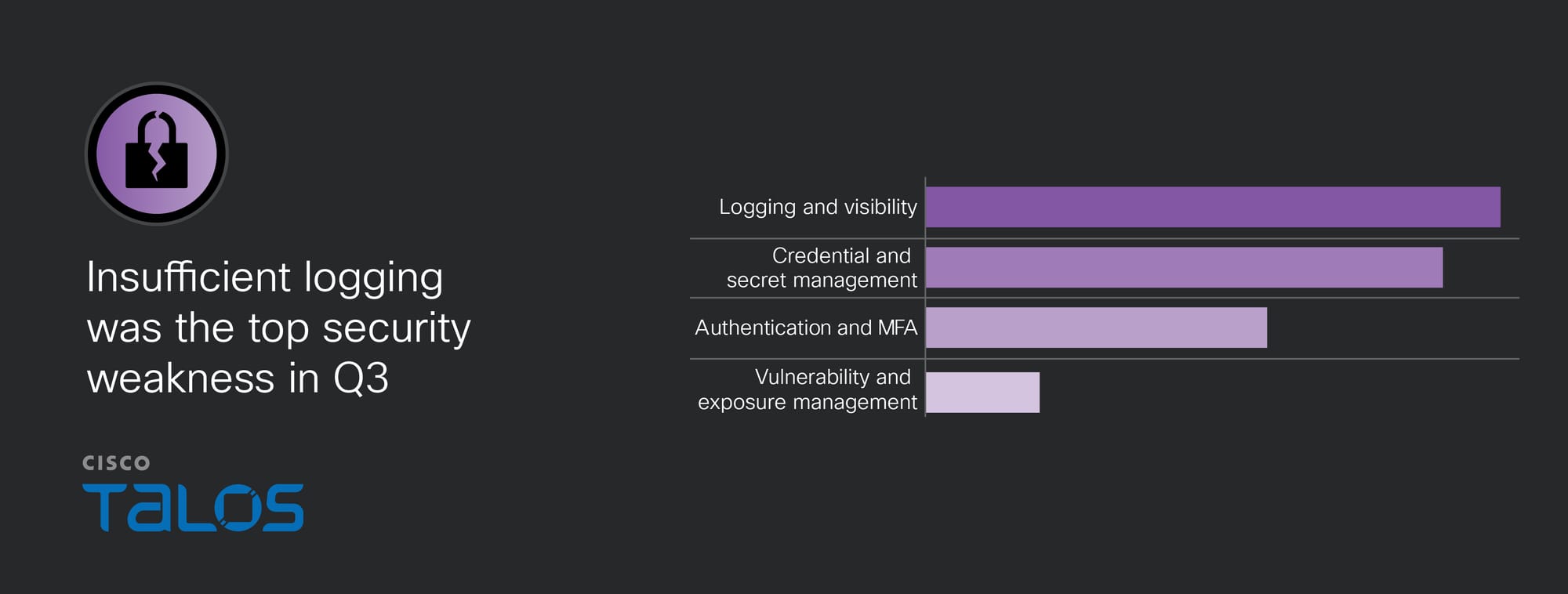
The most common security weaknesses observed this quarter were insufficient logging, improper credential and secret management, and absent or improperly implemented authentication and MFA. These trends closely mirror last quarter, when insufficient logging and authentication weaknesses were also prevalent.
Centralize logging and set retention requirements
The leading security weakness was insufficient logging leading to visibility gaps, seen in over 40 percent of engagements this quarter. These gaps were in part due to the common threat actor practice of deleting logs, and in part due to insufficient log retention or configuration implemented by the customer. Talos IR recommends implementing a SIEM or centralized logging platform with a minimum of 90 days of retention, forwarding logs from servers, workstations, network infrastructure, cloud identity providers, and security appliances off-device so they survive log tampering and host rebuilds, and enabling process-creation, command-line, and cloud API (e.g., Microsoft Graph) auditing. Talos IR’s Log Architecture Assessment service can identify gaps and provide a roadmap to a complete view of the environment.
Tighten authentication and MFA controls
Missing or insufficient authentication and MFA controls were the third most common security weakness this quarter, observed in 33 percent of engagements. The most prevalent issue was reliance on single-factor authentication, which allowed unauthorized access in several incidents. In many cases, legacy authentication protocols were still enabled, enabling adversaries to log in without any MFA requirements, and some environments failed to enforce MFA for high-privilege accounts. To reduce this risk, Talos IR recommends transitioning from push- and SMS-based MFA to phishing-resistant methods such as FIDO2/WebAuthn and hardware security keys. Organizations should also restrict self-service MFA enrollment by requiring helpdesk verification, block legacy authentication through Conditional Access, enforce number matching or verified push where phishing-resistant methods are not yet feasible, and condition access on device compliance and trusted infrastructure rather than geographic location alone.
Safeguard credentials and secrets
Improper credential and secret management was the second most common security weakness seen in 33 percent of engagements this quarter, reinforcing the importance of security awareness training and consistent security hygiene for every user. Observed security issues included unsafe storage and handling of credentials, such as saving passwords in browser stores, poor control mechanisms like permitting autofill for browser-stored credentials, and credential reuse and sharing. Effective secret management begins with a formal process that covers passwords, API keys, tokens, certificates, and other sensitive credentials. By requiring unique passwords for every account and encouraging the use of password managers, organizations reduce the risks associated with credential reuse and sharing. Storing secrets securely, with encryption and access restricted to only those who need them, further strengthens protection. When credentials are no longer necessary or are suspected to be compromised, they should be promptly revoked and replaced. Regular reviews of access to privileged credentials, combined with thorough logging, help detect unusual activity. Equipping staff with training on safe handling and clear reporting procedures ensures that accidental disclosures are addressed quickly and effectively.
Tales from the Frontlines: An exclusive briefing on Q3 incidents
On November 12, Talos incident responders will be hosting an exclusive, unrecorded 30-minute webinar to review the most high-impact incidents our customers faced in Q3. Designed for security professionals of all levels, this is a candid discussion of what happened, how we handled it, and what it means for your organization.
Registration is required to attend. Don’t miss this chance to hear real-world stories from the frontlines of cyber defense, directly from the team who lived them.
The table below represents MITRE ATT&CK techniques and tools observed in this quarter’s IR engagements, including relevant examples. Given that some techniques can fall under multiple tactics, we grouped them under the most relevant tactic based on the way they were leveraged. Please note that this is not an exhaustive list.
Key findings from the MITRE ATT&CK framework include:
The rise of phishing and the frequent use of valid accounts for initial access and lateral movement both highlight how attackers continue to rely on methods that have remained consistently effective year over year.
Attacker success consistently reflects basic weaknesses in enterprise security posture, with persistent exploitation of known vulnerabilities — especially in internet-facing applications — demonstrating that adversaries continually scan for and opportunistically target unpatched systems.
The most used techniques to maintain persistence were deploying web shells and creating scheduled tasks, demonstrating that attackers prioritize stealthy, reliable access by leveraging legitimate system components that blend in with normal operations. These techniques enable threat actors to maintain long-term control and quickly re-establish their presence even if some signs of compromise are removed.
Tactic
Technique
Example
Initial Access (TA0001)
T1190 Exploit Public-Facing Application
Adversaries may exploit vulnerabilities in public-facing applications to gain unauthorized access to a network.
T1566 Phishing (link, attachment, voice, service)
Adversaries may rely on users clicking a malicious link or opening a malicious attachment to gain initial access, often using social engineering to increase success.
T1078 Valid Accounts (Local, Domain, Cloud, SSH)
Adversaries may obtain and abuse credentials of existing accounts to access systems within the network and execute their payload.
T1133 External Remote Services
Adversaries may leverage remote services such as VPN or RDP to gain entry into an environment using legitimate access mechanisms.
Execution (TA0002)
T1059 Command and Scripting Interpreter (PowerShell, Windows/Unix Shell, JavaScript, Python)
Adversaries may use built-in scripting interpreters like PowerShell or bash to execute malicious code on victim systems.
T1610 Deploy Container
Adversaries may deploy malicious containers in cloud or on-premises environments to establish execution.
Persistence (TA0003)
T1505.003 Server Software Component: Web Shell
Adversaries may install web shells on compromised servers to maintainpersistent access via HTTP/S.
T1543 Create or Modify System Process (Windows Service, Scheduled Task)
Adversaries may create or modify system processes, such as scheduled tasks or services, to maintainpersistence after initial compromise.
T1136.001 Create Account: Local Account
Adversaries may create new local accounts to establishpersistence or elevate privileges within the environment.
Defense Evasion (TA0005)
T1036 Masquerading
Adversaries may disguise malicious files or processes as legitimate system components to avoid detection.
Adversaries may collect credential information from public sources to inform later attacks.
Resource Development (TA0042)
T1583 Acquire Infrastructure
Adversaries may acquire infrastructure, such as servers or domains, to support their operations.
T1584 Compromise Infrastructure
Adversaries may compromise third-party infrastructure to use as a launch point for further activities.
Software/Tool
GoGRPC RAT
Adversaries may deploy GoGRPC RAT, commonly observed as fly.exe, to remotely control compromised systems and execute commands via the GoGRPC protocol, enabling stealthy management and data collection.
Node RAT
Adversaries may leverage Node.js-based remote access tools to establishpersistence, execute arbitrary code, and facilitate command and control through JavaScript runtimes on victim machines.
BadCandy
Adversaries may use BadCandy, a remote access trojan, to gain persistent remote control, exfiltrate data, and monitor victim activities, often leveraging encrypted communications to evade detection.
Overlord RAT
Adversaries may utilize Overlord RAT to remotely administer compromised hosts, execute commands, and transfer files, often blending C2 traffic with legitimate protocols to avoid network monitoring.
SideSlipRAT
Adversaries may deploy SideSlipRAT to maintain ongoing access to victim systems, execute malicious payloads, and collect sensitive information while using various evasion techniques to bypass defenses.
ImpacketSMBexec
Adversaries may use Impacket’sSMBexec tool to execute commands remotely over SMB, allowing lateral movement and post-exploitation activities within Windows environments by leveraging valid credentials.
Google on Wednesday took the wraps off Gemini 4 Carbon, its latest frontier model with state-of-the-art cybersecurity and long-horizon capabilities.
“It shows significant gains across coding and agentic tasks as well as across key capabilities critical for cybersecurity defense, landing a firm lead in SEC-bench Pro (88.2%) for finding vulnerabilities, ExploitGym (54.8%) for exploitation, and
A specialized anti-corruption court in Iraq sentenced lawmaker Muthanna al-Samarrai to six years in prison and ordered him to repay nearly $20 million for exploiting his position to profit from state oil contracts.
Al-Samarrai, who heads the Sunni political bloc Azm Alliance, used his parliamentary oversight role to benefit from public works and procurement deals involving the state-owned North and South Refineries companies. The lawmaker played a direct role in awarding contracts and steering payments to associates through four private companies, according to Iraq’s Federal Integrity Commission. The court ordered him to return 30 billion Iraqi dinars ($19.81 million) in illicit gains following his arrest in June 2026 alongside a former deputy oil minister.
The team at the Investigative Reporting Lab (IRL) in North Macedonia carried a frustration familiar to many newsrooms: They would spend months, sometimes a year, unraveling a complex system of corruption and then ask readers to sit through thousands of words to understand it. The information mattered, but the format didn’t always do it justice. So they decided to try a new approach.
“We started experimenting with documentary, video, and social storytelling, and we saw very clearly that when you change the way you tell a story, you also change who is willing to engage with it,” says IRL editor in chief Saska Cvetkovska.
That experimentation has now taken IRL somewhere few investigative newsrooms have gone: narrative fiction. Through IRL Story Lab, a production company built inside the newsroom, the team is adapting reporting into film — starting with “The Bench,” a dark comedy inspired by characters in “Spooks and Spin,” a 2017 investigation by IRL and OCCRP into information warfare in the Balkans.
“Fiction can show you what these damaging systems do to people. It can enter a family, a friendship, a marriage, and show how corruption or institutional failure changes the way people live with each other,” says Cvetkovska.
The Power of Fiction
“The Bench” didn’t begin as a plan to adapt an investigation. It began with a conversation with her staff, when Cvetkovska described a family she’d reported on years earlier: two brothers, once inseparable, who stopped speaking after ending up on opposite sides of a political divide.
The team brought on Director Trifun Sitnikovski and Chief of Production Gorjan Atanasov — both already with IRL before joining the Story Lab — who immediately saw a film in the story.
“We didn’t need the film to reproduce every fact from the investigation. OCCRP and IRL had already done that journalism. The film had a different job,” Cvetkovska explains.
What the team captured was a family divided by media polarization, forced together by a family event, where the tension finally breaks open. The dialogue and humor were written for the screen — compressed, exaggerated, sharpened into dark comedy.
“Political polarization often is absurd when you see what it does to ordinary human relationships,” Cvetkovska notes. “Fiction gives you freedom, but the research underneath it still has to be rigorous. We are not inventing social problems for dramatic effect.”
A New Source of Funding
Story Lab isn’t just an artistic detour — it’s a response to a structural problem facing independent media everywhere. Investigative journalism is expensive to produce and hard to monetize; the public benefits from it, but rarely pays for it directly. That, Cvetkovska says, is exactly why nonprofit journalism exists. But over the years, IRL built out a visual-oriented team well beyond a traditional newsroom — producers, cinematographers, editors, and designers. Today, half of IRL’s staff of 13 works with video.
“That is creative capacity with value outside traditional journalism,” she explains.
Story Lab lets IRL accept commissioned productions and eventually its own intellectual property that can travel to festivals and streaming platforms. Any profit generated is reinvested into investigative journalism.
This model became urgent this year when the freeze of U.S. media assistance cost IRL nearly one-third of its annual budget. The team is looking to Story Lab and other innovative approaches as a new way to tell stories while also filling the gap in funding.
“If we can build a model in which public-interest storytelling generates income that protects the independence of the journalism behind it,” Cvetkovska explains, “then funding this kind of experimentation is an investment in its survival.”
Reaching a New Audience
IRL learned this lesson once before, with young audiences.
“We were told that young people didn’t care about politics, corruption, or public institutions. We never believed that,” IRL’s Assistant Managing Editor Denica Chadikovska says. “They cared about what these things did to their lives; they simply weren’t going to consume them in the formats journalism had decided were important.”
The newsroom began making documentaries and social videos, and young people ages 25-34 now make up a significant part of its audience.
Story Lab is the next step. Viewers of “The Bench” don’t necessarily need to know that it came from an investigation. They can come for the dark comedy, or because they recognize their own family at that dinner table.
“If someone watches a 20-minute film about two brothers destroying their relationship over politics who would never click on an investigation about information warfare in the Balkans, we have reached someone journalism did not,” Cvetkovska says.
“The Bench” has only just begun screening at festivals, but it opened strong: an Audience Award for Best Film and a Special Jury Mention for Best National Short Fiction Film at the Drim Short Film Festival, an annual film event in North Macedonia that serves as a platform for emerging European filmmakers to showcase their work.
“An audience choosing the film tells us something about whether the story connects beyond our own newsroom and media community,” Chadikovska says.
The production mirrored priorities IRL has held for years. More than 60 film and media professionals worked on “The Bench,” many of them young creatives from North Macedonia, a small media market where talented people often feel their only path to a serious career is to leave the country. All of the producers were female, reflecting an organization founded and led by women. “Building local filmmaking capacity and creating public-interest cinema are part of the same idea,” Chadikovska explains.
IRL Story Lab is already developing its next project: a feature film, also inspired by “Spooks and Spin.” It is being developed by Sitnikovski through the Mediterranean Film Institute’s Script 2 Film program, with Academy Award-nominated filmmaker Tamara Kotevska as producer.
“Culture shapes how societies understand themselves,” said Cvetkovska. “Journalism can expose corruption, propaganda, and institutional failure. Film can make people recognize what those forces have done to their families, their communities, and their sense of what is normal. We believe both are forms of public service.”