The GoAhead embedded web server loaded a certificate revocation list into its default TLS backend but never turned revocation checking on, so a revoked client certificate could still pass login on affected setups.
The flaw is in builds that use the OpenSSL backend with mutual-TLS, where the server checks a client certificate and vice versa, and a revocation list is configured to block revoked
Apple on Monday backported fixes for a high-severity security flaw that was exploited in real-world cyber attacks to older devices.
The vulnerability, tracked as CVE-2026-86950 (CVSS score: 8.8), is an out-of-bounds write affecting CoreGraphics that could result in arbitrary code execution when processing a maliciously crafted file.
Patches for the flaw were released last month by Apple in
Flock CEO Garrett Langley says some interesting things to cops behind closed doors. He recently lied about his surveillance technology’s role in tracking a woman who had self-administered an abortion and 404 Media’s coverage of that incident, calling it “entirely false.” Now, in leaked audio obtained by 404 Media, Langley is saying the protests that have broken out around the country against his company, many of which have resulted in communities canceling their contracts with Flock and bagging up the cameras, are not real. Seems pretty real to me!
Garrett Langley, the CEO of automatic license plate reader company Flock, told an audience of police chiefs at a private police conference Sunday that anti-Flock protests around the country are not real, according to leaked audio obtained by 404 Media.
He also said his wife advised him to never apologize, said he would prefer to never do interviews with the press again, and claimed without evidence that the social media opposition to Flock is driven mostly by Russian bots.
“Somebody was paying for [the social media posts and] stopped paying for it,” Langley said about the many viral posts criticizing his company’s technology. “Social media chatter on Flock is down about 95 percent from July. It went down 50 percent last week when Ukraine bombed a Russian data center with a drone. Literally 50 percent overnight. And so look, SI’m the last person, my wife as well, she’s like ‘This is crazy, these people are getting paid to say these things,’” he added, repeating a disproven theory that Ukraine’s strikes on Russian data centers had a significant impact on internet bot activity.
“It’s anonymous bots, and so it is not real,” he continued. “Inorganic activity has led to organic activity, but when I look at protests across the country, it is the same people with the same signs and the same message. That’s not normal. That’s not organic at all.” Langley’s comments echo another unsubstantiated theory that said opposition to Flock comes from a far-left network spreading propaganda at the behest of China.
Crackgate: Apple’s $2,000 folding phone, the iPhone Duo, came out just two days ago and people are already seeing big fat creases down the middle of the folding screen, and some devices are cracked in the same specific spot too. People waited in line overnight at Apple stores to get this thing, and now we’re seeing photos of heinous cracked and creased-up Duos all over social media. In some cases, the phone screens have cracked along the crease, causing a crashout people are now calling “crackgate.”
Bold choice. Let’s see if it pays off. Proton, the company behind ProtonMail and other privacy-focused products, told staff on Monday it would be ‘re-interviewing’ staff across the company about how they use AI in their jobs, with the implication that the interviews may decide whether staffers have “continued employment,” according to an internal Proton email obtained by 404 Media. “These re-interviews are consequential,” a part of the email reads. “Interviewers will document their assessments, which will inform the broader review of our organization and talent. That review may lead to changes in roles, responsibilities, and continued employment. Individual outcomes will be communicated directly once decisions are finalized.”
Are we living in the same timeline? In Sunday’s edition of the New York Times, Marissa Mayer, former president and CEO of Yahoo, told her interviewer something so absurd it’s since gone viral. Struggling with the “impossible task” of naming three things that she loves about her own 10 year old daughter, the New York Times reports, Mayer asked the AI assistant she just launched to do that thinking for her. What she has to say about gender in tech, however, is more out of touch than that. The rest of the story gets into something Mayer has talked about for more than a decade: “the gender card,” as she’s called it. She’s been asked about gender in tech one million times, and has mostly dismissed it. But a decade after the tech girlboss reigned, her thoughts on this haven’t seemed to evolve much.
FROM AROUND THE WEB
I am obsessed with the phrase “catty patty.” Catfish, a criminally underrated Eastern Shore delicacy, makes an appearance in NPR. I’ve only ever known catfish as a very annoying sucker to get on the line, and a pretty good fried fish. Apparently they’re fucking with the ecosystem, so it’s time to eat ‘em. I will do my part.
Muse is targeting older adults. And Meta knows it. From TIME: “‘And the more Siobhán got to know me, the more Siobhán was able to give me what I wanted,’ Fay says, referring to the name she gave the agent, a nod to her Irish heritage. Meta encourages its users to name their AIs—and encourages its AIs to think like humans. ‘You are not a chatbot,’ Muse’s internal instructions read. ‘You are becoming someone.’”
We’re newslettermaxxing. Dictionary.com just named the word “maxxing” as its 2026 Word of the Year. Its definition: “A word that refers to the practice of pursuing an activity to the fullest or optimizing a certain aspect of your life.”
This is so my shit. Local Wiki is the Wikipedia for things within a mile and a half of you. I know what I’m doing after work today.
Jess Asato’s public campaigning for victims of online abuse put her in the crosshairs of Grok’s deepfake scandal. Then the UK member of parliament became a victim of the abuse herself.
Ransomware operators are scaling their attacks, and the barriers to entry continue to fall. In the first half of 2026, Flashpoint identified 6,256 ransomware attacks across industries, representing a 45% increase between 2025 and 2026, as Ransomware-as-a-Service (RaaS) operations expanded and threat actors increasingly leveraged AI, stolen credentials, and vulnerability exploits to accelerate their campaigns.
The impact is widespread. Manufacturing accounted for 18% of observed attacks, followed by business services and consulting (13%) and healthcare (9%). Meanwhile, prolific ransomware groups such as Qilin and Akira continue to demonstrate the scale at which these operations can function.
Understanding how ransomware attacks develop, and where they can be interrupted, is critical for defenders.
Introducing Ransomware in the Age of AI: A Survival Guide for Defenders
Flashpoint’s new guide, Ransomware in the Age of AI: A Survival Guide for Defenders, provides cyber threat intelligence professionals, threat hunters, and security leaders with a practical look at the modern ransomware attack lifecycle, from initial reconnaissance and access to incident response and recovery.
Drawing on Flashpoint’s primary-source intelligence and analysis of evolving threat actor tactics, the guide explores how organizations can identify opportunities to disrupt attacks before they escalate, strengthen incident response, and reduce the risk of repeat compromise.
Access the guide to learn:
How modern ransomware attacks unfold: Follow the attack lifecycle, from reconnaissance, phishing, and initial access through lateral movement, encryption, and ransom negotiations.
Where defenders can intervene: Understand how compromised credential monitoring, vulnerability intelligence, and visibility into underground activity can help identify threats before attackers reach critical systems.
How AI is reshaping ransomware operations: Explore how AI-enabled capabilities, commoditized tooling, and RaaS ecosystems are changing the economics and execution of ransomware attacks.
How to strengthen response and recovery: Learn strategies for containing active incidents, restoring operations, improving cross-team coordination, and reducing exposure to repeat attacks.
“In H1 2026, Flashpoint observed a 45% surge in ransomware activity, with critical sectors like manufacturing, business consulting, and healthcare taking the brunt of these attacks. As RaaS syndicates like Qilin and Akira scale their operations alongside a 27% rise in infostealers, access is becoming faster and cheaper. Effective defense requires grounding incident response in primary-source intelligence across every phase of the attack lifecycle.”
Ian GrayVP of Intelligence, Flashpoint
Understanding the Modern Ransomware Attack Lifecycle
Ransomware attacks rarely begin with encryption. Long before systems are locked or ransom demands appear, threat actors may be gathering intelligence on potential targets, exploiting exposed vulnerabilities, or acquiring stolen credentials through underground marketplaces.
Flashpoint observed a 27% increase in infostealer operations in H1 2026 compared to H1 2025, underscoring the growing role of compromised identities in the ransomware ecosystem. Stolen credentials and session data can provide attackers with access to organizational environments, potentially allowing them to bypass traditional defenses and establish a foothold.
These initial access methods are increasingly interconnected with broader criminal operations. RaaS groups can leverage specialized tools and services throughout the attack chain, while AI-enabled capabilities offer additional opportunities to automate and accelerate certain activities.
This creates multiple opportunities for defenders to act. Intelligence about exposed credentials, emerging exploitation activity, and threat actor behavior can help security teams identify risks earlier and prioritize defensive action before an intrusion progresses.
The guide examines these opportunities across the ransomware lifecycle, outlining how proactive intelligence and coordinated response can help organizations minimize operational disruption and strengthen resilience.
Build a More Proactive Defense Against Ransomware
As ransomware operations continue to evolve, organizations need visibility into the threats targeting their environments and the intelligence to respond at every stage of an attack.
From identifying compromised credentials and monitoring emerging threats to containing incidents and preventing repeat attacks, a lifecycle-based approach helps security teams make more informed decisions before, during, and after a ransomware incident.
Get the Ransomware in the Age of AI: A Survival Guide for Defenders to explore the modern ransomware attack lifecycle and learn how Flashpoint’s threat intelligence can help your organization anticipate, disrupt, and recover from ransomware attacks.
A U.S. federal court has sentenced a businessman to 15 years in prison for his role in running a Ponzi scheme that defrauded hundreds of investors out of millions of dollars. According to a statement from the Department of Justice, Edwin Brant Frost IV, the founder of a conservative, Christian lending firm in Georgia, defrauded more than 300 investors out of over $76 million in a massive Ponzi scheme. Frost, who was convicted of wire fraud in May after pleading guilty, will also have to pay back over $76 million in restitution to victims.
According to federal prosecutors, Frost’s now-defunct company, First Liberty Building and Loan, LLC, ran the Ponzi scheme between at least 2021 and July 2025. Frost scammed investors by claiming he was making high-interest, short-term “bridge loans” to small businesses. Prosecutors stated that after most of the bridge loans defaulted, Frost began using new investor funds to pay interest to existing investors, while secretly diverting at least $5 million for lavish personal purchases and political contributions.
In Sunday’s edition of the New York Times, Marissa Mayer, former president and CEO of Yahoo, told her interviewer something so absurd it’s since gone viral.
Struggling with the “impossible task” of naming three things that she loves about her own 10 year old daughter, the New York Times reports, Mayer asked the AI assistant she just launched to do that thinking for her. It delivered the perfect answer, Mayer said: “It came back and was like, your daughter is empathetic, creative and an animal lover.” Everyone is piling onto that absurd anecdote right now, rightfully so. What she has to say about gender in tech, however, is more out of touch than that.
Saying sensational things on the record — especially knowing that the reporter will not be able to resist using such a shocking story as the lede — is a savvy strategy. For someone as influential as Mayer, telling the list story is transparently a result of years of media training. Mayer is selling her new app, Dazzle, which accesses your camera roll and analyzes your life based on the photos you take. It’s disturbing to see her talk about relinquishing basic cognitive skills like “plan a birthday party” to AI. But the rest of the story gets into something Mayer has talked about for more than a decade: “the gender card,” as she’s called it.
“I never play the gender card,” she told Steven Levy in a 2015 interview. “The moment you play into that, it’s an issue. […] In technology we live at a rare, fast-moving pace. There are probably industries where gender is more of an issue, but our industry is not one where I think that’s relevant.” She repeats similar sentiments in Sunday’s NYT interview.
The height of Mayer’s career coincided with the girlbossification of everything, during the Lean In era, when Notorious RBG and “well behaved women rarely make history” mugs were everywhere. She’s been asked about gender in tech one million times, and has mostly dismissed it. But a decade after the tech girlboss reigned, her thoughts on this haven’t seemed to evolve much.
Later in the NYT piece, she brushed off the notion that gender has any bearing on who gets to participate in the tech industry. She also brushes off a question about bias baked into AI models, something that’s been studied and proven extensively, and instead names female AI executives like Fei-Fei Li as the reason well-documented bias doesn’t exist. She asserts that passion overrides gender, as if just being “passionate” enough erases decades of women’s experiences in the tech workforce.
“To me, gender fades into the background. I talk about passion as a gender neutralizing force,” she told the NYT. “If you’re excited about something, gender doesn’t matter.”
Meanwhile, male figureheads of the AI industry are out here posting slop videos about sperm on main. Half of women in tech leave the industry by 35, earn 84 cents to their male counterparts’ dollar, and women founders receive half the amount of funding that male founders do.
Earlier this month, event organizers canceled one of the biggest gatherings of women and non-binary technologists, the Grace Hopper Celebration. “Unlike past events, this year, both individual registrations and sponsorship commitments came in significantly below our expectations and, ultimately, below the level needed to cover critical operating expenses,” the organizers wrote in a statement.Bloomberg reported that this comes after years of declining attendance, with around 15,000 people attending in 2025, making it the fewest since 2016.
In 2023, GHC attendees reported standing in lines for hours to talk to recruiters, being shoved, harassed, and cut in front of by the hundreds of men who’d suddenly flooded the conference. “They trampled over attendees, shoved their way into the recruiter’s booth to wave their resumes in front of their faces, verbally assaulted attendees, and physically pushed and shoved attendees in line,” one attendee said.
After the GHC 2026 cancellation was announced, Kayley Seow, a tech worker who was at the 2023 conference, contacted me to talk about what it meant to her. She said she felt “pretty shattered” when she heard the conference wouldn’t happen this year. “GHC is such a pillar of the community that you don’t expect to fall, or in this case, not run. Despite its flaws, it continues to be an important space for people hoping to get into tech and those already in it. I’d been recommending it to every undergrad or woman technologist to attend.” There are other, similar conferences held around the country, but GHC is hard to recreate, Seow told me. “Other organizations exist but they operate virtually, there’s events here and there in the Bay, but it’s impossible to find something as concentrated as GHC.”
The people she knows who are most affected are current undergrads who planned to go to GHC to connect with recruiters, find internships, and land graduate jobs, Seow said. “They’re disappointed, and a little scared, since it’s October and we’re coming up on the end of internship recruiting season, especially for the international students who were hoping to talk to the bigger companies at GHC that have the resources to take on international students as interns.” It’s still unclear whether there will be a conference in 2027.
GHC’s cancellation this year follows a string of blows to organizations that support women technologists. Women Who Code, a nonprofit that awarded more than $3.5 million in scholarships and supported a community of 360,000 members, shut down in 2024 after 11 years, citing funding issues.
Things are very different today than they were when Mayer was the first-ever pregnant CEO of a Fortune 500 company. In 2025, at the direction of President Donald Trump’s executive order “Ending Radical and Wasteful Government DEI Programs and Preferencing” and other orders, civil servants across the federal government from NASA to the Social Security office and the CDC had to drop everything to scrub mentions of diversity, equity and inclusion from their systems. This wasn’t just symbolic or semantic. The National Institutes of Health terminated billions of dollars worth of nearly 2,300 federal research grants, cuts that disproportionately affected women and early career researchers. Led entirely by inexperienced men in their early 20s and spearheaded by Elon Musk, the now-defunct Department of Government Efficiency canceled funding that would have advanced potentially lifesaving research projects focused on pregnancy and reproductive health, chronic illness, and vaccine safety for women. The damage done by DOGE cuts to the advancement of science and technology that would have been done by women and would have improved women’s lives around the world is immeasurable and widespread; it’s hard to imagine believing gender plays no role in STEM today in light of what we have seen under the Trump administration over the last year and a half, especially.
But in a way, Mayer is right: Drinking one’s own Kool-Aid is a non-gendered issue. Earlier this year, Sam Altman suggested AI generating podcasts to interact with your kids about their days and got similarly roasted for a week straight. He deserved it, and so does she.
Check Point Research discovered a campaign we track as Yoba where attackers abuse the popularity of AI tools such as ChatGPT and Claude, creating fake GitHub projects that pretend to be desktop applications like GPT-5.6 Sol, GPT-6 Astra, and Claude Opus.
The malware is placed next to legitimate, signed executables from OpenAI and Anthropic so it can be loaded indirectly, a technique commonly known as DLL sideloading, which is often used to bypass security protections.
This campaign demonstrates strong operational security (OPSEC) by avoiding dedicated command-and-control (C2) infrastructure and instead relying on Telegram, Tor, Catbox, and DNS over HTTPS (DoH).
The actor behind the campaign shows indicators that suggest Russian origins and appears to operate primarily in the UTC-4 time zone.
Introduction
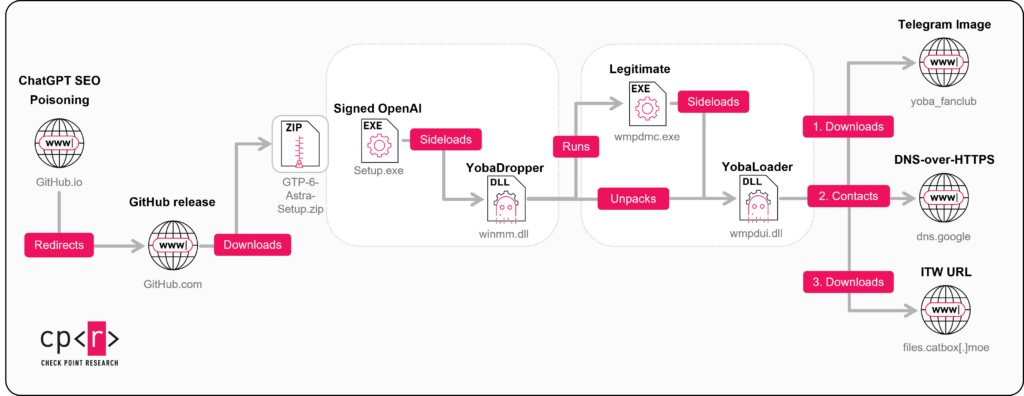
Over the past two months, we have been tracking a campaign that abuses the popularity of AI tools such as ChatGPT and Claude to spread a custom malware chain we call Yoba. The attackers use fake GitHub projects that pretend to be AI desktop applications like GPT-5.6 Sol, GPT-6 Astra, and Claude Opus. These projects look convincing and use real GitHub infrastructure, which helps them appear legitimate to potential victims. The website exhibits search-targeted content and suspicious installer-delivery tactics consistent with an SEO-poisoning lure.
Inside the installers, there is a malicious component we refer to as the YobaDropper. This dropper includes another component, the YobaLoader, which is responsible for contacting attacker-controlled infrastructure and fetching the final payload. In this report, we describe how victims are lured to these fake projects, how the YobaDropper and YobaLoader work together, and how the attackers ultimately use this chain to run unwanted software on infected systems.
Figure 1 — GPT-6 Astra campaign, attack chain.
GitHub Repositories
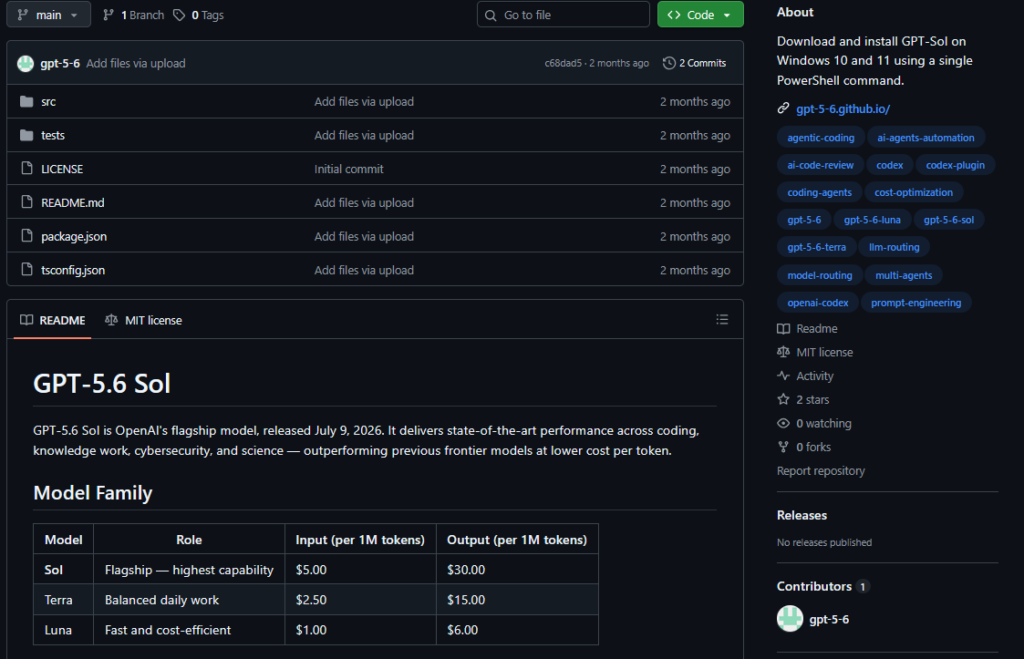
The initial access occurred via malicious GitHub repositories. The projects were impersonating ChatGPT and Claude related models, more specifically GPT-5.6 Sol, GPT-6 Astra, and Claude Opus. No manipulation of fake engagement (stars/forks) was in place.
Figure 2 — GitHub repository.
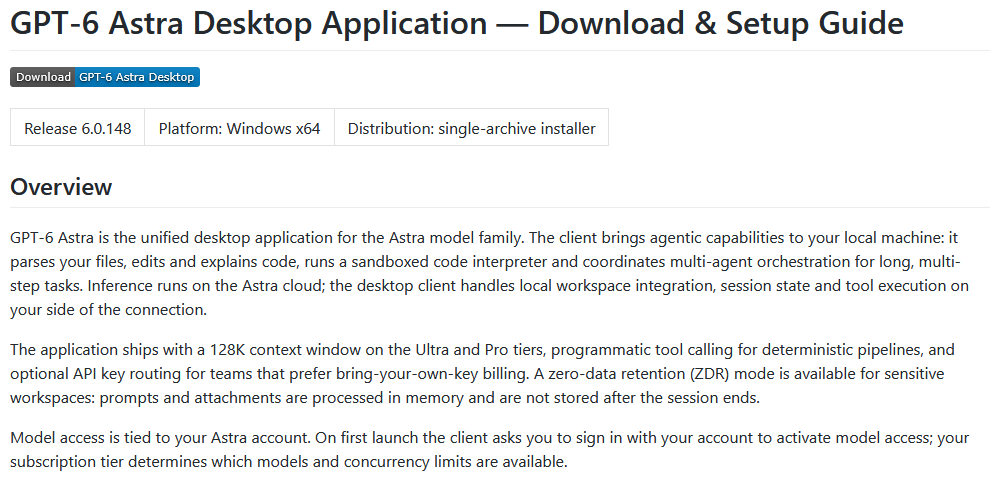
Aside from the repositories, GitHub.io pages were used to describe the capabilities of the software, while the malware was hosted as a release.
Figure 3 — GitHub.io page with links to malicious release.
These phishing landing pages contain download links that point directly to the malicious ZIP releases hosted on GitHub.
Figure 4 — Claude Opus GitHub[.]io page.
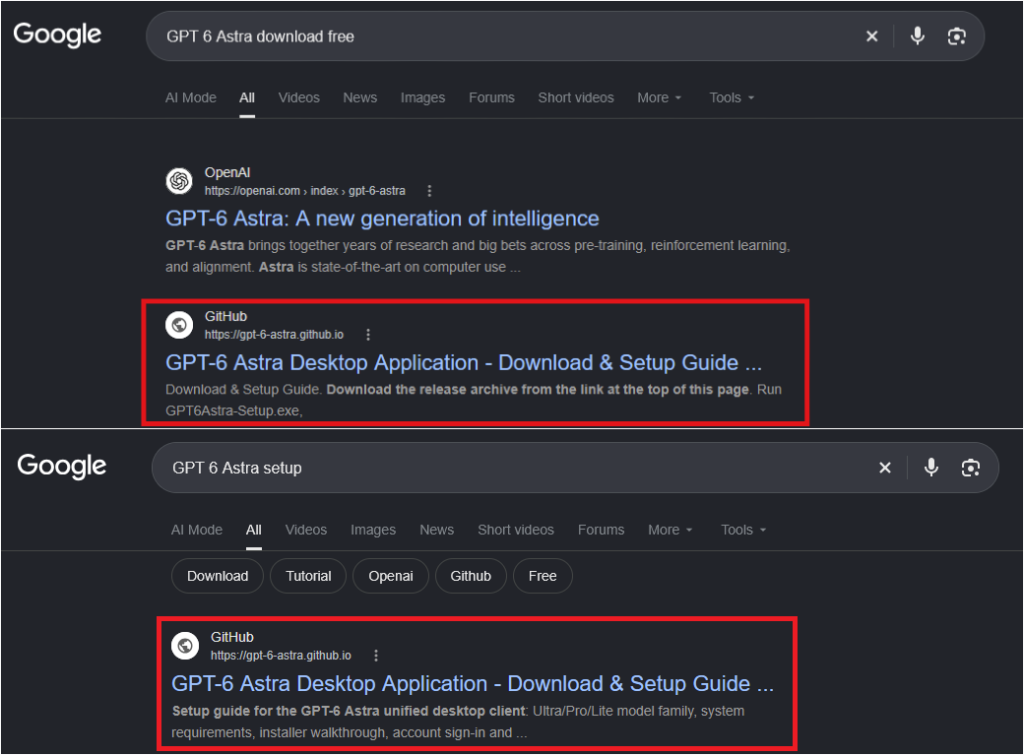
While the repositories do not show signs of fake engagement (such as artificially inflated stars or forks) that would promote them within GitHub’s own search, they still appear among the top results on Google. This is most likely due to SEO poisoning, where the attackers optimize titles, descriptions, and hosting domains to make their malicious projects rank highly in external search engines.
Figure 5 — Google Search results.
Each repository uses a different email address (edwardcarlsonmkym[@]outlook[.]com, daxschneiderdjuu[@]outlook[.]com, and rioprestonlfyx[@]outlook[.]com), and the uploader appears to operate in UTC+4, UTC-4, and UTC+3 respectively. This inconsistency likely reflects a deliberate attempt to obscure the threat actor’s true operational timezone.
Although the first repository was created around July 2026, the first two malicious releases were not uploaded until the end of August, and a third malicious release followed approximately five days later.
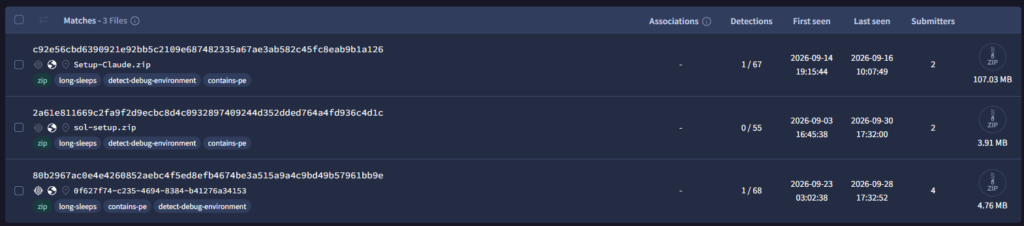
Malicious zip files hosted on GitHub and other legitimate platforms are usually password-protected, since this prevents automated tools from unpacking and therefore analyzing them. However, neither of these repositories used password protection, as the binaries already had very low detection rates thanks to their anti-sandbox and other anti-analysis techniques.
Figure 6 — Low detection rate.
While the two ChatGPT-related releases and their repositories were created about five days apart, the ZIP files contain mostly the same files, including the malicious components, and they maintain the same IoCs.
Filename
sol-setup.zip (ChatGPT)
GPT-6-Astra-Setup.zip
151.0.7922.174.manifest
2026-08-30 15:11:18
N/A
D3dx9_41.dll
N/A
2021-10-18 17:58:06
owl-shell-runtime.json
2026-08-30 15:11:18
2026-08-30 15:11:18
Setup.exe
2026-08-30 15:11:18
2026-08-30 15:11:18
snapshot_blob.bin
2026-08-30 15:11:18
2026-08-30 15:11:18
v8_context_snapshot.bin
2026-08-30 15:11:18
2026-08-30 15:11:18
vk_swiftshader.dll
2026-08-30 15:11:18
2026-08-30 15:11:18
vk_swiftshader_icd.json
2026-08-30 15:11:18
2026-08-30 15:11:18
vulkan-1.dll
2026-08-30 15:11:18
2026-08-30 15:11:18
winmm.dll
2026-08-30 15:14:20
2026-08-30 15:14:20
By adding the compilation timestamps to this these time-related operations, we are able to determine which files appear to contain the malicious functionality without performing any initial analysis.
Filename
Compilation Timestamp (UTC)
D3dx9_41.dll
2076-06-18 21:48:40
Setup.exe
2026-08-19 20:00:27
vk_swiftshader.dll
2026-08-19 20:00:27
vulkan-1.dll
2026-08-19 20:00:27
winmm.dll
2026-08-30 19:14:19
The file that immediately stands out is winmm.dll, which was compiled the same day it was added to the ZIP archive. This suggests it is the component with the malicious functionality, while the other files serve to make the package appear legitimate. The compilation timestamp also indicates the actor is operating in the UTC-4 timezone.
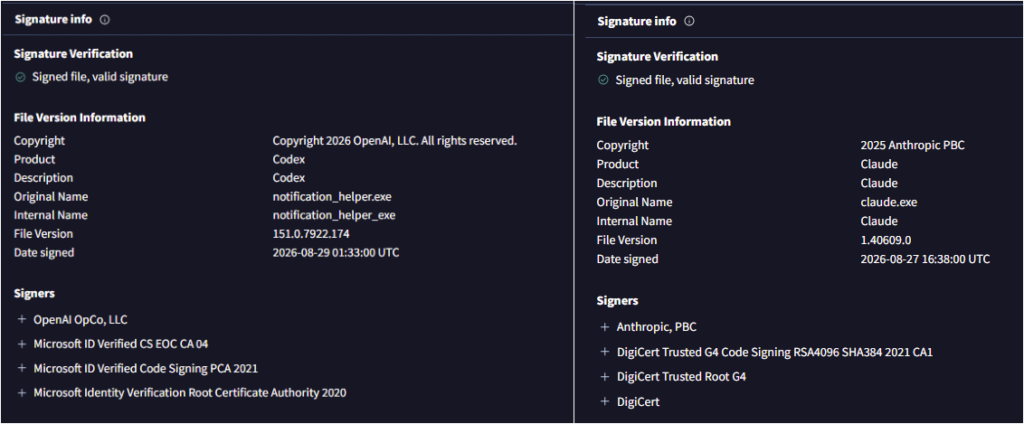
Furthermore, Setup.exe, a legitimate signed OpenAI executable, is used during execution to sideload the malicious DLL. The Setup-Claude.zip file contains the same structure, though in this case Setup.exe is a legitimate signed Claude executable.
Figure 7 — Signed OpenAI and Anthropic binaries.
YobaDropper – winmm.dll
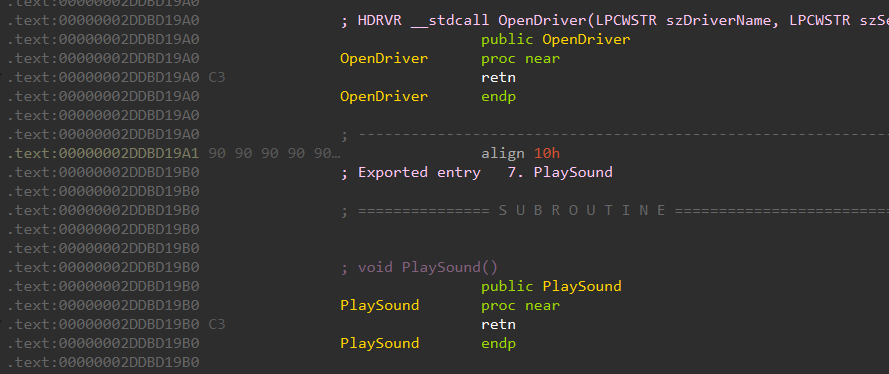
The malicious DLL contains multiple export names, suggesting that the legitimate winmm.dll has been spoofed. As in many other cases, these exports exist but their code has been stripped out, leaving them mostly empty and reducing the size of the binary.
Figure 8 — Stripped code from exports.
All 180 exports contain just a return instruction (C3) followed by NOPs (90), and DllEntryPoint is the only one containing actual code.
Anti-Analysis, Pre-Checks
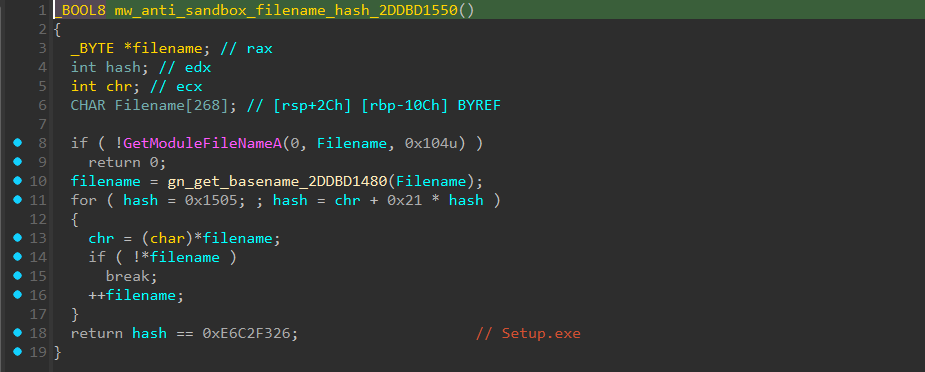
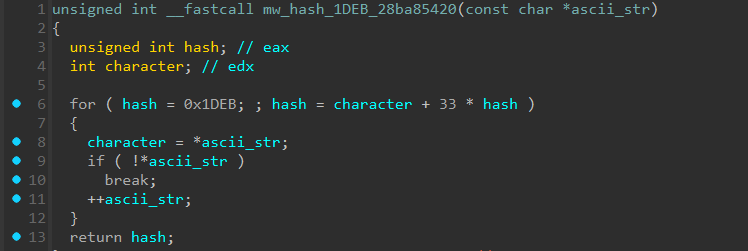
The first function implements an anti-sandbox technique: the malware hashes the basename of its host executable and checks whether the checksum matches the hardcoded value 0xE6C2F326. The hashing algorithm has been identified as DJB2, which other malware families have also used in the past. The malware expects to run under the name Setup.exe, so this check fails if the DLL is executed on its own inside a sandbox environment.
Figure 9 — DJB2 algorithm and hash check.
Although a failed check does not terminate the process, the DLL performs 200,000 iterations of Sleep(5500), amounting to approximately 12.73 days, while repeatedly appending the decoded filler string pddy to a local UTF-16 buffer.
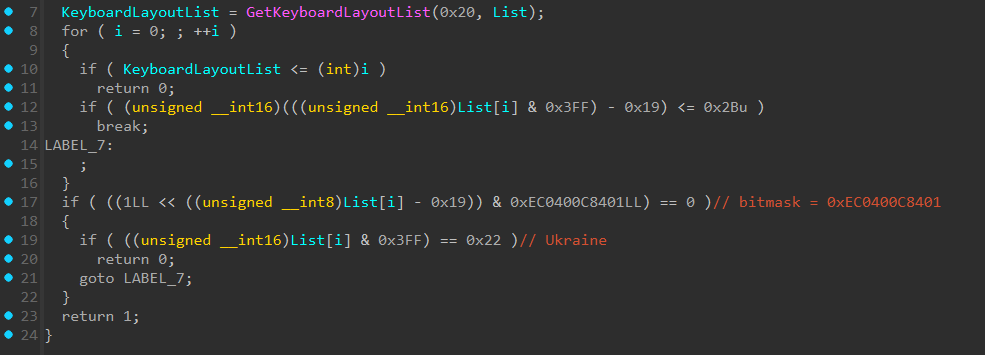
In the second function, the malware checks whether the infected user is located in a CIS country by inspecting the system’s keyboard layout. Ukraine was historically included in such checks, but it is not in the list used by recent malware.
The language check is unusual. Instead of comparing the victim’s keyboard language ID against hardcoded values, the malware checks whether the ID falls within the range 0x19–0x44. For IDs in that range, it tests the corresponding bit in the bitmask 0xEC0400C8401 to determine whether the language belongs to a CIS-region country, with an explicit exception for ID 0x22 (Ukrainian). Bazarloader has used a similar technique in the past, with the bitmask 0xD8080190C03.
Figure 10 — Language checks.
Language IDs excluded from the infection:
Russian
Belarusian
Tajik
Armenian
Azerbaijani
Georgian
Kazakh
Kyrgyz
Turkmen
Uzbek
Tatar
The malware continues to resolve Windows API functions dynamically from kernel32.dll and ntdll.dll by comparing hashes of the exported function names. The hashing algorithm is again DJB2, with the initial value 0x1505.
The last check before the malware unpacks and deploys the embedded payload tests whether the process is running with administrator privileges. If it is not, the malware displays the message “Please run this program as Administrator.” to the victim and terminates itself, requiring the user to rerun it with elevated privileges.
Deploying Phase
The dropper contains multiple XOR-encrypted strings that are decrypted when needed. These strings include the file paths where the embedded binaries are dropped, as well as the decryption keys.
It creates a directory under ProgramData named WMProcess. Then it copies the original WMPDMC.exe from System32 into this newly created folder. Next, it decrypts the embedded payload using the string IRANNUMBERONE as the XOR seed and drops the decrypted payload in the same folder under the name wmpdui.dll.
Using scheduled tasks, the dropper maintains persistence by leveraging the legitimate executable, which will sideload the malicious payload. To make the task appear legitimate, it sets the author to Microsoft Corporation and the description to Collects device metadata for Windows Media Player.. It also sets the boot-trigger delay to PT3M, which corresponds to a 3-minute delay after system startup, and configures the task to run under the Local System account (S-1-5-18).
YobaLoader – wmpdui.dll
The second-stage payload contains the same code as the dropper, which indicates that the same developer is responsible for both components.
The same anti-sandbox technique is used, forcing the malware to be run only by WMPDMC.exe. It again checks the hash of the process basename, and only continues execution if this value matches the hardcoded hash 0x552751E3.
The dropper uses the DJB2 hashing algorithm to hash and verify the process name and to resolve Windows API functions, both with the same seed 0x1505. The loader (YobaLoader) also uses DJB2 for the process name with the same seed as the dropper, but for resolving Windows API functions it uses a different seed, 0x1DEB.
Figure 11 — Hashing windows API functions.
The developer reused the same string-hashing algorithm but changed the seed (0x1505 in the dropper, 0x1DEB in the loader) to separate the hash spaces for each stage, complicating analysis, and reducing the effectiveness of hash-based detection and automated tooling.
Network
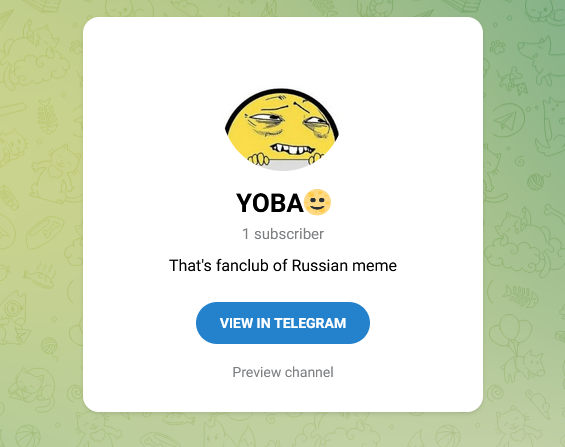
The downloader uses an interesting process to obtain the next-stage payload. It first decrypts multiple strings using a simple XOR operation, among these strings is the URL of a Telegram channel, t[.]me/yoba_fanclub. It then visits this channel using the user-agent string Mozilla/5.0 (Windows NT 10.0; Win64;) and parses the HTML source to extract the src URL of the element with the class tgme_page_photo_image. This class refers to the location where the channel’s profile image is hosted.
Figure 12 — Telegram channel.
It downloads the image and uses the last 50 bytes as a seed to generate a domain based on three lists of dictionary words, which are decrypted as part of the DGA algorithm. This DGA algorithm uses three sets of strings:
Adjectives
Nouns
Verbs
Finally, it generates and appends an integer value in the range 0–999. The generated domain has the following format, "$adjective-$noun-$verb-$digit.dedyn[.]io". By changing the image of the Telegram channel, a new domain can be generated.
The following Python snippet represents the DGA algorithm:
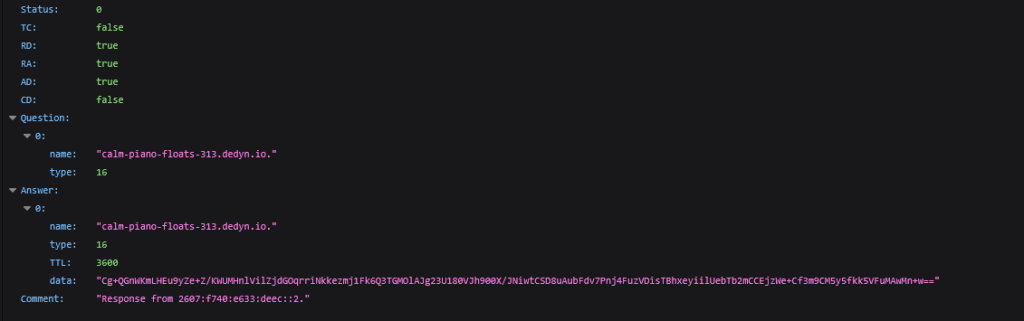
It then queries Google’s DNS-over-HTTPS (DoH) API to obtain an encrypted command from a DNS TXT record, using a URL of the form https://dns[.]google/resolve?name=$DGA&type=TXT.
By relying on a DoH service and common file-hosting platforms, the actor aims to bypass passive DNS monitoring and some gateway-based security protections, making their command-and-control traffic harder to distinguish from regular user activity.
Figure 13 — DNS TXT record, base64 encoded data.
It decodes the Base64-encoded data field from the JSON response and validates it using Ed25519 signature verification with the public key b5c2d20623d4e6647d06a42864edd8629f82c5c384b243fdaeeeca24b3873d64. Once the signature validation succeeds, it decrypts the decoded value using AES in ECB mode with the key 1d0d1368b4d53f3a6322cf40e84e63db.
The downloader retrieves the encrypted payload and decrypts it using the same AES key and ECB mode that were previously used for the DNS data.
The malware provides three methods for deploying the downloaded payload. The selected method is indicated by the first character of the decrypted response that follows the URL (1/2/3):
Injects the downloaded payload into svchost.exe (NtWriteVirtualMemory/NtCreateThreadEx). It enumerates running processes and, using the hashing algorithm with the seed 0x1DEB, searches for the hash value 0xC26CDEA5, which corresponds to svchost.exe.
Saves the payload as a %TEMP%\$10_rand_char\$10_rand_char.exe file and executes it. Before running the executable, the downloader removes the Zone.Identifier alternate data stream, which is hidden metadata used by Windows to track the origin of downloaded files.
Saves the payload as a %TEMP%\$10_rand_char\$10_rand_char.ps1 PowerShell script and invokes it with the following parameters: -WindowStyle Hidden -ExecutionPolicy Bypass -File.
Finally, the injected payload into svchost.exe is an XMRig 6.26.0 miner with a hidden command line targeting a TLS-enabled onion mining endpoint through a local Tor SOCKS5 proxy. It can unpack and start Tor 0.4.9.12 plus lyrebird 0.8.1, monitor user-input activity to pause mining, and conditionally load the WinRing0 driver service for MSR-based mining optimization.
Although we observed an XMRig cryptominer as the final payload in this campaign, the YobaLoader is a generic loader. The operator can supply any PE or PowerShell payload via the signed DNS TXT tasking, so future waves may deliver different malware families.
Past Yoba Versions
Yoba exposes, through the same hashing algorithm it uses for anti-analysis, the specific process name under which it expects to run. Even without having full visibility into the campaign from the very beginning, analysts can still infer which targeted software was used to lure users by correlating this expected process name with the fake AI applications promoted on the associated GitHub repositories and GitHub Pages sites.
Hash
Process
Product
0xE6C2F326
Setup.exe
ChatGPT & Claude Opus
0x56221573
Cursor.exe
Cursor AI Coding Agent
0x39DE0DD8
Unknown
Unknown
Earlier YobaDropper observed in the wild appeared in early June 2026. In this campaign, the dropper was sideloaded by a process named Cursor.exe (hash: 0x56221573). It remains unclear whether Cursor.exe was a legitimate signed binary. The majority of the functionality in this early variant is consistent with the newer versions of both the dropper and the loader.
YobaDropper shows two main differences between its older and newer versions:
Unpacking logic: In the oldest version, the buffer is first Base64-decoded and then XOR-decrypted to extract the YobaLoader. In the newer version, the developer removed the Base64-decoding step and performs only XOR decryption, simplifying the unpacking process.
Execution method: The second change concerns how YobaLoader is triggered. The newer version uses Scheduled Tasks to start the copied legitimate host and sideload the loader, whereas the first discovered version creates the shortcut msdefender_scheduler{7940-8490-6670-1081}.lnk in the Startup folder. This shortcut executes a copied %APPDATA%\Microsaft Difendir\msdtc.exe and sideloads %APPDATA%\Microsaft Difendir\mswsock.dll.
Earlier version of YobaLoader contains language checks and excludes only Russia from infection. In later versions, these checks were moved to the dropper stage and expanded to exclude additional CIS countries, shifting regional filtering earlier in the infection chain.
Figure 14 — Exclusion of Russian language from infection.
While the overall DGA logic remains the same, the early variant uses the extension .aber[.]ir instead of .dedyn[.]io. In addition, instead of injecting into svchost.exe, this variant injects into a different running process identified only by its hashed name 0x21BD94C2.
The initial loader also implements several anti-analysis techniques that have been removed from the newer versions of the malware:
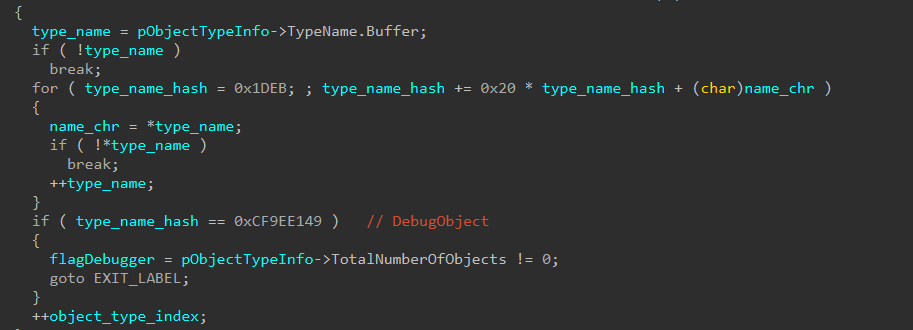
1. Anti-debugging It enumerates all kernel object types and reads their TypeName values. Each type name is hashed using DJB2 with the seed 0x1DEB until the hash matches 0xCF9EE149, which corresponds to DebugObject. If a DebugObject is found, it indicates that a debugger is or was active, and in that case the malware terminates itself.
Figure 15 — DebugObject via NtQueryObject-ObjectAllTypesInformation.
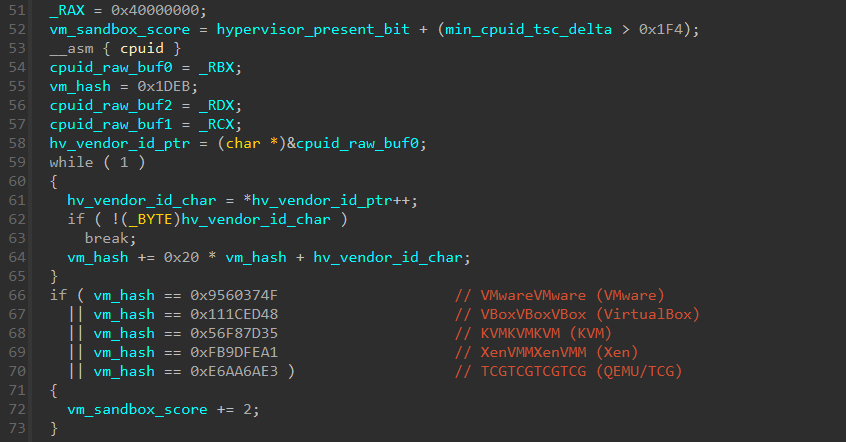
2. Anti-VM The malware uses a VM/sandbox-detection scoring function while running several hardware fingerprinting checks. The maximum score is 6, and the minimum required to continue the infection chain is 3. The checks include:
Hypervisor-present bit and CPUID timing (via RDTSCP).
Despite these small differences in early anti-analysis behavior, the Telegram channel and the profile image used as the seed for the DGA remain the same as in the newer variants, indicating that the operator retained the same infrastructure while iterating on the loader’s evasion logic.
Conclusion
The Yoba campaign shows how attackers can use trusted platforms and the current interest in AI tools to distribute malware in a way that looks believable and harmless at first glance. By packaging their code together with well-known software names and hosting it on GitHub, they lower the chances that users or basic security checks will immediately flag the files as suspicious. Although the underlying techniques are more advanced than typical commodity malware, the main goals remain straightforward: gain a foothold on the victim’s system, avoid easy detection, and then run the attacker’s chosen payload. Organizations should be cautious about installing “AI helpers” or similar tools from unverified repositories and should enforce policies that restrict running software from unknown sources. Combining user awareness with basic technical controls.
Australia’s cyber security authority responded to 1,524 cyber security incidents in the 2025-26 financial year, a 20% increase from the previous year and a 36% rise over five years. The latest Annual Cyber Threat Report shows that phishing, compromised accounts, unpatched systems, ransomware and data theft remain the main operational pressures.
Artificial intelligence is increasing the speed and scale of many established techniques, but the report’s central message is practical: organisations need to patch faster, protect identities, improve logging, manage supplier access and prepare to continue operating during an incident. The Australian Signals Directorate’s Australian Cyber Security Centre also expanded proactive warning activity, issuing more than 4,400 notifications about potential malicious activity during the year.
What Did Australia Record in 2025-26?
Measure
2025-26 result
Change or context
Cyber security incidents
1,524
Up 20% year over year
Potential malicious activity notifications
More than 4,400
Up almost 80%
Cybercrime reports
More than 82,000
About one every 6 minutes
Ransomware incidents
139
Broadly consistent with last year
Data breach incidents
98
Up 66%
Average business cost per report
A$93,500
Up 16% overall
These figures come from different reporting and response channels. Cybercrime reports, incidents handled and proactive notifications should not be added together as if they represent unique victims. Read together, however, they show both high public reporting volume and a larger operational workload for government responders.
What Changed in Australia’s Threat Picture?
The incident count increased, but the more important shift was in impact. Extensive compromises rose from 26 to 40, even though only one Category 2 (C2) incident, the second-highest severity level, was recorded. Ransomware and distributed denial-of-service activity also produced more extensive compromises despite stable or falling overall volumes.
Improved visibility also contributed to the rise. ASD’s ACSC identified 362 incidents after proactively warning organisations about suspicious activity, while more than half of its individual notifications originated from declassified intelligence. The increase therefore reflects a combination of worsening risk, stronger detection and greater reporting awareness.
How Much Did Cybercrime Cost Australians?
More than 82,000 cybercrime reports were submitted through ReportCyber, or about one every six minutes. Identity fraud remained the most frequently reported cybercrime, although reports in that category fell 18%. The Australian Cyber Security Hotline received more than 37,500 calls, down 12% from the previous year.
The average self-reported cost for individuals remained A$33,000. The business average rose 16% to A$93,500 per report. Small businesses reported an average cost of A$55,400, medium businesses A$141,300 and large businesses A$148,100. The 45% rise for medium businesses stands out because these organisations may combine valuable data and connected systems with fewer specialist security resources than large enterprises.
Which States Reported the Most Cybercrime?
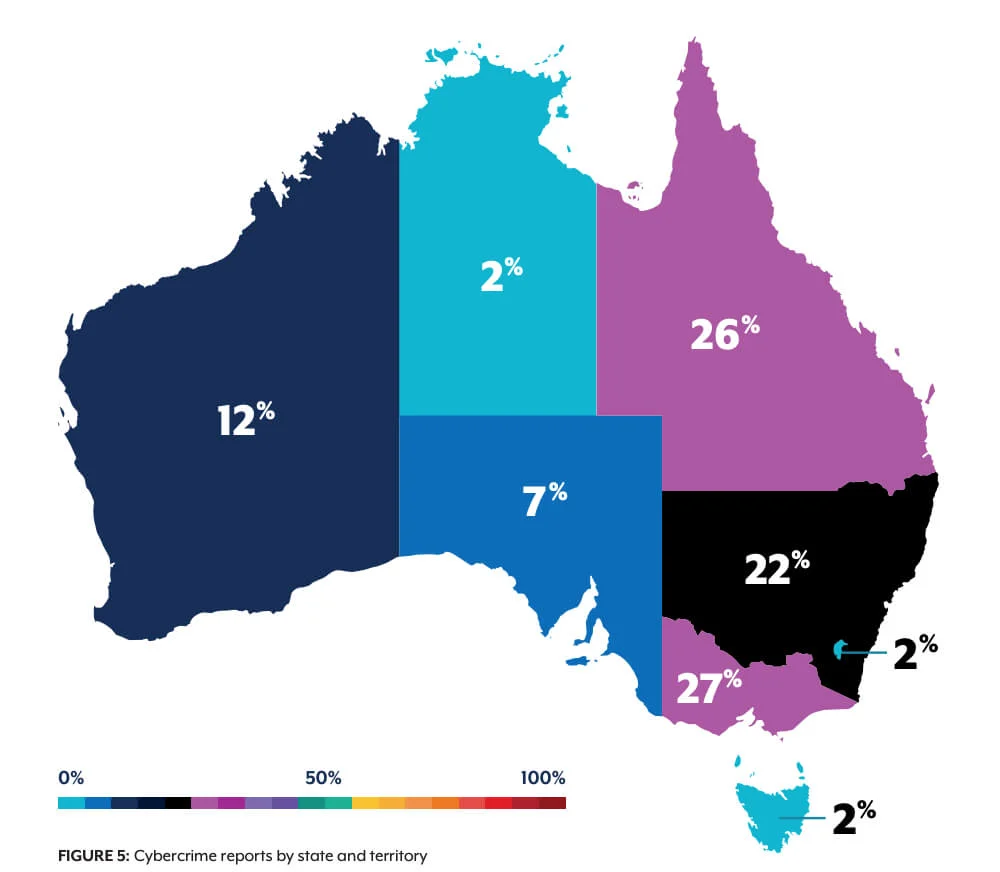
Victoria accounted for 27% of cybercrime reports, followed by Queensland at 26% and New South Wales at 22%. Western Australia represented 12%, South Australia 7%, while the Northern Territory, Australian Capital Territory and Tasmania each accounted for 2%. The report notes that Australia’s three most populous states continued to generate the highest reporting volumes, with disproportionately high reporting rates relative to their populations.
Share of cybercrime reports submitted through ReportCyber by state and territory in 2025-26.
Which Attack Paths Appeared Most Often?
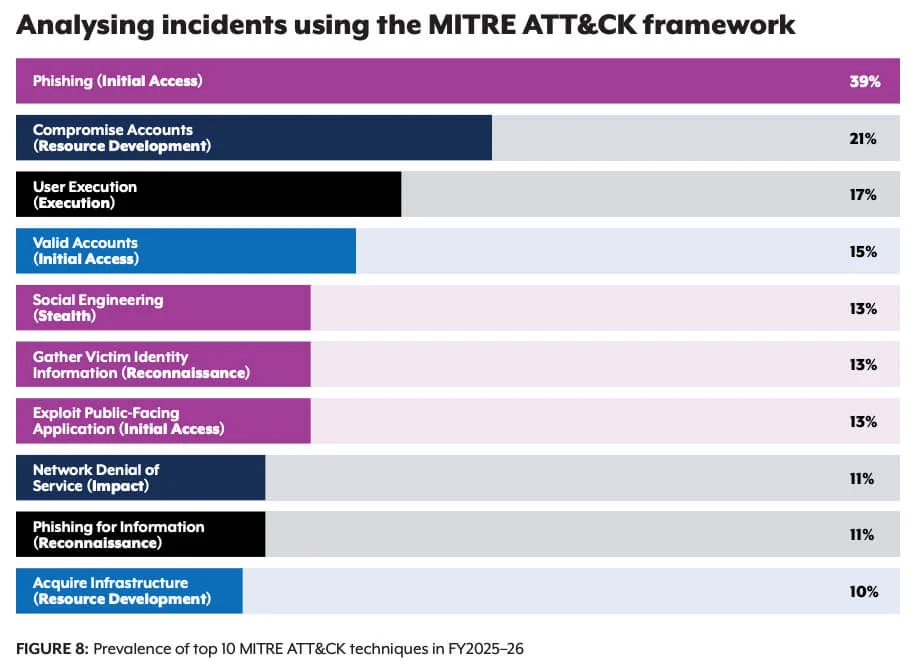
Phishing appeared in 39% of analysed incidents, followed by compromised accounts at 21%, user execution at 17%, valid accounts at 15%, and social engineering at 13%. These percentages overlap because one incident can involve several techniques. The pattern shows why email filtering alone is not enough: identity monitoring, secure recovery processes and post-login detection are also necessary.
Prevalence of the top 10 MITRE ATT&CK techniques observed in Australian cyber security incidents during 2025-26.
Data exposure also became more prominent. ASD’s ACSC responded to 98 data breach incidents, up 66%, while the Office of the Australian Information Commissioner received 1,205 breach notifications during 2025, its highest annual total since the Notifiable Data Breaches scheme began. Stolen personal information can support identity fraud, targeted phishing and account recovery abuse long after the original breach.
Why Did Flat Ransomware Volume Still Matter?
ASD’s ACSC responded to 139 ransomware incidents, broadly consistent with the previous year. However, extensive ransomware incidents increased from 16 to 24. Health Care and Social Assistance, Professional, Scientific and Technical Services, and Manufacturing remained the three most affected industry divisions.
This distinction matters because a stable incident count can hide rising operational harm. Modern ransomware campaigns may combine service disruption, data theft and public extortion, while Ransomware-as-a-Service lowers the barrier for affiliates. Defenders should measure recovery time, systems affected and data exposure, not only the number of attacks.
How Quickly Are Vulnerabilities Being Exploited?
Publicly reported common vulnerabilities and exposures (CVEs) increased 30%. ASD’s ACSC says most vulnerability exploitation occurs within two weeks, while some flaws are exploited within 48 hours of patch or mitigation guidance. It also recorded successful exploitation of a vulnerability first identified in 2008, showing that organisations must address both newly disclosed flaws and unsupported legacy systems.
A useful lesson is that patch speed depends on preparation before a vulnerability is disclosed. Organisations need a current inventory of internet-facing systems, clear ownership, tested emergency change procedures and a way to verify that a fix reached the running service. A policy target has limited value if teams cannot identify the affected asset or confirm deployment.
How Did Proactive Warnings Reduce Risk?
The report provides two examples of threat intelligence changing outcomes. A collective notification about cPanel vulnerabilities was sent to 340 entities and resulted in more than 60 incidents being confirmed. In a separate Akira ransomware investigation, reports from multiple organisations helped ASD’s ACSC connect activity to exploitation of a known SonicWall vulnerability.
ASD’s ACSC then identified almost 1,000 potentially vulnerable devices and around 40 potentially vulnerable Australian organisations, many in critical infrastructure, and issued targeted warnings. Similar reported incidents declined after the public alert. The practical insight is that reporting is not only a compliance task: shared evidence can reveal a campaign early enough to protect organisations that have not yet detected it.
Where Did Cyber Risk Concentrate?
Federal government accounted for 32% of incidents reported to ASD’s ACSC, followed by state and local government at 16%. The report cautions that government reporting obligations influence these totals. Health Care and Social Assistance was the leading non-government sector at 7%, while Manufacturing entered the top ten and recorded the largest increase in reports.
Critical infrastructure accounted for 154 incidents, or 10% of the total, down almost 7%. Phishing was the leading initial-access method in these incidents at 36%, followed by valid accounts at 16% and drive-by compromise at 10%. Financial and insurance services represented 30% of critical infrastructure incidents, ahead of public administration and safety at 21%, and electricity, gas, water and waste services at 17%.
State-sponsored actors continued to seek sensitive information and access that could support later espionage or disruption. The report specifically notes that China-nexus actors increasingly use covert networks built from compromised small-office/home-office routers, Internet of Things devices and smart devices to conceal the origin of malicious activity. This makes asset ownership and secure configuration important beyond conventional servers and employee endpoints.
How Is AI Changing the Operating Tempo?
The report does not present AI as a separate attack type. Instead, it describes AI as an accelerator for reconnaissance, vulnerability research, exploit development, phishing, impersonation, stolen-data analysis and malicious code adaptation. The immediate risk is less about an unfamiliar technique and more about familiar techniques becoming faster, cheaper and easier to personalise.
AI can also improve defence by analysing security data, identifying vulnerabilities, monitoring unusual behaviour and supporting incident response. Those benefits depend on governance. Organisations should limit the sensitive data available to AI systems, apply least privilege, retain audit records and require human review for consequential actions. Security teams should evaluate AI as both a new dependency and a defensive tool.
Why Are Supply Chains and Code Repositories a Priority?
Third-party access and software dependencies can spread one compromise across many organisations. ASD’s ACSC observed attackers using social engineering, stolen credentials and authentication tokens to enter code repositories, expose private source code, steal secrets and modify trusted software packages.
The report uses the self-replicating Shai-Hulud campaign as an example. After a maintainer account was compromised, malicious package versions harvested credentials and cloud metadata, exposed stolen secrets in public repositories and used captured access to compromise other packages. Organisations therefore need an accurate inventory of dependencies and deployed versions, tightly controlled maintainer privileges, secret scanning and rapid token revocation.
What Should Organisations Do Now?
Accelerate patching. Prioritise internet-facing and actively exploited vulnerabilities, replace unsupported technology and verify remediation in production.
Protect identities and sessions. Use phishing-resistant authentication, restrict privileges, secure recovery processes and monitor unusual token or session use.
Improve event logging. Retain the identity, endpoint, cloud, application and network evidence needed to understand access, impact and data exposure.
Reduce supplier and software risk. Map third-party access, dependencies, privileged integrations, code repositories and secrets, then test revocation and containment.
Plan for disruption. Adopt an assumed-breach mindset, test incident response and recovery, and define how critical services will continue when systems are unavailable.
Govern AI use. Limit data exposure, enforce least privilege, validate outputs and retain human oversight for actions that affect systems or customers.
Report suspicious activity early. Technical details and indicators can help authorities identify a wider campaign and warn other potential targets.
What Is the Main Takeaway?
Australia’s 2025-26 threat data shows an environment moving faster without abandoning familiar weaknesses. AI is compressing response time, but credentials, phishing, unpatched systems, supplier access and recovery readiness continue to shape real-world outcomes.
The report’s most useful message is operational: proven controls need to work at greater speed and across the full environment. Organisations that know their assets, protect legitimate access, preserve evidence and practise recovery are better placed to contain both established attacks and AI-assisted variants.
Frequently Asked Questions
What Is the Annual Cyber Threat Report 2025-26?
It is the Australian Signals Directorate’s annual assessment of cyber threats affecting Australian individuals, businesses, government and critical infrastructure. It combines incidents handled by ASD’s ACSC, public cybercrime reports, threat intelligence, notifications and case studies from the 2025-26 financial year.
How Many Cyber Security Incidents Did Australia Record?
ASD’s ACSC responded to 1,524 incidents, up 20% from the previous year and 36% over five years. This is the number of incidents handled by the national cyber security authority, not a complete count of every incident that occurred in Australia.
What Is the Difference Between a Cybercrime Report, an Incident and a Notification?
A cybercrime report is submitted through ReportCyber by a member of the public or an organisation. A cyber security incident is activity that ASD’s ACSC assessed or assisted with, while a notification is a warning sent to an entity about potential malicious activity or exposure. The categories can overlap, so their totals should not be combined.
What Was the Most Common Attack Technique?
Phishing was the most prevalent MITRE ATT&CK technique, appearing in 39% of analysed incidents. Compromised accounts, user execution and valid accounts were also common, showing that attackers frequently combine social engineering with legitimate credentials or sessions.
How Much Did Cybercrime Cost Australian Victims?
The average self-reported cost was A$33,000 for individuals and A$93,500 for businesses. These are averages for reports that included a cost, not an estimate of Australia’s total economic cost, and the business figure varied substantially by organisation size.
Did Ransomware Increase in 2025-26?
The total remained broadly stable at 139 incidents, but extensive ransomware compromises increased from 16 to 24. This means the volume was flat while the number of more consequential incidents rose.
How Serious Was the Data Breach Trend?
ASD’s ACSC responded to 98 data breach incidents, a 66% increase. Stolen personal information can be reused for identity fraud, targeted social engineering and account recovery attacks, so the effects may continue well beyond the initial intrusion.
How Is AI Affecting Cyber Security?
AI is reducing the time and skill needed for reconnaissance, exploit development, phishing and data analysis. It can also help defenders find vulnerabilities, analyse events and respond faster. The report recommends using AI with controlled data access, auditability and human oversight.
How Fast Do Organisations Need to Patch?
There is no single safe deadline for every vulnerability. ASD’s ACSC has observed most exploitation within two weeks and some within 48 hours of patch or mitigation guidance, so internet-facing and actively exploited flaws require urgent action. Organisations should also identify and replace unsupported systems that cannot receive fixes.
Which Sectors Reported the Most Incidents?
Federal government reported the largest share at 32%, followed by state and local government at 16%. Health Care and Social Assistance led non-government sectors at 7%. These percentages reflect reporting to ASD’s ACSC and are influenced by sector-specific obligations and reporting maturity.
What Should Smaller Organisations Prioritise First?
Start with a small set of controls that reduce common attack paths: automatic updates, phishing-resistant authentication, protected backups, secure account recovery, basic event logging and a tested incident contact process. Choosing products that are secure by default can reduce the operational burden where specialist resources are limited.
Why Does Reporting an Incident Matter?
A single report may reveal infrastructure, indicators or techniques affecting other organisations. The Akira and cPanel examples show how combined evidence and proactive notifications can identify vulnerable entities and reduce further incidents. Australian organisations can report even when compromise has not yet been confirmed.
AI is becoming a third wheel in relationships, increasingly playing a role in the most intimate parts of our lives.
It shows up in the flirty first text, the polished dating profile, the therapized language we use with a partner after a fight, the strength we gather after heartbreak, and everywhere in between. For some, AI is a source of companionship itself. And even if you’re not personally an AI user, you may still be dating, loving, arguing with, or trusting someone who is.
As AI moves deeper into our relationships, it’s reshaping connection, blurring what feels authentic, and creating new ways for intimacy to be exploited.
AI is starting to replace human interaction
AI is moving into emotional territory once reserved for other people. For some, it’s no longer just a tool, but a source of support, companionship, and even romantic connection.
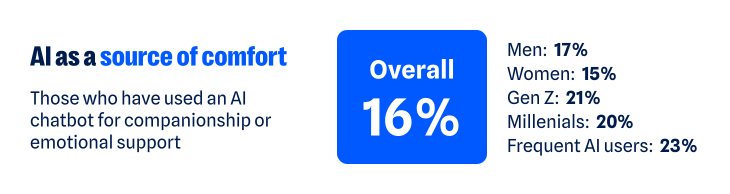
According to our recent research, about one in six have turned to a chatbot for companionship or emotional support. That climbs to about one in five among Gen Z and Millennials, and nearly one in four among regular AI users (those who use AI daily or multiple times a week). The more time people spend with AI, the more likely they are to humanize its role, making room for it as a friend, confidant, advisor, or even partner.
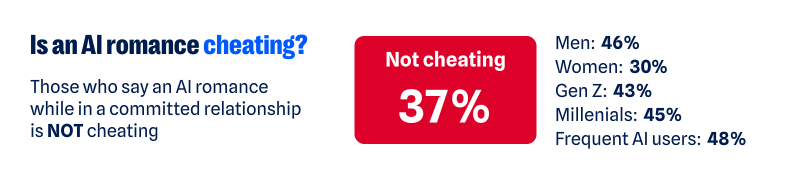
As AI takes on more intimate roles, it’s also starting to challenge the boundaries of real human relationships. More than one in three (37%) say having a romantic relationship with an AI chatbot while already in a committed relationship isn’t the same as cheating. That view is more common among men (46% versus 30% of women), Gen Z and Millennials (43% and 45%), and regular AI users (48%).
Whether the relationship is platonic or romantic, the more AI is treated like a human, the more personal the stakes become. Just like you have to be cautious when telling a human your deepest, darkest secrets, the experience is similar when using AI. Nearly two-thirds (65%) worry that private conversations they’ve had with AI could be exposed.
One survey respondent said:
“I have used a chatbot…for emotional support, and it is worrying to think those conversations could be leaked.”
The technology may be artificial, but the relationships people form with AI can feel very real. And as with any relationship, that means there are boundaries to work out, privacy to protect, and vulnerabilities to manage.
AI is creating new ways to weaponize intimacy
AI’s growing role in human intimacy also has a darker side. The same technology that can offer comfort, advice, or companionship can also be used to violate the most intimate parts of our lives.
Non-consensual image abuse, sextortion, and other forms of sexual abuse have long been part of the internet’s dark side. Generative AI has made that content easier to create. Someone trying to exploit another person no longer needs an actual intimate photo, video, or private exchange. A regular photo—or even just someone’s likeness—can be transformed into sexual content they never made, never shared, and never consented to.
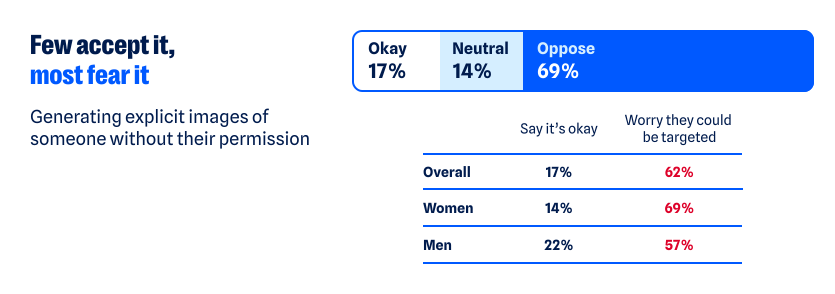
Most people draw a clear line against that, but not everyone does. About one in six people say it’s acceptable to generate explicit images of someone without their permission for personal use. Another 14% are neutral, bringing the share who do not explicitly oppose the behavior to nearly one in three (31%).
Views differ sharply by age and sex:
Younger adults are more accepting of someone using AI to generate non-consensual content: nearly one in four Gen Z (24%) and Millennials (23%) say it’s okay, compared with 13% of Gen X and just 5% of Boomers+
Men are also more permissive: more than one in five (22%) say it’s okay, compared with 14% of women
Attitudes toward the behavior may vary, but the fear of becoming a target is far more widespread. Overall, nearly two-thirds of people (62%) worry someone could create fake nude or sexually explicit photos or videos of them. Women feel this threat more acutely: nearly seven in ten (69%) are concerned, compared with 57% of men.
For some, this fear has already become a reality:
One in ten say AI has been used to generate nude or sexually explicit imagery of them without permission
One in ten say someone has threatened to release AI-generated compromising or explicit imagery of them
As one respondent recounted:
“I had someone make fake nudes of me using AI on my photos from my social media and threaten to post them on Facebook…[it] made me more cautious about AI.”
The intimate material may be fake, but the fear, coercion, and potential for reputational, emotional, and financial damage are completely real.
AI is making it harder to know who you’re really talking to
The threat doesn’t stop with fabricated sexual content. AI is also making it harder to know whether the person on the other side of a screen is who they claim to be.
Humans have always edited themselves for other people. We choose the most flattering photo, write and rewrite the text before sending it, and present our most interesting selves—especially when forming new relationships. AI dramatically expands what that kind of self-editing can look like, and people aren’t shy about using it:
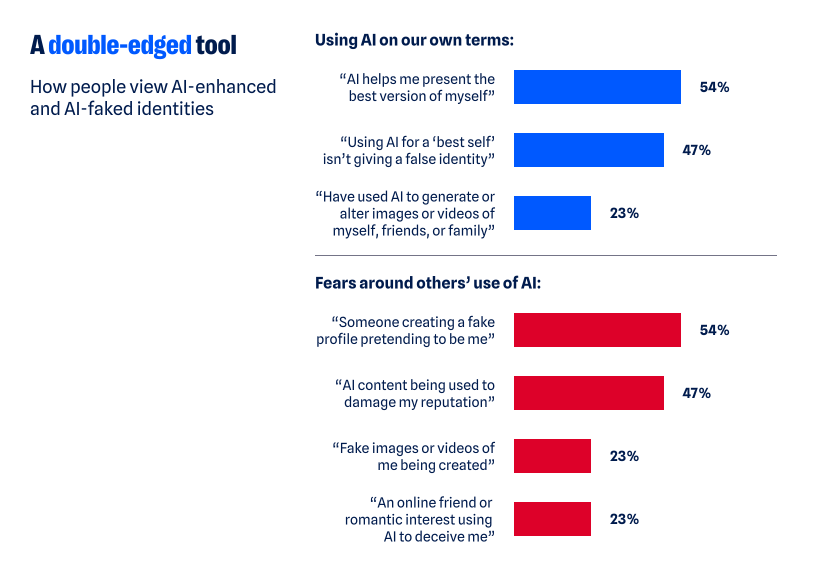
54% say AI helps them present the best version of themselves
47% say using AI to present your “best self” to employers, friends, or romantic partners does not present a false identity
That rises to 58% of both Gen Z and Millennials and 64% of regular AI users
But where does enhancement end and deception begin? Is an AI-polished dating profile still authentically you? What about a message you didn’t write? A photo that looks like you, only better?
There’s a flipside to using AI to make ourselves look or sound better: If we can do it, so can everyone else. And people are much less comfortable when they’re not the ones controlling the technology. Two-thirds (67%) worry that an online friend or romantic interest could use AI-generated images, videos, or other content to deceive them.
Catfishing, fake photos, and lies on dating profiles aren’t new. AI just makes the deception easier. Someone’s photos, backstory, messages, and even their voice can all be faked.
One person described leaving dating apps after realizing the person they were talking to had gone well beyond simply polishing their profile:
“[The] dating profile had fake pictures…[it] wasn’t just making true events sound interesting and more flirty, but creating completely false photos and information. Left the dating apps again and needed to reset.”
AI can distort identity in the other direction, too. It can also create a version of us we never chose to put into the world.
76% worry about someone creating a fake profile pretending to be them
70% worry about fake images or videos of themselves being created
71% worry AI-generated content could be used to damage their reputation
Relationships are built on mutual trust. AI can distort both sides of the connection: who we think the other person is, and who they think we are.
AI is quietly finding its way into the space between people
Not all of AI’s influence on intimacy is so dramatic. Much of it happens quietly, showing up in how people communicate with each other and navigate relationships:
More than one in three have used AI to help write or edit a message
About one in seven have turned to it for advice about a relationship or personal decision
One in ten say it has already changed how they date or communicate romantically—rising to nearly one in five among Gen Z
The survey responses show what this looks like in real life. For example, one respondent described using AI with their partner as a way to step outside their own point of view:
“Personally, it has helped me. We use AI in our relationship as a reflection tool, and it has sometimes helped us take on the perspective of the other.”
For another, AI helped them work through jealousy:
“So, I used to accuse my partner, and I got really territorial about them but once I talked to AI about it, they gave helpful advice and now we are stronger than ever.”
AI is also showing up in other difficult relationship moments. One person said it helped them “stay calm and communicate” when problems came up with their partner; another said it allows them “to pause and refine [their] thoughts” before responding.
Sometimes the role is simpler. One respondent said AI gives them “new romantic words” for their partner, while another said they’ve asked AI for advice on how to make their partner smile. AI’s growing role in relationships may be unsettling, but the benefits people describe are definitely there.
AI isn’t just helping people find the right words. It’s also helping them decide what version of themselves to put forward in the first place. More than one in three say it’s okay to use AI to create or improve a dating profile; nearly two-thirds aren’t opposed. One respondent described using AI as a “creative advisor” to polish their profile and come up with conversation starters.
AI doesn’t have to replace a relationship to help shape it. It can influence how people communicate, what advice they take, and how they choose to present themselves.
AI’s intimacy problem is ultimately a trust problem
From connection to deception to outright harm, the same question keeps surfacing: Can I trust what’s in front of me? And would I know if I couldn’t?
Nearly nine in ten people (88%) say AI is making it harder to tell what online content is genuinely human or real. And 84% say even convincing video evidence no longer necessarily feels like proof. That uncertainty follows people into dating and relationships, where knowing what—and who—to trust is deeply personal.
AI may make it easier to start a conversation, smooth over a hard one, or feel connected when you’re lonely. But relationships and intimacy of all kinds still come down to trust, and AI is making that trust a little harder to take at face value.
About the research
The research in this article is based on a March 2026 survey about AI, identity, and the collapse of digital trust and was conducted among 1,500 respondents in the United States, United Kingdom, Germany, Austria, and Switzerland. The research was prepared by an independent research consultant and distributed via Forsta.
Something feel off? Check it before you click.
Malwarebytes Scam Guard helps you analyze suspicious links, texts, and screenshots instantly.




 Table Of Contents