
- The evolution of malware command-and-control (C2) infrastructure has shifted away from fragile, centralized servers and hardcoded domains toward resilient, decentralized blockchain networks that eliminate single points of failure.
- Threat actors are leveraging immutable public ledgers such as Bitcoin transactions, EVM smart contracts via techniques like EtherHiding, TRON wallets, and Solana memo programs to store, mask, and persistently update their operational endpoints.
- By executing read-only remote procedure call (RPC) queries to retrieve encrypted C2 configurations directly into compromised endpoint memory, adversaries can continuously bypass traditional perimeter defenses and domain seizures.
- Modern cybersecurity requires a fundamental shift away from static domain blocklists toward monitoring anomalous outbound JSON-RPC traffic, analyzing endpoint memory, and treating blockchain infrastructure as an active threat communication channel.
The command-and-control (C2) channel is the operational backbone of any persistent malware campaign. It is also the most fragile component. The moment an actor’s C2 infrastructure is identified and reported to the hosting provider, the domain registrar, or law enforcement, the campaign’s operational capability collapses. This fundamental asymmetry, where defenders need to identify only a single infrastructure link to disrupt an operation, has driven a multi-decade arms race in resilience techniques, spanning from fast flux DNS evasion to decentralized and peer-to-peer architectures.
Traditional C2 infrastructure where malware beacons to a hardcoded domain or IP address is volatile by design. Security researchers or incident responders who identify the C2 address can trigger a response. The hosting provider can null-route the IP addresses and the domain registrars can suspend malicious domains under abuse policies, law enforcement can obtain court orders compelling infrastructure seizure, and threat intelligence vendors push blocklist updates that cut off the malware from its C2 links across several compromised endpoints simultaneously.
This single point of failure model renders sophisticated malware families inactive once their C2 is identified and sinkholed. By redirecting malware traffic to researcher-controlled servers, researchers can not only disrupt the botnet but map the full victim community, gather forensic telemetry, and notify affected organizations.
The arms race
Threat actors have progressively hardened their C2 infrastructure through several evasion techniques to outpace defensive capabilities. Amongst these techniques, some of the popular approaches include the employment of domain generation algorithms (DGA), content delivery network (CDN) domain fronting, peer-to-peer (P2P) architecture, and dead drop resolvers.
DGAs replace static, hardcoded server domains with dynamically generated domains. Malware programmed with a shared mathematical seed computes hundreds or thousands of pseudorandom domain names on a scheduled basis, systematically attempting to resolve each one until it establishes contact with an address registered by the threat actor. While this technique prevents defenders from neutralizing an entire operation by simply seizing or blocklisting a single domain, defenders counteracted DGAs by reverse engineering the generation algorithms, predicting future domains for proactive sinkholing, and applying machine learning models to detect algorithmically generated strings within enterprise DNS queries.
The CDN domain fronting technique evolved to bypass perimeter inspection mechanisms by exploiting discrepancies between the transport and application layers of encrypted web traffic. By initiating a TLS handshake with a legitimate, reputable domain hosted on a major CDN and specifying a covert, malicious host inside the encrypted HTTP Host header, threat actors route communications through benign enterprise traffic profiles. Enterprise security tools inspecting the outer connection perceive only standard communication with a trusted global platform, effectively masking the true destination behind high reputation infrastructure. However, major cloud providers and network carriers have largely dismantled this evasion vector by standardizing routing policies and enforcing strict matching between TLS Server Name indication values and internal request headers.
P2P architectures eliminate the single point of failure in a centralized server altogether by structuring infected hosts into a decentralized, self-healing mesh network. Instead of querying a primary server for instructions, compromised nodes propagate operational commands, binary updates, and collected data directly between adjacent peers using custom overlay routing protocols. This distributed topology ensures that severing dozens or even hundreds of individual endpoints leave the broader network intact and functional. Nevertheless, peer-to-peer networks suffer from inherent architectural exposure, because defenders and security researchers can enumerate the entire topology by acting as benign nodes, map peer lists, and progressively isolate the infected nodes.
Dead drop resolvers establish an indirect channel by abusing established third-party web services as covert repositories for downstream infrastructure coordinates. Rather than communicating with an adversary’s operational network directly, deployed malware retrieves encoded or encrypted IP addresses and domain names embedded inside public social media bios, code repository commits, or image metadata. By masking this initial discovery phase behind legitimate user activity on high-traffic consumer platforms, attackers blind simple reputation-based network defenses. Defenders eventually contain dead drop tactics by working directly with service providers to enforce aggressive account suspension, remove flagged content, and monitor automated outbound API requests from internal enterprise endpoints.
Each of the above techniques still relies on some degree of centralized infrastructure that can, under the right conditions, be neutralized.
The evolution of the blockchain as bulletproof hosting technique
C2 configuration hosting on the blockchain eliminates the operational dependencies through embedding encrypted server addresses and URLs directly into confirmed transactions that cannot be deleted or altered by any party, preventing any single authority from taking down the records.
A public blockchain is a distributed append-only ledger. Once a transaction is confirmed by the validators, it becomes a permanent, globally replicated record. The inherent architectural properties that make public blockchains attractive for financial systems translate directly into ideal characteristics for a resilient C2 configuration hosting channel. When configuration parameters such as active endpoint IP addresses and domain names or operational instructions are embedded into blockchain transactions, no single entity, cloud provider, or law enforcement agency possesses the administrative authority to delete, overwrite, or withhold that data. The ledgers are distributed globally, guaranteeing high availability and persistent access regardless of regional takedowns.
Furthermore, leveraging public blockchains enables operational advantages regarding attribution and survivability. Traditional C2 mechanisms often expose the operator through payment trails, registrar records, or network traffic directed at centralized hosts. By contrast, transactions on distributed ledgers can be broadcast pseudo-anonymously through cheaper wallets and retrieving the embedded configuration data which mimics the benign blockchain queries such as public RPC API lookups or block explorer scraping. Combined with nominal transaction fees, the blockchain functions as an indestructible, globally accessible record where deployed malicious agents can reliably synchronize updates without ever exposing the core infrastructure behind them.
Bitcoin blockchain adoption
The adoption of the Bitcoin blockchain as a C2 configuration hosting channel began around 2016 – 2019, conceived by threat actors seeking to overcome the operational fragility of centralized hosting and vulnerable DNS registrars. Because Bitcoin transactions are permanently recorded and broadcast across nodes globally, configuration details written to the ledger become immutable, preventing law enforcement and infrastructure providers from seizing, altering, or sinkholing the underlying records.
The most prominent implementation of this tradecraft emerged in September 2019 when security researchers at Trend Micro uncovered a new variant of the Glupteba botnet that used Bitcoin transactions to update its active C2 servers. Glupteba embedded a function that queried public Electrum servers for transactions linked to hardcoded script hashes controlled by the threat actors. By parsing the script, the malware extracted AES-encrypted payloads containing operational domains and fallback addresses, allowing the botnet to automatically regain connectivity whenever its active infrastructure faced defensive takedowns.
Prior to Glupteba’s abuse, threat actors explored Bitcoin’s public visibility through auxiliary resolver mechanisms, notably observed in certain iterations of the Cerber ransomware and early proof-of-concept crimeware throughout 2016 and 2017. Rather than embedding direct payloads in transaction scripts, these actors monitored output transaction values, addresses, and block explorer APIs to derive seeds for pseudorandom domain generation. While these early experiments exposed the defensive blind spots of relying on public ledger lookups, the high transaction fees, block confirmation latencies, and 80-byte payload constraints of Bitcoin eventually prompted modern campaigns to migrate toward high throughput smart contract ecosystems and memo programs.
Weaponization of smart contracts on public Ethereum Virtual Machine blockchains
An Ethereum smart contract is an autonomous, self-executing software application deployed directly to an address on the Ethereum network. Compiled into bytecode that runs on the decentralized Ethereum Virtual Machine (EVM), it is distributed across several independent nodes rather than hosted on a central server. Smart contracts operate transparently, resist blocking restrictions, and cannot be shut down or modified by any single hosting provider or authority.
Smart contract architecture is more appealing to threat actors when compared to a standard transaction of a block in the blockchain. A block serves as the structural foundation of the blockchain ledger which builds verified transactions into immutable, time-stamped entries. A standard transaction represents an ephemeral event where a message is broadcasted to move funds or call an address, which may include an arbitrary payload inside the input field. Once mined, this transaction data is written permanently into blockchain history. A smart contract, by contrast, acts as a persistent entity capable of storing data that can be modified over time through subsequent transactions.
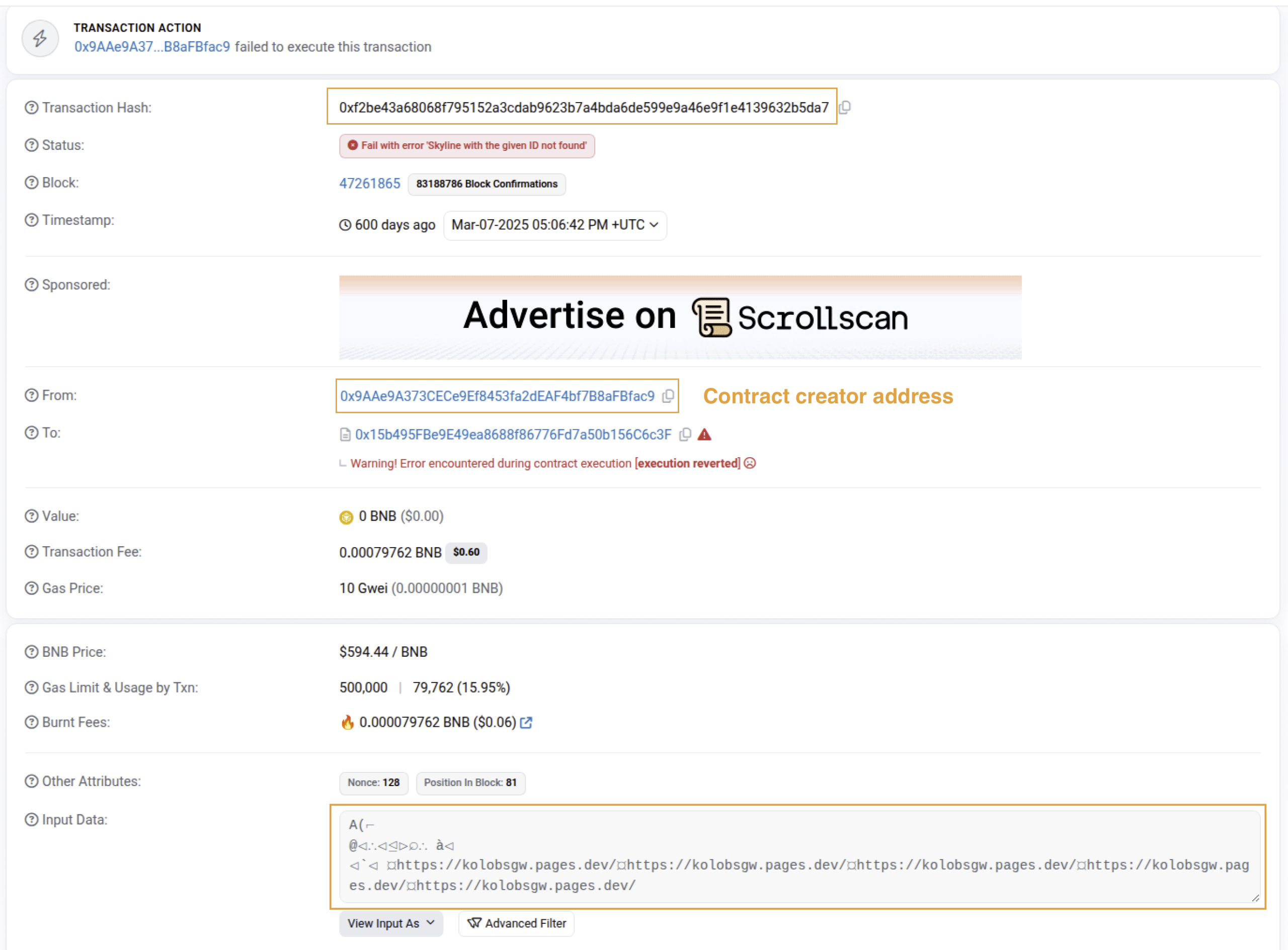
Threat actors misuse this unique capability through a technique known as EtherHiding: transforming smart contracts into resilient dead drop resolvers. In the attacks, the actors deploy a smart contract holding encoded C2 domains or IP address within a contract variable. The malicious programs deployed on the compromised machines query the contract via public legitimate blockchain RPC endpoints using JSON-RPC calls such as eth_call over HTTPS and decrypt the encrypted payload received in response in the compromised machine memory and connect to the C2 infrastructure. Because eth_call simulates a contract read operation without creating an on-chain transaction, implants and scripts could retrieve live C2 addresses, leaving no transactional footprints on the ledger.
The EtherHiding technique was surfaced in October 2023, when security researchers documented how threat actors bypassed conventional domain takedowns by using Binance Smart Chain (now BNB Smart Chain) contracts as anonymous, indestructible hosting platforms.
The primary cluster initially responsible for pioneering EtherHiding is the financially motivated threat actor group tracked as UNC5142 and reported by researchers in October 2025, widely associated with the ClearFake distribution campaign. ClearFake initially leveraged Cloudflare workers to deliver drive-by download lures and fake browser updates but shifted to blockchain storage when cloud vendors disrupted their operational infrastructure.
Following the tactical success demonstrated by cybercriminals, state-sponsored advanced persistent threat (APT) groups also integrated EtherHiding into targeted operations. Security researchers revealed in October 2025 that the North Korean state-sponsored threat cluster UNC5342 (linked to social engineering campaigns known as Contagious Interview) adopted EtherHiding to target developers in the cryptocurrency ecosystem. In the report, researchers disclosed that the actor UNC5342 deployed custom smart contracts on BNB Smart Chain to store second-stage payloads and active C2 endpoints for their JADESNOW and INVISIBLEFERRET malware families. They updated the configuration data more than 20 times within a few months, demonstrating how both state-sponsored adversaries and cybercriminal enterprises exploit EVM-compatible ledgers.
TRON adoption
Threat actors have increasingly embraced the TRON blockchain to construct multi-chain fallback systems that resist traditional domain seizures and infrastructure takedowns, initially reported in September 2026. APT groups, most notably UNC5342 and Iranian state-sponsored actors, incorporate TRON as a front-line communication channel by embedding encoded routing details directly within wallet transactions. Deployed implants issue routine queries to public TRON application programming interfaces (APIs) to retrieve these transaction records, extract cryptographic keys or location pointers, and connect to secondary payload contracts hosted on platforms like BNB Smart Chain. By capitalizing on TRON’s nominal transaction overhead, high processing throughput, and massive legitimate transaction volume, adversaries create an unseizable setup that forces defenders to attempt simultaneous disruptions across distinct, decentralized ecosystems to break command access.
Adoption of the Solana Memo transaction
On the Solana network, transactions and the Solana Program Library (SPL) memo program operate under a distinct execution model compared to EVM-based smart contracts. A Solana transaction is an atomic package containing one or more instructions executed in sequence, capable of invoking multiple independent on-chain programs within a single block confirmation. The SPL Memo Program is a native, pre-deployed utility program residing directly within the Solana runtime. Rather than managing complex state machines or maintaining custom variables, the Memo Program simply validates an arbitrary string passed to it such as UTF-8 text or Base64-encoded binary data and records it directly into the transaction’s verified execution log.
Threat actors repurpose this architecture by treating the Memo Program as a lightweight, transaction-level dead drop resolver. In this technique, the actor controls standard Solana wallets and periodically broadcasts micro-value transactions that execute a call to the Memo Program. These transactions contain encrypted C2 IP addresses or staging domains. The implanted malware on the compromised endpoints is, configured with the Solana memo program ID, query public Solana JSON-RPC endpoints using standard calls like getSignaturesForAddress and getTransaction. The malware pulls the newest confirmed transaction associated with that wallet, extracts the payload from the memo instruction logs, decrypts the destination in memory, and initiates network beacons. When an operational IP or domain is sinkholed by security teams, the attacker simply broadcasts a new transaction with an updated memo payload, and the malware automatically retrieves the latest transaction on its next polling cycle without requiring binary updates on the victim machine.
Solana’s technical profile presents distinct characteristics compared to earlier public blockchains when evaluated as a low-latency, resilient data distribution layer. Processing over 65,000 transactions per second with sub-second block confirmation times around 0.4 seconds, the network enables near-instant propagation of broadcast data globally, avoiding the prolonged mempool delays characteristic of Bitcoin’s seven transactions per second (TPS) or Ethereum’s 15 – 30 TPS baseline. Economically, execution fees averaging approximately U.S. $0.000025 per transaction allow several updates to be published.
Threat actors are leveraging Solana memo transactions for hosting the C2 configurations that were first seen employed by the Lazarus APT group reported in March 2026. In September 2026, Cisco Talos discovered malicious activity conducted by a suspicious North Korea-aligned threat actor UAT-12643, including the use of the Overlord RAT and implementation of a resilient C2 server discovery mechanism by using the Solana blockchain. The actor embeds encrypted C2 URLs into the Solana blockchain using the Solana Memo Program, a native Solana program that validates and permanently records arbitrary text strings in the blockchain ledger as part of a transaction.
Looking ahead at defensive approach to counter bulletproof blockchain dead drops
The weaponization of public blockchains ranging from legacy Bitcoin script hashes to EVM smart contracts, TRON accounts, and Solana memo fields fundamentally inverts how we counter adversary infrastructure. By turning decentralized ledgers into resilient dead drop resolvers, threat actors have removed the single points of failure that security teams traditionally rely on to dismantle operations. Standard approaches like registrar-level domain seizures, hosting takedowns, and DNS sinkholing simply don’t work when the staging record lives across many immutable nodes.
Enterprise defense needs to move past static indicators and focus on how endpoints interact with Web3 infrastructure. Because, resolving these dead drops relies on standard read-only Remote Procedure Call (RPC) queries, monitoring or blocking outbound traffic to public node providers like Infura, QuickNode, Tatum, and native chain endpoints could help reduce the attack surface significantly, if they aren’t required for business operations. Security teams should baseline normal developer or business activity and flag automated, high-frequency calls using methods like eth_call, getTransaction, and getSignaturesForAddress. Network defenders should inspect JSON-RPC payloads for anomalous base-encoded data and unexpected payload lengths. Also, endpoint telemetry should prioritize detecting lightweight in-memory decrypters before they can unpack and beacon out to the resolved C2 destinations.
As defenders mature these detection capabilities, adversary tradecraft will inevitably shift. Talos researchers are anticipating that on-chain C2 pipelines will move towards multi-chain fallback architectures, chaining lookups across multiple cryptocurrency networks to evade single-ecosystem blocks. As commercial RPC gateways implement stricter abuse detections, attackers will likely route the RPC lookups through decentralized RPC aggregators, private transaction relayers, or zero-knowledge proof (ZKP) verification systems that obscure the querying host. Eventually, tracking this activity requires treating public ledgers not just as financial tracks, but as an active adversary communications layer.
Source: Cisco Talos Intelligence · 2026-11-18