Day: October 21, 2026

  • Widespread PHP Flaw May Cause Many Site Outages Today

    Widespread PHP Flaw May Cause Many Site Outages Today

    Expect to see quite a few websites serving error pages today: Nearly 70 percent of websites need to update their core software to fix a pair of vulnerabilities that allow an attacker to seize full control over affected servers. Experts say there are working exploits for the flaws, and that these critical bugs are already being exploited in the wild.

    Image: Shutterstock.com, Sashkin.

    The flaws at issue are present in PHP, the programming language that powers sites running on a large number of web publishing systems, including Drupal, Magento, Joomla and WordPress. Earlier today, PHP released an emergency security update to fix two critical bugs that can allow an attacker to execute code of their choosing on a vulnerable server.

    Reuters reports that government websites in Europe and elsewhere went offline today after the PHP vulnerabilities were disclosed. Cloudflare said it has already detected some exploitation of the flaw, and that at 3:02 am (UTC) it implemented web application firewall rules to protect websites from attack traffic seeking to exploit the bugs, which could cause a denial of service condition, remote code execution, and data exposure.

    OpenAI, which was involved in the vulnerability research and outreach, said “given the severity of these flaws and PHP’s widespread use, we consider this one of the most impactful security issues in recent memory.”

    Censys, a company that tracks the technology used by Internet hosts, said a recent scan identified approximately 2.58 million Internet facing hosts and 54.9 million web properties running PHP.

    Security experts at Wiz said every PHP version released in the last decade is affected by at least one of these vulnerabilities [full disclosure: Wiz is an advertiser on this blog].

    “These findings rank among the most severe vulnerabilities discovered in PHP, and arguably in software history,” reads a blog post published today by a team of researchers at Wiz, which was one of several organizations credited with discovering the vulnerabilities. “The underlying flaws had been present for decades, but demonstrating their exploitability required an exceptionally complex chain of steps, at the edge of what human researchers could practically achieve. Frontier AI models substantially reduced that barrier, turning a longstanding flaw into an exploit.”

    The Wiz researchers say it is likely the PHP vulnerabilities will be mass-exploited to install web-based backdoors or “web shells,” which give attackers a web-based panel that allows them to remotely control infected sites. Wiz said that prior to the PHP bugs being publicly disclosed, the company worked with the PHP team, Calif and OpenAI to measure the size of the problem and coordinate patch verification and disclosure.

    The PHP zero-day vulnerabilities are being tracked by their CVE numbers, CVE-2026-109618 and CVE-2026-109619, and they affect all web servers running PHP 5.4 or later. The bugs are fixed in PHP 8.5.12, 8.4.27, 8.3.36, and 8.2.35.

    According to Wiz, PHP is so deeply embedded in many web applications that we are likely to see organizations struggling to patch these vulnerabilities for some time to come, comparing this PHP vulnerability pair with the Log4Shell weakness that emerged in 2021 — a widespread, severe-as-it-gets security flaw in Log4j, a popular Java logging framework.

    “A vulnerability in core PHP reaches far beyond a single application,” the Wiz researchers wrote. “PHP runs across clouds, hosting providers, content-delivery networks and millions of independently managed servers. Reducing exposure before the technical details became public required coordinated work across that entire ecosystem.”

    The SANS Internet Storm Center is keeping an eye on major software platforms that are shipping updates to deal with these PHP flaws. For example, Ubuntu just released updated PHP packages. For a technical deep-dive on these vulnerabilities that tells the timeline of the discovery of these bugs in a comic book style, check out this post from Calif, another technology company credited with finding the PHP flaws.
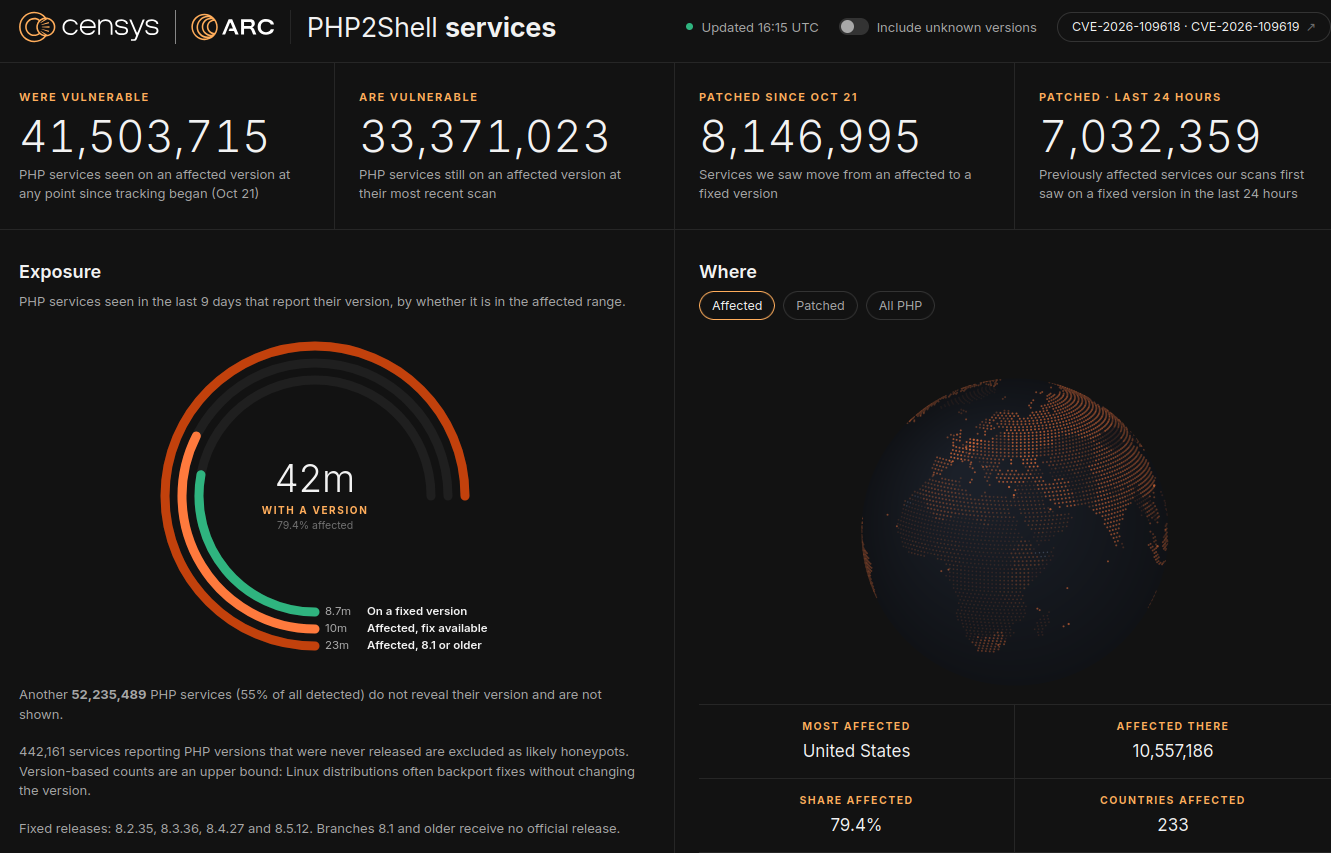
    A snapshot of php2shell.censys.com, the website Censys set up to track the PHP vulnerabilities.

    This is a fast-moving story. Updates will be noted here with timestamps.

    Update, 2:30 pm ET: Add figures from Censys and a link to Calif’s writeup.

    Source: Krebs on Security · 2026-10-21

  • Critical RCE vulnerabilities in PHP (CVE-2026-109618, CVE-2026-109619)

    Critical RCE vulnerabilities in PHP (CVE-2026-109618, CVE-2026-109619)

    UPD 23.10.2026: added Kaspersky SIEM rules and events for developing custom detection rules or conducting threat hunting.

    UPD 22.10.2026: added a description of how the Kaspersky Managed Detection and Response service detects the described malicious activity.

    UPD 22.10.2026: added a description of how Kaspersky Vulnerability Management detects vulnerable versions of PHP.

    Vulnerability overview

    On October 20, 2026, the PHP security team published a preliminary notice regarding an upcoming emergency release that addresses two critical vulnerabilities (both rated 9.2 on the CVSS scale). The patches were released on Wednesday, October 21, 2026, at 14:00 UTC.

    The release was expedited after information about the vulnerabilities was leaked to the public before the scheduled embargo was lifted. In a post on Hacker News, a user reported two RCE vulnerabilities in PHP, allegedly affecting all versions starting with PHP 5.4.0.

    The vulnerabilities in question are CVE-2026-109618 and CVE-2026-109619. Shortly after the post appeared, researchers confirmed the existence of the vulnerabilities. Along with the leak of details, an exploit unofficially named PHP2Shell appeared online. In the leaked demo video, the exploit is shown in action on web servers running WordPress, MediaWiki, phpBB, Magento, Joomla, Laravel, Symfony, Drupal, and WHMCS — platforms that power many modern websites. The authenticity of the demonstration and the exact behavior of the exploit had not been independently verified at the time of publication.

    According to the researcher who published the PoC, the vulnerabilities are related to the handling of the multipart/form-data MIME type in conjunction with the session upload progress mechanism (session.upload_progress) in the PHP core and fall under the categories of use-after-free and memory corruption. This means that the flaws cannot be fixed via application code, and the only fix is to update PHP on the server. The attack requires no authentication: an attacker with network access to a PHP application can execute arbitrary code with the privileges of the PHP process without needing to authenticate. Security advisories issued by the PHP team on October 21 confirm this information.

    The vulnerabilities affect PHP versions 5, 7, and 8. As of this publication, branches 8.2 through 8.5 are supported. Older branches, including PHP 8.1, 8.0, 7.x, and 5.x, have reached the end of their lifecycle; however, due to the critical severity of the vulnerabilities, backported patches have also been released for versions 7.4, 8.0, and 8.1.

    Sansec experts estimate that widespread exploitation could begin within 15 minutes of the update’s release. We strongly recommend that administrators responsible for publicly accessible PHP web servers take the following steps before the patch is available:

    1. Take an inventory of all PHP-based systems in your infrastructure (such as web servers, control panels, and third-party software).
    2. Disable upload-progress: set session.upload_progress.enabled = Off using the php_admin_flag in PHP-FPM pools.
    3. Block multipart requests on nginx and Apache servers.
    4. Consider temporarily isolating PHP applications that connect to the Internet until fixes are released.
    5. Be ready to install the patch immediately upon its release.
    6. Plan to migrate servers running unsupported versions (8.1 and earlier) to the latest PHP branch.

    Detection by Kaspersky solutions

    Kaspersky solutions detect the described malicious activity at various stages of the attack. Possible detection scenarios are listed below.

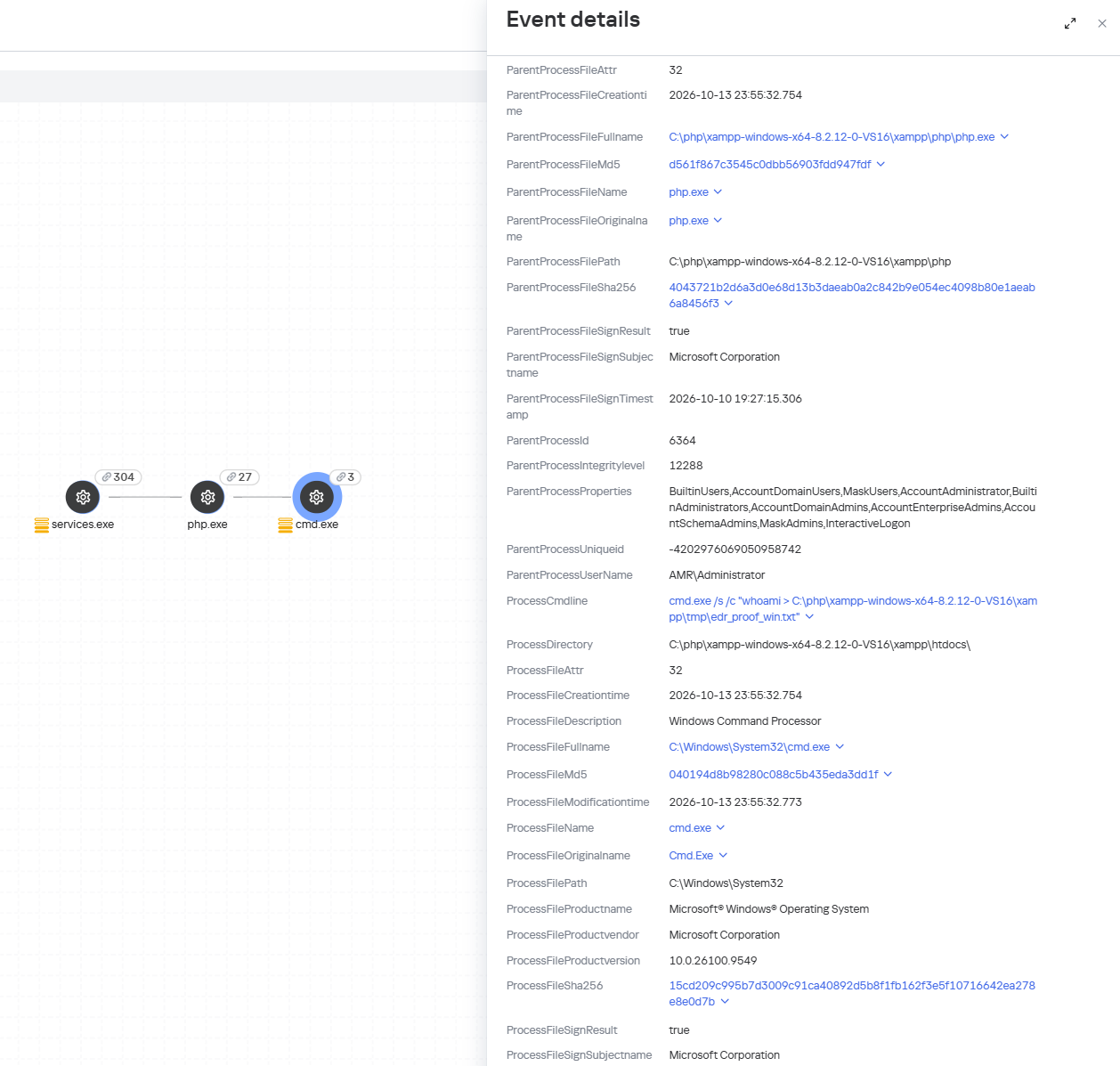
    When an attempt is made to exploit these RCE vulnerabilities, Kaspersky Endpoint Detection and Response promptly alerts the user to suspicious actions performed in the context of a web server, on both Linux and Windows machines. This activity is detected by the following rules:

    Detection of the PHP2Shell vulnerability exploit by KEDR

    Detection of the PHP2Shell vulnerability exploit by KEDR

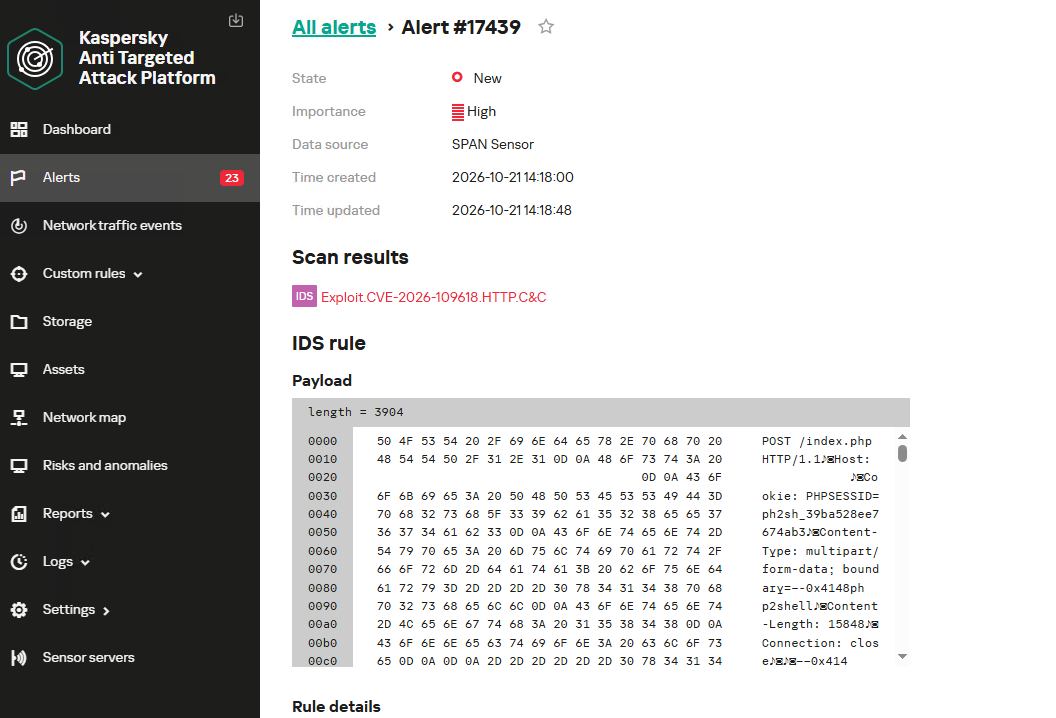
    Exploitation of the PHP2Shell vulnerability in network traffic is detected by Kaspersky Anti Targeted Attack (KATA). This solution detects such activity with the following verdicts: Exploit.CVE-2026-109618.HTTP.C&C and Exploit.CVE-2026-109619.HTTP.C&C.

    Detection of the PHP2Shell vulnerability exploit by KATA

    Detection of the PHP2Shell vulnerability exploit by KATA

    Kaspersky Endpoint Security, now available as Kaspersky Next, also detects malicious post-exploitation activity using the Behavior Detection component, with verdicts such as PDM:Exploit.Linux.Generic and PDM:Exploit.Win32.Generic.

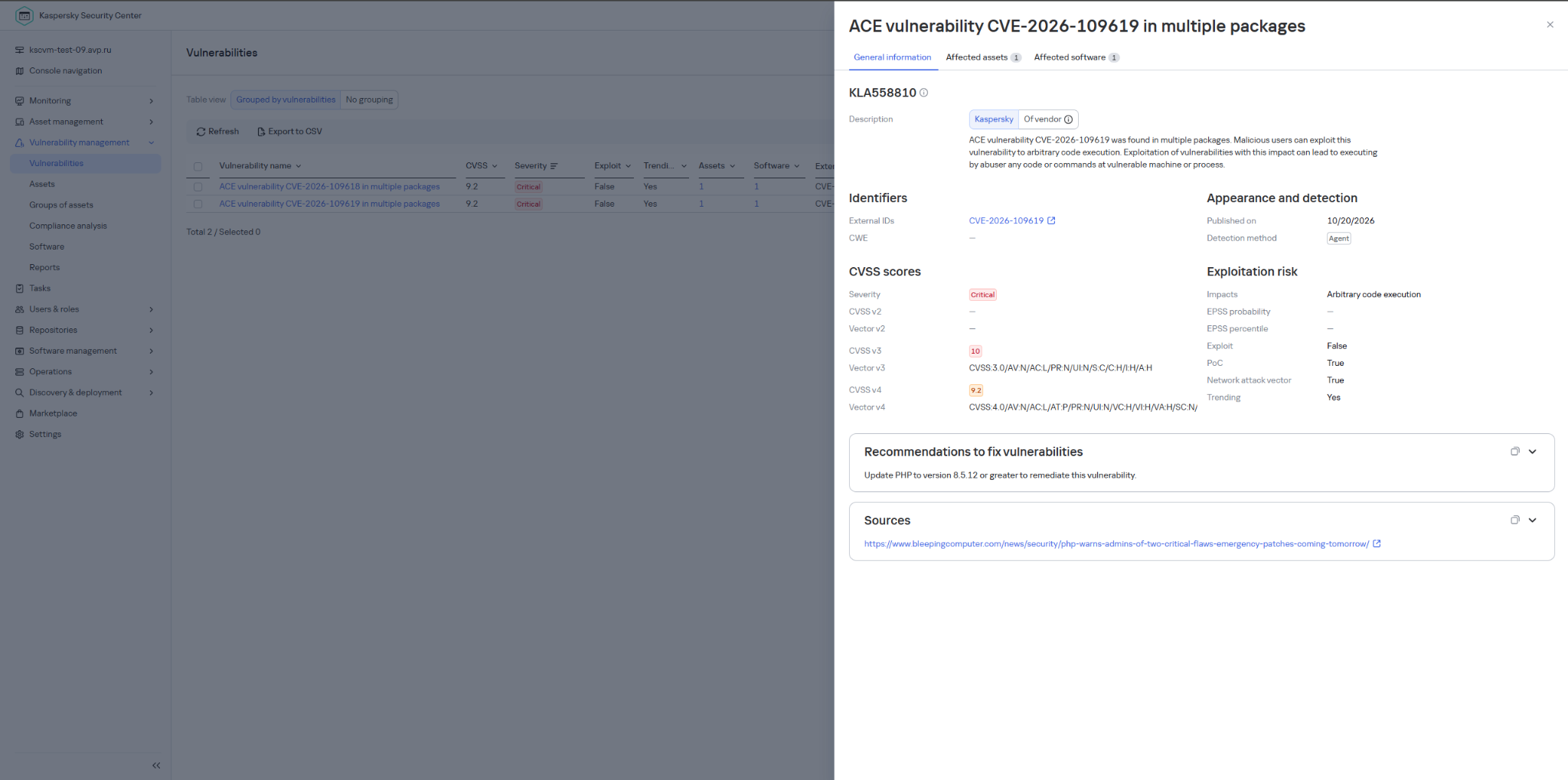
    Our Kaspersky Vulnerability Management solution detects vulnerable software versions using the Vulnerability scanning and Agentless black-box scanning components.

    Detection of the PHP vulnerability in Kaspersky Vulnerability Management

    Detection of the PHP vulnerability in Kaspersky Vulnerability Management

    The Kaspersky Managed Detection and Response service detects the exploitation of the described vulnerabilities by monitoring activity characteristic of RCE:

    • Spawning of suspicious processes by the web server;
    • Creation of suspicious executable files in the web application directory;
    • Creation of suspicious scripts in the web application directory;
    • Creation of files with uncommon extensions in the web application directory;
    • Execution of reconnaissance commands by the web server process;
    • Execution of persistence commands by the web server process;
    • Delivery and launch of web shells on the web server.

    Moreover, MDR detects other malicious activity not directly related to remote code execution.

    To protect companies that use our Kaspersky SIEM system, the product repository includes rules that help detect the following malicious activity.

    • Execution of suspicious executable files by web server processes on Windows and Linux machines:
      • R300_04_Windows shell started by a web application
      • R152_08_A running Linux shell process has a suspicious parent process
    • Execution of reconnaissance commands by the web server process:
      • R286_05_Possible web-shell (Linux)

    We also recommend monitoring the creation of scripts or executable files in the web server directory when developing your own detection rules or conducting threat hunting:

    ((DeviceEventClassID = '4663' AND DeviceCustomString1 ilike 'WriteData') OR DeviceEventClassID = '11')
    AND match(FileName,'(?i).*\.(php|asp|aspx|ashx|jsp|js|jar|jse|dll|exe|bat|ps1|vbs|wsf|wsh|msi|msp|hta|cpl)$')
    AND match(DestinationProcessName,'(?i).*(php-cgi|nginx|httpd|w3wp)\.exe')
    Name = 'openat' AND has(SA.Nametype, 'CREATE')
    AND
    length(arrayFilter(x -> match(x, '(public_html|var/www|usr/local/apache2|usr/local/httpd|var/apache|srv/www|home/httpd/html|srv/http|usr/share/nginx/html|var/lib/pgsql/data|usr/local/mysql/data|var/lib/mysql|var/vsftpd|etc/bind|var/named)'), SA.FileName))>1
    AND
    length(arrayFilter(x -> match(x, '\.(aspx|asp|asmx|asax|ashx|jspx|jsp|js|phpt|php|phtml|pht|cfm|shtml|htaccess|fcgi|cgi|pl|py|sh)'), SA.FileName))>1

    Source: Securelist (Kaspersky GReAT) · 2026-10-21

  • Two critical RCEs in PHP core

    Two critical RCEs in PHP core

    Two critical RCEs in PHP core

    Update 10/22: Added section detailing observations of in the wild exploitation and associated IOCs.

    Cisco Talos is tracking the disclosure of two unauthenticated remote code execution (RCE) flaws in PHP core, dubbed “php2shell”, triggered by a plain HTTP request and exploitable before any application code runs, affecting every PHP build since 5.4. Based on the entities involved in the disclosure, artificial intelligence and associated technologies played a key role in the discovery of these vulnerabilities — yet another example of how these technologies are forcing change across the landscape, most notably on patching processes for organizations because of the wave of vulnerabilities being disclosed. 

    Cisco customers are covered with the Cisco Talos Network Intrusion Prevention (SNORT®) signatures 67359, 67360, and 67375. These rules are also available in the Community Ruleset for open-source customers. Splunk Enterprise Security customers have an Enterprise Security Content Update with detections available. Please refer to the following recommendations, detection, and coverage guidance for more information.

    Details

    CVE-2026-109618 and CVE-2026-109619 are both critical vulnerabilities with a CVSS v4.0 score of 9.2.

    • CVE-2026-109618 occurs when out-of-memory handling interrupts PHP while internal request data is only partially initialized. Request cleanup may then treat invalid data as valid.
    • CVE-2026-109619 occurs when a stale internal state is reused after its backing memory has already been freed, before normal initialization resets it.

    Impact

    The potential blast radius is enormous and extends across the PHP ecosystem. The vulnerability sits in PHP core, so applications running affected versions — including WordPress, Drupal, Magento, Shopware, WooCommerce, and Laravel, plus PHP sites hosted through cPanel or Plesk — may be exposed. Note that many older branches will no longer receive fixes, so customers are urged to upgrade to a supported version as soon as possible.

    Talos regularly investigates threat actor exploitation of vulnerabilities. State-sponsored and affiliated threat actors, as well as ransomware and other financially motivated groups, all employ tactics to exploit RCE. Talos assesses that all industries running PHP applications are at risk for exploitation if systems remain unpatched.

    PHP 8.1 and older are end of life (EOL), and PHP 8.2 security support ends Dec. 31, 2026. Talos’ initial estimates based on open-source intelligence show a significant corpus of PHP systems that will not receive a patch (~50%). If your organization is running PHP 8.1 or older, Talos very strongly advises immediate update to PHP 8.2 or later. There is no patch for PHP 8.1 or older.

    Talos is actively monitoring the impact of these CVEs and has not seen them being exploited in the wild yet (as of October 21, 2026 14:00 UTC/10:00 a.m. ET).

    Observed Exploitation 

    Cisco Talos began observing exploitation attempts within hours of the vulnerabilities’ disclosure. So far, most of the activity is scanning, along with some uncoordinated attempts to deliver various payloads. This is expected: scanning or basic exploitation with public proof-of-concept (PoC) code takes far less effort than integrating a vulnerability into an actor’s own tooling. We expect exploitation volume to grow in the coming days, and campaigns to become more sophisticated and coordinated as more capable groups finish updating their tooling and begin deploying it. 

    Recommendations and detection guidance

    Talos strongly recommends all PHP users to upgrade to the available fixed releases. There are no intermediate or temporary controls that provide comprehensive protection; however, PHP advises that the following measure may reduce exposure to specific attack paths:

    CVE-2026-109618

    • Set memory_limit=-1, preferably in a way applications can’t override, such as php_admin_value in the FPM pool or Apache configuration, and check that no pool, directory or application setting puts a finite limit back. This removes the controllable PHP memory limit failure, but an underlying allocation failure can still reach the vulnerable path.
    • Set a low post_max_size. For applications that don’t require file uploads, set post_max_size = 8M. If file uploads are necessary, set post_max_size = 32M. Keep upload_max_filesize below post_max_size. Consider enforcing limits at the web server or proxy level for decoded request size, input field count, multipart part count, header count, and nesting depth. These limits must also cover requests without a usable Content-Length.
    • Use a container or cgroup limit as an availability boundary, preferably with a policy that kills only the affected worker. Do not substitute RLIMIT_AS or RLIMIT_DATA, as these can cause the vulnerable allocation failure.

    CVE-2026-109619

    • Set session.upload_progress.enabled=0 and restart every worker. Use php.ini, an FPM pool, or server configuration that applies before request parsing. Do not rely on ini_set() or FPM .user.ini. This blocks the confirmed session paths but not other variants.
    • On PHP 8.5, set fatal_error_backtraces=0 and restart every worker. This blocks the confirmed fatal backtrace path only.
    • Remove invalid or deprecated settings applied per request that emit diagnostics before initialization. Hiding diagnostics with error_reporting, display_errors, or @ does not help.
    • Fix attacker-reachable fatal errors and execution timeouts, including failures in callbacks, upload or import processing, and cleanup.

    This is another vulnerability that owes its discovery to AI and its associated technologies. As we move through 2026, the wave of vulnerabilities and related patches is building. Talos advises organizations to work on a triaged process for prioritizing vulnerabilities with a specific focus on public-facing systems and vulnerabilities that are under active exploitation. The glaring need to prioritize vulnerabilities along with a streamlined process for rolling out patching strongly indicates that the historic trend of “baking in” patches before deployment is not going to survive the AI era.

    The true impact of this vulnerability will take time to evaluate. These types of vulnerabilities that impact core technologies tend to cascade into other platforms and applications as they evaluate impact and provide associated patching, harkening back to the waves of exploitation that we saw after Log4J.

    Coverage

    SNORT® SIDs covering these vulnerabilities for subscribers: 67359, 67360, 67375. Free community rules are live through our Community Ruleset.

    Splunk has released an Enterprise Security Content Update (ESCU) related to the ongoing PHP2Shell activity with additional detections. Splunk Enterprise Security customers are urged to download and apply.

    Talos would like to highlight the efforts of Ankur Tyagi, Dalton Schaadt, Brandon Stultz, and Matt Killion for providing emergency coverage and mitigations for these threats.

    In this video, Talos’ Nick Biasini explains what the vulnerabilities allow adversaries to do, how to assess your exposure, and what defenders should prioritize.

    Indicators of Compromise (IoCs) 

    5.191.140[.]240 
    158.69.113[.]75 
    94.154.43[.]149 
    143.246.223[.]124 
    45.198.224[.]169 
    85.11.167[.]243 

    Source: Cisco Talos Intelligence · 2026-10-21

  • New PhaaS Platform Uses AI to Craft Phishing Lures and Mask Malicious Activity

    Researchers have uncovered Athena StealthRoute, a phishing-as-a-service platform featuring an AI Studio that generates phishing lures and decoy content designed to conceal attacks

    Source: Infosecurity Magazine · 2026-10-21

  • ‘This Is Not a Drill’: Critical PHP Vulnerabilities Are Setting the Internet on Fire

    ‘This Is Not a Drill’: Critical PHP Vulnerabilities Are Setting the Internet on Fire

    The PHP Foundation has revealed two serious vulnerabilities that could impact millions of websites. Security experts warn that failure to quickly patch the flaws could have dire consequences.

    Source: WIRED Security · 2026-10-21

  • “Next Exploit Opportunities”: How a Threat Actor Used AI to Help Plan and Execute Multiple Types of Cybercrime Activities

    “Next Exploit Opportunities”: How a Threat Actor Used AI to Help Plan and Execute Multiple Types of Cybercrime Activities

    An investigation into a threat actor bypassing AI safety controls to coordinate credential theft, VoIP fraud planning, and database exfiltration.

    Source: Palo Alto Networks Unit 42 · 2026-10-21

  • Symantec Uncovers AI Agent Hijacking Models for Autonomous Cyber-Attacks

    Researchers at Symantec have uncovered an AI agent designed to operate a full cyber-attack without human intervention

    Source: Infosecurity Magazine · 2026-10-21

  • AI Guardrails Aren’t Stopping Criminal Hackers

    AI Guardrails Aren’t Stopping Criminal Hackers

    Hackers around the world are all-in on using agentic AI to wage attacks—and manipulating tools like Anthropic’s Claude to help them carry out their crimes.

    Source: WIRED Security · 2026-10-21

  • A Design Flaw in Share Links Exposes Users’ Personal Conversations With Meta’s Muse

    A Design Flaw in Share Links Exposes Users’ Personal Conversations With Meta’s Muse

    The company is suspending the feature after security researchers discovered how easy it was to access sensitive information shared with the AI assistant.

    Source: WIRED Security · 2026-10-21

  • Ransomware Attacks Rise as Rival Gangs Vie For Market Supremacy

    Cybercriminal groups The Gentlemen and Qilin dominate ransomware attacks – and both are evolving their tactics in an attempt to outdo one another

    Source: Infosecurity Magazine · 2026-10-21